The AI Music Briefing #25: Everyone says AI tracks are draining the royalty pool. Who's counting?
The week of October 17 to October 23, 2026, when Goldman Sachs warned AI tracks could drain the royalty pool and Spotify's numbers pointed elsewhere, Believe and TuneCore artists got an AI remix opt-in, and Suno admitted it kept the recordings it trained on.
My stack My fav 6 tools for AI music after testing 70+
-
 ElevenMusic · Music generation
-
 Moises · Stem separation
-
 Controlla · Voice swap & cloning
-
 Cryo Mix · Mixing + mastering
-
 Neural Frames · Music videos
-
 ONCE · Distribution
Some links are affiliate links — I earn a commission at no cost to you. Every tool here is one I run myself and truly believe in. This stack is proven.
Issue #25 · the week of October 17 to October 23, 2026 · ~7 min read. The Friday read for music industry professionals working at the intersection of AI and the traditional music business. Curated by Christopher Wieduwilt.
What’s in store:
- Top Story: everyone says AI tracks are draining the royalty pool. Nobody’s counting the right thing
- Believe and TuneCore artists now get a yes or no on Spotify’s AI remix tool
- Fontaines D.C. will ban AI from their videos by contract
- The musicians’ union takes AI pay to the major labels on November 3
- Suno admits in court it kept the recordings it trained on
Prefer to watch? My YouTube video this week covers different stories from the ones in this briefing, so it adds to this issue instead of repeating it:
This week in AI music: Believe artists got an AI opt-in, and Fontaines D.C. got a no-AI clause
Believe and TuneCore artists can now opt in to Spotify’s AI remix tool. The musicians’ union wants that kind of consent for session players, and Fontaines D.C. are writing AI out of their contracts.
Also, Apple quietly bought an AI audio editor in June.
Believe and TuneCore sign Spotify’s AI covers and remixes deal, with a double opt-in for artists
Believe and TuneCore signed Spotify’s AI covers and remixes deal on October 20. Artists opt in twice, first to AI programs at all, then to Spotify by name, and remix streams pay the original’s rights holders. No price or per-stream rate yet.
The AFM’s “Human Made, Human Paid” campaign takes AI pay to UMG, Sony and Warner
The American Federation of Musicians launched “Human Made, Human Paid” on October 20, asking for consent, credit and pay whenever musicians’ work trains AI. It takes that ask to UMG, Sony, Warner and Hollywood Records when contract talks resume November 3.

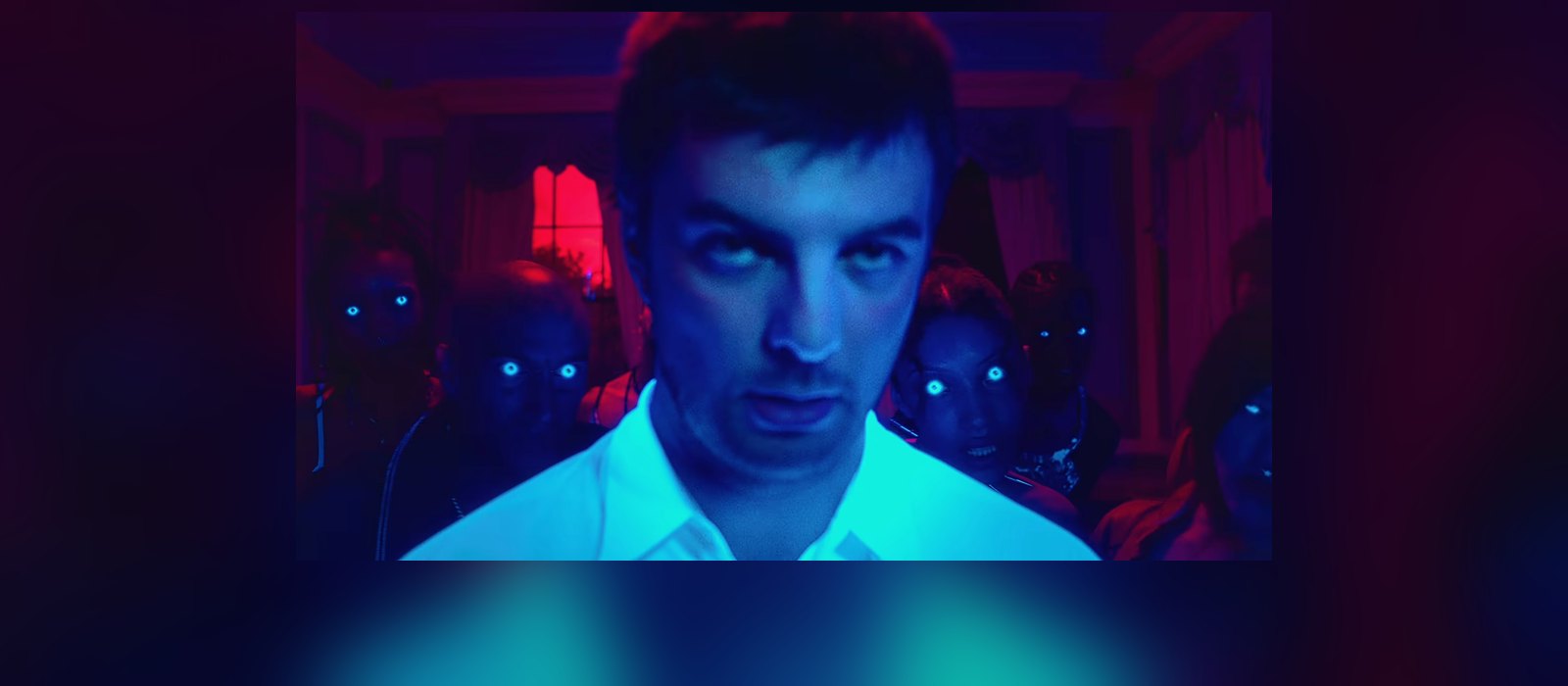
Fontaines D.C. weren’t told AI was used in the “Marianne” video, and will ban it by contract
Grian Chatten said nobody told Fontaines D.C., their label XL or their management that AI was used in the “Marianne” video. The band will put a no-AI clause in future contracts.
Spotify reaches 306 million Premium subscribers as AI spend pushes operating costs up 26%
Spotify ended Q3 with 306 million Premium subscribers, and co-CEO Gustav Söderström says it stands to “thrive in the agentic age”. Operating costs rose 26%, with marketing, cloud and AI spend named as the main drivers.
Musixmatch buys Music Reports, owner of the Songdex registry and Blokur
Musixmatch bought Music Reports, owner of the Songdex registry and Blokur, in its first acquisition in 16 years. Music Reports administers more than $400 million in royalties a year, and Musixmatch plans AI agents to match them.
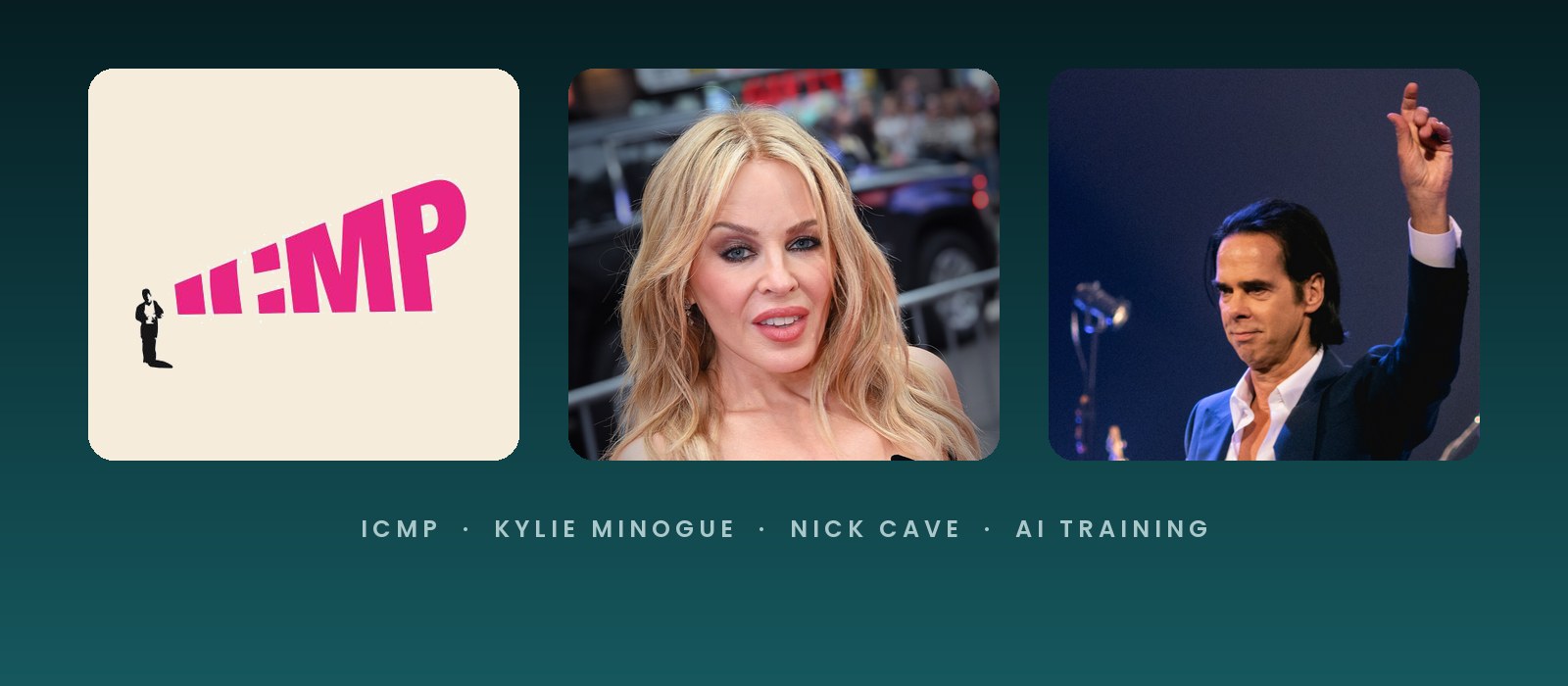
ICMP says Google’s Gemini reproduces Kylie Minogue and Nick Cave lyrics as Australia weighs an AI training exception
Publishers’ body ICMP told Guardian Australia that Google’s Gemini reproduces Kylie Minogue and Nick Cave lyrics. It says Australia is the only one of 62 countries weighing a commercial AI training exception, and the inquiry reports in November.
Daisy the Great say ADHD Vision ads run a fake AI version of “The Record Player Song”
Daisy the Great say ads for the ADHD Vision app run a “horrible fake AI version” of “The Record Player Song”, with the same melody and rewritten lyrics. They’re “trying to fight it and having a hard time so far.”

UMG licenses its catalog to TYGER, an app whose AI reshapes songs to react to gameplay
UMG licensed its catalog to TYGER, an app whose AI reshapes songs to react to gameplay in games like Fortnite and Valorant. UMG is the first major to sign, and neither company says what a play pays.

Meomuru’s Suno-made “The Adult I Dreamed Of” reaches No. 3 on Melon’s Top 100
Meomuru’s “The Adult I Dreamed Of” hit No. 3 on Melon’s Top 100 on October 14, with his lyrics and a vocal made in Suno. Melon shows no AI label, and the song earns nothing from Korea’s songwriter society, KOMCA.

Apple bought Samplab’s AI audio editor in an asset deal that only surfaced in an EU filing
Apple bought Samplab’s AI audio editor, which turned recorded audio into editable notes, in a June asset deal that only surfaced in an EU filing on October 19. Samplab went offline on September 17.

Arooj Aftab wants artists paid twice for AI, for training and for every new song it makes
Grammy winner Arooj Aftab wants artists paid twice for AI: once when it trains on their music, and again “everytime it uses what it learned from my music to make new music”.
Top Story: Everyone says AI tracks are draining the royalty pool. Who’s counting?
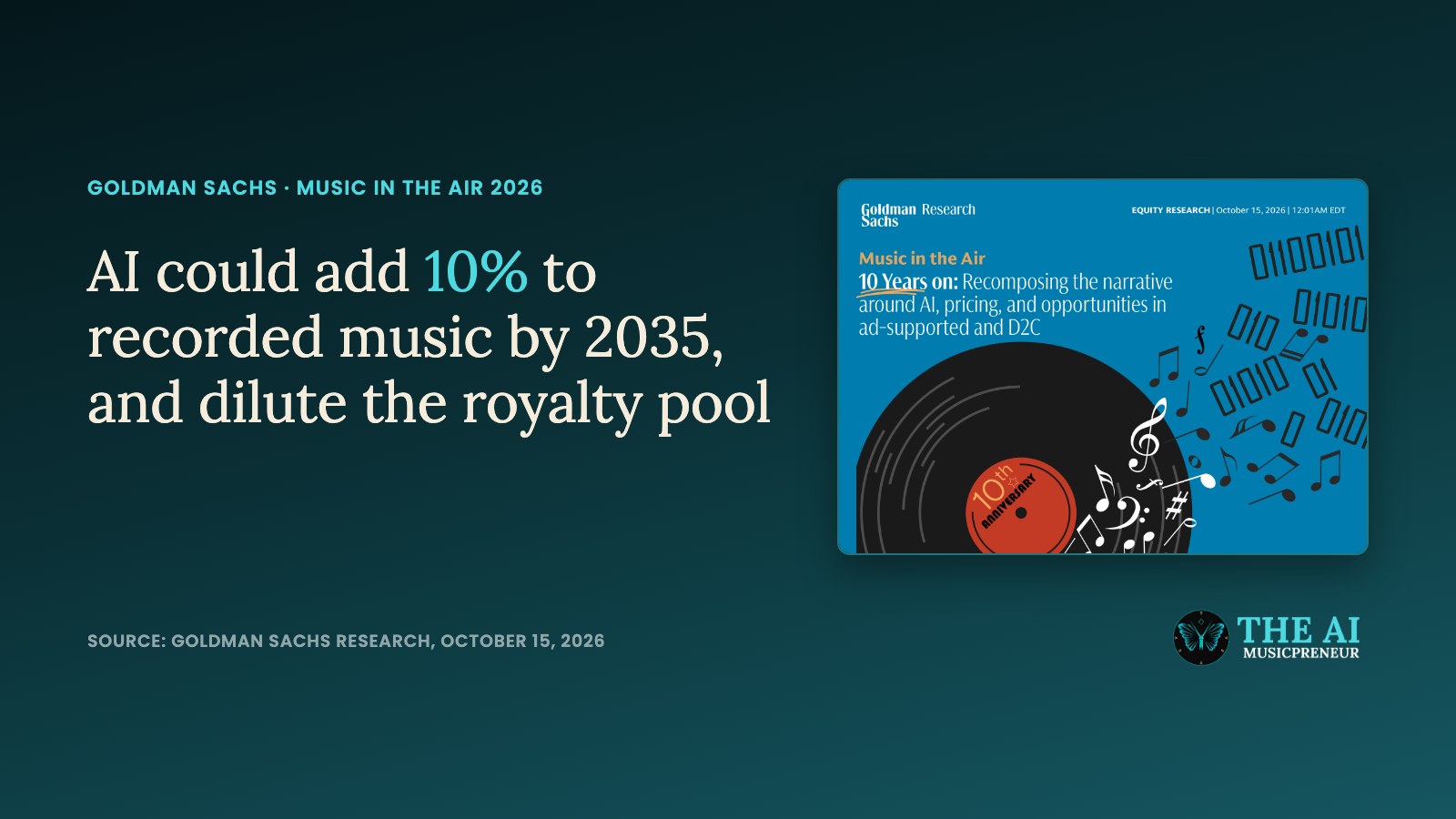
The “AI flood” gets measured in uploads. Royalties get paid on streams. So cut the farms that game the streams, and leave the format alone.
Goldman Sachs doesn’t see it that way. Its Music in the Air report, out October 15, lists AI as a structural risk for labels:
“The traditional royalty payout model could be pressured as millions of AI-generated tracks entering the music streaming ecosystem divert a portion of the royalty pool away from human-created IP,” Goldman Sachs Research wrote.
And honestly, the math is right. Streaming pays out of one pot a month, split by each track’s share of streams. Close to 90,000 fully AI tracks reached Deezer every day in June.
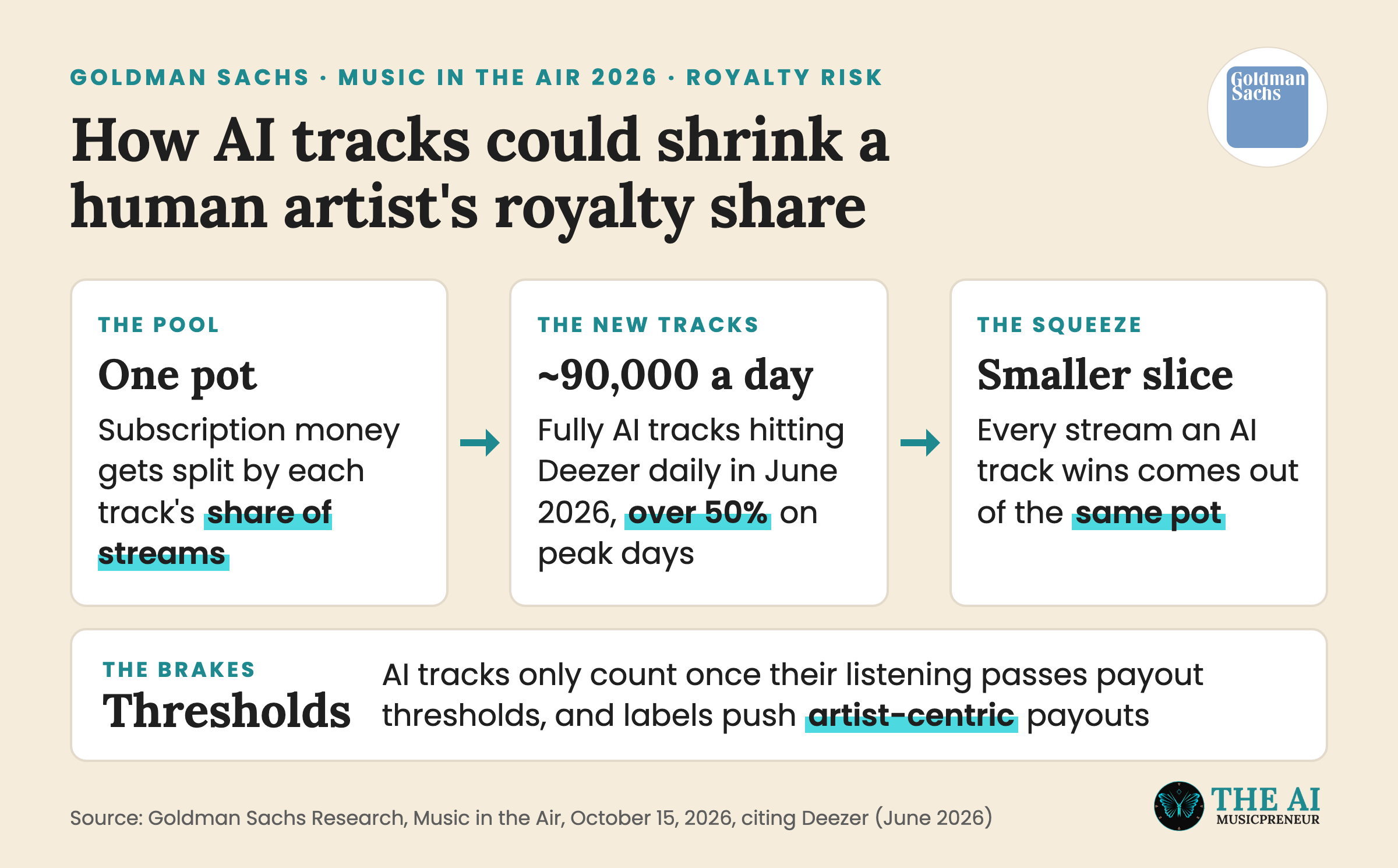
That warning rests on 2 beliefs: AI uploads turn into AI royalties, and someone has counted how much.
Spotify’s 1,000-stream royalty threshold already starves the AI farms
Since 2024, a Spotify track needs 1,000 streams in 12 months to earn anything. On October 20, Spotify said tracks that are likely AI-generated are 10 times more likely to miss that bar. It also took more than 50 million slop and spam tracks out of recommendations this year.
So 10,000 generated tracks at 40 plays each make 400,000 streams and $0. Goldman’s own caveat says the same thing: AI tracks only take money once they pass payout thresholds.
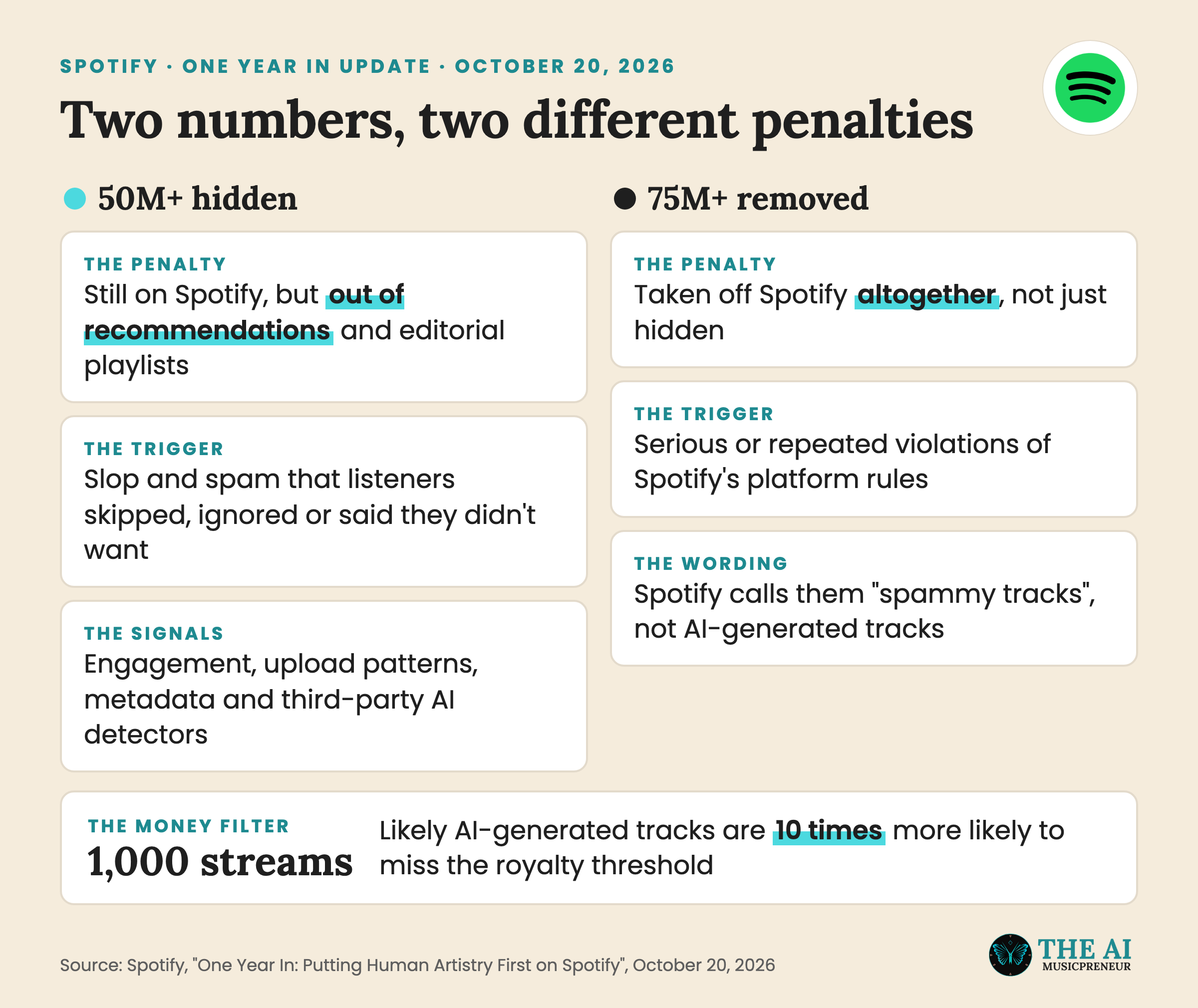
So most of the flood never reaches the pot. The upload count and the royalty share are 2 different numbers.
Nobody has counted AI’s real share of the royalty pool yet
Spotify also deleted 75 million “spammy tracks”, and its post never says how many were made with AI. In court, the labels want DistroKid’s AI counts and Suno wants the MLC’s play data, both to argue whether AI hurt the market.
If the damage showed up in the numbers, nobody would need a subpoena to find it.
Goldman Sachs put AI music at 0.1% of the royalty pool a year ago
The last public estimate is Goldman’s own. Its June 2025 edition put AI music at 0.1% of the royalty pool, according to Music Business Worldwide. That number is more than a year old, and Deezer’s AI uploads went from over 20,000 a day to close to 90,000 since. But uploads are the part that doesn’t pay.
Measure AI’s royalty share in streams, then cut the farms
- Measure AI’s share by the streams that clear the payout bar, never by uploads.
- Cut the behaviour: mass uploads, duplicates, artificially short tracks, bot plays, AI passed off as human.
- Leave the song people actually chose to play alone, however it was made.
My rule has a cost. Under the scoring Duke researchers used to hunt AI artists on Spotify, a new human act with 4 singles in a week, no Bandcamp page and no gigs lands in the same band as 8 of their 9 confirmed AI acts. Behaviour filters will hide some honest new artists with the farms. I’ll take that over cutting a whole format out of the pool.
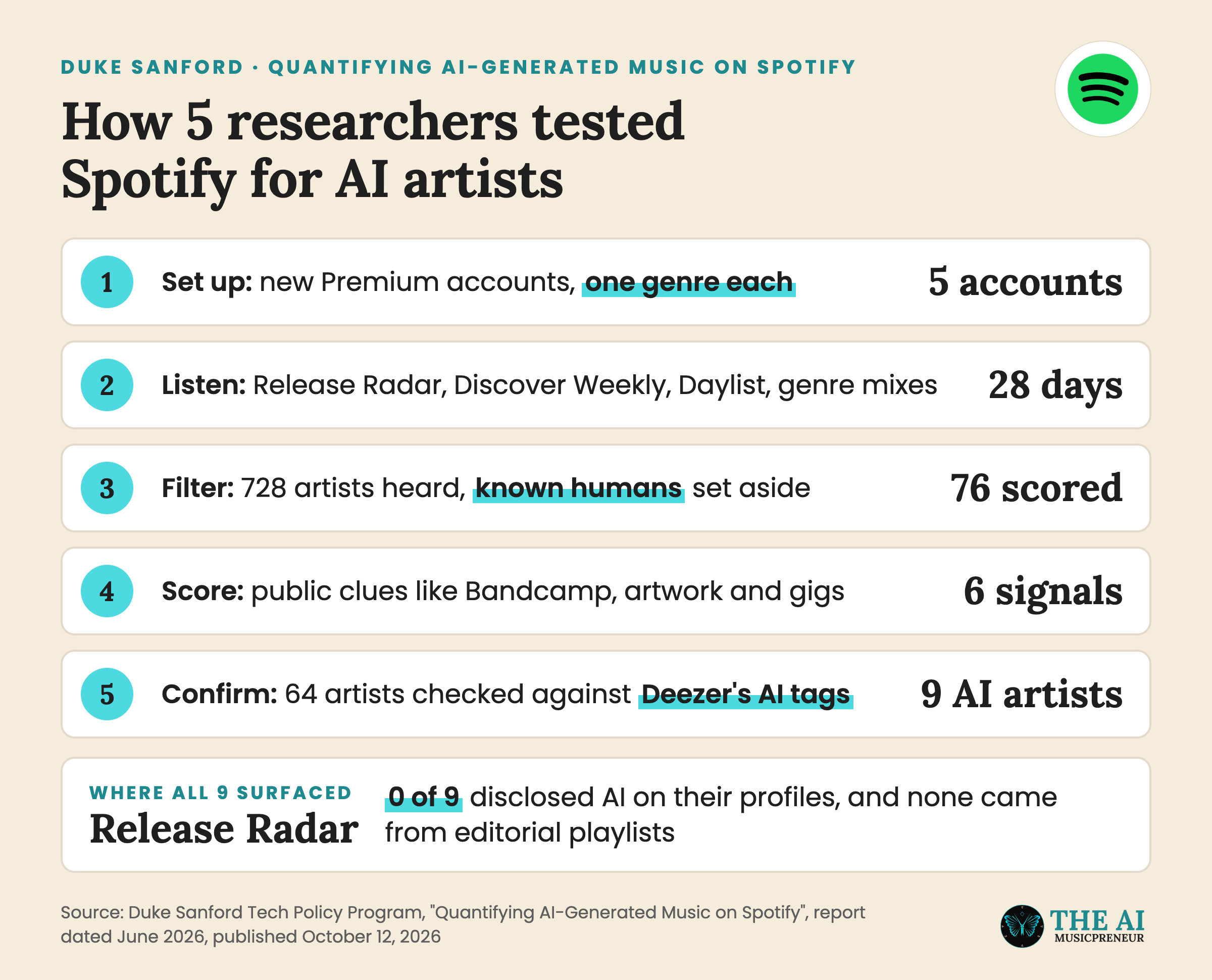
Count the streams, cut the farms, keep the format.
AI Music Lawsuit Tracker: Suno admitted it kept its training recordings, and Reservoir sued for up to $337.8M
4 cases moved this week, and 1 of them is new. The other 9 on my tracker, including RIAA v. Udio, GEMA v. Suno and UMG v. DistroKid, did not.
Here’s what changed:
Reservoir v. Suno & Anthropic (new): up to $337.8 million over 1,050 songs and 853 lyrics
Reservoir sued Suno over 1,050 songs and Anthropic over the lyrics to 853 on October 21, from Joni Mitchell’s “Both Sides Now” to Madonna’s “Papa Don’t Preach”. With 2 DMCA claims on top, its maximum across both suits is $337.8 million. Anthropic will defend the case, and Suno declined to comment.
UMG & Sony v. Suno (v6): Suno admits it hasn’t deleted its training recordings
Suno answered on October 20 and admits it “has not deleted all of the sound recordings it has used to train its AI models”. It never says it stopped using them, and that’s the part the labels’ laundering claim against v6 leans on. Fair use is its first defense.
RIAA v. Suno: the labels want Suno investor Lightspeed to testify on training data risk
The labels asked a Boston court on October 13 to make Suno investor Lightspeed testify about the “legal risk of training data”, alongside the DistroKid and MLC data fights from the Top Story. No rulings yet.
Concord v. Anthropic: Judge Eumi Lee heard both fair use motions and hasn’t ruled
Judge Eumi Lee heard both sides’ fair use motions on October 21 and hasn’t ruled. The publishers cited almost 120,000 requests to Claude for “synthetic” lyrics in 6 months, and argument may run into early November.
→ Full case files and timelines
One thing to do this weekend: check which playlists your Spotify streams come from
Open Spotify for Artists and look at the playlists your songs get streamed from.
Goldman Sachs says “generic, functional, and background-oriented music categories face greater disruption risk” from AI. That’s lo-fi, sleep and study playlists, where AI tracks cost almost nothing to make.
If most of your streams come from mood playlists like those, that’s your exposure. Goldman expects “generationally recognizable catalog, superstar artists, and culturally relevant front-line IP” to hold up best.
About The AI Music Briefing
The AI Music Briefing is a weekly Friday read for music industry professionals working at the intersection of AI and the traditional music business. Curated and written by Christopher Wieduwilt, founder of The AI Musicpreneur. Browse every issue of the briefing.
Got a tip, a story, or a partnership idea? Reach out any time. Every message lands directly in my inbox.
— Christopher
About the author

Covering AI music tools, industry shifts, and news for music creators and professionals. Twice-weekly newsletter at aimusicpreneur.com.