German appeals court rules your own lyrics stay protected when Suno makes the music
My stack My fav 6 tools for AI music after testing 70+
-
 ElevenMusic · Music generation
-
 Moises · Stem separation
-
 Controlla · Voice swap & cloning
-
 Cryo Mix · Mixing + mastering
-
 Neural Frames · Music videos
-
 ONCE · Distribution
Some links are affiliate links — I earn a commission at no cost to you. Every tool here is one I run myself and truly believe in. This stack is proven.
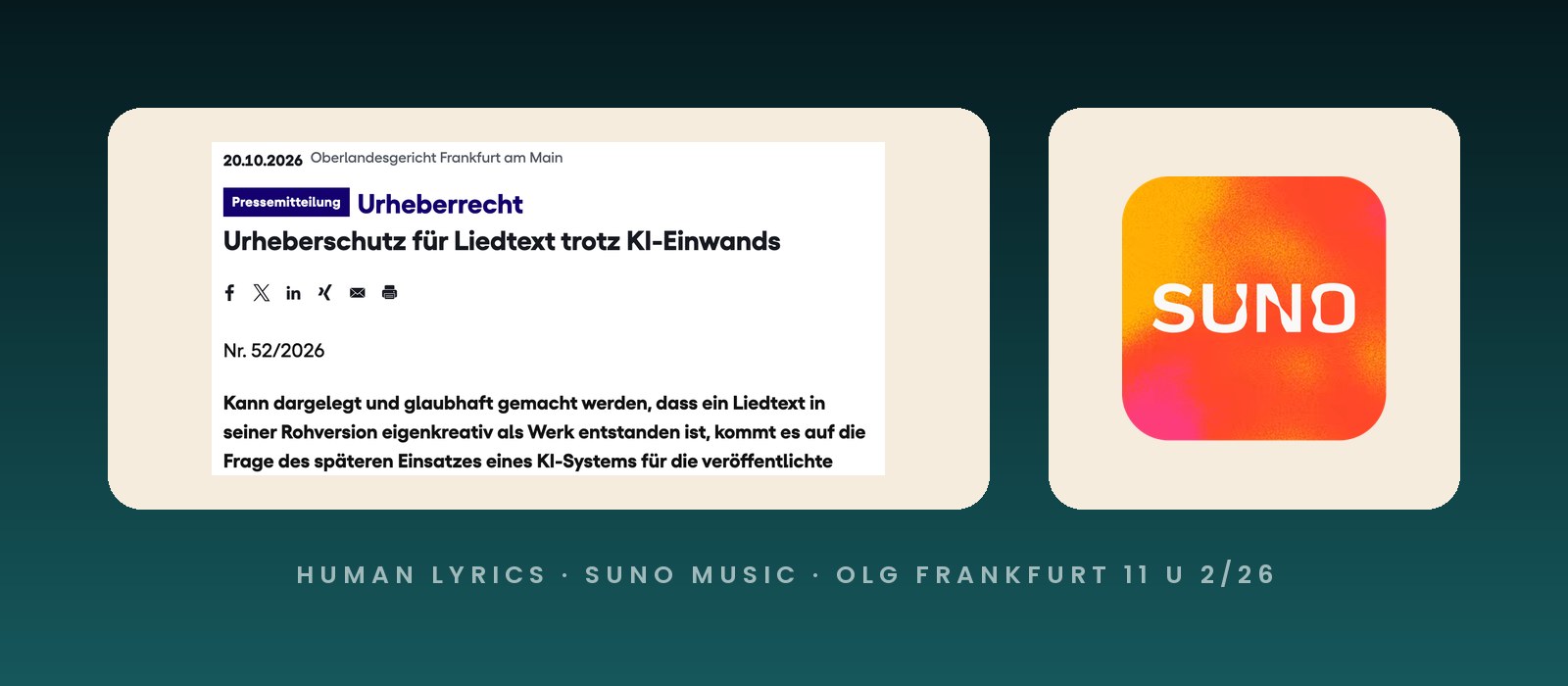
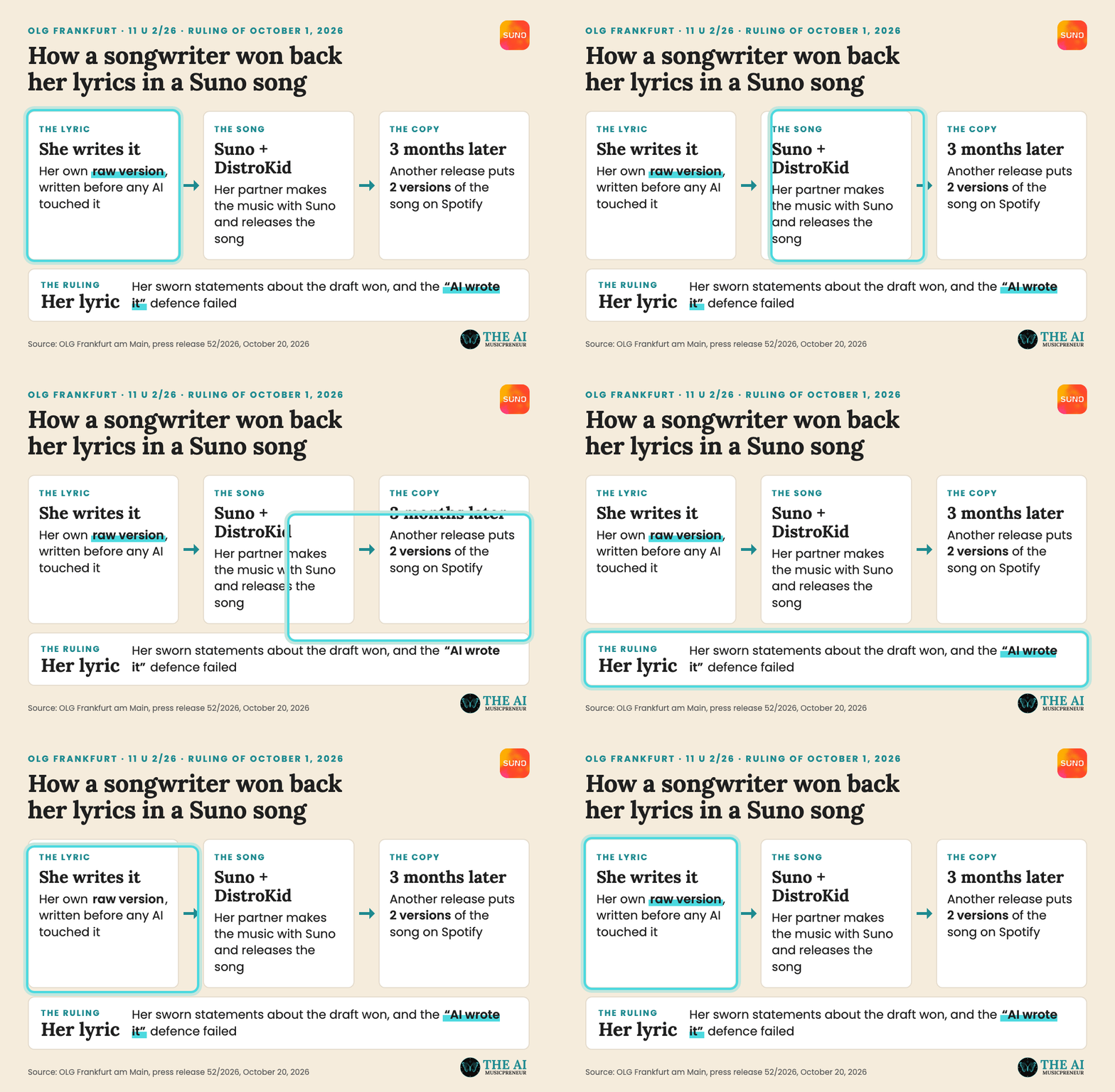
A songwriter in Germany wrote her lyrics. Her partner turned them into a song with Suno and released it on DistroKid. 3 months later, 2 versions of that song showed up on Spotify, released by someone else.
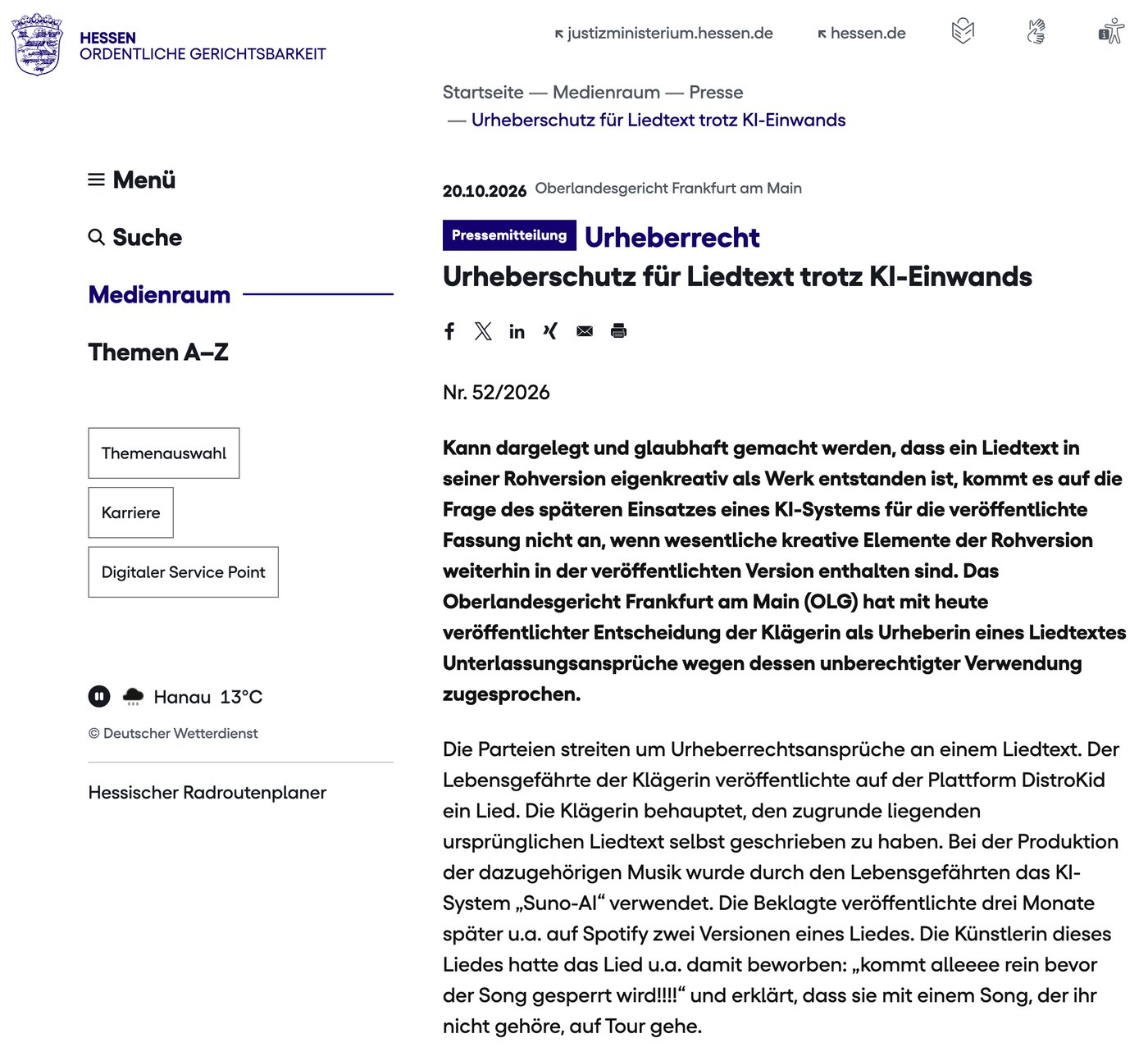
On October 1, 2026, the Higher Regional Court of Frankfurt am Main (OLG Frankfurt) ruled that the lyrics are hers. The other side’s main defence was that AI wrote them, and it didn’t work. The court announced the decision, case 11 U 2/26, in a press release on October 20.
If you write your own lyrics and make the music in Suno, this ruling is about you.
What happened in the OLG Frankfurt Suno lyrics case
The court doesn’t name anyone: not the songwriter, not her partner, not the song. Here’s what the press release and the lower court’s ruling say:
- She wrote the lyric herself. KPW’s write-up of the first ruling dates it to spring 2025.
- Her partner produced the music with Suno and released the song on DistroKid.
- 3 months later, the defendant released 2 versions of a song with her lyrics in it, including on Spotify.
- The artist on those versions promoted it with “kommt alleeee rein bevor der Song gesperrt wird!!!!” (“everybody get in before the song gets blocked!!!!”) and said she was touring with a song that wasn’t hers.
One detail several German write-ups blur: the press release treats the defendant and that artist as 2 different parties. Hogan Lovells’ AI case tracker says the defendant acted “as the digital distributor under the other artist’s label.” So it was the company that put out the copy that lost.
She asked for a fast-track court order to stop the release. The Regional Court of Frankfurt granted it on December 17, 2025 (case 2-06 O 401/25). The defendant appealed, and the OLG’s 11th civil senate, which handles copyright, rejected the appeal on the main points.
Why the “AI wrote it” defence failed at OLG Frankfurt
The defendant’s argument was simple. The lyrics weren’t written by her, they were generated by AI, and AI text has no author, so there was nothing to infringe.
To back that up, it brought a private expert report listing signs of AI.
The chorus is only sung in full once. Everything feels “übertrieben” (exaggerated). Some lines make “wenig Sinn” (little sense).
The court wasn’t convinced, and it turned the argument around. AI software usually works on probabilities and pattern recognition, so odd choices with no further explanation point away from AI, not towards it. Basically, a model writes the most likely next line, which makes the weird lines sound human.
Without further explanation, given that AI software usually relies on probabilities in pattern recognition, this actually points against digital generation.
The court also found a clear storyline in the lyric, a “Cinderella plot” that the defence’s own expert had picked out.
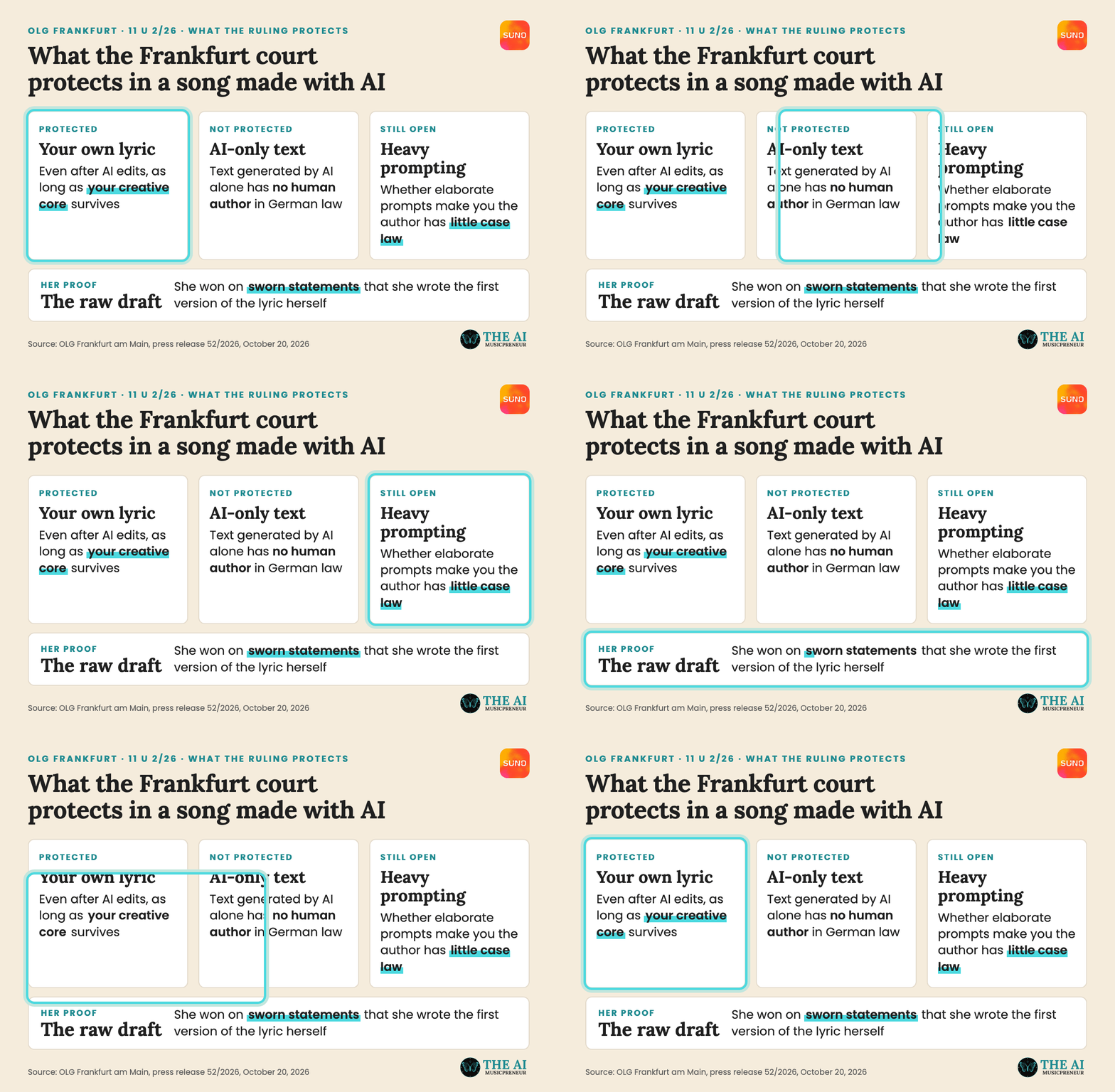
What won the case: “in sich überzeugende eidesstattliche Versicherungen”, internally convincing sworn statements that she wrote the raw version herself. The lower court had already accepted her statement plus her partner’s, and said that if every case needed an expert report, fast-track relief in copyright cases would effectively be abolished, per KPW’s summary of the first ruling.
Can you copyright lyrics in a song made with Suno?
In Germany, after this ruling, the answer for lyrics you wrote yourself is yes, with conditions. The court’s rule, translated: if you can show your raw lyric was your own creative work, it doesn’t matter whether an AI system was used later for the published version, as long as the essential creative parts of the raw version are still in it.
It didn’t even need to work out how much Suno changed. Hogan Lovells notes small edits were made “by the plaintiff and likely by SunoAI”, and the court said that question can stay open.
The limits matter just as much:
- Text generated only by AI has no protection. Under German copyright law, only a human can be an author (§ 2 and § 7 UrhG).
- Whether “elaborate prompting” makes you the author is still open. The court said there is little case law on it so far.
- The ruling covers the lyrics. It says nothing about who owns the music Suno generated.
The US lands in the same place. The Copyright Office’s Part 2 report from January 29, 2025 protects human-authored work that is “perceptible in an AI output”, “but not the mere provision of prompts.”
Suno’s own terms hand Pro and Premier users Suno’s rights in a song, but say Suno “makes no representation or warranty to you that any copyright will vest in any Output.” Free users can only use their songs for non-commercial purposes, and every plan now has a monthly download cap.
This is a different question from GEMA v. Suno, where a Munich court ruled on July 31, 2026 that Suno needed a licence for the music it trained on.
Munich was about what went into Suno. Frankfurt is about who owns what comes out with your words in it.
Frequently asked questions
Which court decided the Suno song lyrics case in Frankfurt, and what is the case number?
The 11th civil senate of the Higher Regional Court of Frankfurt am Main (OLG Frankfurt) decided it on October 1, 2026, case 11 U 2/26. It confirmed a ruling by the Regional Court of Frankfurt from December 17, 2025, case 2-06 O 401/25, and announced the decision in press release 52/2026 on October 20, 2026.
Does the OLG Frankfurt ruling make the music Suno generated copyrighted?
No. The ruling is about the lyrics the songwriter wrote herself. It says nothing about who owns the music Suno generated, and the court said text generated only by AI has no copyright protection under German law.
Who were the parties in the OLG Frankfurt Suno lyrics case?
The court did not name anyone. The press release describes a songwriter whose partner released the song on DistroKid, and a defendant that released 2 versions 3 months later. Hogan Lovells' AI case tracker says the defendant acted as the digital distributor under another artist's label.
How is the OLG Frankfurt lyrics ruling different from the GEMA v. Suno ruling?
GEMA v. Suno, decided by the Munich Regional Court on July 31, 2026, is about training: whether Suno needed a licence for the music it learned from. The Frankfurt case is about output: who owns the lyrics a human wrote inside a song made with Suno.
About the author

Covering AI music tools, industry shifts, and news for music creators and professionals. Twice-weekly newsletter at aimusicpreneur.com.