Spotify says it will thrive in the age of AI agents: 7 takeaways from its Q3 2026 earnings call
My stack My fav 6 tools for AI music after testing 70+
-
 ElevenMusic · Music generation
-
 Moises · Stem separation
-
 Controlla · Voice swap & cloning
-
 Cryo Mix · Mixing + mastering
-
 Neural Frames · Music videos
-
 ONCE · Distribution
Some links are affiliate links — I earn a commission at no cost to you. Every tool here is one I run myself and truly believe in. This stack is proven.
Spotify ended Q3 2026 with 306 million Premium subscribers, 1 million more than it had promised Wall Street. And on the earnings call on October 22, co-CEO Gustav Söderström opened his remarks with one topic: AI agents.
His claim is that Spotify is “in one of the few categories that actually stands to thrive in the agentic age.” Meanwhile Spotify’s operating expenses grew about 26% in a year, and its own Q3 2026 Update names marketing, cloud and AI spend as the main drivers.
I went through the full call transcript, the shareholder deck and the trade coverage. Here are the 7 things that matter if your music lives on Spotify.
1. Spotify says it stands to thrive as people use AI agents like Muse
Söderström’s argument is simple. Agents are great at taking over chores, like paying bills, answering email or booking a restaurant, and people love getting rid of chores.
But music is the opposite of a chore, so the time an agent frees up is time people want to spend listening. That’s why he thinks Spotify gains from agents instead of being replaced by them.
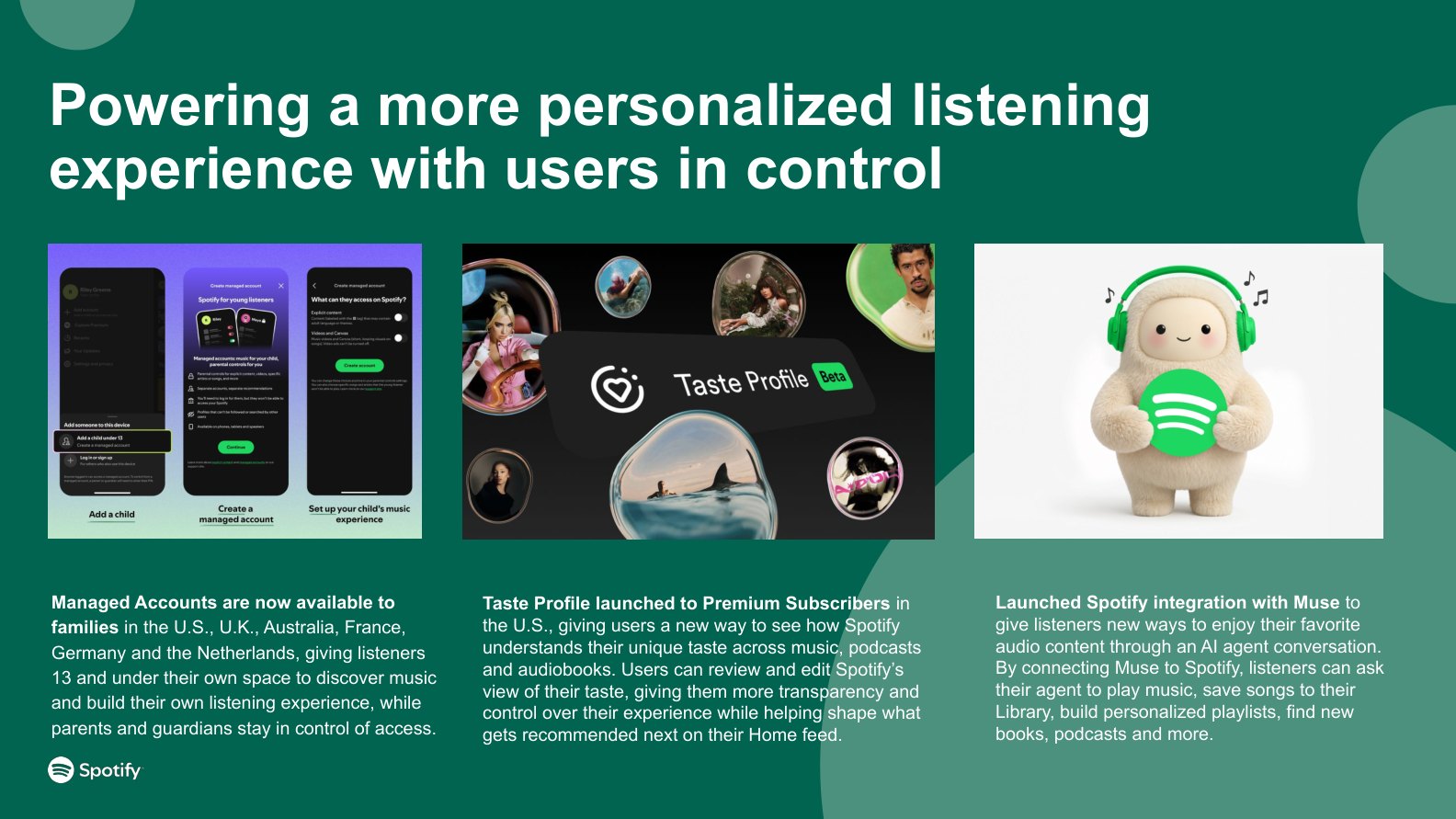
Spotify built for this early, he said. It was the first service available inside ChatGPT, it works with Meta’s Ray-Ban glasses, and it was the only media service in Meta’s Muse agent at launch.
Nobody asks an agent to summarize a song for them.
Inside the Spotify app, the agent idea goes further. Söderström said you can ask Spotify to go through your listening history back to 2008, speed up or slow down your favourites, sort them by key and BPM, and mix them into a running playlist at your exact cadence.
2. Spotify says the listening stays on Spotify when an agent asks
Analyst Jessica Reif Ehrlich asked the obvious question: if people talk to Muse instead of Spotify, who owns the listener?
Söderström’s answer was that nothing moves. “We are not sending the music or anything to any of these agents,” he said, according to Benzinga’s transcript of the call. The agent remote-controls Spotify in the background, and Spotify decides what to play.
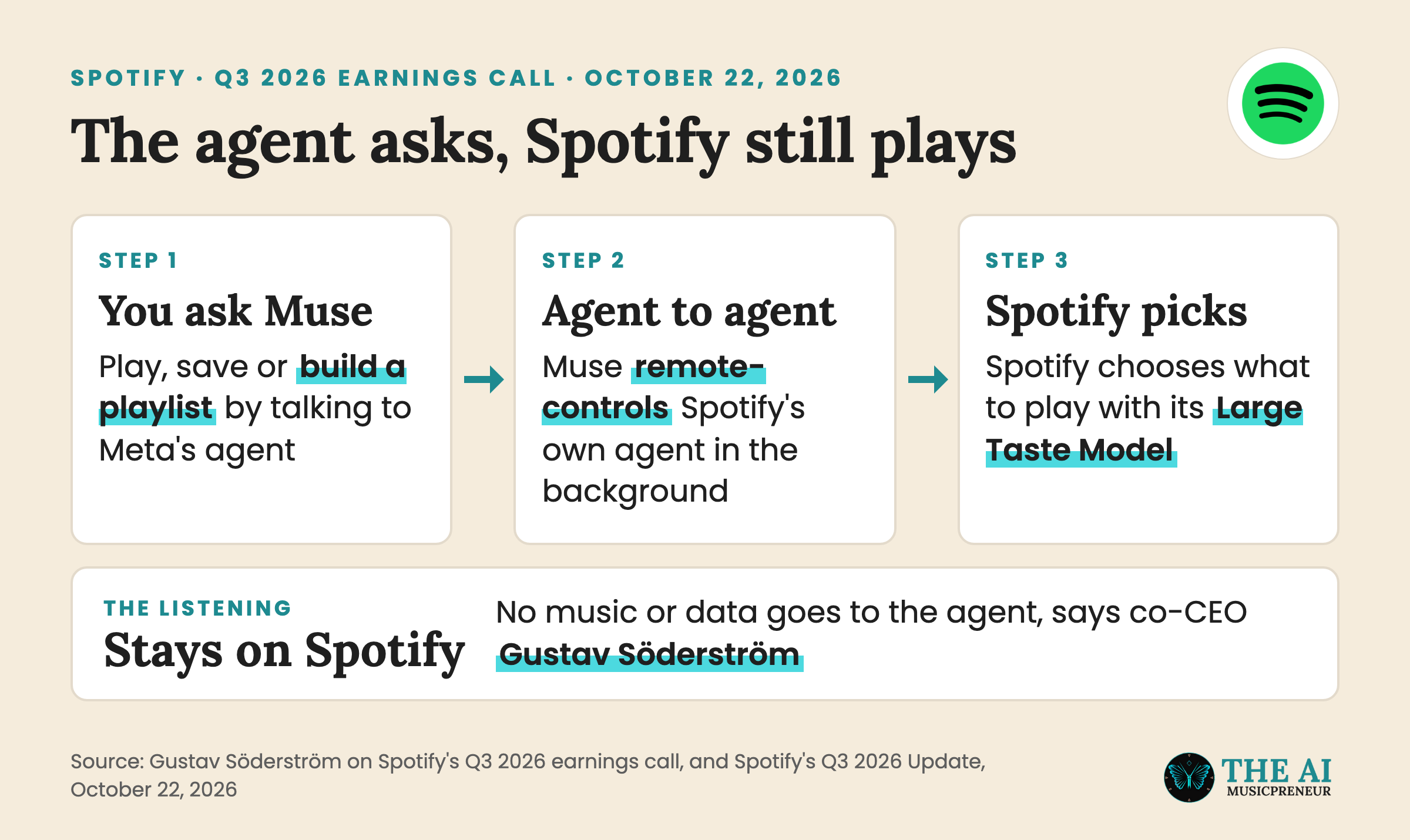
He even called it “a positive data loop for Spotify.” If you ask Muse to make a podcast about something you’ve been discussing, that podcast lands privately in your Spotify, and Spotify learns about your interests from it.
Rich Greenfield pushed on the risk that agents cancel subscriptions you don’t use. Söderström said Spotify was “never a bet on you forgetting about your subscription,” pointing to more than 100 million users who use Spotify about 28 days a month.
So for now, a play requested through Muse is still a play on Spotify, by Spotify’s own account.
3. Spotify’s AI and cloud spend pushed operating expenses up 26%
Operating expenses rose about 26% year on year to €967 million, Billboard reported. Strip out currency moves and social charges (payroll taxes tied to employee stock), and it’s 19%.
Spotify’s deck says that 19% was “primarily driven by an increase in marketing alongside cloud and AI spend in support of growth initiatives.”
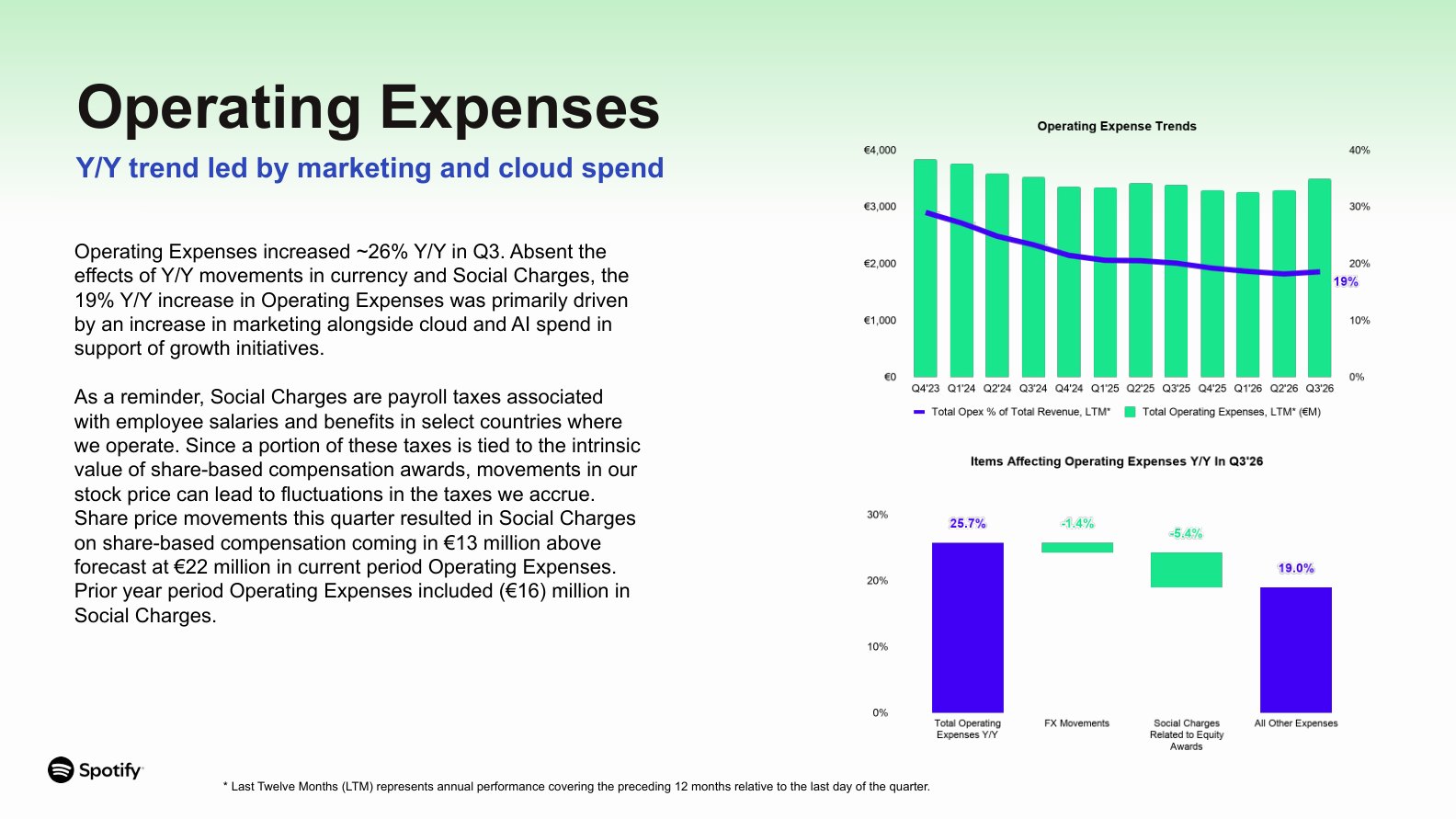
Co-CEO Alex Norström said opex growth peaked in Q3 and moderates from Q4 on. But don’t read that as AI spending going down.
CFO Christian Luiga said the AI investments “accelerated feature shipping while keeping headcount flat.” Asked about the return on tools like Claude Code, Söderström said Spotify saw a big jump in features actually shipped to users in its last 6-month cycle, “which is why you should expect us to sort of remain at these investment levels.”
4. Spotify’s Large Taste Model is driving double-digit growth in discoveries
The Large Taste Model is Spotify’s own AI model of what each listener likes, across music, podcasts and books. Söderström said it’s already producing “double-digit growth in discoveries,” which he called one of the leading metrics for how exciting people find Spotify.
He added that it’s on track to add billions of listening hours per year, even though Spotify is only starting to roll it out.
People are also talking to Spotify directly. Söderström said “tens of millions of people” now speak to Spotify in English, the kind of request Talk to Spotify was built for when it launched in beta in July.
His other favourite on the call was Mixing Tools, which he said is “scaling like crazy.”
5. Spotify’s Mixing Tools reach almost 40 million Premium listeners
Spotify started rolling out Mixing Tools about a year ago. Söderström said almost 40 million Premium users now listen to mixes, and millions of people create mixes of their own each month.
Mixes also feed Spotify’s AI. Playlists told Spotify which songs go together, but mixing “tells us exactly how and when they fit, down to the millisecond,” he said.
He tied it straight to remixes: “Give people good tools and they will invest in shaping the music themselves.”
Norström confirmed Spotify added Believe and TuneCore as partners for its paid AI remixes and covers tool. Universal Music Group, Merlin and Kobalt have also signed, Reuters reported. Norström said Spotify is building it “with consent, credit, and compensation at the core.”
6. Spotify’s About the Song feature is close to 100 million users
Norström said About the Song is now used by almost 100 million people. He credited WhoSampled, which Spotify bought, with the data set behind it, and Söderström named it when asked about demand for Spotify’s AI features.
It’s the same feature Lorde criticised in July.
Spotify’s agent goes further on credits. Söderström said you can now ask Spotify “exactly who wrote and performed on what on each track.”
So the songwriter and performer credits on your releases are now something listeners can ask Spotify about directly.
7. Spotify’s Universal and Warner deals come up in Q1 2027
The last question of the call came from analyst Michael Morris. He noted that Spotify’s agreements with Universal Music Group and Warner Music Group reach their two-year mark in the first quarter of 2027, and asked how Spotify’s 2027 pricing plans and add-on tiers factor into the renewal talks.
Norström wouldn’t talk terms. He called it “a reoccurring two-year rhythm” and said the relationship is improving “primarily because our interests are aligned.”
That matters for AI because Spotify’s remix and covers tool is meant to be a paid extra. KeyBanc estimated in September that Spotify’s AI music features could add about 2% to its revenue per listener.
Spotify’s Q4 2026 guidance and what comes next
Spotify expects 818 million monthly active users and 316 million subscribers by the end of 2026, on €5.2 billion in Q4 revenue and €820 million in operating income.
If it hits that, Spotify will post about €2.86 billion in operating income for 2026, its highest ever, by Music Business Worldwide’s count.
Norström also said he’s seen a preview of this year’s Wrapped, which lands in Q4. The Q4 results come next, and last year’s Q4 call was in February.
Frequently asked questions
What did Gustav Söderström say about AI agents on Spotify's Q3 2026 earnings call?
Söderström said Spotify is in one of the few categories that stands to thrive in the agentic age. His reasoning is that agents take over chores people would rather not do, while entertainment is something people want to spend their freed-up time on. He also said Spotify was the only media service inside Meta's Muse at launch.
How does Spotify work inside Meta's Muse AI agent?
You ask Muse to play music, save songs, build playlists or find books and podcasts, and Muse talks to Spotify's own agent in the background. Söderström said the listening still happens on Spotify and that Spotify does not send music or user data to the agent. Spotify does the reasoning about what to play with its own taste model.
Why did Spotify's operating expenses rise in Q3 2026?
Spotify's operating expenses rose about 26% year on year in Q3 2026. Without currency effects and social charges the increase was 19%, which Spotify's Q3 2026 Update says was primarily driven by marketing alongside cloud and AI spend. Spotify says operating expense growth peaked in Q3 and will moderate from Q4 2026 into 2027.
How many Spotify Premium users listen to mixes made with Spotify's Mixing Tools?
Söderström said on the Q3 2026 call that almost 40 million Premium users now listen to mixes, and that millions of people create mixes of their own each month. Spotify started rolling out its Mixing Tools about a year before the call.
When do Spotify's licensing deals with Universal Music Group and Warner Music Group reach their two-year mark?
An analyst on Spotify's Q3 2026 earnings call said the Universal Music Group and Warner Music Group agreements reach their two-year mark in the first quarter of 2027. Co-CEO Alex Norström did not discuss terms, but said renewals follow a recurring two-year rhythm and that the relationships are improving because interests are aligned.
About the author

Covering AI music tools, industry shifts, and news for music creators and professionals. Twice-weekly newsletter at aimusicpreneur.com.