
Goldman Sachs says AI could add 10% to recorded music revenue by 2035, and warns AI tracks could dilute the royalty pool
My stack My fav 6 tools for AI music after testing 70+
-
 ElevenMusic · Music generation
 -
 Moises · Stem separation
 -
 Controlla · Voice swap & cloning
 -
 Cryo Mix · Mixing + mastering
 -
 Neural Frames · Music videos
 -
 ONCE · Distribution
Some links are affiliate links — I earn a commission at no cost to you. Every tool here is one I run myself and truly believe in. This stack is proven.
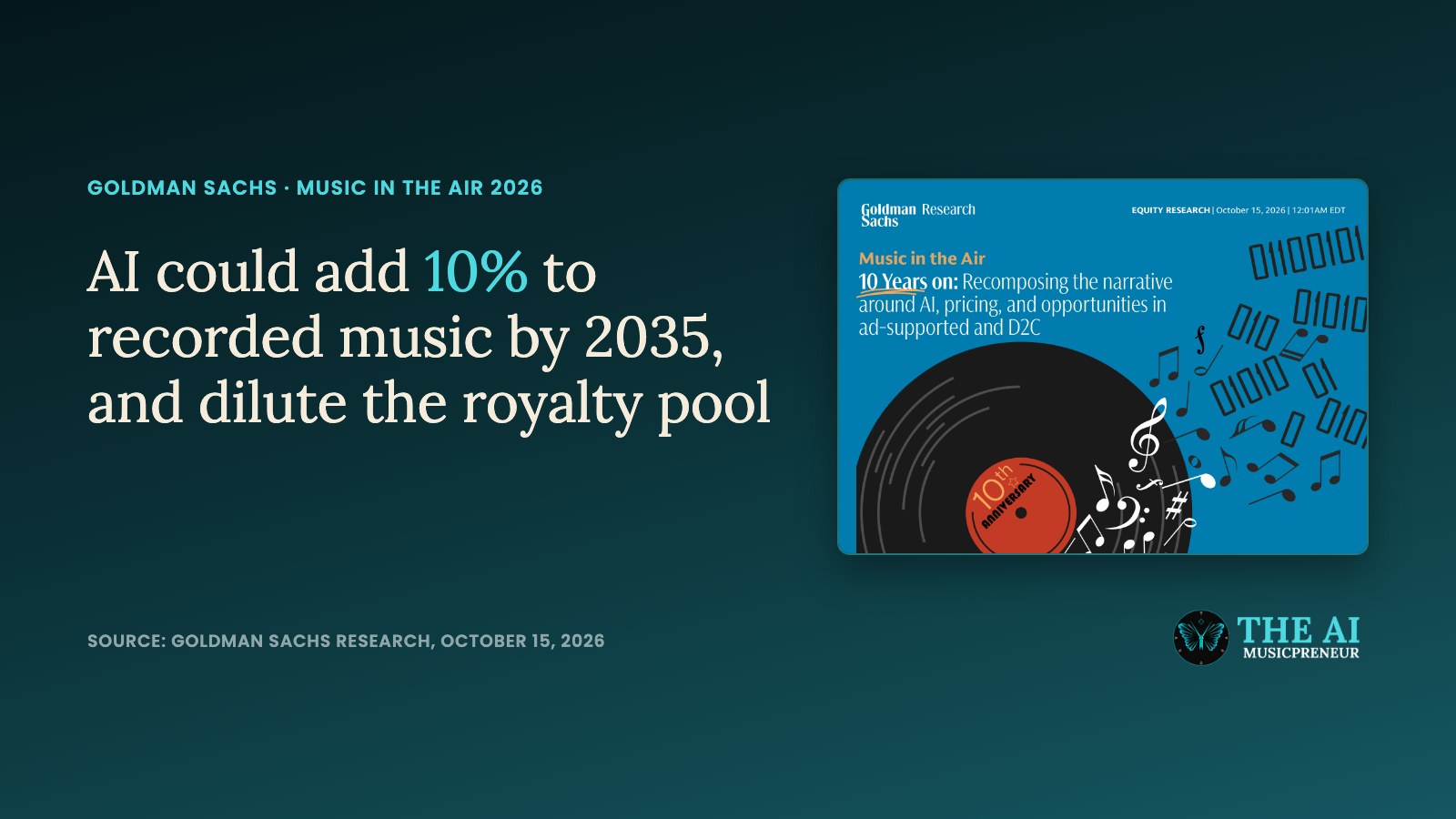
Goldman Sachs thinks AI could add about 10% to recorded music revenue by 2035. In the same report, the bank warns that AI tracks could take a slice of the royalty pool that pays human artists.
Both claims come from Music in the Air 2026, the 10th edition of Goldman’s annual music industry report, dated October 15, 2026. Digital Music News and Hypebot reported on it the next day.
Goldman now expects recorded music revenue for rights holders to grow 5.9% a year, from $31.7 billion in 2025 to $56.1 billion in 2035. It’s the first time since 2022 that the bank has raised its industry estimates, and AI is one of the reasons it gives.
Where Goldman Sachs’ $3.3 billion AI music estimate comes from
Goldman’s summary says “AI-related licensing, creation tools, and new monetization opportunities have the potential to drive ~10% upside to Recorded Music revenues by 2035.”
The model behind that line is plain multiplication. Goldman starts with the paid music subscribers it expects in the US, Canada, Europe, Japan, South Korea and Australasia in 2035: 628 million people. It assumes 8% of them pay $11 a month for an AI music product, which is 50.2 million users.
Then it gives rights holders about half of that money. That’s below the roughly 2/3 labels get from streaming today, because the AI platform pays for training and compute and takes its own cut.
Multiply it out and you get $3.3 billion a year. Against the $33 billion Goldman expects subscription streaming to pay rights holders in 2035, that’s the 10%.
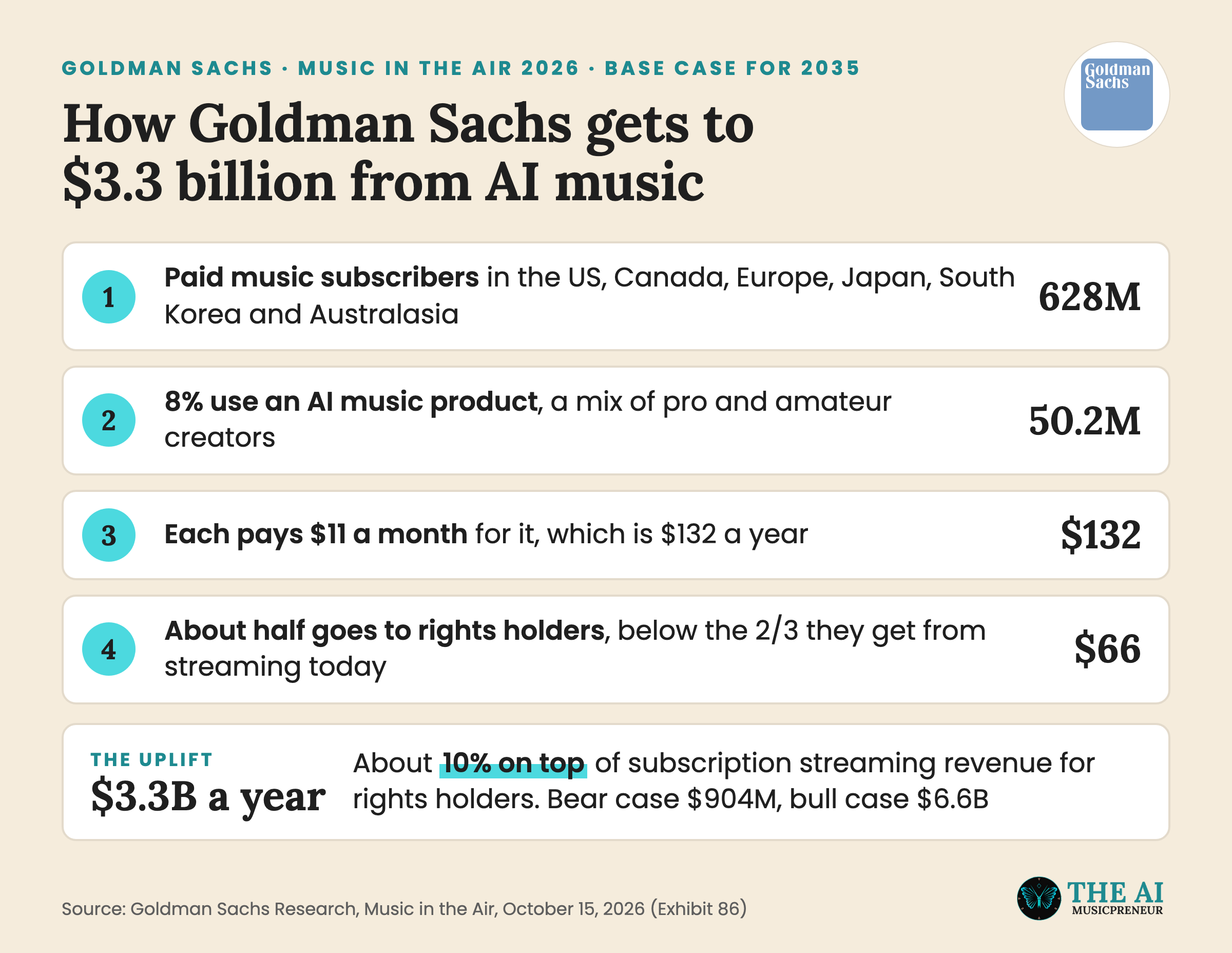
Goldman calls this base case the most likely. The bear case (4% at $6 a month) comes to $904 million, and the bull case (10% at $18) to $6.6 billion.
The money would flow through licensed deals like Warner Music’s settlements with Suno and Udio, or Believe and TuneCore opting artists into Suno’s licensed models. Warner has already told investors its AI deals start paying off in fiscal 2027.
The other half of Goldman’s AI chapter is about who loses share.
Will AI music reduce streaming royalties for human artists?
AI music could reduce streaming royalties for human artists, and Goldman Sachs lists it as a structural risk for record labels.
It comes down to how streaming pays out. Most streaming services pay rights holders out of one pot each month, and that pot gets split by each track’s share of total streams. So when AI tracks win more of those streams, every human track’s share of the same pot gets smaller.
The traditional royalty payout model could be pressured as millions of AI-generated tracks entering the music streaming ecosystem divert a portion of the royalty pool away from human-created IP.
The upload volume is already there. Deezer received close to 90,000 fully AI-generated tracks a day in June 2026, and those uploads passed 50% of everything delivered on peak days. In the June 2025 edition, Goldman cited more than 20,000 a day at Deezer and put AI music at 0.1% of the royalty pool, according to Music Business Worldwide.
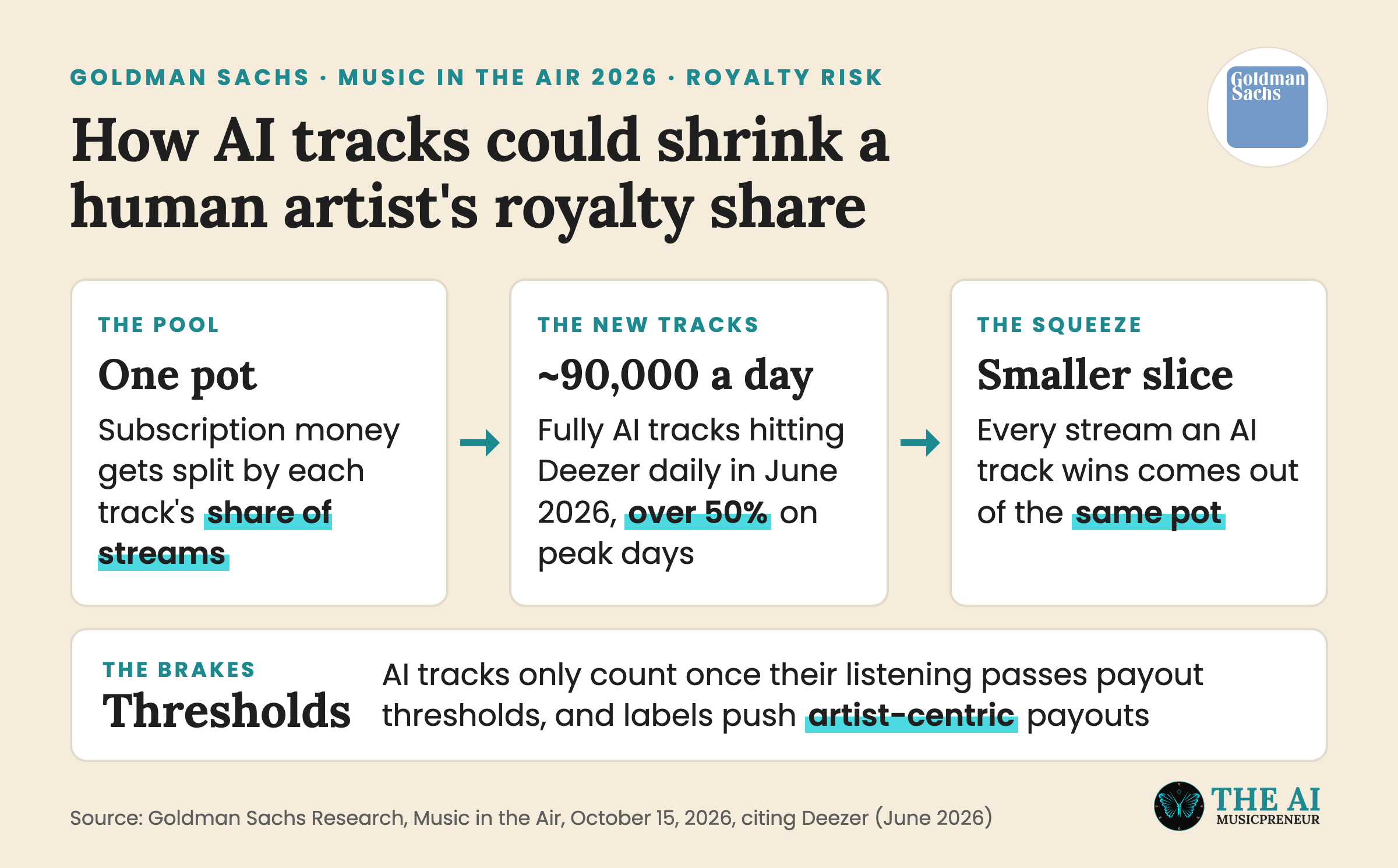
Goldman adds 2 caveats to the dilution risk:
- AI tracks only take money from the pool once their listening passes the thresholds that make a track eligible for payouts.
- The risk is highest in functional, mood-based music like lo-fi, sleep and study playlists, “where AI tools can easily produce content at near-zero marginal cost, and there is less brand affinity for specific artists.”
Labels are answering with artist-centric payment models, per-subscriber minimum guarantees with streaming services and AI-protection tools, according to the report. Belgian artist manager Gust Moons went further in August and argued fully AI-generated tracks should earn no royalties at all.
Which music Goldman Sachs says is most exposed to AI by 2035
Goldman splits music into 2 groups. It expects “generationally recognizable catalog, superstar artists, and culturally relevant front-line IP” to stay the most insulated, while “generic, functional, and background-oriented music categories face greater disruption risk.”
The report also sees AI tools cutting into what labels sell. With AI handling production, mastering and marketing at a fraction of the cost, Goldman writes that independent artists can “theoretically achieve label-quality output without surrendering their IP or royalty shares.”
If you release your own music, you can see which group your streams sit in today. Spotify for Artists lists the playlists your songs get streamed from, and if most of them are mood playlists for sleep, study or focus, your music falls in the category Goldman marks as most exposed.
Frequently asked questions
What is Goldman Sachs' Music in the Air 2026 report?
Music in the Air is Goldman Sachs' annual equity research report on the music business, and the 2026 edition, dated October 15, 2026, is the 10th. It forecasts recorded music, publishing and live music through 2035 and expects total industry revenue to grow 5.8% a year to $198.1 billion. Eric Sheridan and Stephen Laszczyk head the list of Goldman analysts who wrote it.
How did Goldman Sachs change its recorded music forecast between Music in the Air 2025 and 2026?
The June 2025 edition expected recorded music revenue of $55.0 billion in 2035, after Goldman cut its near-term forecasts following a weak 2024. The October 2026 edition raises that to $56.1 billion and lifts its 2026 recorded music forecast by 1.2%. Goldman says it is the first time since 2022 that its industry estimates have gone up.
Which music companies does Goldman Sachs favor in Music in the Air 2026?
Goldman says it favors distributors of music and audio, such as the big streaming services, and live entertainment businesses over owners of music rights, where it takes a more selective approach. On AI specifically, it calls scaled streaming services relative beneficiaries and sees a more balanced risk and reward for labels and rights holders.
Does Goldman Sachs' $3.3 billion AI music estimate include money from AI tracks on Spotify?
No. The $3.3 billion is revenue from people paying for AI music products, such as AI creation tools sold as a paid tier or add-on, with about half going to rights holders. Streams of AI-generated tracks on services like Spotify sit in the separate royalty pool, which is where Goldman sees the dilution risk.
About the author

Covering AI music tools, industry shifts, and news for music creators and professionals. Twice-weekly newsletter at aimusicpreneur.com.