Universal and Sony ask a court to force DistroKid to reveal how many AI songs it uploads
My stack My fav 6 tools for AI music after testing 70+
-
 ElevenMusic · Music generation
 -
 Moises · Stem separation
 -
 Controlla · Voice swap & cloning
 -
 Cryo Mix · Mixing + mastering
 -
 Neural Frames · Music videos
 -
 ONCE · Distribution
Some links are affiliate links — I earn a commission at no cost to you. Every tool here is one I run myself and truly believe in. This stack is proven.
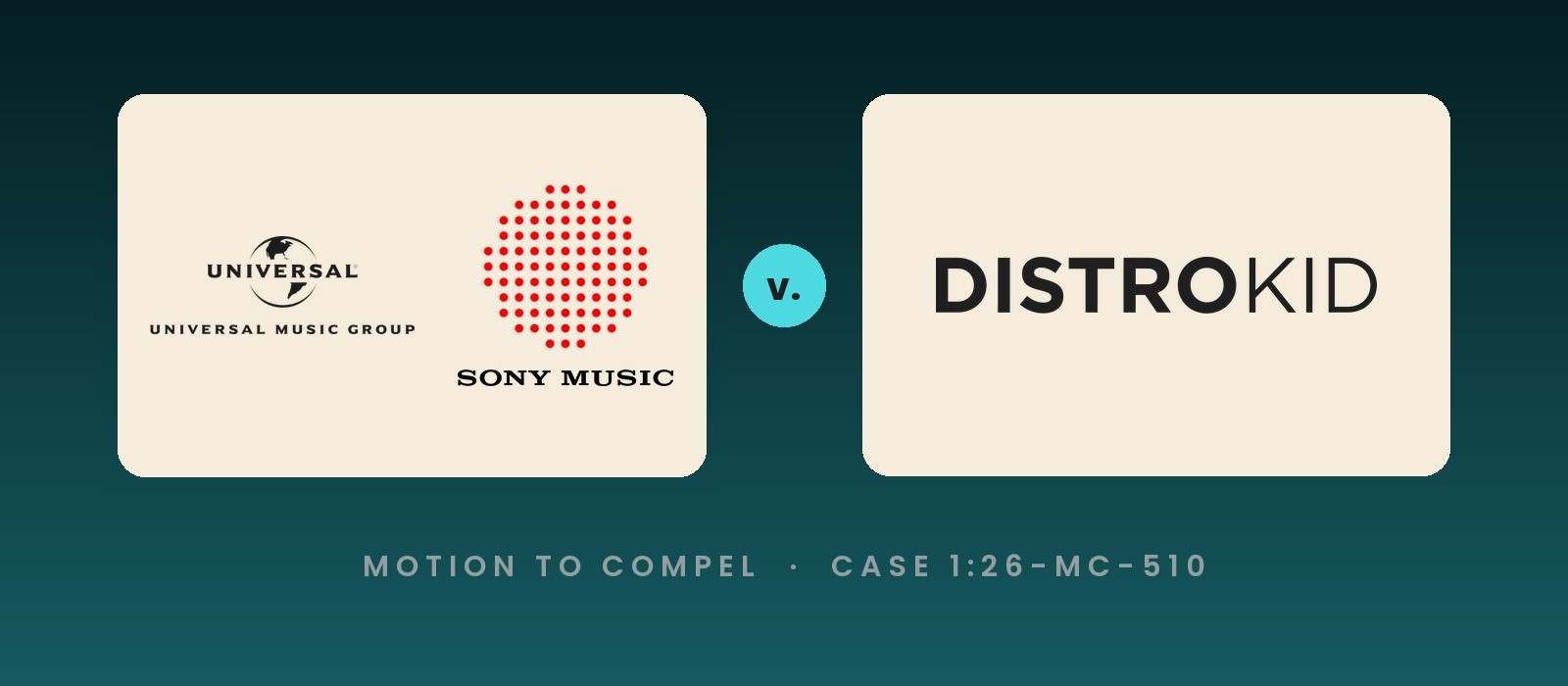
Universal Music Group and Sony Music asked a federal court in Manhattan on October 14, 2026 to force DistroKid to say how many AI-generated songs it sends to streaming services. They want the numbers as evidence in their copyright case against Suno.
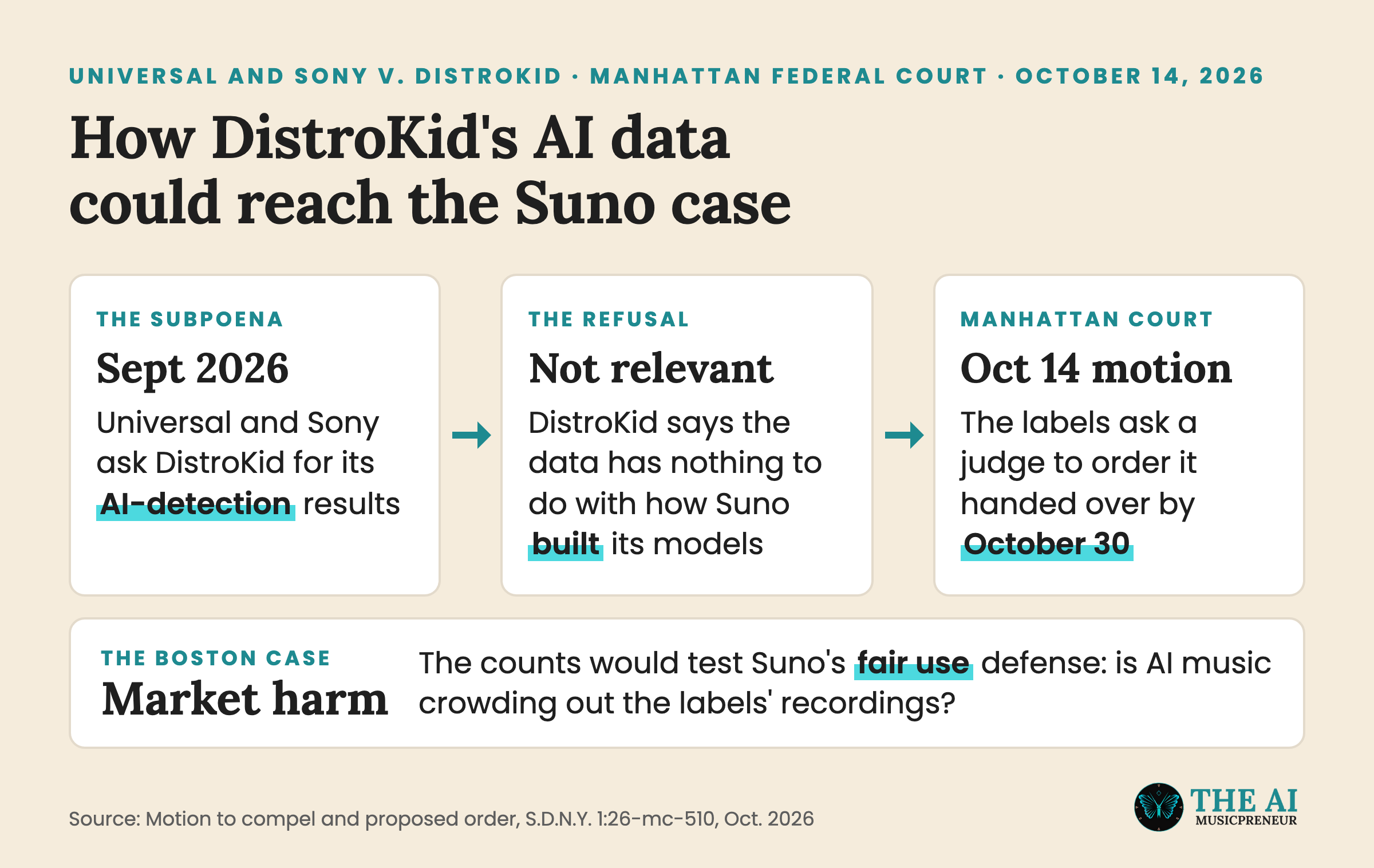
The labels served DistroKid a subpoena in September, and they say it “refuses to produce a single document.” Their filing, as quoted by The Hollywood Reporter, calls DistroKid’s scale “staggering”.
That’s more than all other distributors combined. One caveat: the number counts every track, not only AI ones. The AI count is what the labels want the court to make DistroKid produce.
What Universal and Sony want DistroKid to hand over by October 30
The labels’ proposed order asks the judge to make DistroKid produce 2 sets of documents by October 30, 2026.
The first is a monthly count, starting from the day DistroKid began using a third-party “prediction model” it described in an October 9 response to the subpoena:
- How many recordings DistroKid delivered to streaming services.
- How many of those it ran through the prediction model.
- How many the model scored as likely AI-generated, in whole or in part.
- What those flagged tracks earned in streams and royalties, and how many the model traced to Suno, if it can.
The second is about the model itself: its name and vendor, when DistroKid started using it, whether it can tell which AI service made a track, and what DistroKid knows about its accuracy, including false positives.
So besides the AI disclosure boxes uploaders tick themselves, DistroKid runs tracks through an outside detector, and I couldn’t find DistroKid announcing that anywhere. The order asks for counts and totals, with no track titles or artist names.
DistroKid has admitted that it measures that flow with an AI-detection tool. Whether that flow is harming the market for plaintiffs' recordings is a question at the center of Suno's fair use defense.
Why is a fight about Suno happening in a New York court at all?
Why a DistroKid subpoena in Manhattan matters to the Suno fair use case in Boston
DistroKid isn’t a party to the Suno case. That case is UMG and Sony v. Suno, filed in Boston in June 2024 and overseen by Judge F. Dennis Saylor IV.
A subpoena is how you get documents from a company you aren’t suing. When that company says no, the fight goes to the federal court where it has to comply, which here is Manhattan.
The date wasn’t random. Judge Saylor’s amended schedule made October 14 the last day to raise most third-party discovery disputes in the case, and the labels filed that day.
According to the labels, DistroKid refused because the data has nothing to do with how Suno built its models. The labels point to fair use, Suno’s main defense: one of the 4 things a US court weighs is whether the copying hurts the market for the original recordings.
Suno “does not track where its outputs are distributed once they leave Suno’s platform,” the labels told the court, which makes DistroKid’s counts “highly relevant information that only DistroKid possesses.”
DistroKid told Billboard on October 16 that it is “a third party in the ongoing litigation” and will “continue to cooperate with the legal process as this matter proceeds.”
Sony isn’t part of UMG’s September 15 lawsuit against DistroKid in Delaware, the case behind the recent DistroKid takedowns.
How many AI songs does DistroKid upload?
Nobody outside DistroKid knows. DistroKid hasn’t published an AI count, and the 12 million figure covers every track it sent to that one service.
The closest public number is a share. In SIQA’s Mid-Year 2026 report, DistroKid carried 77.6% of AI releases that listed a distributor.
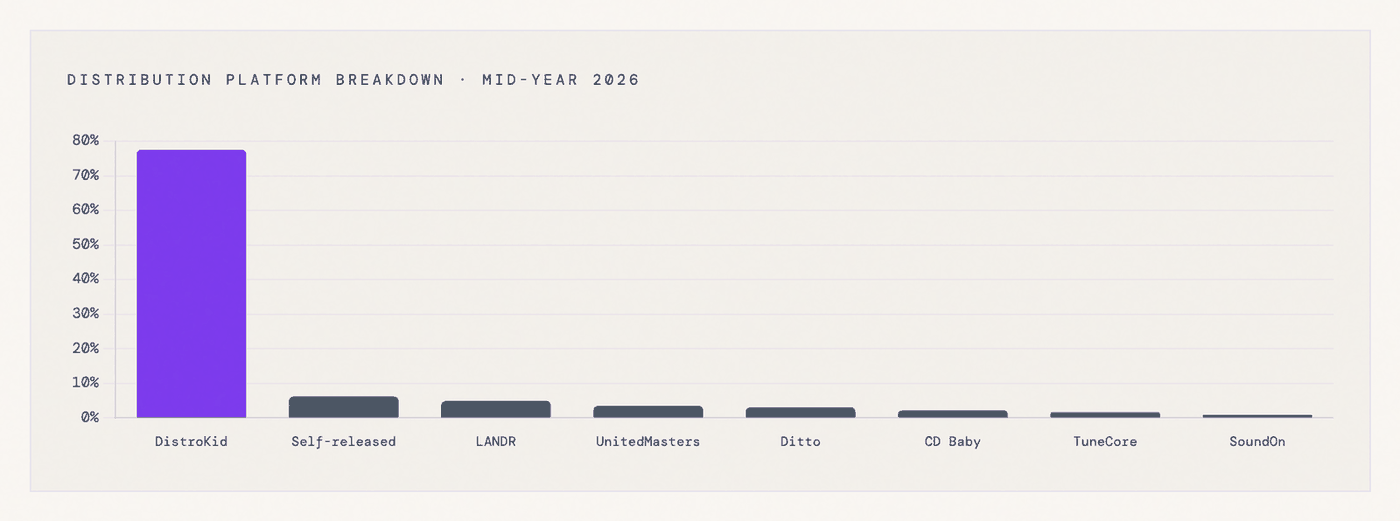
For scale on the receiving end, Deezer says fully AI-generated tracks passed 50% of its daily uploads in June 2026, close to 90,000 a day, across every distributor.
Even if the judge signs the order, the counts go to the labels’ lawyers first. They’d only become public in a filing in the Suno case, where dispositive motions are due on June 22, 2027.
No judge has ruled on the motion yet. If you release AI-assisted music in the meantime, my AI music distribution roundup compares 7 distributors’ AI rules.
Frequently asked questions
Which lawsuit is Universal and Sony's DistroKid subpoena part of?
It belongs to UMG Recordings v. Suno, case 1:24-cv-11611, which Universal, Capitol Records and Sony filed in Boston federal court in June 2024 and which Judge F. Dennis Saylor IV oversees. The Manhattan filing, case 1:26-mc-510, exists only to enforce the subpoena on DistroKid, which is not a party to the Suno case.
Is Sony Music part of Universal's lawsuit against DistroKid?
No. Universal Music Group sued DistroKid alone in Delaware federal court on September 15, 2026. Sony joined Universal only in the October 14, 2026 motion asking a Manhattan court to enforce their shared subpoena on DistroKid in the Suno case.
Would Universal and Sony's proposed order reveal which DistroKid artists were flagged as AI?
Not as written. The proposed order asks for monthly counts of tracks delivered, tested and scored as likely AI-generated, plus their total streams and royalties and any count attributed to Suno. It does not ask for track titles or account names.
When are summary judgment motions due in Universal and Sony's 2024 lawsuit against Suno?
Judge Saylor's September 22, 2026 amended schedule sets dispositive motions, the stage where a fair use ruling is expected, for June 22, 2027. Expert reports start on January 28, 2027, and fact discovery on the labels' YouTube stream-ripping claim closes on November 20, 2026.
About the author

Covering AI music tools, industry shifts, and news for music creators and professionals. Twice-weekly newsletter at aimusicpreneur.com.