Kid Rock used Suno for the choir arrangements and some orchestrations on Halfway 2 Jesus
My stack My fav 6 tools for AI music after testing 70+
-
 ElevenMusic · Music generation
 -
 Moises · Stem separation
 -
 Controlla · Voice swap & cloning
 -
 Cryo Mix · Mixing + mastering
 -
 Neural Frames · Music videos
 -
 ONCE · Distribution
Some links are affiliate links — I earn a commission at no cost to you. Every tool here is one I run myself and truly believe in. This stack is proven.
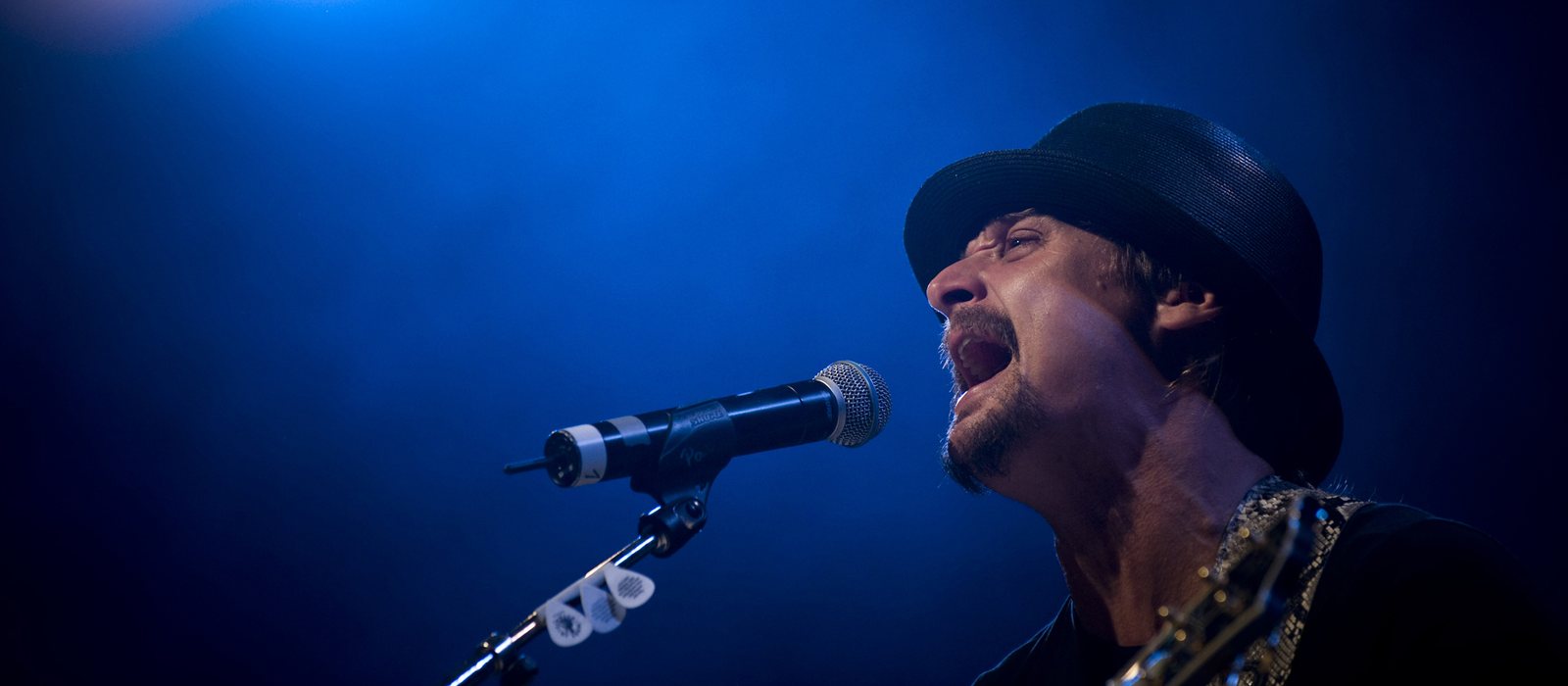
Kid Rock’s faith-based album Halfway 2 Jesus came out on Saturday, October 17, 2026, and some of what you hear on it was made in Suno.
Kid Rock (real name Robert Ritchie) used Suno “mostly to craft full choir arrangements and some orchestrations” on the record, Billboard’s Gary Graff reported on October 15. The rest of the 17-track album, which he announced on October 1, was recorded at his Dixie Ridge Studios in Nashville with session musicians and members of his Twisted Brown Trucker band.
“I really do view it as another tool,” Kid Rock told Graff. He compared Suno to using samples and said it “lets me get what I hear in my head to my audience…without (AI) writing the song.”
What did Kid Rock use Suno for on Halfway 2 Jesus?
Suno did 2 jobs on Halfway 2 Jesus, according to Billboard: mostly full choir arrangements, and some of the orchestrations.
The songs and the playing came from people. Kid Rock wrote most of the material with his longtime friend Uncle Kracker, John Eddie and other writers, and the album’s guests are Eminem, Lil Wayne, Rascal Flatts’ Gary LeVox and Jimmie Allen.
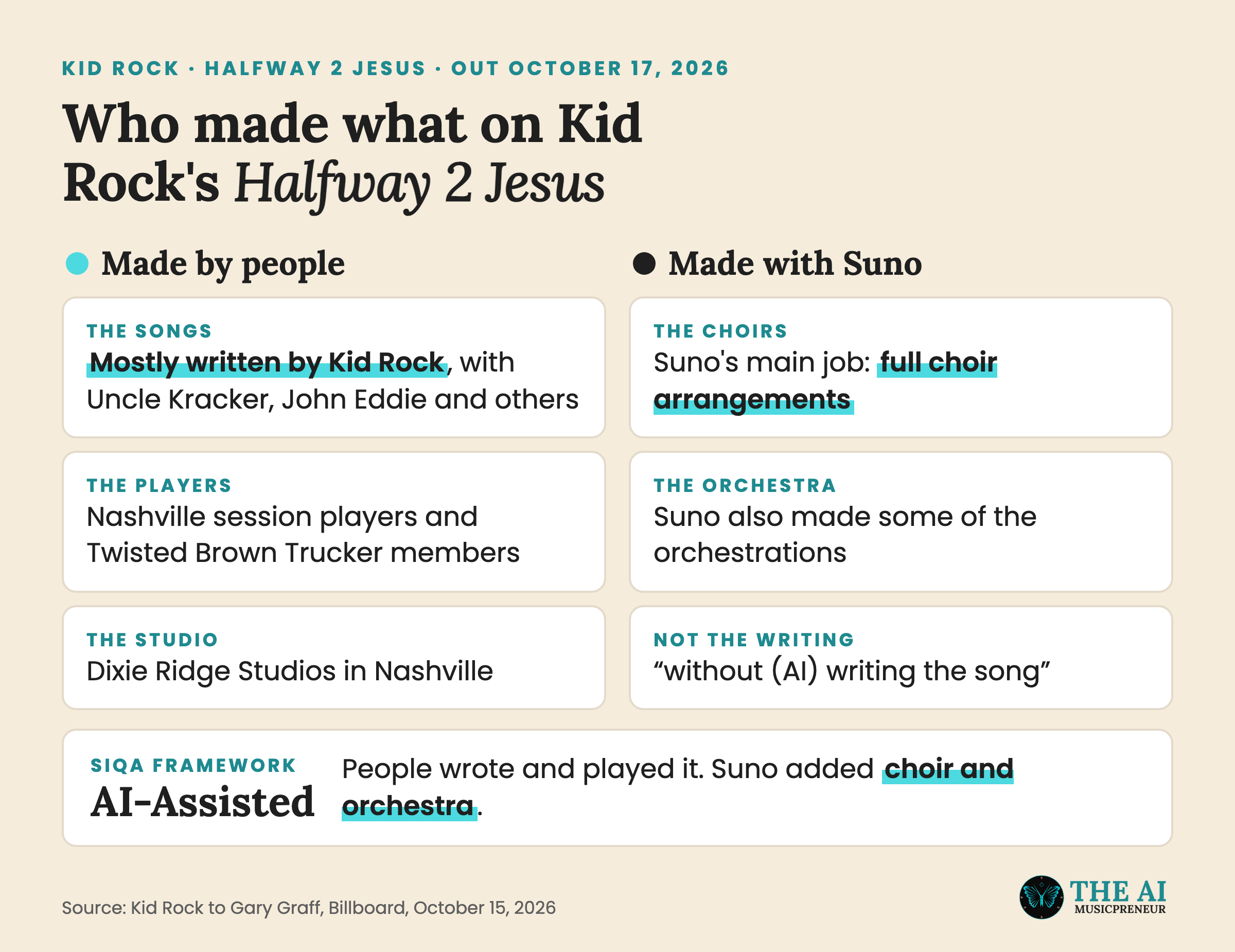
Under the SIQA framework, which I use to classify tracks in the Artist Index, that mix is AI-Assisted: people fill core creative roles like writing and performing, and AI fills others. That’s my classification, not a label Kid Rock has used.
Kid Rock also said AI could turn into a problem for music, and that it’s still to be determined:
I agree it can be a huge problem down the line. I think it's to be determined. Until then… you can build a house with pound of nails and a rock, or you can get a nail gun. So it's another tool.
He’s not the first big name to say on record which parts came from Suno. In August, Tyga confirmed he used Suno for ’80s synths and a guitar solo on $TARFACE. And the day before Graff’s piece ran, A$AP Rocky called AI a tool for jobs like splitting stems.
My list of famous artists using AI in music tracks where each one puts it in the workflow. So can you do what Kid Rock did on your own release?
Can you use Suno choir and orchestra parts on a commercial release?
Yes, if you make them on a paid plan. The catch is copyright.
Suno’s Terms of Service, in force since September 3, 2026, assign the output to Pro and Premier subscribers. Free and Basic users agree to use theirs only for “lawful, personal and non-commercial purposes.” Pro costs $8 a month and Premier $24 on annual billing.
Suno says so itself: it “makes no representation or warranty to you that any copyright will vest in any Output.”
The US Copyright Office’s January 2025 report on AI and copyrightability explains why. Copyright covers what a human made, and a prompt alone doesn’t count. So a choir you prompted in Suno is the one part of your song you can’t register.
Your lyrics, your melody and the parts you played still can be registered, and you disclaim the AI parts when you file, as I cover in my AI music copyright explainer.
Royalty registration follows the same line. ASCAP, BMI and SOCAN have accepted partly AI-generated works since October 28, 2025, while fully AI-generated songs still don’t qualify.
One more rule in Suno’s terms: you agree not to remove or hide the watermark or metadata Suno adds to a track to disguise where it came from.
So if a Suno choir is going under your next single, generate and download it on Pro or Premier, and list it as AI-generated when you register the song.
Frequently asked questions
When did Kid Rock release Halfway 2 Jesus, and how many tracks are on it?
Kid Rock released Halfway 2 Jesus on Saturday, October 17, 2026, after announcing it on October 1. The album has 17 tracks, and its lead single, 'James 1:17 (Jesus Is King)', came out on his own Top Dog Records label.
Is Kid Rock's album called Halfway 2 Jesus or Halfway to Jesus?
Both spellings show up. Coverage of the October 1, 2026 announcement, Billboard's included, used 'Halfway to Jesus', while Billboard's October 15 interview and most coverage since use 'Halfway 2 Jesus'.
Who wrote the songs on Kid Rock's Halfway 2 Jesus?
Kid Rock wrote most of the album with his longtime friend Uncle Kracker, John Eddie and other writers. Longtime Twisted Brown Trucker keyboardist Jimmie 'Bones' Trombly wrote 'Into the Setting Sun', and the album includes covers of Tom T. Hall's 'Me and Jesus', Larry Norman's 'Why Don't You Look Into Jesus' and Lee Greenwood's 'God Bless the U.S.A.'
About the author

Covering AI music tools, industry shifts, and news for music creators and professionals. Twice-weekly newsletter at aimusicpreneur.com.