Duke researchers found 9 undisclosed AI artists on Spotify, all through Release Radar
My stack My fav 6 tools for AI music after testing 70+
-
 ElevenMusic · Music generation
 -
 Moises · Stem separation
 -
 Controlla · Voice swap & cloning
 -
 Cryo Mix · Mixing + mastering
 -
 Neural Frames · Music videos
 -
 ONCE · Distribution
Some links are affiliate links — I earn a commission at no cost to you. Every tool here is one I run myself and truly believe in. This stack is proven.
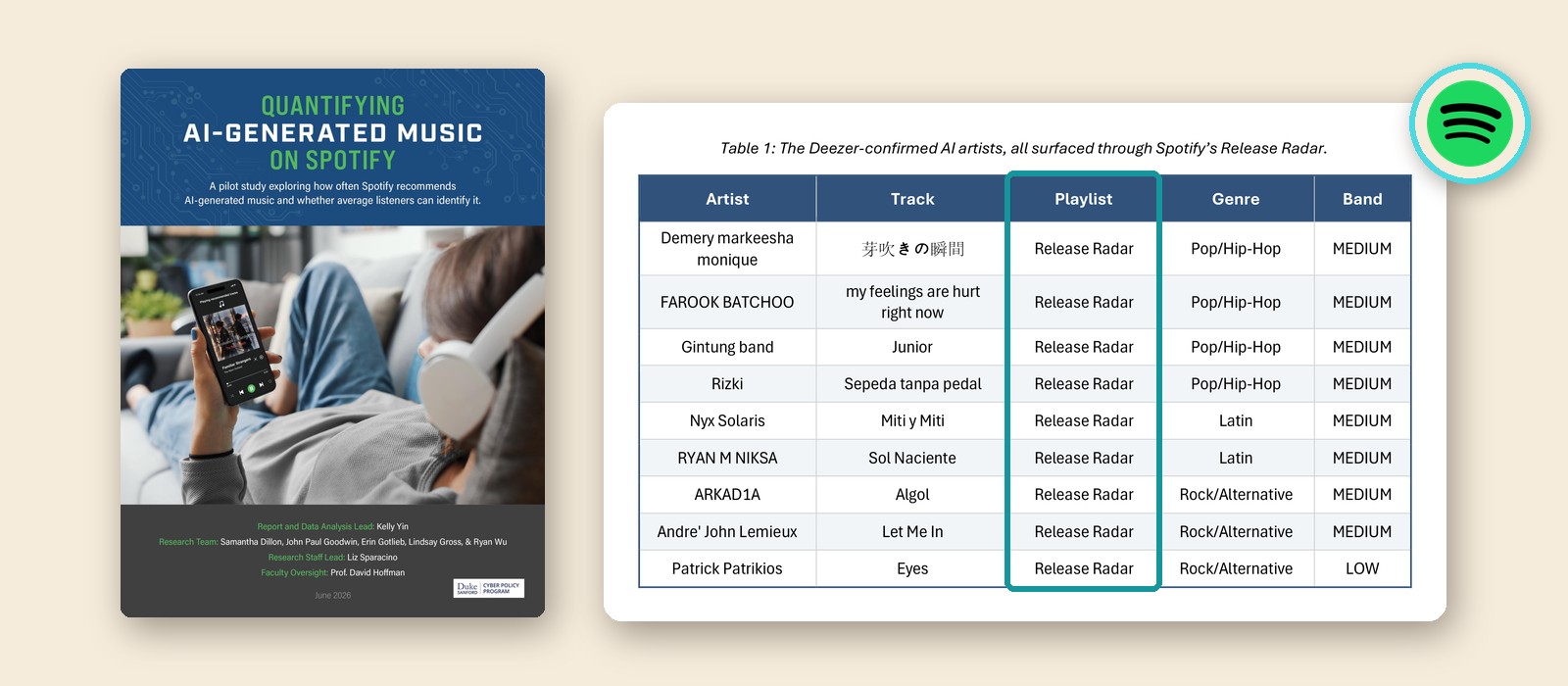
5 Duke University researchers spent 28 days listening to Spotify on brand-new accounts and found 9 AI-generated artists. Spotify’s Release Radar recommended every one of them, and none of the 9 said anywhere on their profiles that they used AI.
The study, Quantifying AI-Generated Music on Spotify, comes from the Duke Sanford Tech Policy Program, which published it on its blog on October 12, 2026. The team heard 728 artists, scored 76 unfamiliar ones on public clues, and used Deezer’s AI tags to confirm the 9.
How the Duke Sanford team hunted for AI artists on Spotify
Each researcher trained a new Spotify Premium account on one genre, starting from Billboard Hot 100 artists: Pop and Hip-Hop/R&B, Latin, Electronic/Dance, Alternative and Rock, or Country.
After 3 days of training came 25 days of Spotify’s own picks: Release Radar, Discover Weekly, Daylist, genre mixes and prompted playlists. Any artist who wasn’t a known name and had no trace of live shows got scored on 6 public signals, from an AI disclosure to a missing Bandcamp page.
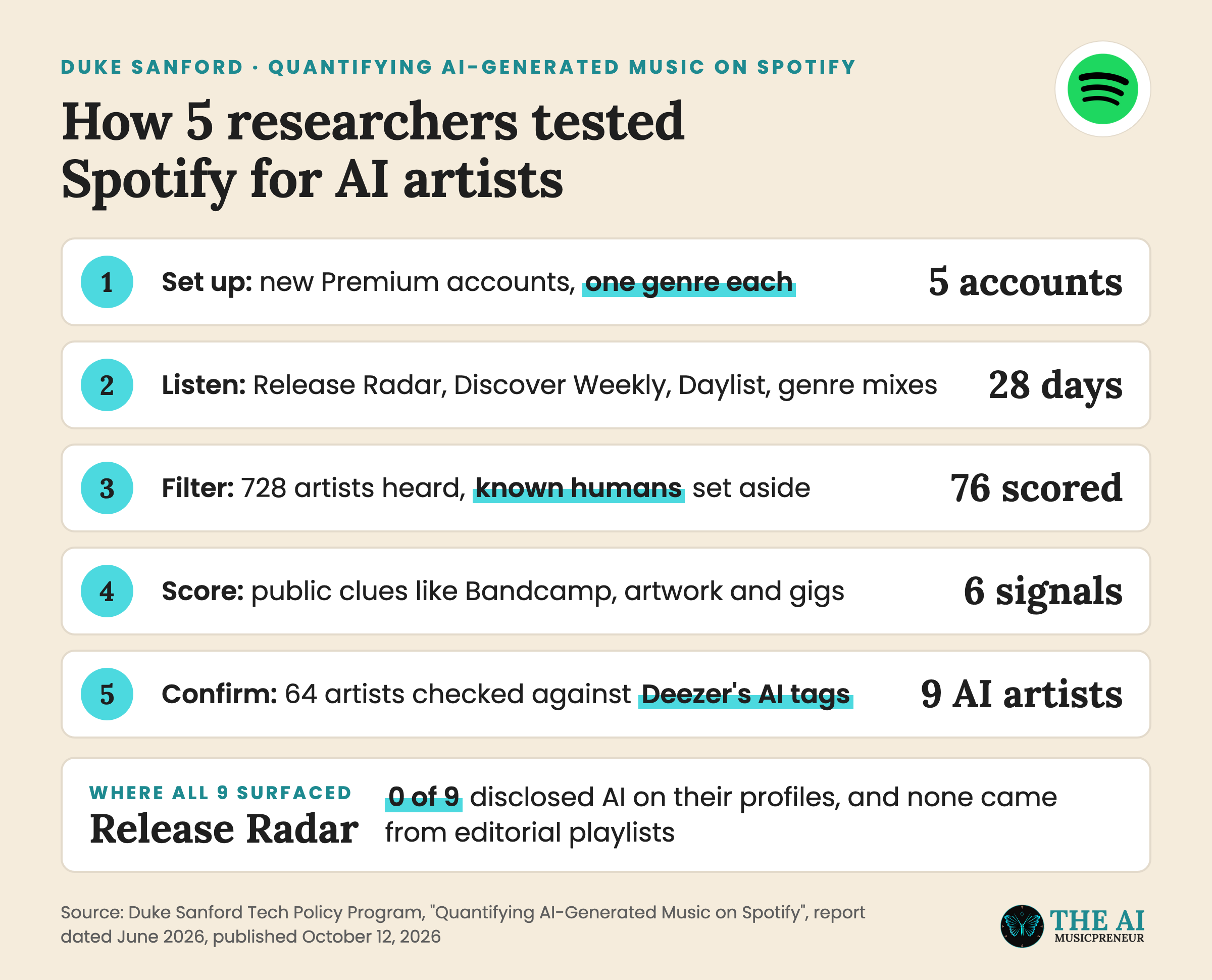
64 of the 76 scored artists could be found on Deezer, and its AI tag confirmed 9: 4 in Pop/Hip-Hop, 2 in Latin and 3 in Rock/Alternative. The Country and Electronic accounts turned up none.
Why the Duke study says Spotify listeners can’t spot AI artists on their own
The team’s checklist matched Deezer about 14% of the time, because a brand-new human act also has no gigs, a thin Instagram and no Bandcamp page. Deezer only catches the generators it was trained on, so a missing tag doesn’t prove a human made the track either.
The clearest pattern was where the 9 came from. All of them arrived through Release Radar and none through playlists picked by human editors. Of the 75 tracks the method flagged across 1,221 songs, 64 (85.3%) came through Release Radar too.
Not only are listeners encountering AI-generated music on the platform, but Spotify is actively recommending it.
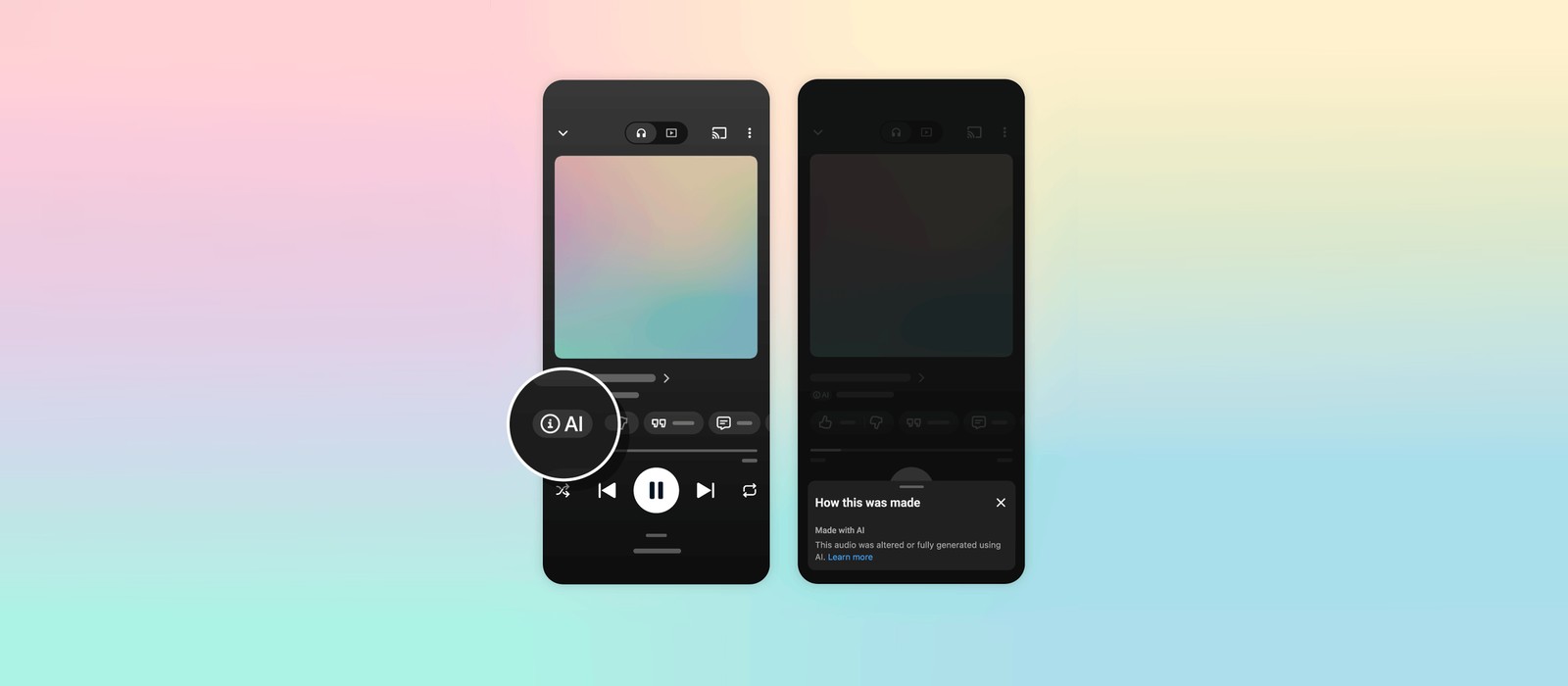
The blog post calls the platforms’ reliance on “voluntary labels from the artist” “ineffective.” One of its 4 recommendations is that distributors collect AI disclosures at upload, the route YouTube Music now uses for its AI labels. On Spotify, volunteer trackers like SoullessMusic and SlopTracker fill the gap for now.
The report flags 2 caveats itself. Release Radar and Discover Weekly were played in full every week while the other playlists got 30-minute sessions, which the authors say “might explain” the Release Radar skew. And the authors thank the Human Artistry Campaign, a coalition of music organizations that campaigns on AI policy, for its “assistance in the making of this report.”
Does the Duke study predate Spotify’s AI Persona badge?
Possibly. The cover says June 2026, but the report never says when the listening took place, a gap Music Ally pointed out on October 16. The report also cites sources from July 2026.
The timing matters, because Spotify made 3 changes this year that touch AI artists and Release Radar:
- Verified by Spotify launched on April 30, 2026, and profiles that primarily represent AI artists weren’t eligible at launch.
- Release Radar got session controls in July for genre, new-to-you artists and “Editors’ picks.” An AI filter wasn’t among the options Spotify named.
- The AI Persona badge was announced on August 11, with badges due from mid-September. Spotify said it “won’t rely on self-disclosure alone” and reviews larger profiles itself.
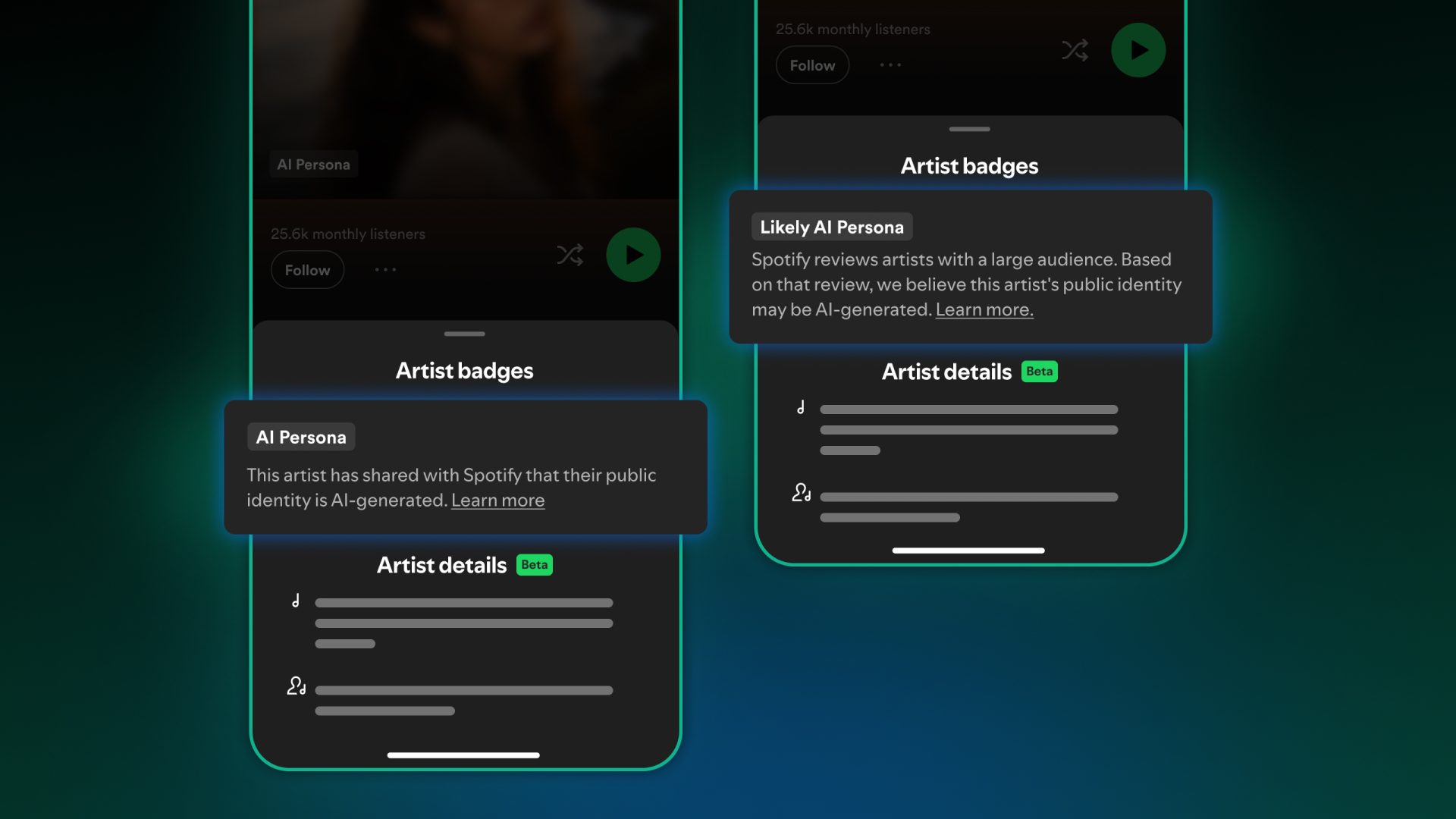
“By default, Spotify will not include AI Personas in any editorial or algorithmic recommendations,” the AI Persona announcement says. Spotify adds that the badge “is about the artist’s public identity, not about how the music was made.” I couldn’t find a public response from Spotify to the Duke report.
How to tell if a song on Spotify is AI-generated
Start with the badge on the artist’s profile. AI Persona means the artist disclosed it, and Likely AI Persona means Spotify’s review team flagged the profile.
No badge? Then you’re doing what the Duke team did by hand:
- Open the song credits and look for an AI credit.
- Search Bandcamp for the artist, because Bandcamp removes music made wholly or substantially by AI.
- Check the release pace. Duke flagged more than 3 singles, or more than 1 album, in a single week.
- Look for live shows on Songkick, Bandsintown or Setlist.fm.
- Scan the playlist with the Deezer AI Music Detector, which estimates the AI share but doesn’t name individual songs in Spotify playlists.
None of these proves anything alone, which is why the report puts the job on the platforms. My guide to spotting AI-generated songs covers the vocal tells and the detectors, and Deezer has announced a toggle that will hide fully AI-generated music before the end of 2026.
If you release music yourself, the same checklist gets run on you. Under Duke’s scoring, a new human act with 4 singles in a week, no Bandcamp page and no listed gigs lands in the same medium band as 8 of the 9 AI acts. A Bandcamp page, listed shows and an AI credit wherever you did use AI give that listener the right answer.
Frequently asked questions
Which genres did the Duke Sanford Spotify study cover?
Each of the 5 accounts was trained on one genre: Pop and Hip-Hop/R&B, Latin, Electronic/Dance, Alternative and Rock, or Country. Deezer confirmed AI artists in 3 of them: 4 in Pop/Hip-Hop, 2 in Latin and 3 in Rock/Alternative. The Country and Electronic accounts turned up no confirmed AI artists.
Does the Duke Sanford report name the AI artists it found on Spotify?
Yes. Table 1 of the report lists all 9 Deezer-confirmed artists with the track that surfaced each one, its genre and its confidence band. Every row lists Release Radar as the playlist. The appendix also lists all 76 scored artists and their Deezer results.
Who wrote the Duke Sanford report on AI-generated music on Spotify?
Kelly Yin led the report and data analysis, with Samantha Dillon, John Paul Goodwin, Erin Gotlieb, Lindsay Gross and Ryan Wu on the research team. Liz Sparacino was the research staff lead and Prof. David Hoffman provided faculty oversight. The authors thank the Human Artistry Campaign for its assistance.
What does the Duke Sanford Tech Policy Program want Spotify to change about AI music labels?
The report asks for 4 changes. Spotify should show AI labels on track pages and inside recommendation playlists, platforms should let listeners filter or reduce AI music in recommendations, distributors should collect AI disclosures at upload in standard metadata, and Spotify should publish regular reports on how much AI music it hosts and recommends.
How many tracks did the Duke researchers flag as possible AI on Spotify?
The researchers heard 1,221 distinct tracks and flagged 75 of them: 48 at medium confidence and 27 at low confidence. 64 of those 75 tracks (85.3%) came through Release Radar. No track reached the high band, because that band required the artist to disclose AI use.
About the author

Covering AI music tools, industry shifts, and news for music creators and professionals. Twice-weekly newsletter at aimusicpreneur.com.