





How do you tell if a song is AI-generated?
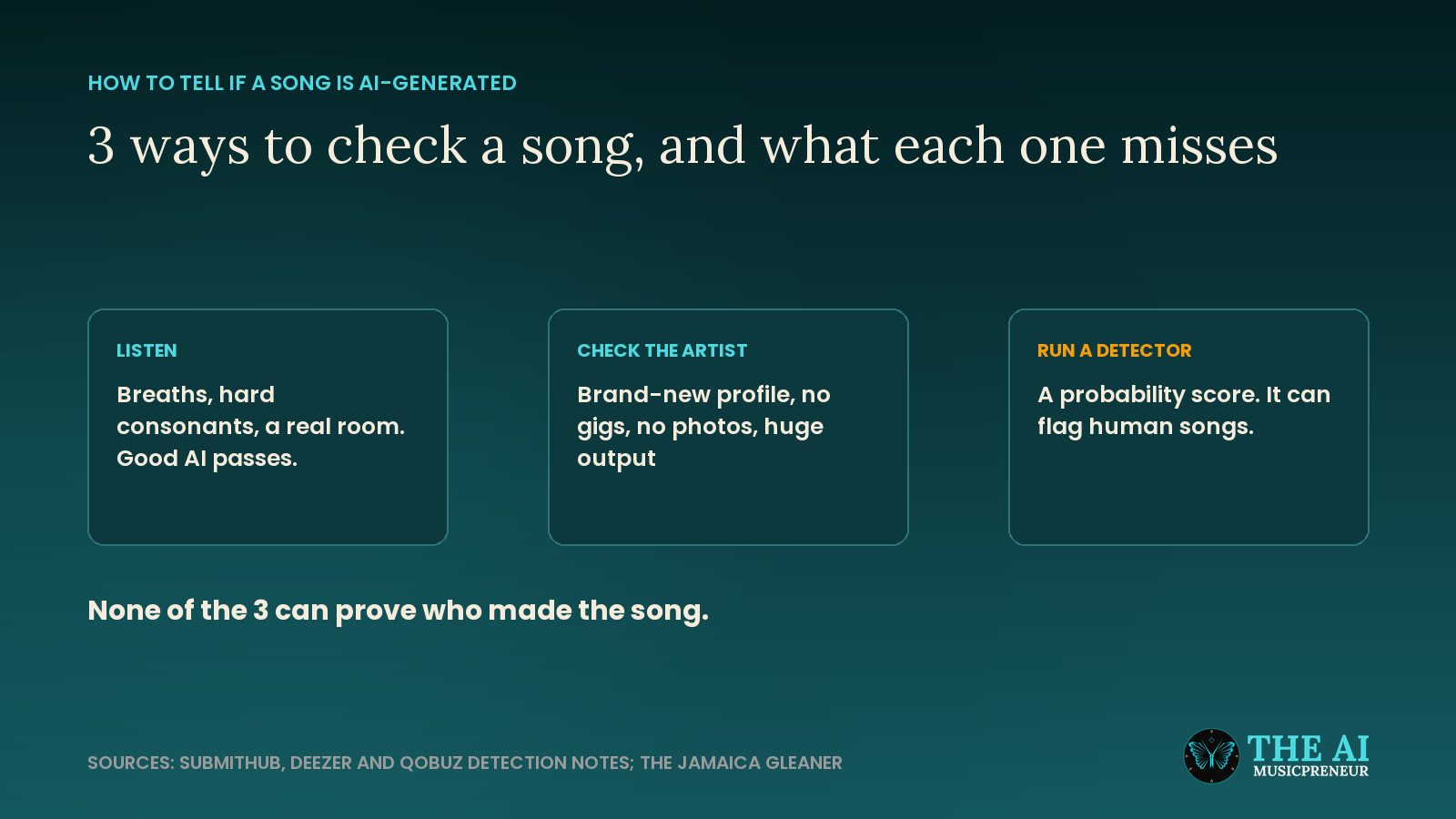
Here’s how to tell if a song is AI-generated: listen for the vocal tells, check the artist’s profile, look for a platform tag, and run the track through an AI music detector. Each one gives you a hint, and none of them proves who made the song.
Dancehall veteran Papa Michigan found that out the hard way. TuneCore blocked a song he recorded in a studio with live musicians, because its review team found “indicators” of generative AI, The Jamaica Gleaner reported on October 5, 2026.
So here’s what each check can tell you, where it breaks, and why the answer that holds up comes from the person who made the song.
How to tell if a song is AI-generated by listening
Start with the vocal, because that’s where most AI songs still give themselves away. Here’s what to listen for:
- Breaths. AI singers often skip breaths entirely or drop them in at suspiciously even gaps.
- Hard consonants. S, T and P sounds can come out soft or smeared while the vowels sound perfect.
- The room. The reverb sounds added on top, and every instrument sits at the same distance from you.
- The drums. Snares and guitar plucks can feel cushioned, without the snap of a real hit.
- The lyrics. Generic images and rhymes that could fit any song in the genre.
The catch is that these tells shrink with every model release. When I compared Suno v6 with v5.5, the v6 drum kit was the first one that sounded like a real kit to me.
So your ears catch the obvious cases. A well-made AI track will pass a casual listen, which is why the next check moves away from the audio.
Is this song AI? Check the artist profile first
Ask who released it. AI projects tend to leave a pattern on their streaming profile:
- A profile that’s only weeks or months old.
- Dozens of releases in a short time, often with near-identical artwork.
- No live dates, no photos of a real person, no social accounts outside the streaming service.
- A biography that says a lot and names nothing.
My rundown of 13 AI artists with millions of streams shows how far profiles like that can get. None of these signs is proof on its own, because plenty of human artists are new, anonymous or prolific.
Does Spotify label AI-generated music?
Not on the song. Spotify allows AI music, and it puts an AI Persona badge on artist profiles, so you only see it when you open the artist.
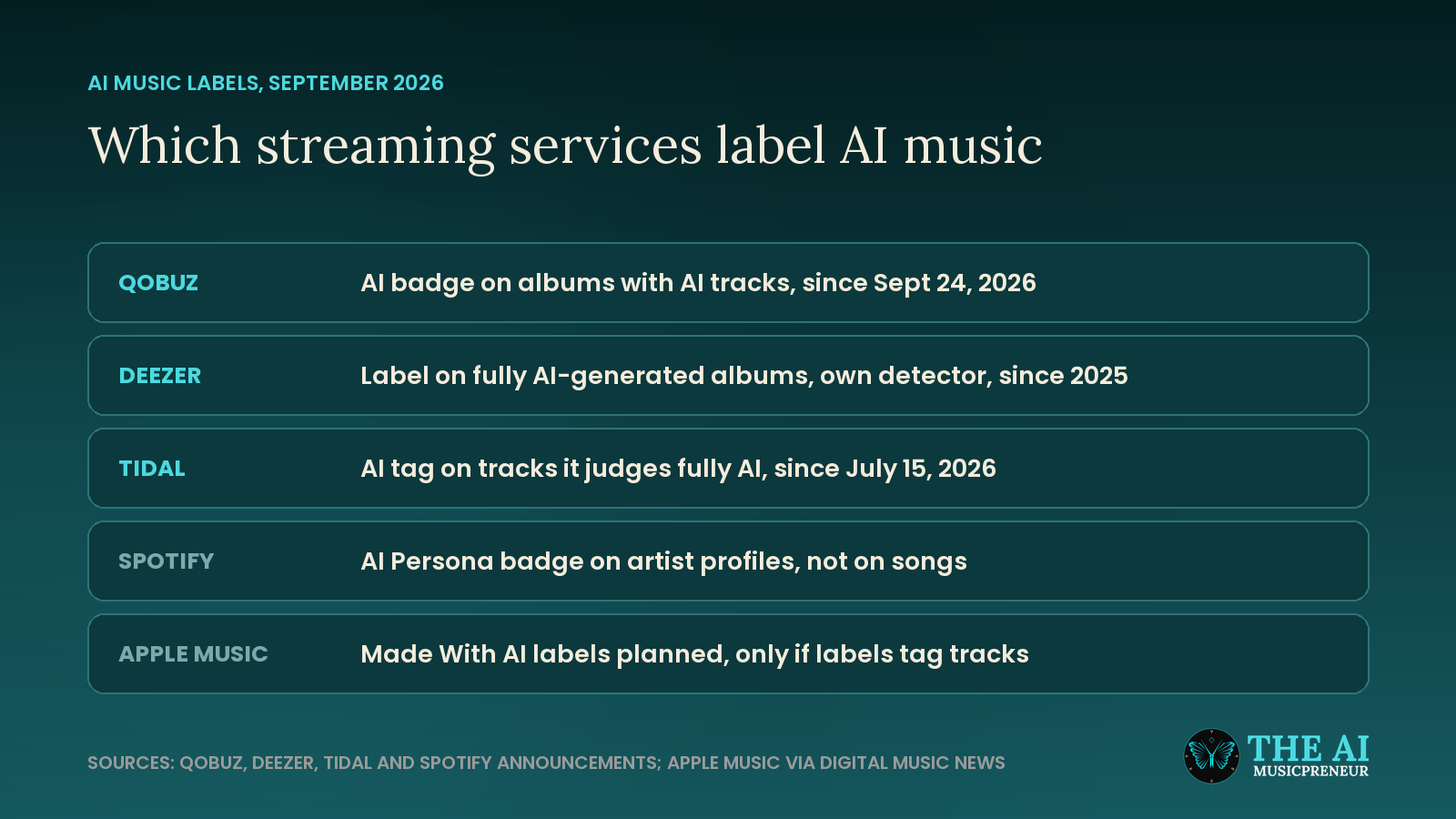
Evon Mullings, general manager of the Jamaica Music Society (JAMMS), explained to the Gleaner how the big services differ:
- Apple Music and YouTube rely on uploaders labelling or tagging their own AI use.
- Deezer runs its own detector and tags fully AI-generated music.
- Spotify relies on voluntary disclosure and metadata supplied by the uploader.
Qobuz joined the detection side when it started showing an AI tag on September 24, 2026, and TIDAL tags tracks it judges fully AI.
A tag is useful when you see one. Most songs don’t carry one, though, which leaves you with the detectors.
Are AI music detectors accurate?
An AI music detector gives you a probability, not a verdict. You paste a link or upload a file, and the tool returns a score for how likely it is that a generator made the track.
You can try a few for free. SubmitHub’s AI Song Checker gives 2 free detections, Deezer’s free AI music detector scans your playlists, and the site has tool pages for IRCAM Amplify’s detector and AHA Music’s.
The score only means something once someone draws a line. SubmitHub blocks any submission scored 85% or higher, and writing your own lyrics doesn’t earn an exemption.
That’s where it goes wrong for human artists.
What happens when an AI detector flags a human-made song?
Papa Michigan’s track “Who Can Be Against Me” was meant for his album So Many Roads. TuneCore told him the release wasn’t eligible for distribution, in an email the Gleaner quoted:
“After reviewing your release, our content review team identified indicators suggesting the use of generative AI tools that rely on datasets that are not properly licensed, which does not align with TuneCore’s requirements.”
He appealed, called the track “a 100-per-cent human studio recording”, and asked for a review by a human moderator. He also posted footage of the studio and the musicians who played on it. In the end he removed the song and released So Many Roads on August 14 without it.
Mullings says this is no longer rare. Distributors such as TuneCore, DistroKid and CD Baby are under pressure from Apple Music, Spotify and Deezer to act as gatekeepers and tag AI music before it reaches the stores.
The scenario of some human-made music being rejected (false positive) by digital distributors is becoming increasingly common.
What should an artist do if their song is wrongly flagged as AI?
If it happens to you, here’s what I’d do, in this order:
- Keep your proof before you need it. Session files, stems, dated bounces and phone footage from the studio. Papa Michigan’s strongest move was showing the musicians who played.
- Ask for a human review. Reply to the rejection, say plainly that the track is human-made, and ask for a person to check it.
- Ask which part was flagged. If you know whether it was the vocal, a sample or the whole mix, your appeal can answer it directly.
- Declare any AI you did use. A tool you used on one stem is easier to explain in the upload form than in an appeal.
That last point is the one I’d build your whole release routine around.
Why disclosing AI use beats waiting for a detector to guess
Every check above is a guess made after the song is out. The only person who knows how a track was made is the person who made it, so the most reliable label starts with them.
That’s the idea behind the SIQA Verified Registry, which launched in September 2026 under the line “Verified, Not Flagged.” Creators register a track and declare how AI was involved, SIQA reviews the entry, and the result is a numbered public certificate. (Disclosure: I sit on SIQA’s Creative Advisory Council.)

The registry uses 3 classifications from the SIQA framework:
- AI-Assisted: a human fills one or more core creative roles, and AI fills others.
- Human + AI Hybrid: the artist uses AI to clone and reproduce their own voice.
- Fully AI-Generated: melody, lyrics, production and arrangement all come from AI, and the human prompts, directs and selects.
SIQA doesn’t use detection tools for this. Its chart and registry run on creator disclosure plus a human audit, because detection is probabilistic and its false positives land on human creators, the problem Papa Michigan ran into.
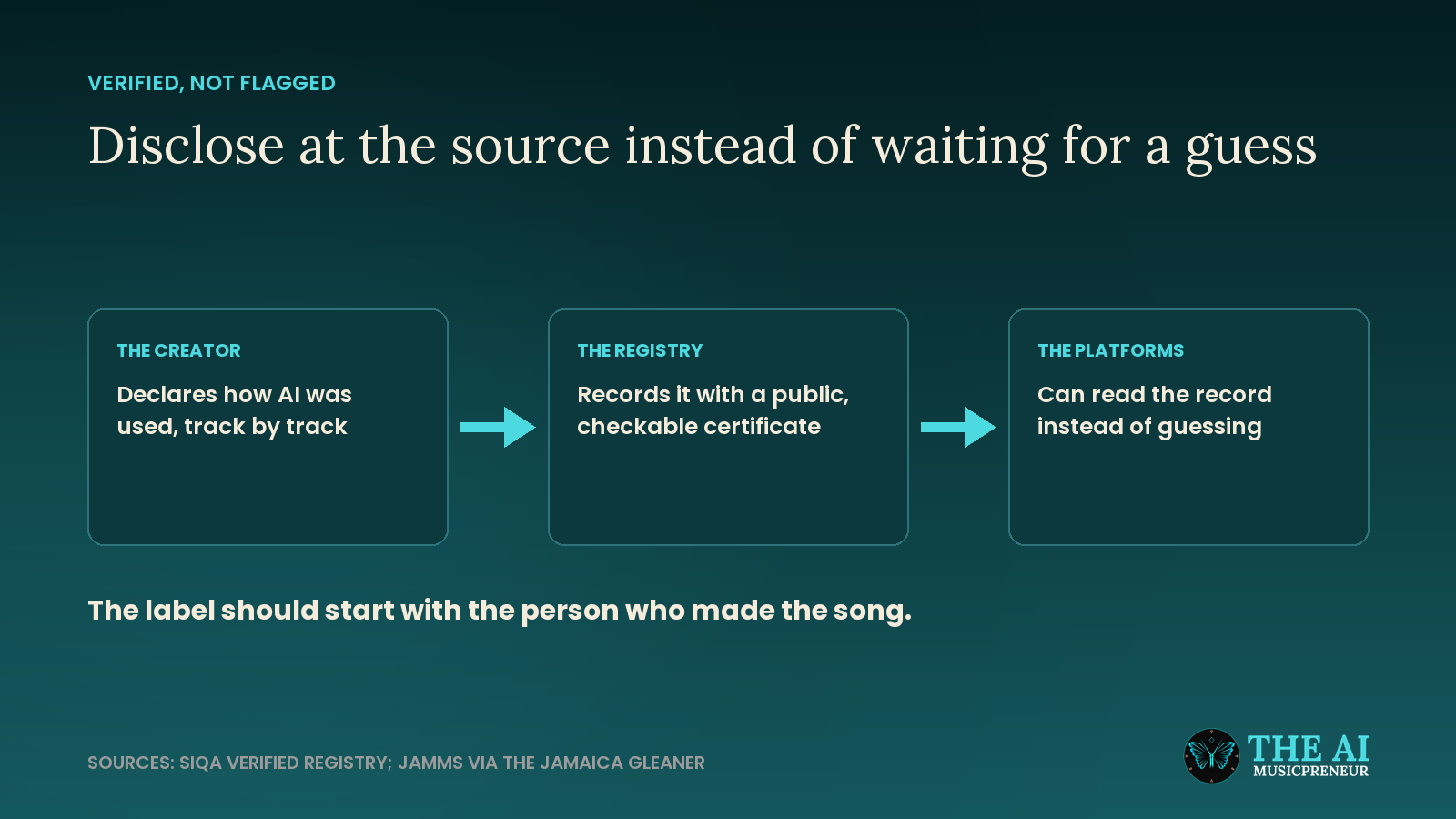
Here’s why that matters for your releases. SIQA offers its records to distributors at intake and to streaming services for their AI labels, and any AI agent can query them. If DSPs and distributors read a creator’s declaration, they can label a song correctly instead of guessing from the waveform.
It’s the same logic as the RIAA and IFPI’s proposed AI labels: the tag next to your song is only as accurate as the disclosure behind it. If you don’t set yours, a detector or a default will set it for you.
So if you used AI on your next release, say how at upload and register it. If you didn’t, keep the session files, because they’re the proof a detector can’t argue with.
More questions about spotting AI-generated songs
Can you tell Suno or Udio vocals from a human singer by ear?
Sometimes. Missing or evenly spaced breaths, soft hard consonants and reverb that sounds added rather than recorded are common tells. The newest models hide most of them, so a good AI vocal can pass a casual listen.
Is SubmitHub’s AI Song Checker free?
Partly. SubmitHub’s AI Song Checker gives 2 free detections without an account, and more if you create a free account with no payment. You paste a Spotify, SoundCloud, YouTube or Disco link, or upload a file.
Does Deezer tag AI-generated tracks?
Yes. Deezer runs its own detector and has labelled fully AI-generated albums since 2025. It also offers a free detector that scans your Spotify or Apple Music library for AI tracks.
How can an artist prove a song TuneCore flagged as AI is human-made?
Show how it was made. Papa Michigan posted footage of the studio and the musicians who played on his track and asked TuneCore for a review by a human moderator. Session files, stems and dated recordings are the strongest proof you can hand over.
What is the SIQA Verified Registry?
The SIQA Verified Registry is a database where creators register a track and declare how AI was used, as Fully AI-Generated, AI-Assisted or Human + AI Hybrid. SIQA reviews each entry and issues a public certificate that labels, distributors, streaming services and listeners can check.