Deezer survey finds 80% want AI music labelled, as SoundCloud cracks down on AI slop and Spotify opens Artist Profile Protection to all artists

My stack My fav 6 tools for AI music after testing 70+
-
 ElevenMusic · Music generation
-
 Moises · Stem separation
-
 Controlla · Voice swap & cloning
-
 Cryo Mix · Mixing + mastering
-
 Neural Frames · Music videos
-
 ONCE · Distribution
Some links are affiliate links — I earn a commission at no cost to you. Every tool here is one I run myself and truly believe in. This stack is proven.
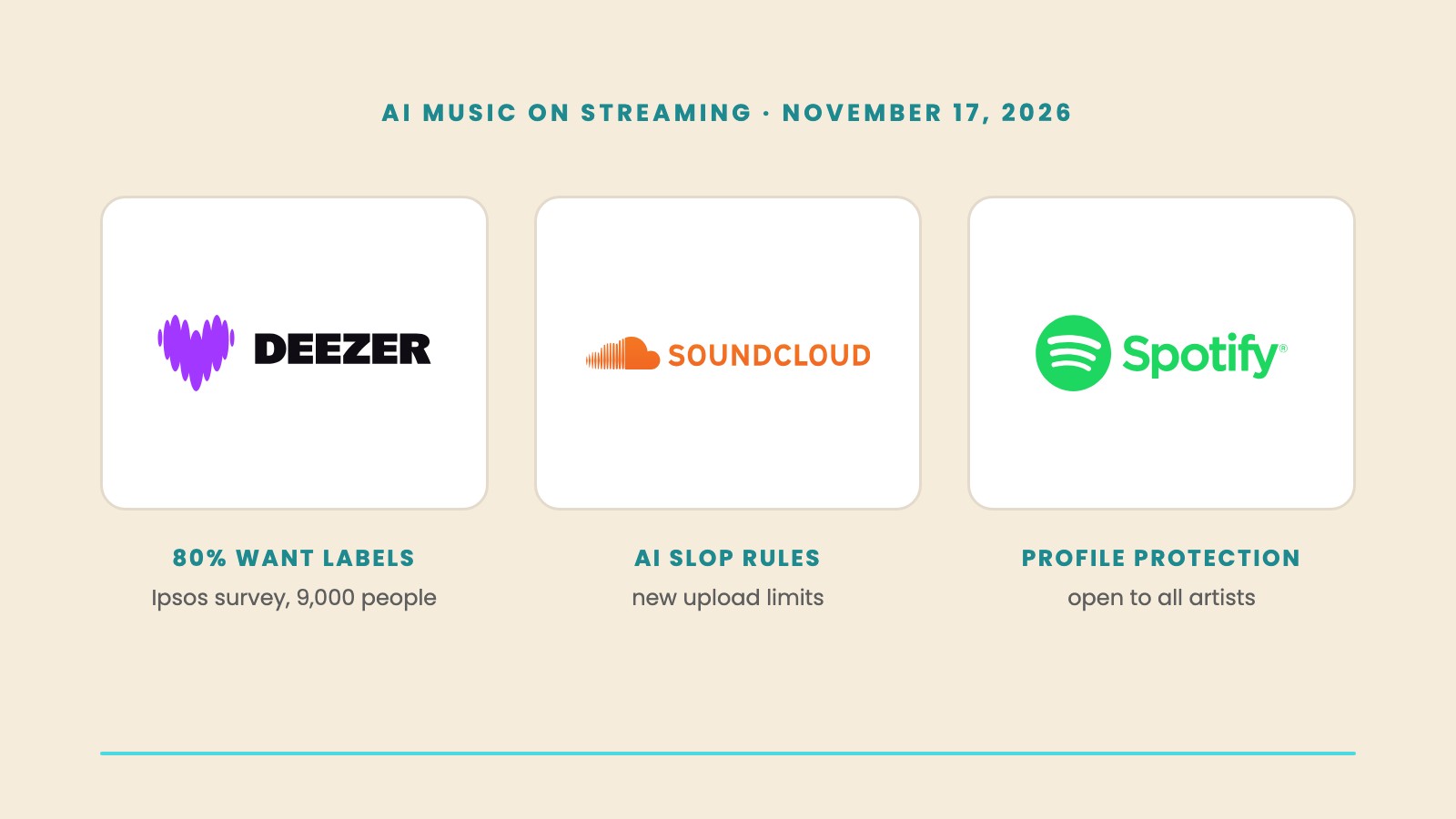
80% of people want AI music labelled, and that includes songs where AI only helped. That’s the headline from Deezer’s second AI music survey with Ipsos, which asked 9,000 people in 8 countries and came out on November 17, 2026.
The same day, SoundCloud rewrote its rules to ban “AI slop” and excessive uploads, and Spotify opened Artist Profile Protection, its tool for keeping fake releases off your profile, to every artist.
So 3 platforms moved on the same Tuesday. Deezer asked listeners what they want, SoundCloud changed what you’re allowed to upload, and Spotify changed who decides what shows up under your name.
What Deezer’s 2026 Ipsos survey found about labelling AI music
Ipsos asked people in the US, Canada, Brazil, the UK, France, the Netherlands, Germany and Japan. It’s the second edition, so most numbers come with a comparison to 2025.
These are the results that matter if you release music:
- 80% want both 100% AI-generated and AI-assisted music clearly labelled.
- 72% of streaming users want to know when a service recommends fully AI-generated music.
- 60% say fully AI-generated songs shouldn’t sit in the main charts next to human-made ones, up 8 points on 2025, and only 7% want them treated equally.
- 67% think fully AI-generated tracks should pay out less than human-made music.
- 69% think fully AI-generated music threatens the livelihood of current and future artists.
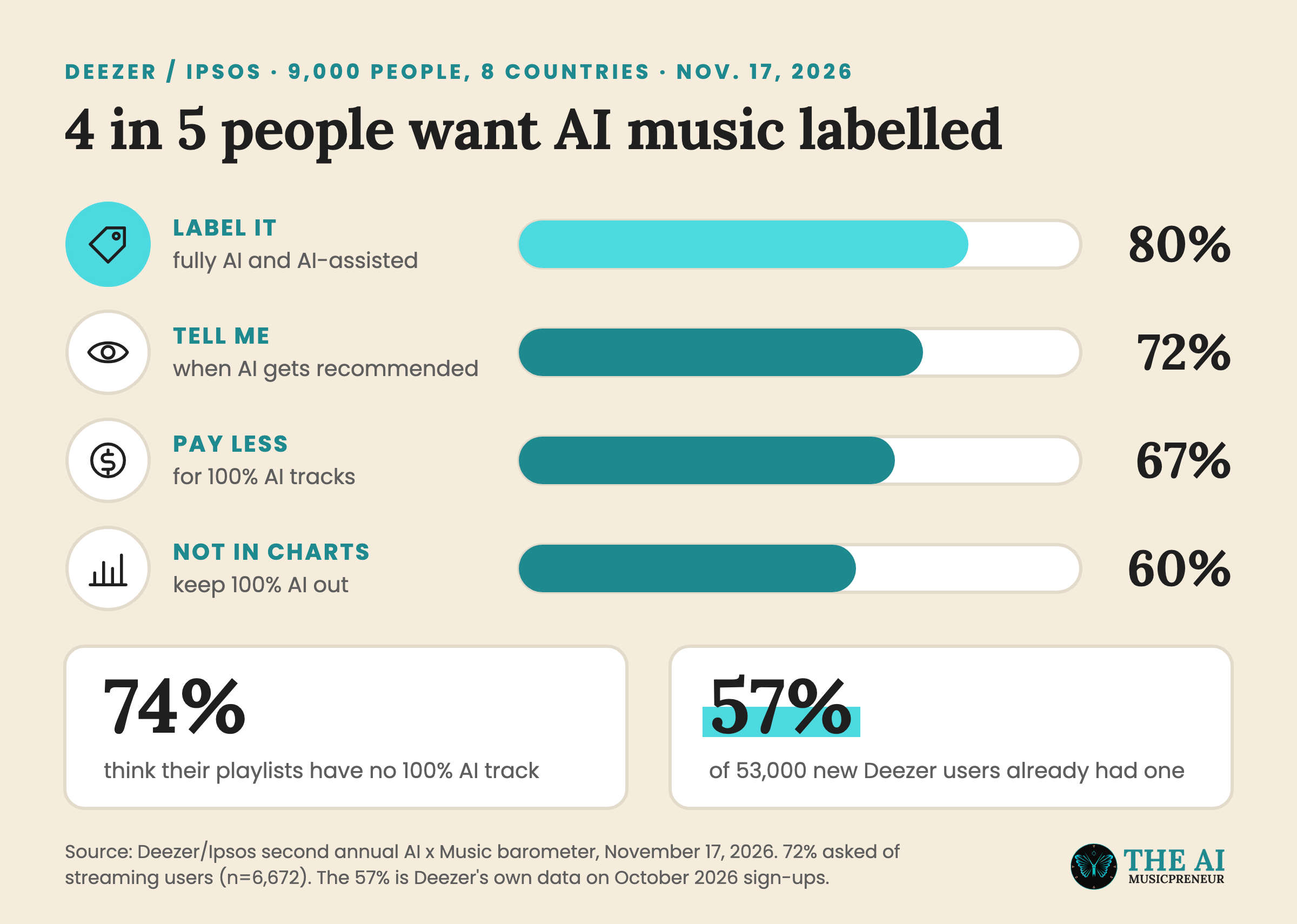
The number that surprised me most isn’t from the survey at all. 74% of streaming users think their playlists contain no fully AI-generated track. But Deezer checked the libraries of the 53,000-plus people who joined it from other services in October, and nearly 57% already had at least one. In June, when Deezer launched its free playlist scanner, that figure was 43%.
US respondents moved the most. 69% now think AI will lead to a loss of creativity in music, up 4 points, and only 37% think AI helps musicians make music, down 17 points in a year. “Concerns about AI having a negative impact on creativity and artistry are clearly growing, especially in the United States,” Deezer CEO Alexis Lanternier said.
Deezer already acts on its own numbers. Tracks its AI music detector flags get tagged and kept out of algorithmic recommendations and editorial playlists, and a toggle to hide them is due before the end of 2026.
SoundCloud went after the same problem from the upload side.
SoundCloud’s November 2026 rules against AI slop, spam and excessive uploads
SoundCloud CEO Eliah Seton announced the changes in a post called “AI Is Changing Music. Its Future Must Be Built Around Artists.” AI music is still allowed. The update goes after 2 things that come with it, volume and deception.
On volume, “AI slop has no place on SoundCloud,” Seton wrote. The updated Community Guidelines now say users who submit “an excessive amount of uploads, as determined by us” can get upload limits and extra review.
On deception, a new “AI Abuse” section bans mass-producing near-duplicate tracks to inflate earnings, using AI to fake plays and followers, and “presenting AI-generated work as human-created.” The new Terms of Use let SoundCloud “withhold, reverse, or recover payouts” when it finds that, as Digital Music News reported.
On labels, Seton is honest that SoundCloud isn’t there yet. He wrote that telling fully AI-generated music apart from AI-assisted work “is complex,” so for now SoundCloud shows the identification info its more than 10 approved AI partners send, like the ElevenMusic integration that publishes songs straight to SoundCloud with a disclosure.
So if you make music with AI and upload it to SoundCloud, you’re fine. Passing a Suno track off as fully human-made, or running an AI persona as if it were a real person, now puts your payouts at risk.
Spotify’s change is about something else: your name.
How to turn on Spotify Artist Profile Protection, and who can use Block releases
Spotify’s launch post now carries a one-line update: “As of November 17th, 2026, Artist Profile Protection is now available for all artists on Spotify.” It had been in beta since March, and during the beta fakes still landed on Bridgit Mendler’s profile in June and on Gemma Hayes’ in October.
When a release lists you as an artist, you get notified, and you can remove yourself if it isn’t yours. A removed release doesn’t show on your profile, count toward your stats or get recommended to your listeners.
Admins and Editors on your Spotify for Artists team can switch it on, according to Spotify’s help page:
- On desktop, open the user menu from your avatar and select Artist Profile Protection.
- On the mobile app, go to the Music page and open the Review tab.
- Keep the default, Review releases, and check Music > Review whenever an alert comes in.
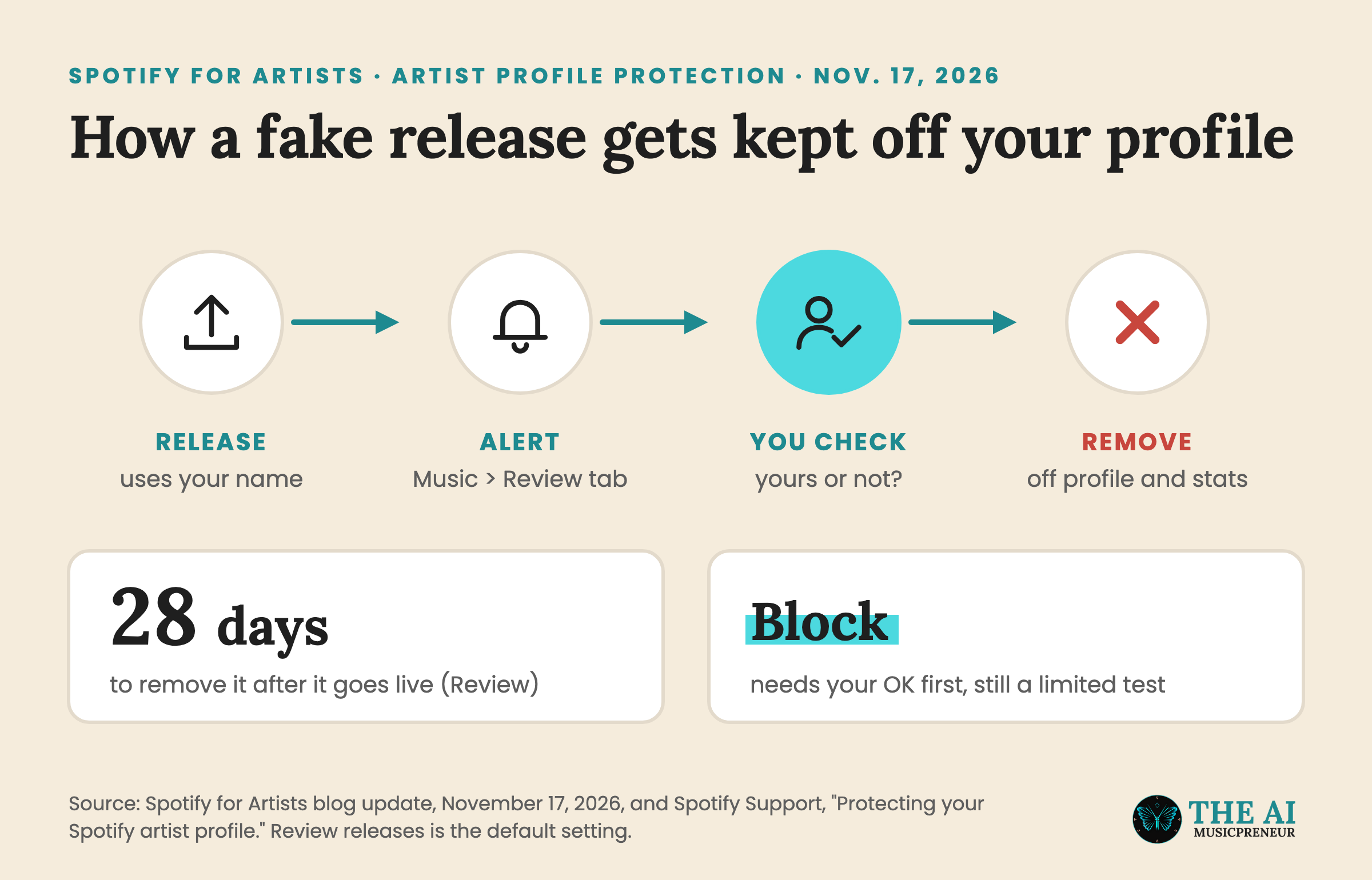
The catch is in that default. With Review releases, a release you don’t act on goes live as scheduled with you listed on it. You have up to 28 days after it goes live to remove yourself. That’s a change from the March beta, which kept releases you hadn’t acted on off your profile, as Music Business Worldwide reported.
The stricter mode, Block releases, makes every release wait for your approval, and you can hand trusted distributors an “artist key” so their deliveries go through pre-approved. That’s the part Digital Music News said “isn’t available to everyone… yet.” Spotify’s help page confirms it is testing Block releases “with a limited group of artists so you may not see this setting available to you at this time.”
Artists should never have to find someone else's music under their name.
Who labels AI music after Deezer’s 80% finding: Deezer tags tracks, Spotify badges personas, SoundCloud passes on partner data
Put the 3 updates next to the survey and here’s where each platform stands on labels:
- Deezer tags the fully AI-generated tracks its detector catches.
- Spotify marks AI artists with an AI Persona badge and keeps them out of recommendations by default. Artist Profile Protection is about who a release lists, not how it was made.
- SoundCloud shows whatever its approved AI partners pass on.
80% of Deezer’s respondents asked for labels on AI-assisted music too, and that’s the part none of these 3 updates touches. The chart question is moving faster: 60% want fully AI tracks out of the main charts, and ARIA has already banned them from the Australian charts.
For your own releases, 2 things are worth doing this week. Turn on Artist Profile Protection in Spotify for Artists, even if you won’t release anything until next year, because a fake can land on a quiet profile just as easily. And if you use AI in your songs, say so wherever a platform asks, because on SoundCloud, passing AI work off as human-made can now cost you your payouts.
Frequently asked questions
How many people and countries were in the 2026 Deezer and Ipsos AI music survey?
Ipsos surveyed 9,000 people in 8 countries: the United States, Canada, Brazil, the UK, France, the Netherlands, Germany and Japan. 6,672 of them were music streaming users. Deezer published the results on November 17, 2026, as the second edition of its yearly AI music barometer.
Did US listeners turn more negative on AI music in Deezer's 2026 survey?
Yes. Deezer says US respondents were significantly more negative on every general attitude question than in 2025. 69% now think AI will lead to a loss of creativity in music, up 4 points, and only 37% think AI helps musicians make music, down 17 points.
Can you still upload AI-generated songs to SoundCloud after its November 2026 rule change?
Yes. SoundCloud's November 17, 2026 update does not ban AI music. It bans AI slop, spam and excessive uploads, and AI Abuse such as near-duplicate tracks made to inflate earnings, fake plays, deepfakes, and presenting AI-generated work as human-created.
What happens if you ignore a release in Spotify Artist Profile Protection?
With the default Review releases setting, the release goes live as scheduled with you listed as an artist. You can still remove yourself from it for up to 28 days after it goes live, according to Spotify's help page.
What is a Spotify artist key?
An artist key is a unique code you can give a trusted distributor when you use Spotify's Block releases setting. Releases delivered with it count as pre-approved, so they go live without manual approval. Spotify says to keep it private and ask for a refresh if someone else gets it.
About the author
Covering AI music tools, industry shifts, and news for music creators and professionals. Twice-weekly newsletter at aimusicpreneur.com.