Suno CEO Mikey Shulman says "AI music is not a crime," and that fixing streaming fraud takes 4 parties in one room

My stack My fav 6 tools for AI music after testing 70+
-
 ElevenMusic · Music generation
-
 Moises · Stem separation
-
 Controlla · Voice swap & cloning
-
 Cryo Mix · Mixing + mastering
-
 Neural Frames · Music videos
-
 ONCE · Distribution
Some links are affiliate links — I earn a commission at no cost to you. Every tool here is one I run myself and truly believe in. This stack is proven.
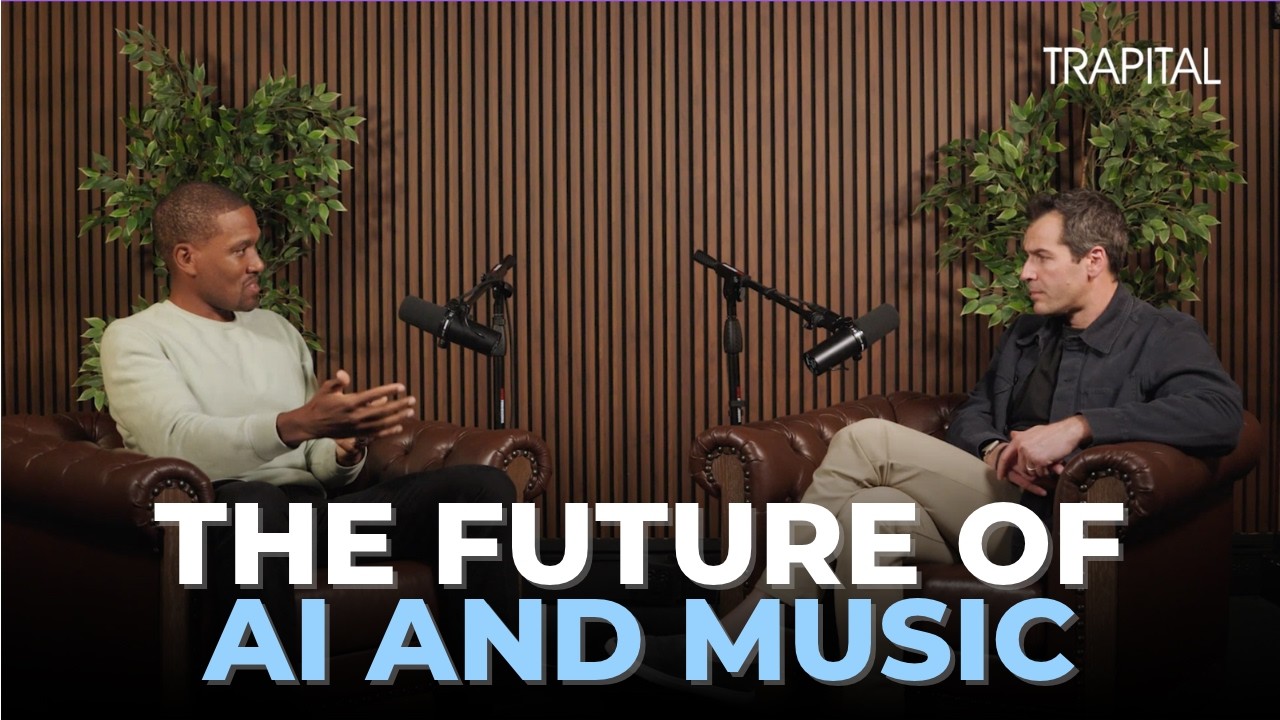
“AI music is not a crime.” That’s Suno CEO Mikey Shulman on the Trapital podcast with Dan Runcie, in an episode published November 12, 2026. Runcie had asked him whether Suno’s safeguards are working against people who use AI tracks to drain money from the streaming royalty pool.
Shulman’s answer has 2 parts. Streaming fraud is a crime he says he’s “vehemently opposed” to, and lumping it in with AI music is a “sleight of hand”. The fix, he says, needs 4 parties in one room: AI companies, rights holders, distributors and streaming services. Music Ally picked up the quote on November 13.
Mikey Shulman on Trapital: streaming fraud is a crime, AI music is not
Here is the full answer, from 31:14 in the episode:
“There is a sleight of hand I think that sometimes happens of equating streaming fraud with AI music. I am vehemently opposed to streaming fraud. That is a crime. The fact that AI music is sometimes involved, AI music is not a crime. We delight millions of people every day, and… these things are not the same.”
He says Suno does more about fraud than people see. The public part is the download caps (7 on Free, 20 on Pro and 60 on Premier since September 3) and watermarking. The rest happens “behind the scenes”, and he didn’t say what that is.
Fraud has been in the news all autumn. Michael Smith got 18 months in prison on October 6 for an $8 million scheme built on AI songs and bot streams. Spotify says it has pulled more than 50 million slop and spam tracks out of its recommendations this year, on top of 75 million it deleted.
Why Mikey Shulman says streaming fraud needs 4 parties in one room
Shulman calls fraud a human problem. “There’s AI companies like ours, there’s rights holders, there’s distributors, there’s DSPs, and you kind of need all of them working together to solve this problem,” he said.
In plain terms, each one only sees part of the scam. Suno sees who makes and downloads the songs. The distributor sees who uploads them. The streaming service sees the plays and pays out, and the rights holders are the ones whose share of the pool shrinks.
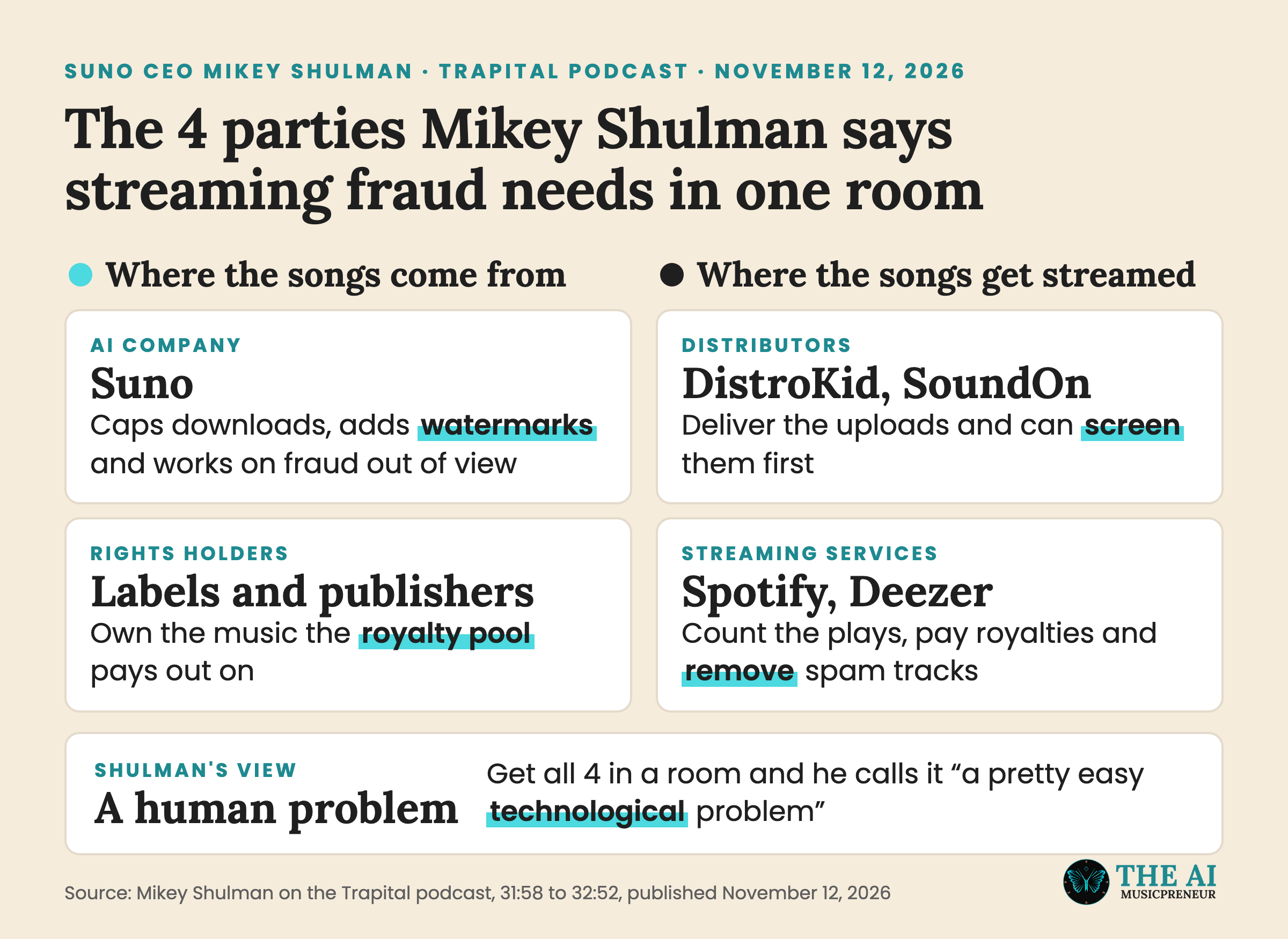
“If you have those four parties in a room together, it’s actually a pretty easy technological problem,” Shulman said. He blames the speed of AI for the gap: people “just don’t have the muscle memory in cooperating across those four parties together.”
He’s optimistic because all 4 have a reason to fix it. Some distributors already screen at the door, like TikTok’s SoundOn with ACRCloud.
Mikey Shulman on Suno’s download caps: scammers move to platforms without them
Runcie pushed further. If Suno’s data can tell a parent making a song about their kid brushing their teeth from someone mass-downloading tracks, could it restrict that second user harder?
Shulman didn’t promise that. “It is very hard to… identify behavior as our platform changes,” he said. “As you restrict downloads, you’re going to push those scammers to other platforms that don’t have them,” he went on, adding that it’s “too early to tell exactly what the right long-term solution is” and that “it will be a bit of a cat and mouse game.”
So Suno’s own CEO expects the download caps, which only started on September 3, to need changing as the scammers move.
Mikey Shulman calls AI detection stats “overblown”
Shulman doesn’t want any single party drawing the line on what counts as AI music. He called Spotify’s “AI slop and spammy tracks” wording “deliberately, I think, opaque”, and said that’s “exactly the right thing to do because where this line is is going to change.”
On detection labels, he went further. “A lot of the stats that… get put out are overblown and don’t match exactly what we see and what we hear,” he said, and many are “done to promote a certain narrative.” Even a perfect detector, “which it isn’t”, would treat a track worked on for 4 weeks in Suno Studio the same as a quick prompt:
That will look the same to that program as I typed six words into the prompt box and out popped a mediocre song.
He didn’t say which stats he meant. The platforms’ own numbers point in different directions: Deezer says AI tracks are over 50% of its daily uploads, while Qobuz says 0.38% of its streams come from AI music.
If you release Suno songs, the platform’s rules still decide how your track gets treated, whatever Shulman thinks of the labels. My Spotify AI music rules guide covers what Spotify allows and how to upload without getting flagged as spam.
Frequently asked questions
Who hosts Trapital, the podcast where Mikey Shulman said AI music is not a crime?
Dan Runcie hosts Trapital. The episode with Mikey Shulman, titled "Suno's Grand Plan for the Future of Music", went up on YouTube on November 12, 2026 and runs about 42 minutes. The streaming fraud part starts at around 30:44.
Did Mikey Shulman say what Suno does about streaming fraud behind the scenes?
No. Shulman named the public measures, download restrictions and watermarks, and said other work happens behind the scenes. He did not describe that work on the Trapital podcast.
What did Mikey Shulman say about Songkick and live music on Trapital?
Asked about Suno's live plans after its Songkick purchase, Shulman described a hypothetical concert where a fan's Suno mashup of the opening act and the headliner gets played at the encore. He said live shows still run into hardware limits and delay, so in his example the mashup was made a month in advance.
What was the last song Mikey Shulman made on Suno, according to the Trapital interview?
Shulman said he made a dance mashup of 2 tracks while trialing a remix product. He would not say which artist it was.
About the author
Covering AI music tools, industry shifts, and news for music creators and professionals. Twice-weekly newsletter at aimusicpreneur.com.