Qobuz now tags AI-generated music, and says only 0.38% of its streams come from AI tracks
My stack My fav 6 tools for AI music after testing 70+
-
 ElevenMusic · Music generation
 -
 Moises · Stem separation
 -
 Controlla · Voice swap & cloning
 -
 Cryo Mix · Mixing + mastering
 -
 Neural Frames · Music videos
 -
 ONCE · Distribution
Some links are affiliate links — I earn a commission at no cost to you. Every tool here is one I run myself and truly believe in. This stack is proven.
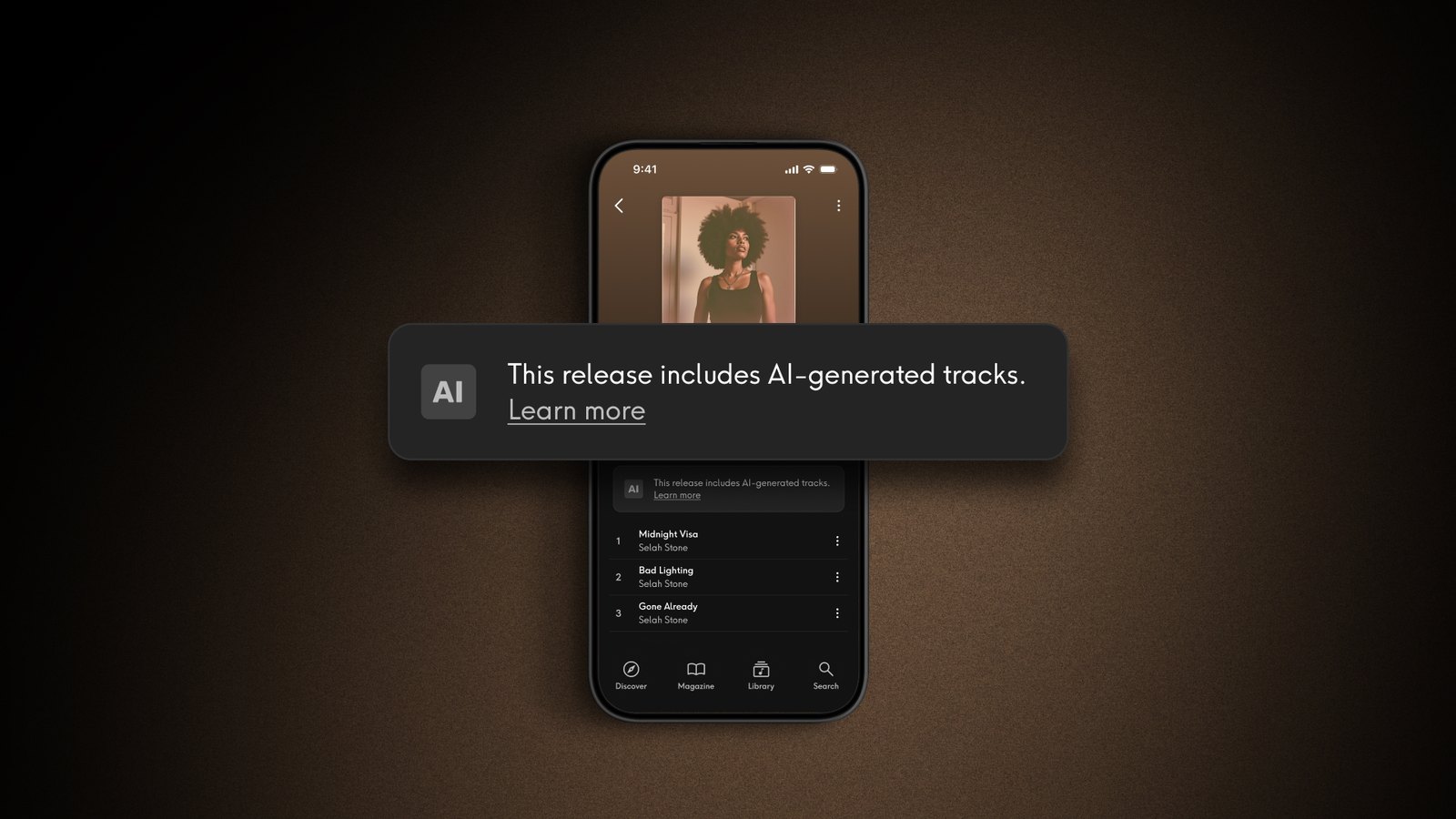
Qobuz now shows a tag on albums its own detector has identified as AI-generated. It launched the tag on September 24, 2026, together with its first AI numbers: only 0.38% of streams on Qobuz come from AI-identified tracks.
That’s 1 stream in every 263, as TechRadar worked it out. And 60% of the streams those AI tracks do get are flagged as fraud and cut out of royalty payouts, according to Qobuz’s announcement.
The Paris-based hi-res streamer built the detection in-house. It sits under Qobuz’s AI Charter, first published in February 2026 and now on version 2.
Back in May I covered Qobuz passing 1.2 million users on an anti-AI pledge. This is the first time that pledge shows up on screen for listeners, with numbers attached.
What the Qobuz AI tag looks like and where it shows
In Qobuz’s launch image, the tag sits on the album page, right above the track list. It’s a small grey “AI” square next to one line of text: “This release includes AI-generated tracks. Learn more.”
So the tag works at release level. The updated charter says it in its own words: “A visible badge informs our users when an album includes content identified as AI-generated.” Neither the announcement nor the charter mentions a separate marker on each track.
Qobuz says the tag is live within its app. When it first announced the detector on February 26, 2026, it said the tags would show across all Qobuz applications “in the coming months.”
Georges Fornay, Deputy CEO of Qobuz, said the tag is the next step after detection: “Today, the challenge is no longer just detecting AI-generated music but enabling listeners to identify it clearly.”
Everyone should be able to know what they are listening to and make informed choices.
The tag came with 3 numbers on how much AI music Qobuz listeners actually hear.
Qobuz’s first AI numbers: 0.38% of streams, and 60% of AI streams flagged as fraud
Qobuz published these figures with the launch, as reported by Digital Music News:
- 0.38% of all streams on Qobuz come from tracks identified as AI-generated.
- 60% of streams on AI-identified tracks are deemed fraudulent by Qobuz’s anti-fraud systems, so they’re excluded from rights-holders’ royalty payouts.
- More than a third of AI-identified albums with no listening activity, covering 4 million tracks, have been removed from the Qobuz search engine.
Qobuz puts the low stream share down to human curation. Its editors pick the playlists and featured releases, so AI-generated content stays outside the places listeners find new music.
For comparison, Deezer said in July 2026 that fully AI-generated music makes up between 1 and 3% of its total streams, and that up to 85% of streams on those tracks were fraudulent in 2025. Qobuz hasn’t published how its detector works, so the two sets of numbers come from different systems.
The fraud figure lands in a week when AI streaming fraud is in court too. On September 22, lawyers for Michael Smith, who pleaded guilty to an $8M AI streaming scheme, asked a judge for probation and argued no artist suffered “any perceptible harm.”
What happens to an album Qobuz identifies as AI-generated
The tag is only the part listeners see. Qobuz’s announcement and charter describe 4 more things that happen once an album is identified as AI-generated.
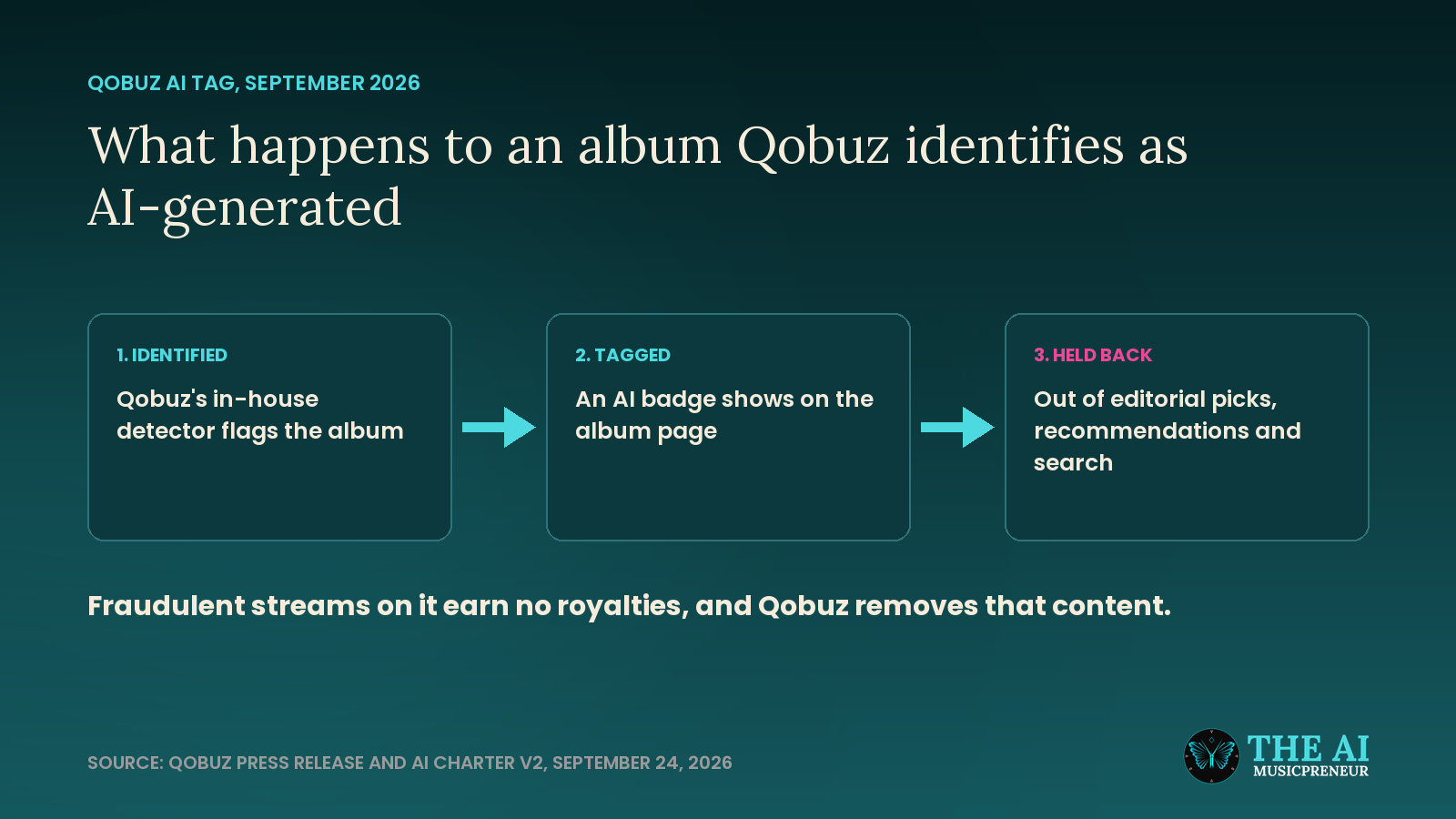
- Editorial: it doesn’t get featured in Our Selections, New Releases, Qobuzissimes, Albums of the Week or Qobuz playlists.
- Recommendations: it’s excluded from Qobuz’s algorithmic recommendations.
- Search: it’s removed from search results, but it stays findable if you type its exact title.
- Royalties: streams Qobuz identifies as fraudulent are excluded from reporting and royalty payments, and the content tied to that fraud is removed from the catalog.
The search rule is where the 4 million tracks come in. Qobuz says it took them out of its search engine, and its charter says de-indexed albums stay findable by exact title (TechRadar’s write-up says they left the library, but Qobuz’s own release doesn’t say that).
The bigger open question is what Qobuz counts as AI-generated in the first place.
Does the Qobuz AI tag separate fully AI-generated tracks from AI-assisted ones?
Not on screen. There’s one tag with one line of text, and it doesn’t say how much of a release was made with AI.
The September announcement doesn’t say where the detector draws the line either. The clearest statement is from February, when Qobuz said it had started analyzing its catalog to identify and tag content “that is 100% AI-generated.”
The charter points the same way. Qobuz says it supports AI as a creative tool for human artists, naming “mixing, mastering, composition aid,” and opposes “industrial production of AI-generated content, without human creative intervention.” It also lists contract clauses that prohibit delivering 100% AI-generated content to Qobuz.
And it admits the limit: “No reliable solution exists today to identify all AI content with certainty, especially when partial human intervention occurred.” So if you make the music in Suno and write the lyrics yourself, Qobuz hasn’t said which side of the line that lands on.
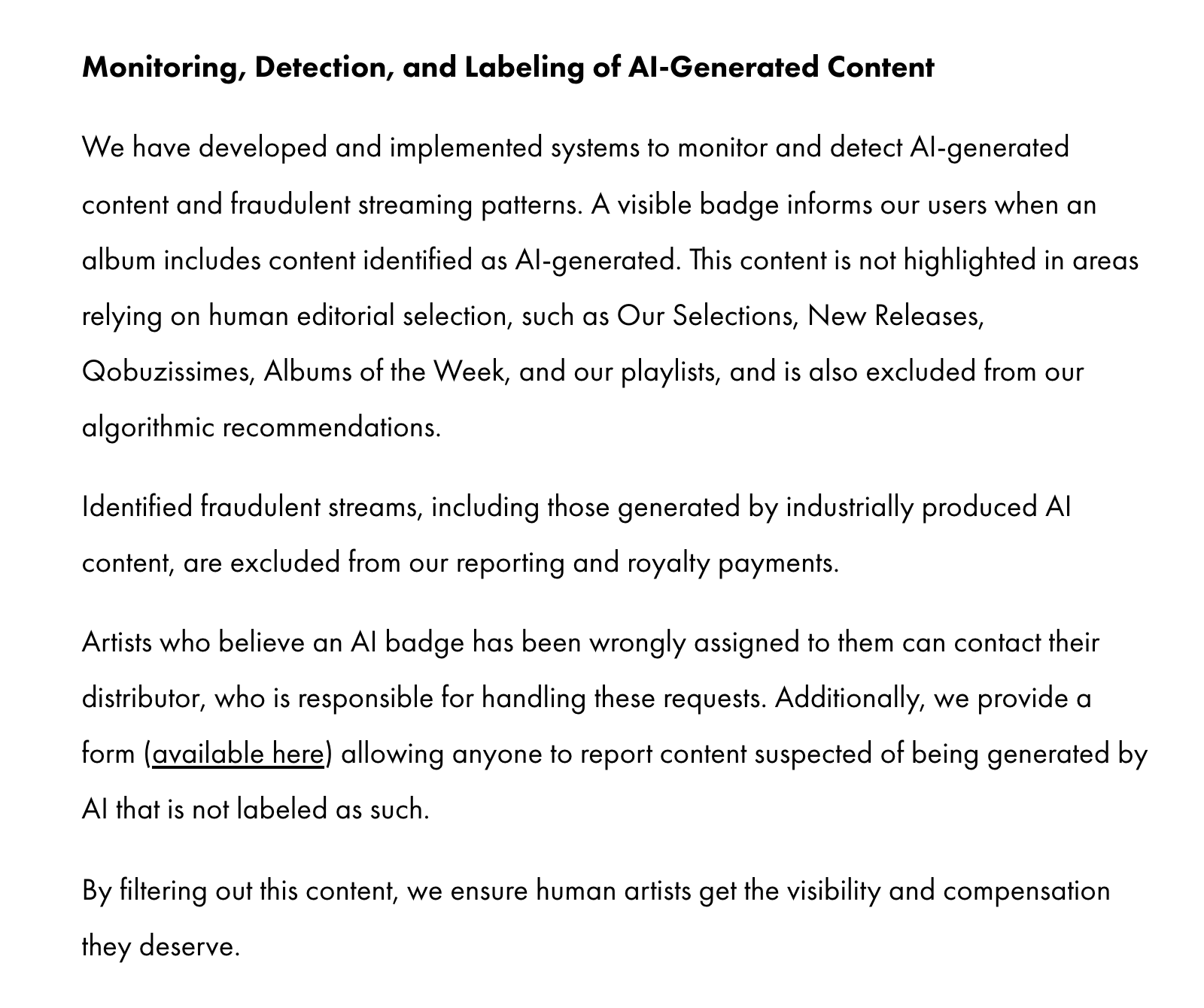
The charter does cover what happens when a tag is wrong, missing or declared upfront:
- Wrong tag: artists who think an AI badge was wrongly assigned should contact their distributor, who handles the request.
- Missing tag: anyone can flag unlabeled AI content through Qobuz’s AI tagging report form.
- Declared AI: Qobuz is building in the DDEX field for AI-generated content, so tracks that labels and distributors declare as AI get identified automatically. It says that rollout is underway.
Which streaming services label AI music in 2026?
5 of the big streaming services now handle AI labels in 5 different ways. Qobuz and Deezer detect AI music themselves and tag albums, TIDAL tags tracks it judges fully AI, Spotify labels artists instead of songs, and Apple Music waits for labels to tag their own releases.
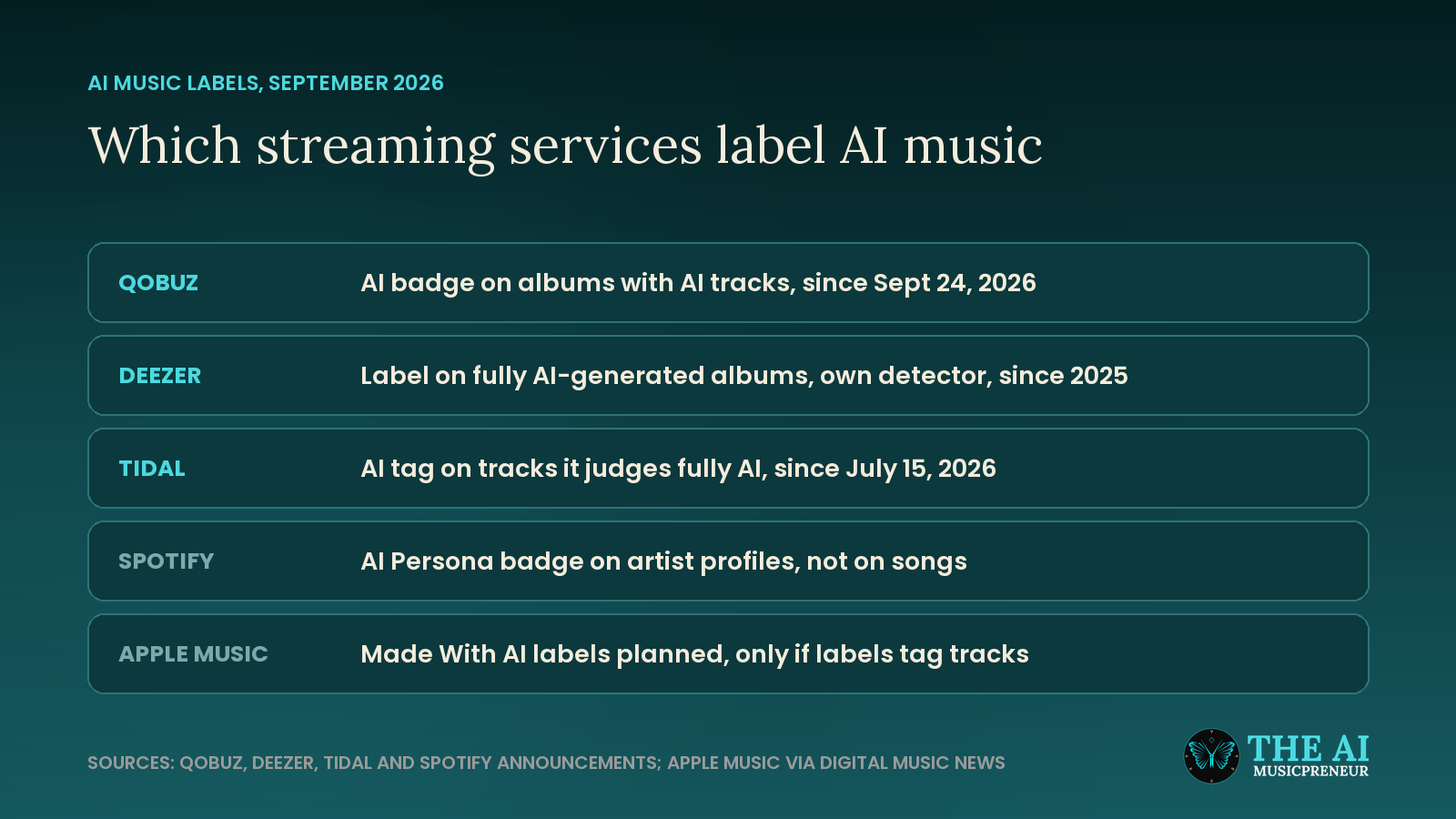
- Qobuz: an in-house detector and an AI badge on albums with AI-generated tracks, live since September 24, 2026.
- Deezer: its own AI music detector has labeled fully AI-generated albums since 2025. In July 2026, Deezer said it will also delete fraud tracks and unstreamed AI uploads.
- TIDAL: since July 15, 2026, tracks TIDAL judges fully AI-generated carry an “AI” tag and earn no royalties.
- Spotify: the AI Persona badge, announced August 11, 2026, marks artist profiles whose identity may be AI-generated and keeps their music out of recommendations by default. The songs themselves don’t get a label.
- Apple Music: Apple told partners on August 20, 2026 that it will show Made With AI labels later this year, based only on tags labels and distributors add themselves.
Upload rules differ just as much as the labels do. My breakdown of AI music rules per streaming platform covers what each service allows.
For Qobuz, the rules can still move. It calls the AI Charter “a living document” and says it will keep changing alongside technological and regulatory developments.
Frequently asked questions
When did Qobuz start showing its AI-generated music tag in the app?
Qobuz rolled out the tag on September 24, 2026. It first said on February 26, 2026 that its in-house detector had started tagging AI content, and that the tags would reach all Qobuz apps in the following months.
How can an artist dispute a wrong AI badge on Qobuz?
Qobuz's AI Charter says artists who believe an AI badge was wrongly assigned should contact their distributor, who is responsible for handling the request. Qobuz also runs a public form where anyone can report AI-generated content that hasn't been labeled.
Can listeners still find AI-generated albums in Qobuz search?
Only by exact title. Qobuz's AI Charter says albums identified as AI-generated are removed from search results but stay findable if their title is searched directly. Qobuz says more than a third of AI-identified albums with no listening activity, covering 4 million tracks, are already out of its search engine.
Does Qobuz use the DDEX AI disclosure field to identify AI-generated music?
It's being added. Qobuz's AI Charter says it is integrating the DDEX field for AI-generated content, so tracks that rights holders declare as AI get identified automatically. Qobuz says the rollout across labels, distributors and aggregators is underway.
Does Qobuz stop paying royalties on AI-generated tracks like TIDAL does?
Qobuz hasn't said it does. It says streams it identifies as fraudulent are excluded from royalty payouts, and that 60% of streams on AI-identified tracks currently fall into that group. TIDAL stopped paying royalties on tracks it judges fully AI-generated from July 15, 2026.
About the author

Covering AI music tools, industry shifts, and news for music creators and professionals. Twice-weekly newsletter at aimusicpreneur.com.