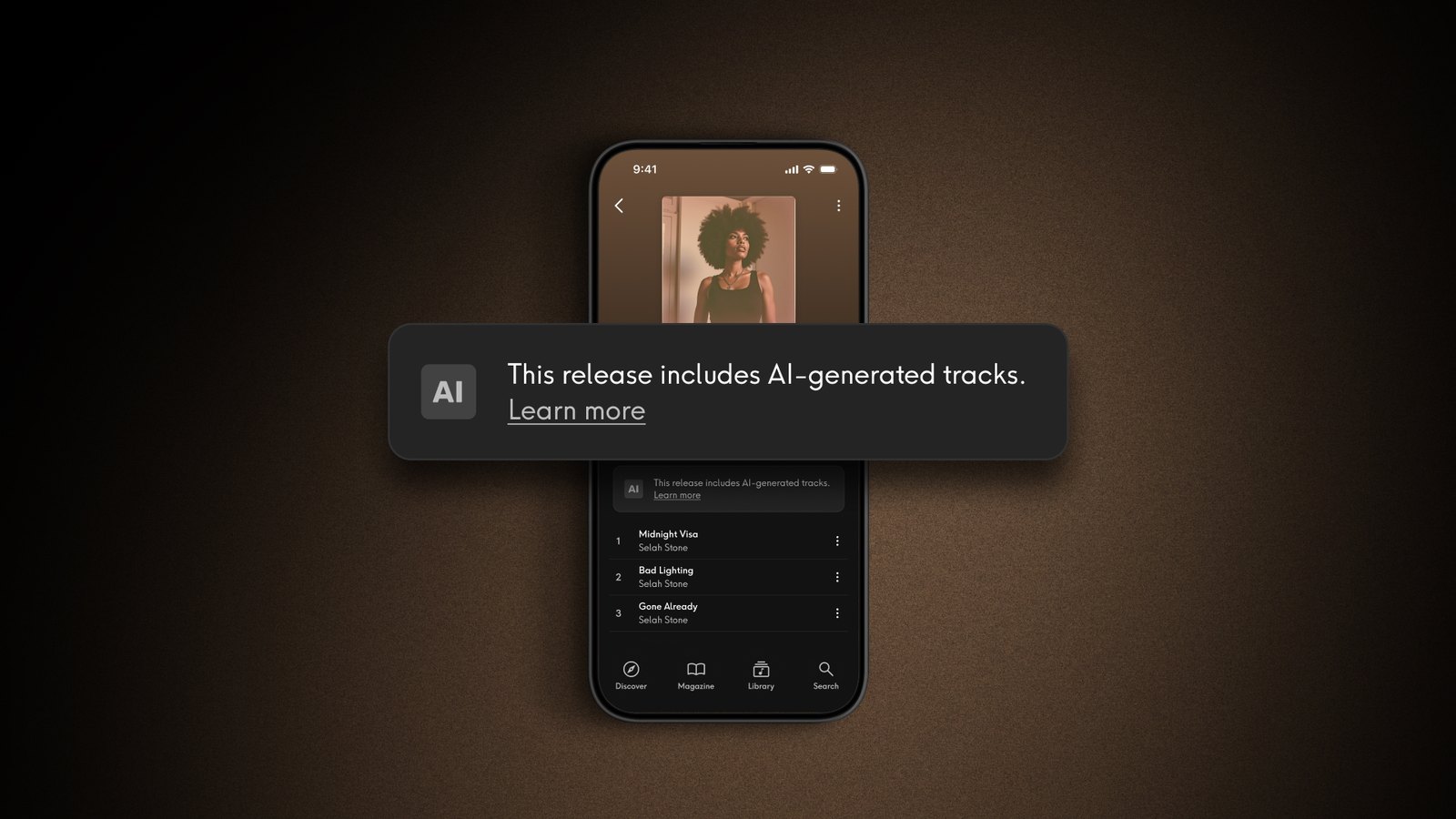
TIDAL cuts off royalties for fully AI-generated music
My stack My fav 6 tools for AI music after testing 70+
-
 ElevenMusic · Music generation
 -
 Moises · Stem separation
 -
 Controlla · Voice swap & cloning
 -
 Cryo Mix · Mixing + mastering
 -
 Neural Frames · Music videos
 -
 ONCE · Distribution
Some links are affiliate links — I earn a commission at no cost to you. Every tool here is one I run myself and truly believe in. This stack is proven.
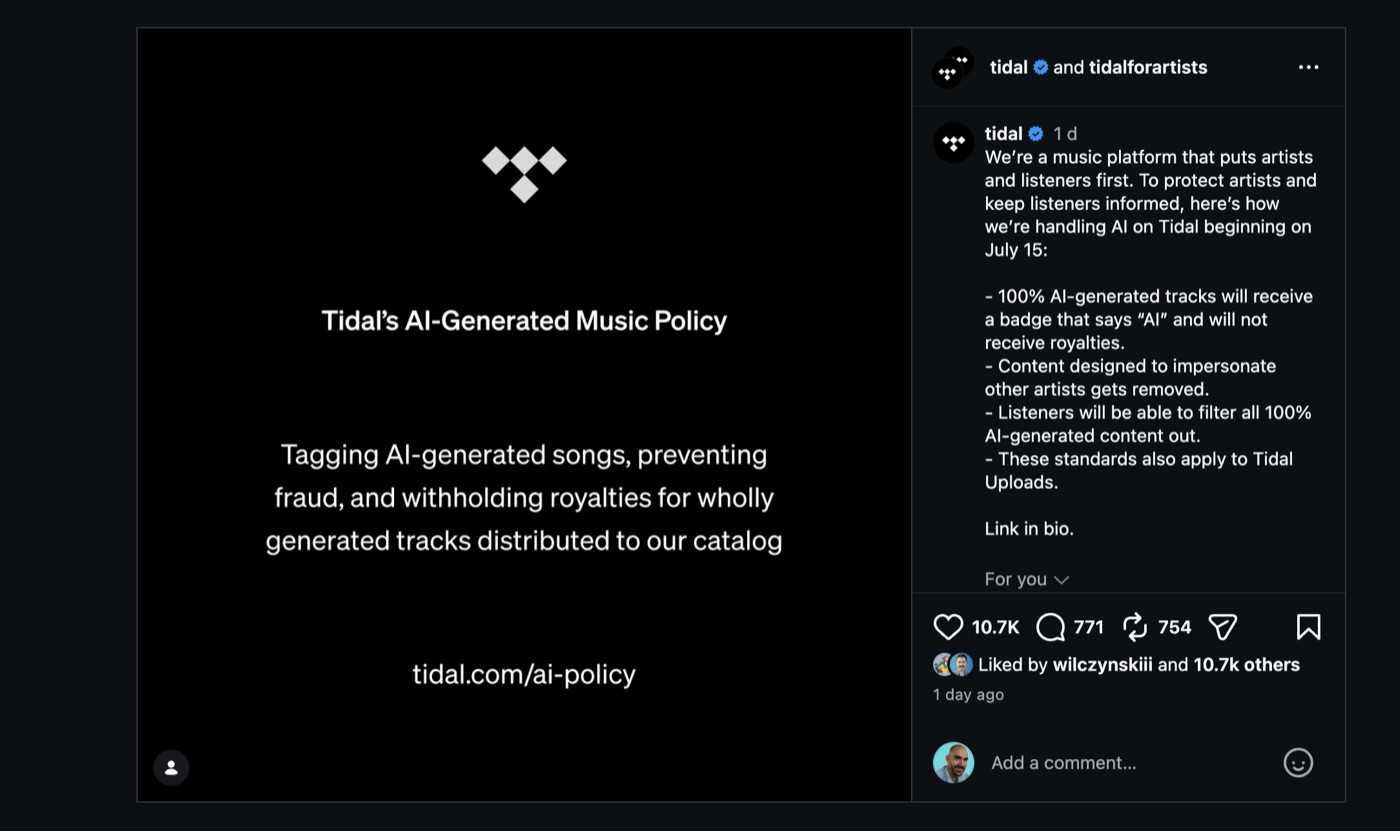
TIDAL will stop paying royalties on music it judges to be fully AI-generated. The streaming service published a new AI policy on June 29, 2026, and the rules take effect July 15. Tracks flagged as 100% AI keep streaming, but they lose royalties and get pulled from TIDAL’s direct-to-fan sales.
What TIDAL’s AI policy changes
TIDAL’s policy draws a line between the music it will host and the music it will pay. Fully AI-generated tracks stay available to stream. They no longer collect royalties, they cannot earn through direct-to-fan sales, and they get an on-platform tag telling listeners a song was deemed 100% AI. TIDAL also said it will use automated tools to remove AI tracks built to impersonate a real artist or group.
“We are committed to protecting and rewarding organic creativity to avoid compromising an artist’s ability to connect with and build their fandom,” said Tony Gervino, TIDAL EVP and editor-in-chief, in the company’s announcement. Many listeners, he added, “do not want to be exposed to, or prompted to listen to, wholly AI-generated music.”
AI's takeover of the music industry isn't inevitable if we take even greater steps now to monitor and control it.
How TIDAL compares to Spotify, Apple Music, and Deezer
TIDAL is the latest service to set AI rules, after Spotify, Apple Music, Deezer, Qobuz, and SoundCloud. Most of them lead with labeling and filtering. TIDAL points the policy at the money. Deezer took the same hard line earlier, denying AI tracks monetization and pulling them from recommendations and editorial playlists.
The volume explains the urgency. Deezer reports nearly 75,000 fully AI-generated tracks land on its platform every day, around 1 to 3% of streams, many of them flagged as fraudulent. Spotify, by contrast, has spent two years on a shifting set of AI rules built around disclosure and spam filters. Deezer even shipped a free AI detector so listeners can scan playlists themselves.
What the policy means for artists
If you record your own music, this is a small win on incentives. A large share of AI uploads exists to farm the royalty pool, not to find listeners. Cut the payout and you remove the reason to flood the catalog.
The harder question is classification. TIDAL has not detailed how it separates a fully AI track from a song that used AI for one vocal or one stem, and that line decides who gets tagged. If you build with AI, read the policy before you distribute to TIDAL.
Either way, the durable lesson sits where it always does. The fans who follow you directly are worth more than any single platform’s payout rules, and the artists who already get paid fairly are the ones who own the relationship.
Frequently asked questions
What is TIDAL's new AI music policy?
TIDAL's policy, published June 29, 2026, stops tracks judged to be fully AI-generated from earning royalties or selling direct to fans, effective July 15, 2026. Those tracks can still stream but carry a tag marking them as 100% AI. TIDAL will also remove AI tracks that impersonate real artists.
When does TIDAL's AI music royalty policy take effect?
The policy takes effect on July 15, 2026. TIDAL announced it on June 29, 2026, framing it as a way to protect and reward organic creativity.
Can you still upload AI music to TIDAL?
Yes. AI-assisted and fully AI music can still be distributed to TIDAL and streamed. Tracks judged to be 100% AI lose royalty eligibility and direct-to-fan sales, and uploads that impersonate a real artist are removed.
How does TIDAL's AI policy compare to Spotify and Deezer?
TIDAL and Deezer both deny royalties to fully AI tracks, while Spotify and Apple Music lean more on labeling and filtering. Deezer goes further still by removing AI tracks from recommendations and editorial playlists.
About the author

Covering AI music tools, industry shifts, and news for music creators and professionals. Twice-weekly newsletter at aimusicpreneur.com.