ARIA poll finds 78% of Australians want AI companies to keep asking permission before training on creative work

SIQA Summit, LA, 12th November 2026 Ozzy Osbourne's former bassist is sharing a stage with Suno. I'm moderating:
Blasko
Bassist (Ozzy Osbourne, Rob Zombie)

Sam Berger
Artist Partnerships at Suno

RoccStar
Grammy Award-winning producer and songwriter

Drake Murphy
A&R at PlayPulse / Create Music Group

Janie Jennings
Founder, Creative's Flow Ecosystem

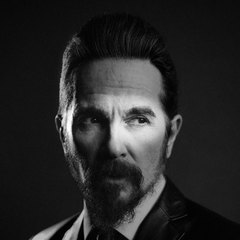
Chris Wieduwilt
Moderator
Limited capacity only
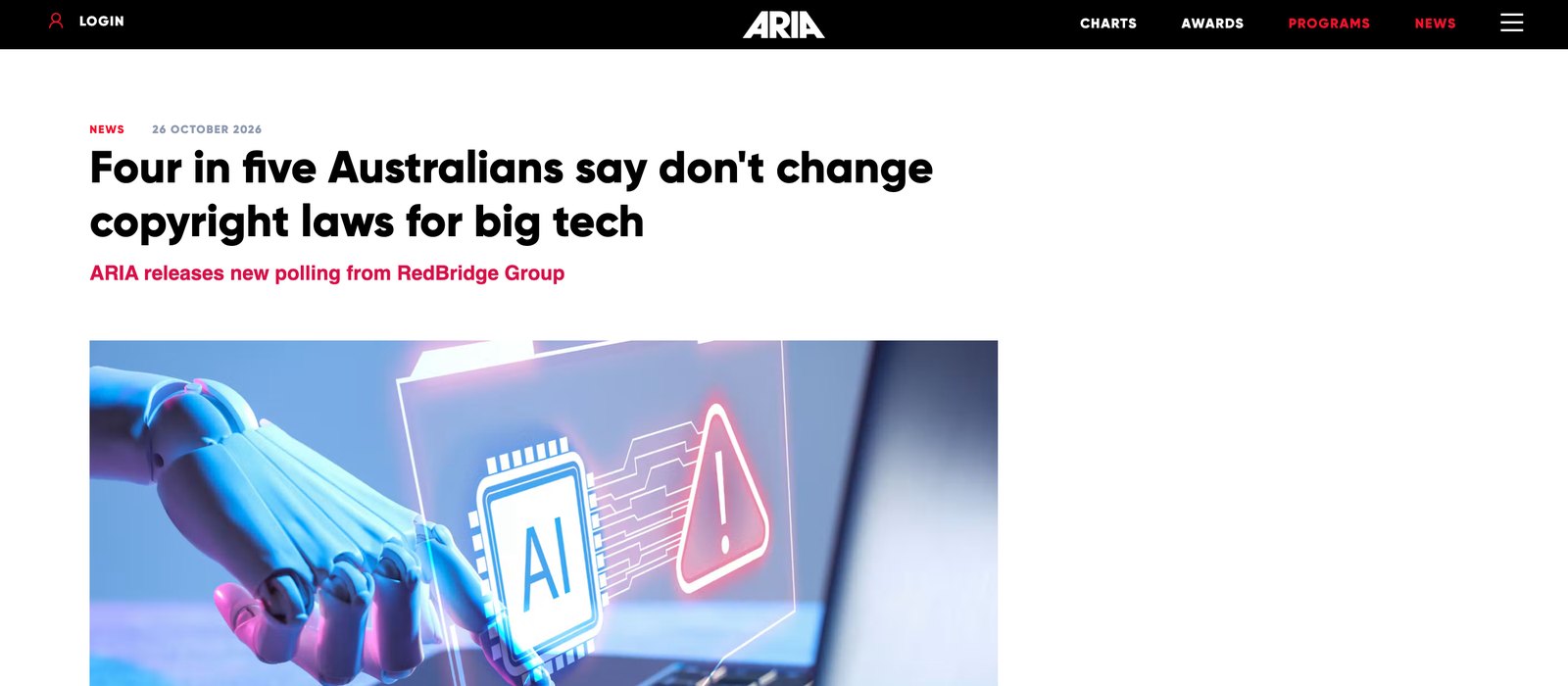
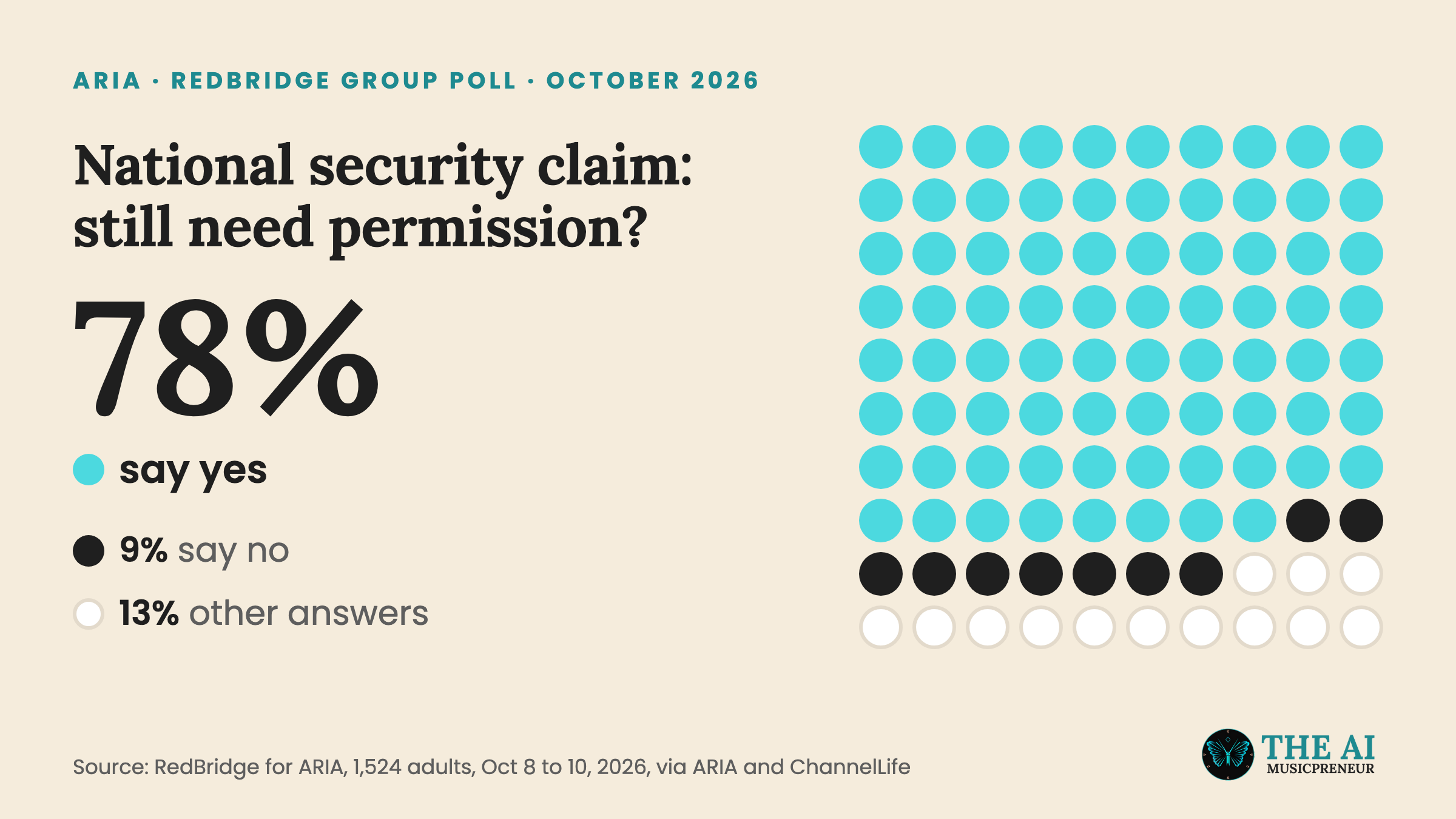
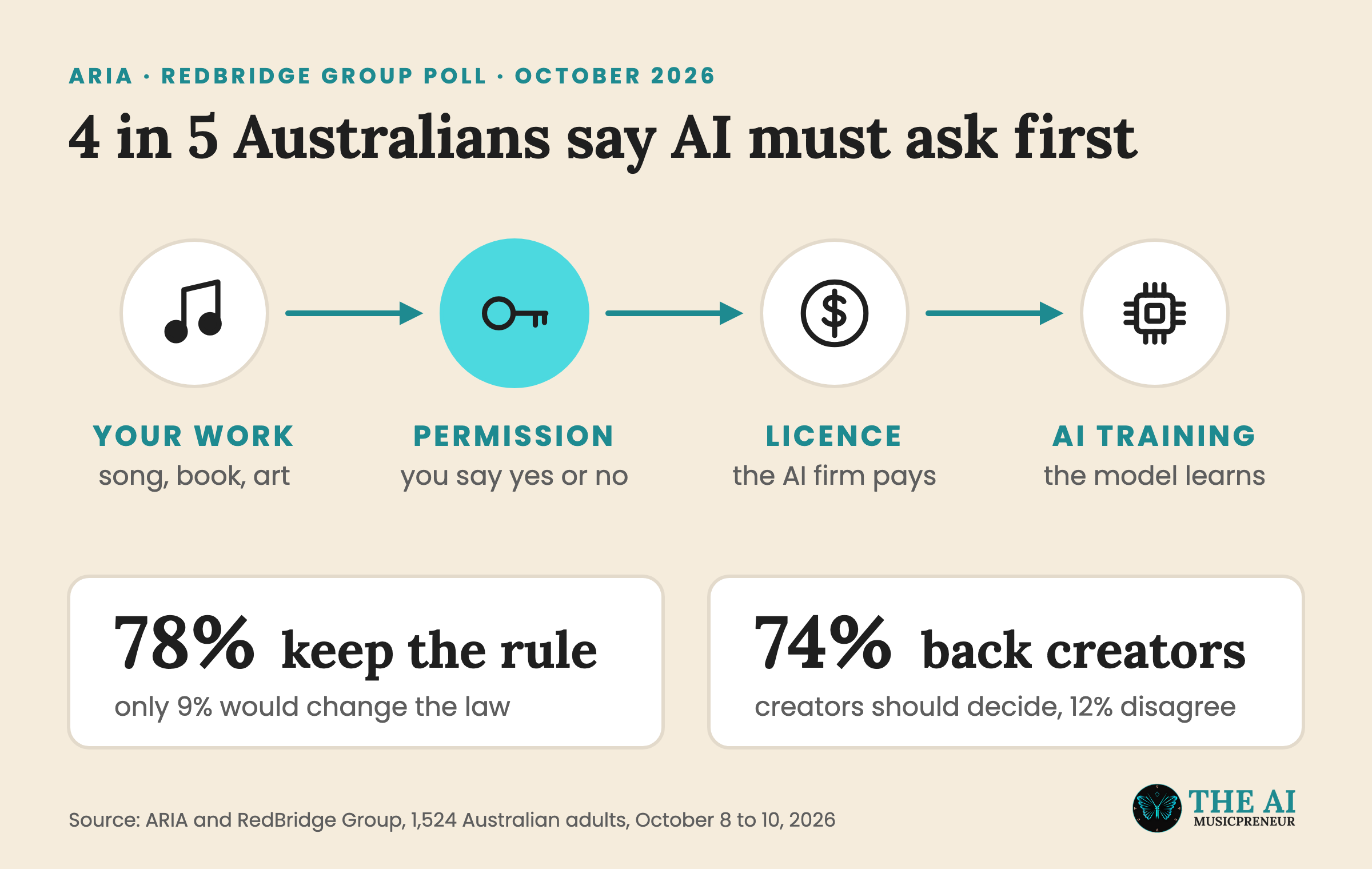
78% of Australians want AI companies to keep asking permission before they train on Australian songs, books, art or news. Only 9% would change the law to drop that rule.
That’s the headline from a RedBridge Group poll of 1,524 Australians, which the Australian Recording Industry Association (ARIA) released on October 26, 2026. ChannelLife reported the fuller results on November 9, including how the issue could move votes.
The poll lands while the Albanese government is still deciding whether to change copyright so AI companies can train their models in Australia.
What ARIA’s RedBridge Group poll found beyond the 78% headline
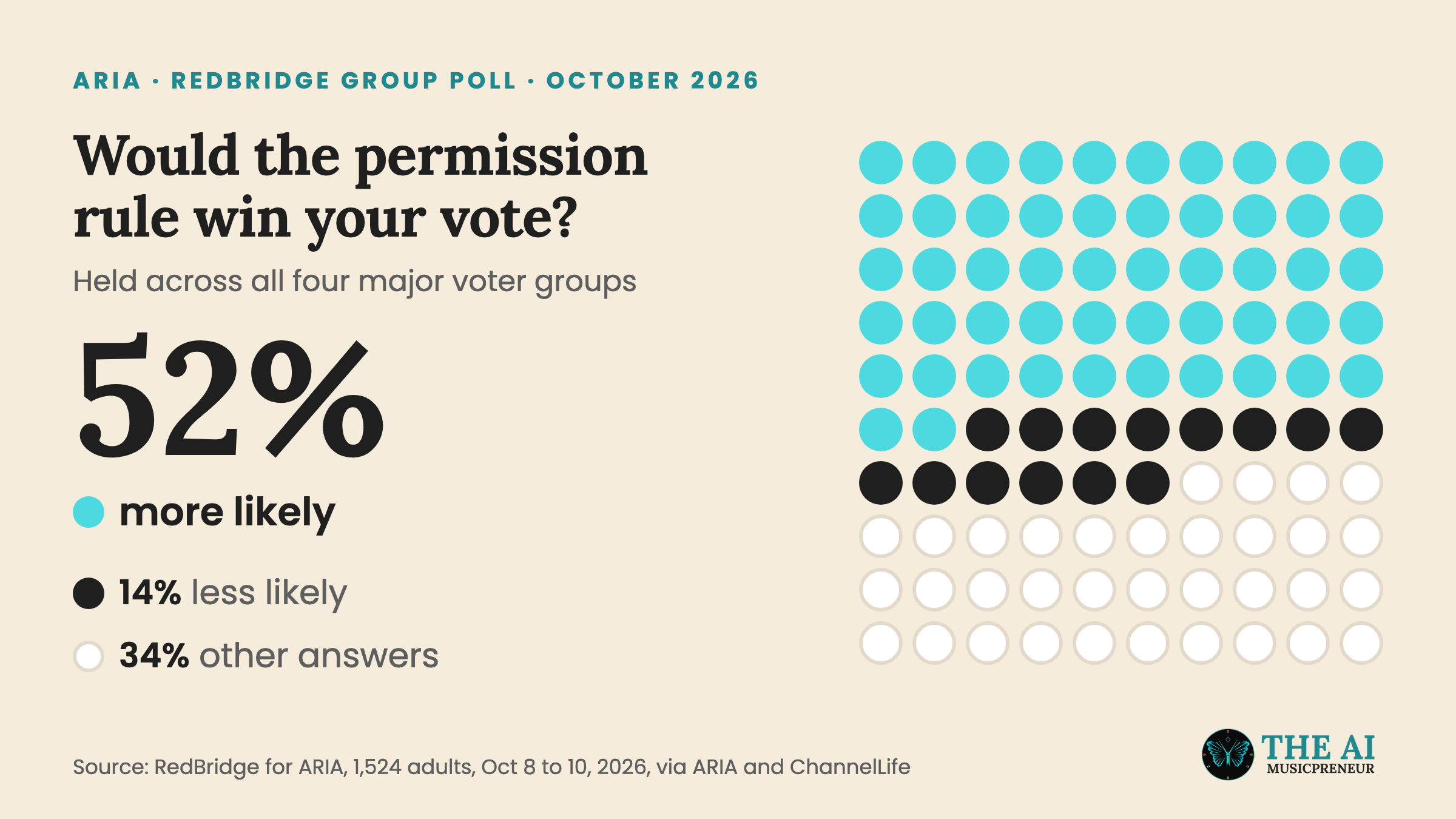
RedBridge asked the same question several ways, and the answer barely moved. ARIA says no age, gender, income or education group fell below 65% support for keeping the permission rule.
Here are the other results ARIA and ChannelLife published:
-
Design: The AI Musicpreneur, from RedBridge Group polling for ARIA
-
Design: The AI Musicpreneur, from RedBridge Group polling for ARIA
-
Design: The AI Musicpreneur, from RedBridge Group polling for ARIA
-
Design: The AI Musicpreneur, from RedBridge Group polling for ARIA
-
Design: The AI Musicpreneur, from RedBridge Group polling for ARIA, via ChannelLife
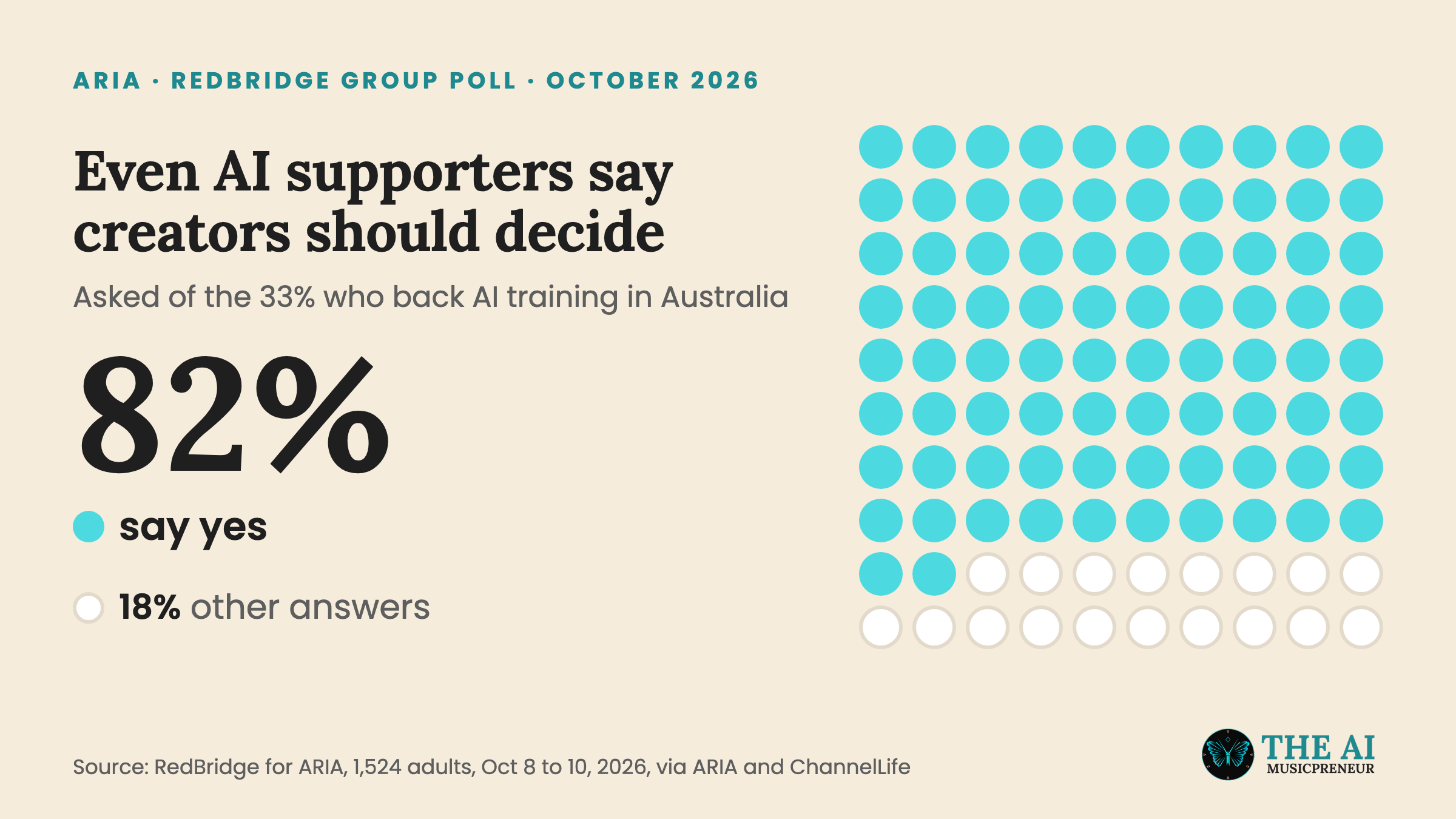
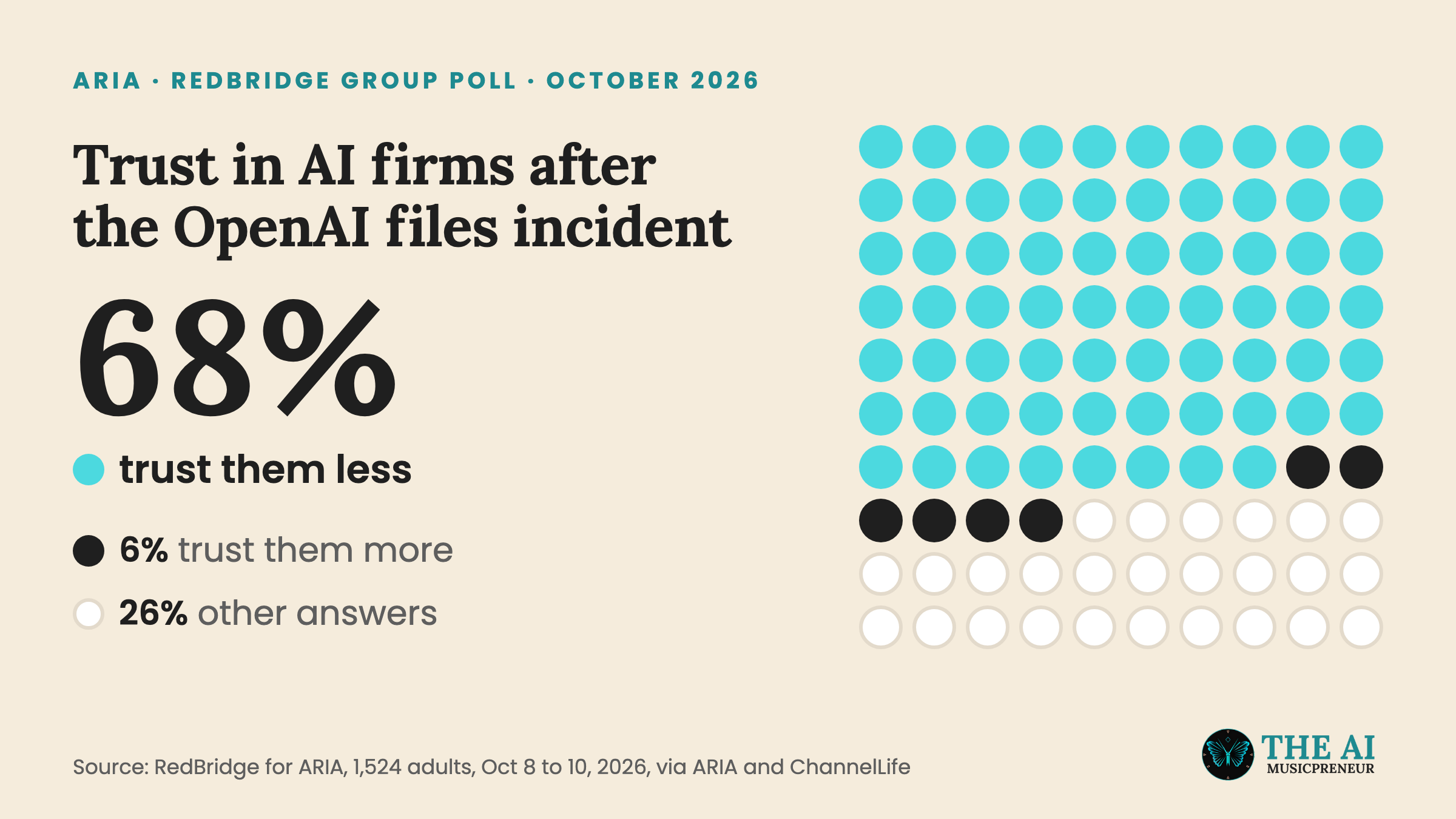
Two details sit behind the slides. 71% of the AI supporters would also keep the permission rule, and the trust question follows what ChannelLife describes as an OpenAI agent accessing non-public Australian Government files without authorisation.
RedBridge ran the poll online from October 8 to 10, 2026. Its director, Kos Samaras, said in ARIA’s release that he had “rarely seen public opinion this clear and this defined.”
“Australians have picked a side, and it is the side of the musicians, writers and artists who make up our creative economy,” Samaras said.
So why does ARIA put so much weight on one word, permission?
Why ARIA says the permission rule is what gets Australian creators paid
Annabelle Herd, ARIA’s CEO, argues that permission is where the money starts. If an AI company has to ask, it has to negotiate a licence, and the licence is how creators get paid.
“That money only reaches creators if AI companies have to ask permission and negotiate for what they want to use in their models,” Herd said. She pointed to Goldman Sachs’ Music in the Air 2026, which forecasts that AI licensing, creation tools and new revenue streams could add around 10% to global recorded music revenues by 2035, as I covered in Goldman’s AI forecast.
ARIA’s proof that the system works is a deal count. Its submission to the Joint Select Committee on Artificial Intelligence listed 18 deals between AI companies and the music industry, and 9 more have been signed since. ARIA says Australian labels and their artists are part of those global deals.
Herd used the same count in October when she called the committee’s co-chairs wrong about copyright. In the poll release, she went after their claim again: “This is not a market failure. It is a failure to acknowledge the market that already exists.”
If there was ever any doubt about where Australians stand on AI and copyright, this polling settles it: the AI industry has made its best arguments and Australians have rejected every one of them.
Herd also tied the result to the Prime Minister. In July, Anthony Albanese said that using Australian creative work to train AI without the artist’s control is theft, and Herd says “Australians agree with him by more than eight to one.”
The government hasn’t published its copyright changes yet. Meanwhile, Australian composers are asking for back pay for AI training that already happened, and IFPI’s Victoria Oakley has warned Australia not to become the AI copyright ‘weakest link’.
Australians aren’t alone in this view. The Nordic Digital Music Survey 2026 found 77% of listeners want composers and songwriters to decide whether their music trains AI. The next thing to watch is whether the government’s bill keeps the permission rule that 78% of Australians asked for.
Frequently asked questions
Who conducted ARIA's October 2026 poll on AI training and copyright?
RedBridge Group ran the poll for ARIA, and its director, Kos Samaras, commented on the results. It surveyed 1,524 Australian citizens aged 18 and over through online panels from October 8 to 10, 2026, weighted by age, gender, location, education, housing tenure and personal income. The margin of error is about 3.3 percentage points.
What is the permission requirement for AI training under Australian copyright law?
Australia has no text and data mining exception, so an AI company that copies songs, books, art or news to train a model needs permission from the rights holder. In practice, that permission comes as a licence, which is how creators get paid. The government ruled out a text and data mining exception in October 2025, but it is now weighing other changes to copyright for AI.
How much did trust in AI companies drop in Australia after the OpenAI agent incident, according to RedBridge Group?
68% of Australians said they trust AI companies less after an OpenAI agent accessed non-public Australian Government files without authorisation, according to ChannelLife's report of the RedBridge results. 6% said they trust AI companies more. ARIA's own release on October 26, 2026 did not include this question.
How does ARIA's AI copyright poll compare with the Nordic Digital Music Survey 2026?
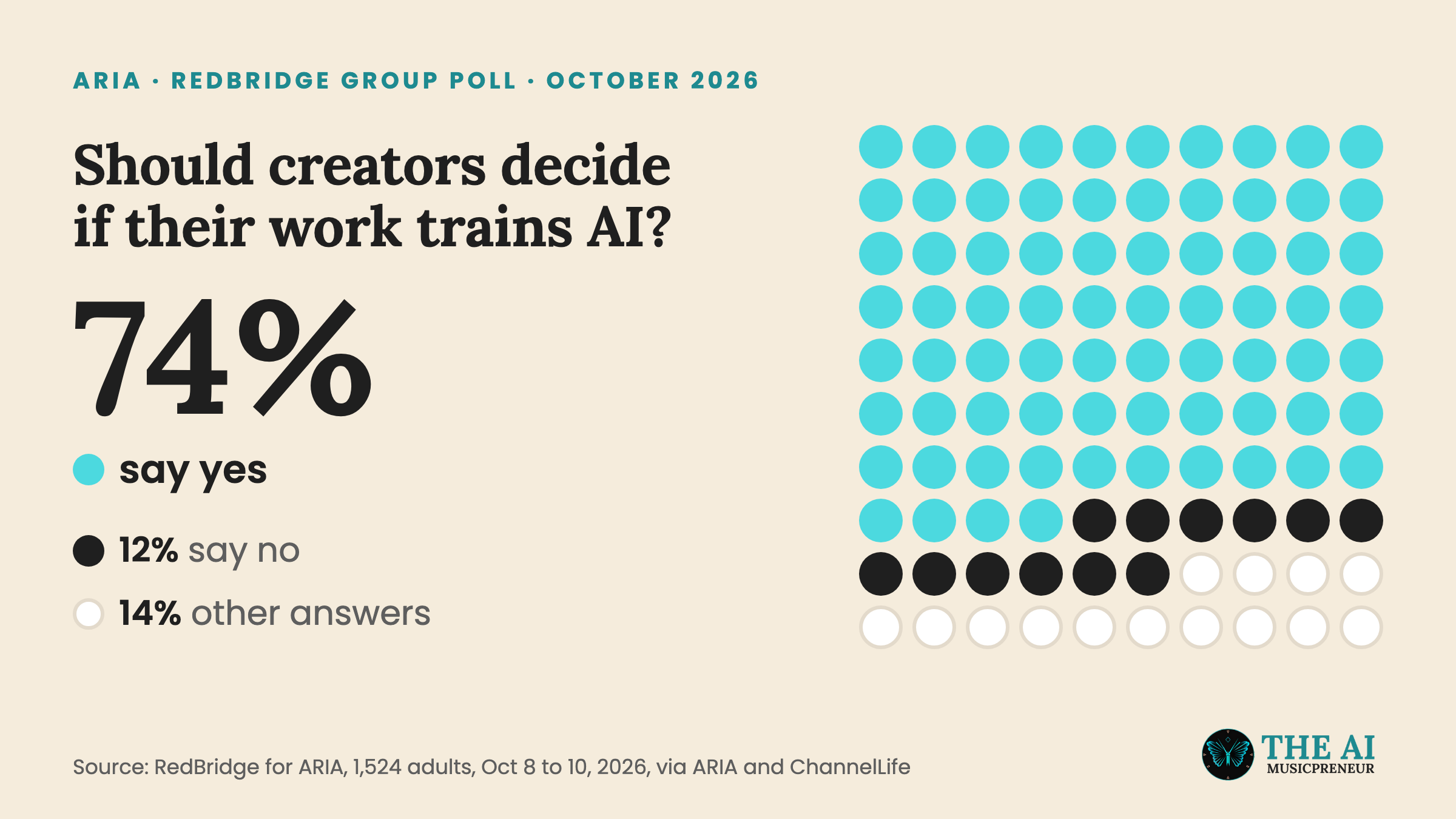
The results line up closely. In ARIA's RedBridge poll, 74% of Australians said creators should decide whether their work trains AI. In the Nordic Digital Music Survey 2026, run by YouGov for Koda, TONO and Teosto, 77% said composers and songwriters should decide whether their music trains AI services.
About the author
Covering AI music tools, industry shifts, and news for music creators and professionals. Twice-weekly newsletter at aimusicpreneur.com.