IFPI chief warns Australia not to be the AI copyright 'weakest link', because one safe harbour exposes music everywhere

SIQA Summit, LA, 12th November 2026 Ozzy Osbourne's former bassist is sharing a stage with Suno. I'm moderating:
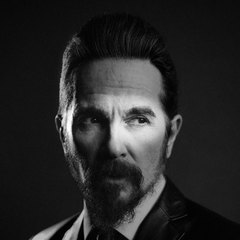
Blasko
Bassist (Ozzy Osbourne, Rob Zombie)
Sam Berger
Artist Partnerships at Suno

RoccStar
Grammy Award-winning producer and songwriter

Drake Murphy
A&R at PlayPulse / Create Music Group

Janie Jennings
Founder, Creative's Flow Ecosystem

Chris Wieduwilt
Moderator
Limited capacity only
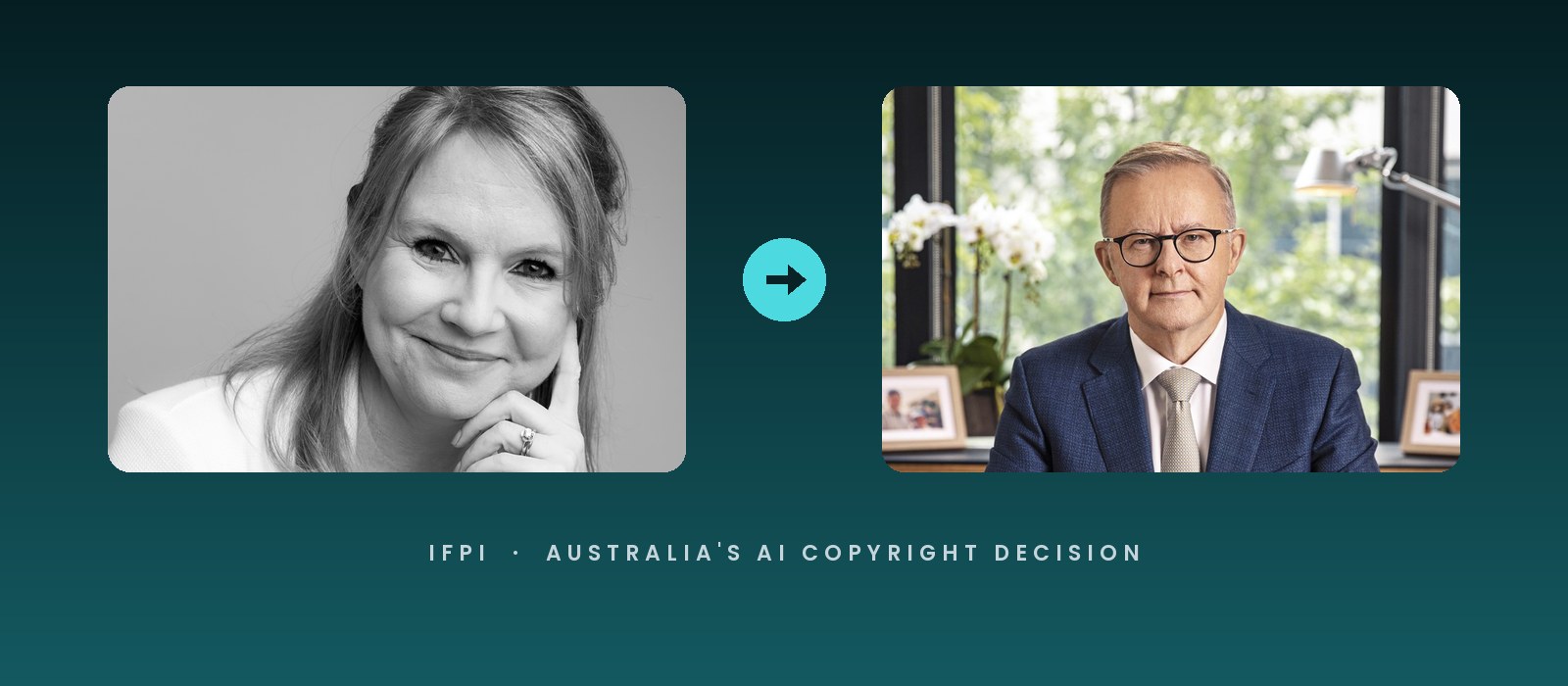
One safe harbour. That’s all an AI company needs to train on your songs, according to IFPI chief executive Victoria Oakley, and right now she’s watching Australia.
Oakley told Guardian Australia on November 8, 2026 that weakening copyright to help AI companies would be “ridiculous and dangerous” and “a disaster for creativity.” IFPI represents the recording industry worldwide, with 8,000 record company members in 70 countries, per its 2024 announcement of Oakley’s appointment.
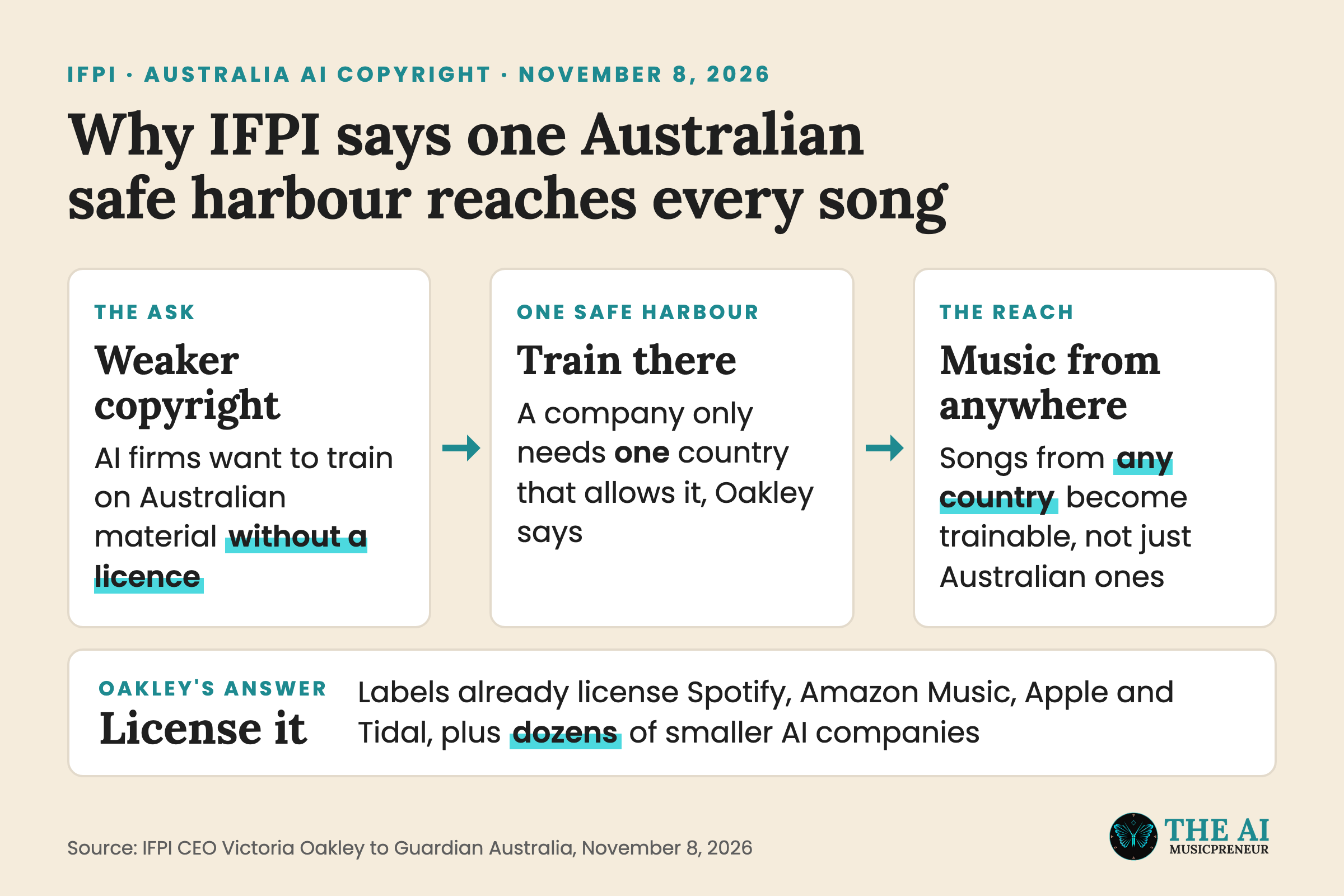
Her point is that Australia’s choice doesn’t stay in Australia. “You just need one safe harbour, because then you can train on music from anywhere in the world. So this isn’t just about Australian music and Australian culture; it’s about music and culture everywhere.”
I don't think Australia wants to be the weakest link in this situation, the one that believed the promises and gave in and threw creativity under the bus on behalf of everyone else.
What IFPI’s Victoria Oakley told Guardian Australia about the Albanese government’s AI copyright review
The Albanese government is weighing copyright changes inside a wider set of AI policies, covering data centres, online safety, the workforce, energy and the economy. Large AI companies have asked for a weaker law so they can train on Australian material, and some say licensing under the current law is too difficult.
Anthropic went further and suggested an “opt-out” model, the Guardian reports. In plain words, an AI company could copy your songs unless you told it not to, the same idea the Attorney-General’s department was already consulting on in September.
That sits awkwardly next to Prime Minister Anthony Albanese’s own words. In July he promised “the strongest possible protection” and called AI training without creator control “theft”.
Oakley says AI companies made the same pitch in the US, the UK and other countries, and IFPI’s members are worried Australia could agree to what the others turned down. “I just don’t think it’s true that you will only get investment or growth, or be seen as pro-innovation, if you entirely give in to the demands of AI companies,” she said.
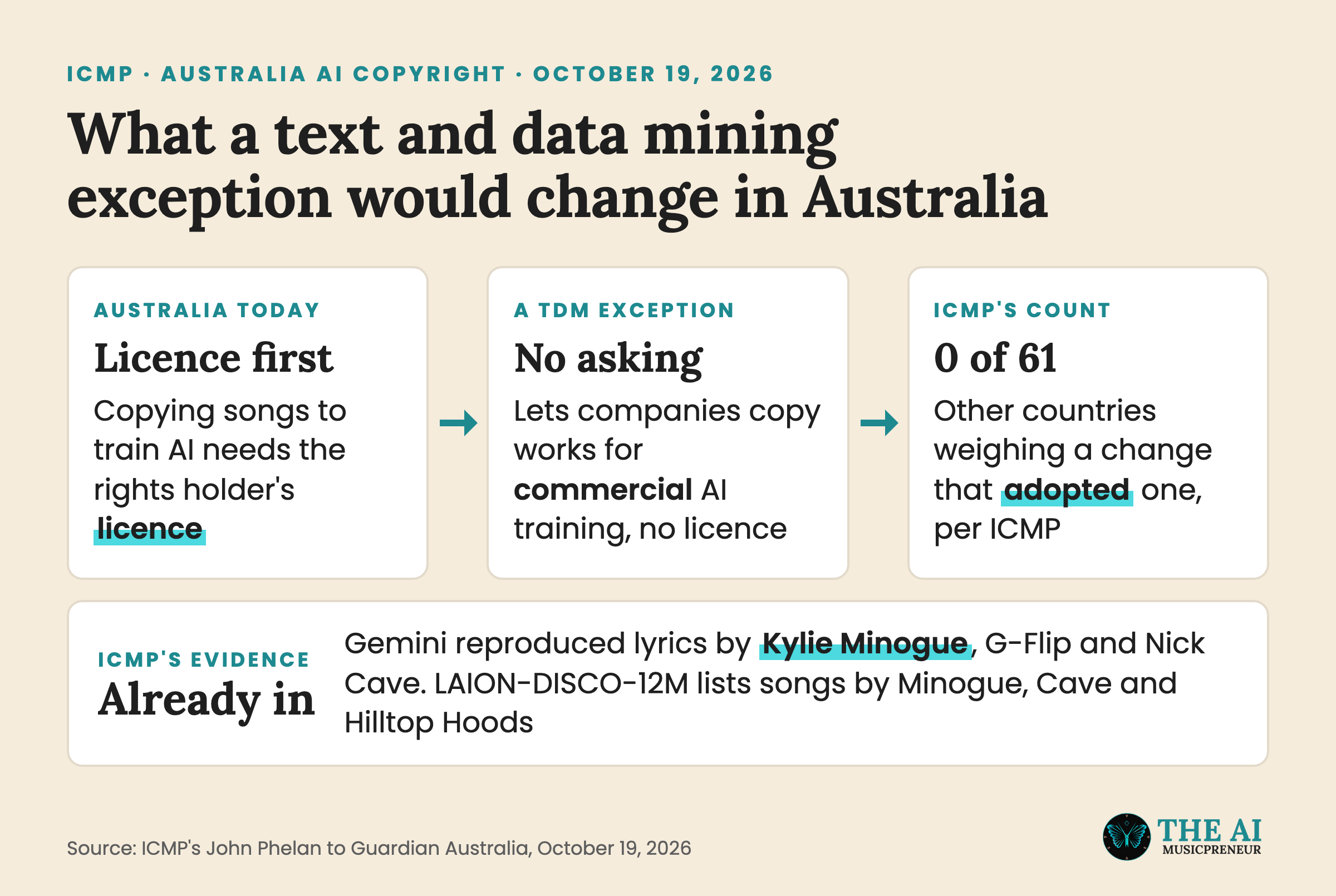
ICMP, the global music publishers’ body, made a similar count in October: of 62 countries that weighed a change, none of the other 61 adopted a commercial text and data mining exception, as I covered in ICMP’s warning to Australia.
IFPI is now taking the argument to other governments. “We’ve been talking to capitals around the world, saying ‘are you seeing what’s going on in Australia?’ We think this is a disaster for creativity,” Oakley said.
The government’s latest line came from Attorney-General Michelle Rowland’s office the week before. A spokesperson said the government is “committed to supporting” creatives and pledged that “any future copyright changes deliver meaningful control and fair compensation.”
So why does a London-based trade body care this much about one country’s law?
Why IFPI says one Australian safe harbour reaches music from every country
A safe harbour, in this fight, is a country where copying songs to train AI is legal without a licence. An AI company only needs that rule in one place, the place where it trains its model.
That’s why Oakley says creative industries worry about “contagion.” If Australia gives in, copyright material from any country could be affected.
ARIA’s Annabelle Herd made a related point to the AI committee in October. Australian law protects overseas works the same as local ones, so any carve-out would cover overseas songs too.
There’s a legal risk for the government as well. Coalition senators and the recording industry have warned that a change could breach Australia’s constitution, and constitutional expert Anne Twomey said that’s “potentially” a concern, depending on how a law is drafted. Nationals senator Ross Cadell put it bluntly: “We could be liable for ‘just terms’ compensation for acquiring that property for every rights holder on Earth.”
Oakley wouldn’t speculate on a court fight, but she said the change would damage Australia’s standing in the creative world. “It would be a huge mistake and I think the prize is not worth what you’re throwing away.”
So if you release music anywhere, this fight is about your catalogue too. A training exception in Canberra would reach your songs the same way it reaches an Australian artist’s.
Can AI companies license music the way Spotify does? Oakley’s answer to OpenAI
OpenAI says it’s a different case. Answering questions from independent senator David Pocock at the parliamentary committee on AI, OpenAI said Spotify “has a different business, where it primarily transmits un-transformed copyrighted content, so would be expected to license content that it streams.”
Oakley’s answer is that labels have already signed dozens of licensing deals with smaller AI companies around the world. “It is perfectly possible to license. I’m almost shocked that these words are coming out of the mouths of some of the larger AI companies,” she said.
“We already know how to license music to tech platforms because that’s exactly how Spotify works, or Amazon Music, Apple, or Tidal.”
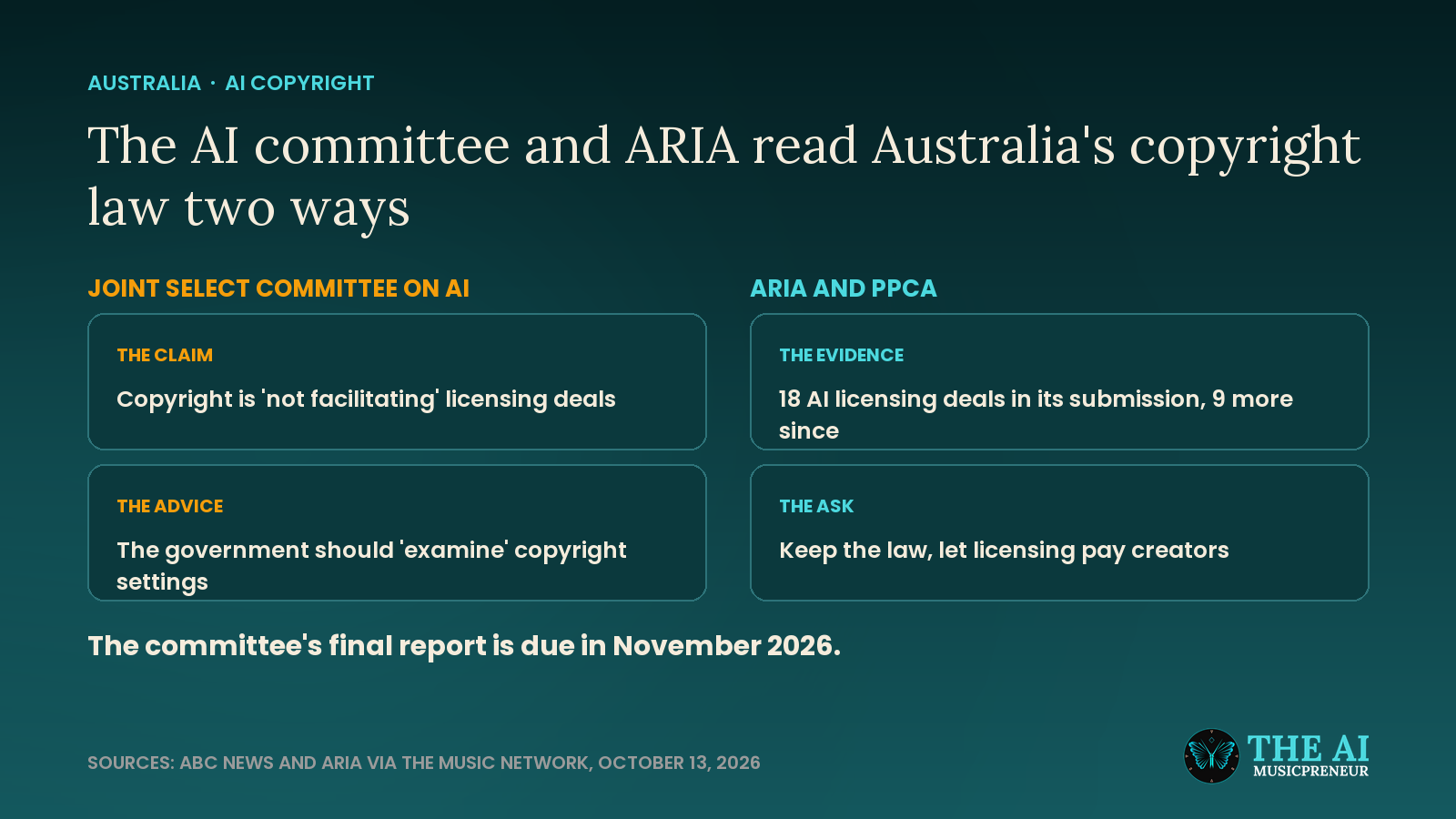
ARIA’s count backs her up: 27 AI licensing deals with the music industry, 18 in its submission to the inquiry and 9 announced since. Anthropic’s special envoy Jeffrey Bleich told the same committee that “you can’t license the entire internet.”
Oakley has been making the same case outside Australia. In a Billboard interview published November 5, she called Australia “the most live example” of a government proposing laws that throw “creativity entirely under the bus.”
Her verdict in that interview: “And it’s ludicrous. We all know there are solutions.”
Her pitch to the AI companies fits in one line. “Come to us and we’ll make it work.”
Where Australia’s AI copyright decision stands in November 2026
The Joint Select Committee on Artificial Intelligence told the government in October to “examine” Australia’s copyright settings, and its final report is due this month. Rowland’s office has promised control and compensation, and IFPI has told governments everywhere to watch.
Whichever way Canberra goes, the decision won’t stay in Canberra. That’s Oakley’s whole point.
Frequently asked questions
Who is Victoria Oakley, the chief executive of IFPI?
Victoria Oakley was appointed IFPI's chief executive in April 2024, after nearly two decades in the British Diplomatic Service and a spell as CEO of the consultancy Portland. IFPI represents the recording industry worldwide, with 8,000 record company members in 70 countries.
What did Attorney-General Michelle Rowland say about AI and copyright in November 2026?
A spokesperson for Attorney-General Michelle Rowland said the Australian government is committed to supporting creatives. The government pledged that any future copyright changes deliver meaningful control and fair compensation, Guardian Australia reported.
What opt-out model has Anthropic proposed for Australian copyright law?
Anthropic suggested an opt-out model that would let it scrape content unless rights holders signal an objection, according to Guardian Australia. Under that approach, the songwriter or label has to say no, instead of the AI company asking first.
Could weakening Australia's copyright law for AI breach the Australian Constitution?
Coalition senators and the recording industry have warned it could, because letting AI companies scrape copyrighted material might count as an acquisition of property, which the Constitution says must be on just terms. Constitutional expert Anne Twomey told Guardian Australia that is potentially a concern, depending on how the legislation is drafted.
About the author
Covering AI music tools, industry shifts, and news for music creators and professionals. Twice-weekly newsletter at aimusicpreneur.com.