ICMP warns Australia that Kylie Minogue and Nick Cave songs are already in AI training data
My stack My fav 6 tools for AI music after testing 70+
-
 ElevenMusic · Music generation
-
 Moises · Stem separation
-
 Controlla · Voice swap & cloning
-
 Cryo Mix · Mixing + mastering
-
 Neural Frames · Music videos
-
 ONCE · Distribution
Some links are affiliate links — I earn a commission at no cost to you. Every tool here is one I run myself and truly believe in. This stack is proven.
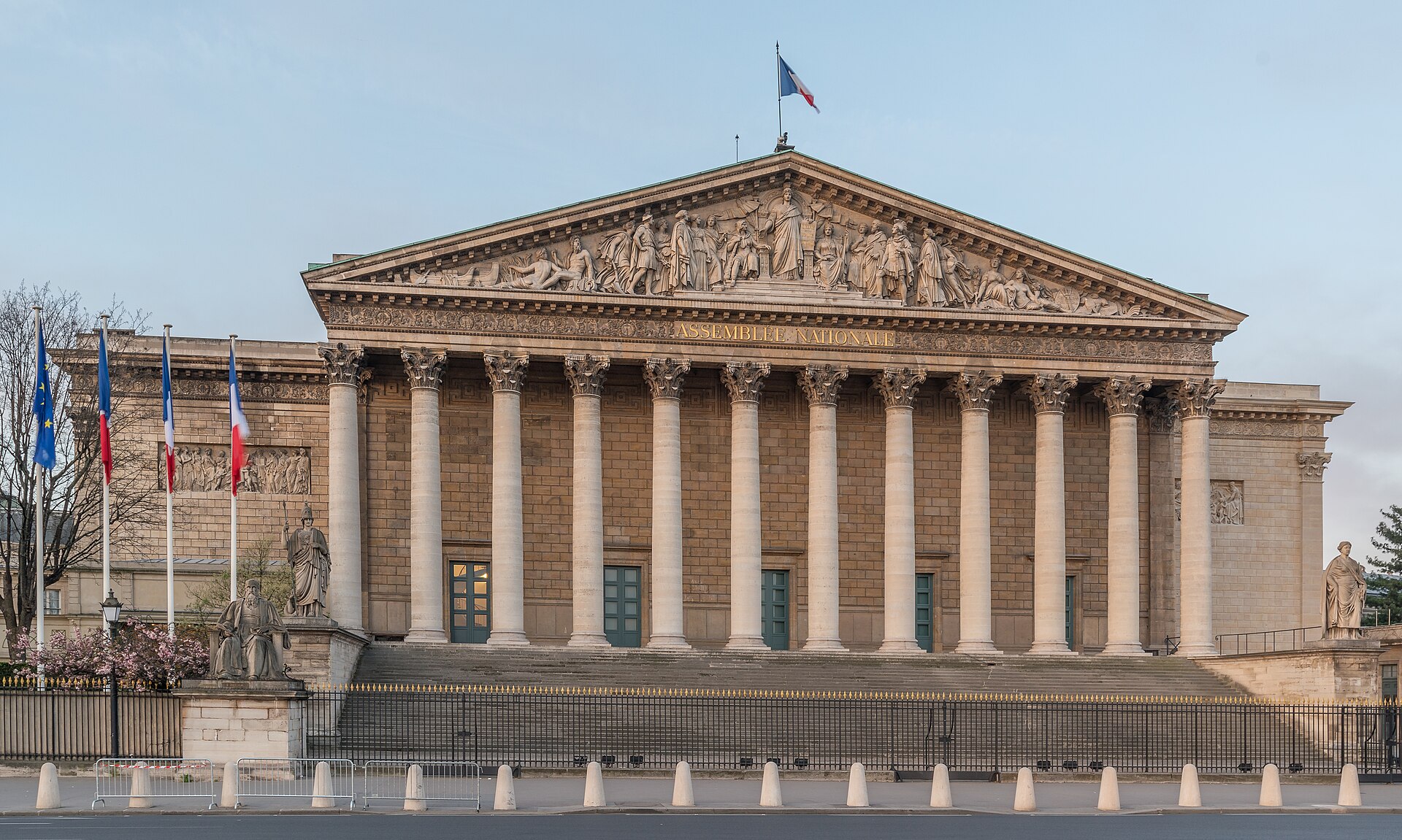
62 countries have looked at changing copyright law for AI training, and not one of the other 61 has handed AI companies a commercial carve-out. That count comes from the International Confederation of Music Publishers (ICMP), and it’s aimed straight at Australia.
On October 19, 2026, ICMP told Guardian Australia that AI has already been trained on songs by Kylie Minogue and Nick Cave without payment. ICMP represents Sony, Warner and Universal plus thousands of independent publishers, and its director general, John Phelan, warned Canberra not to give in.
“They’re trying to strong-arm Australian policymakers into ‘if you don’t do this, we won’t invest’,” Phelan said. What the AI companies want, in his words, is to “legitimise larceny.”
What ICMP showed Guardian Australia about Kylie Minogue and Nick Cave songs
The AI industry’s main line in Australia is that its models aren’t trained on Australian content, because local copyright rules keep them out. ICMP brought 2 pieces of evidence against that.
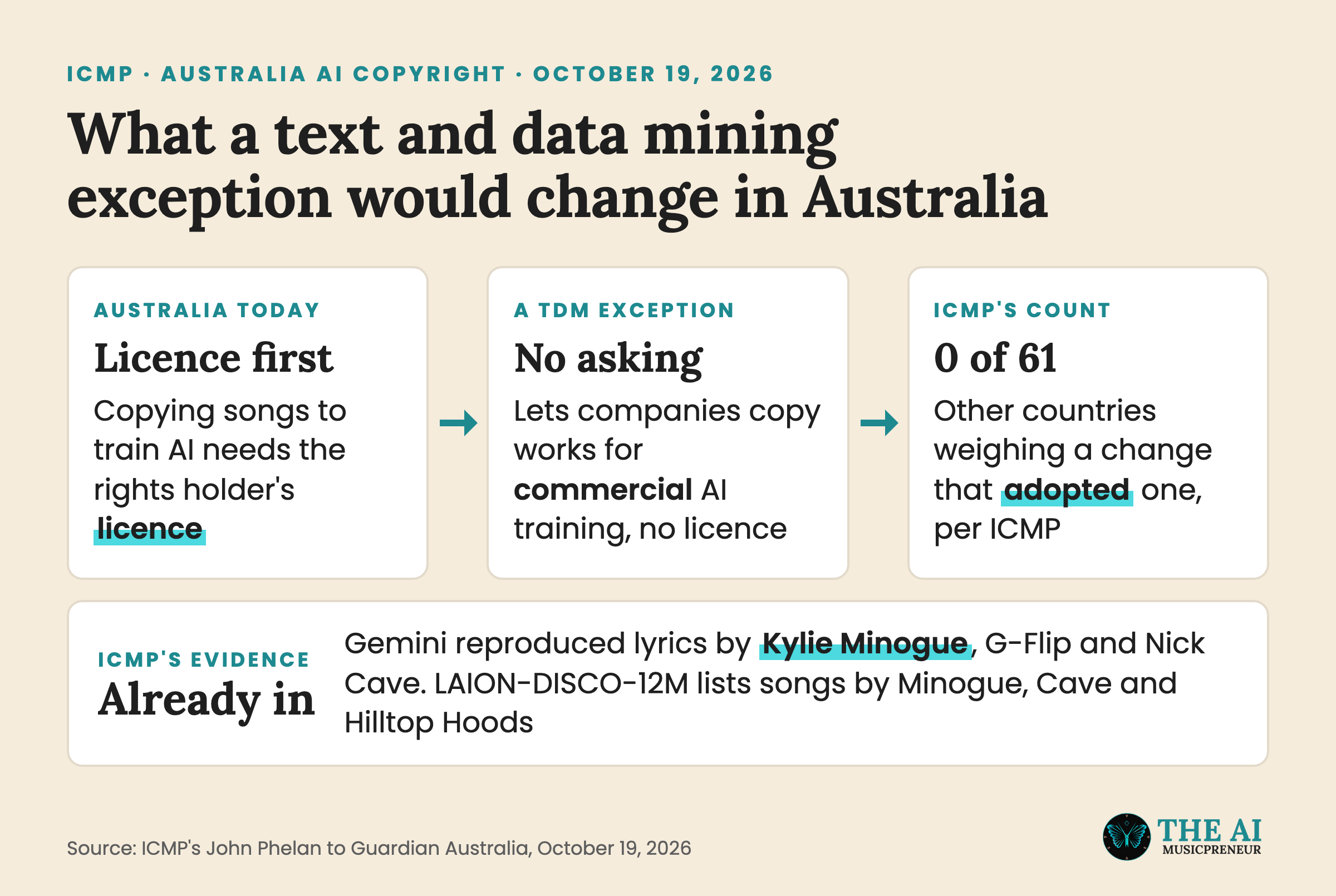
The first is Google’s Gemini. In material given exclusively to Guardian Australia, ICMP showed the chatbot reproducing lyrics by Kylie Minogue, G-Flip and Nick Cave.
The second is LAION-DISCO-12M, a dataset The Atlantic reported on in June. It’s basically a giant spreadsheet: 12,648,485 rows, each one a song title, artist and album with a link to the audio on YouTube. Phelan says tracks by Minogue, Cave and Hilltop Hoods are in it.
I covered that reporting when The Atlantic published its AI training databases, and it’s what pushed Australia’s music industry into its open letter on AI training in June. Phelan described the method the same way: spreadsheets with millions of lines of music that sits on YouTube.
Why ICMP says Australia is the only one of 62 countries weighing a commercial AI training exception
The change on the table is a text and data mining exception, or TDM exception. In plain words, it’s a rule that lets a company copy your songs to train AI without asking you or buying a licence.
Phelan says AI companies have taken that ask to dozens of countries. “There isn’t a single country among the other 61 [countries] … which has introduced a new text and data mining exception for commercial purposes,” he said.
The AI companies are making their case at the same inquiry. Anthropic’s special envoy, Jeffrey Bleich, told Australia’s Joint Select Committee on Artificial Intelligence that “you can’t license the entire internet,” and OpenAI’s Adam Cohen pointed to US fair use. Phelan thinks US copyright lawsuits and the cost of building models are why they’re looking for a country that will write licences out of the law.
The world is very much watching what Australia does.
The committee itself hasn’t settled the question. Its chair, Labor MP Jo Briskey, and deputy chair, Liberal Senator Jonathon Duniam, asked the government to “examine current copyright settings” in a letter to Anthony Albanese, while making sure creators keep control and get paid. In July, Albanese himself said AI training without artist control is theft.
The final report is due in November 2026. And if Australia does become the first of those 62 countries to say yes, the carve-out would cover songs from everywhere, not only Australian ones, as ARIA’s Annabelle Herd told the same committee.
Frequently asked questions
Who does the International Confederation of Music Publishers (ICMP) represent?
ICMP is the global trade body for music publishing. It represents the publishing businesses of Sony, Warner and Universal, plus thousands of independent music publishers across six continents.
What is the LAION-DISCO-12M dataset?
LAION-DISCO-12M is a music dataset the non-profit LAION released in late 2024. It lists metadata for 12,648,485 songs, including title, artist and album, each paired with a link to the song on YouTube. The Atlantic reported on it in June 2026, and ICMP says it includes tracks by Kylie Minogue, Nick Cave and Hilltop Hoods.
What did Anthropic's Jeffrey Bleich tell Australia's Joint Select Committee on Artificial Intelligence about licensing?
Bleich, Anthropic's special envoy, told the committee that you can't license the entire internet. He said that under existing Australian law, training could be found illegal if Anthropic couldn't get a licence from every person holding rights in Australia.
What did OpenAI's Adam Cohen tell Australia's AI committee about fair use?
Adam Cohen, OpenAI's chief of economic policy, said the fair use exception in US law fundamentally protects the development of new technology. He pointed to OpenAI's deals with News Corp and the Guardian as examples of paying for work, while arguing US law doesn't require it.
About the author

Covering AI music tools, industry shifts, and news for music creators and professionals. Twice-weekly newsletter at aimusicpreneur.com.