Universal and Sony ask a court to make Suno investor Lightspeed testify on the legal risk of training data
My stack My fav 6 tools for AI music after testing 70+
-
 ElevenMusic · Music generation
-
 Moises · Stem separation
-
 Controlla · Voice swap & cloning
-
 Cryo Mix · Mixing + mastering
-
 Neural Frames · Music videos
-
 ONCE · Distribution
Some links are affiliate links — I earn a commission at no cost to you. Every tool here is one I run myself and truly believe in. This stack is proven.

Universal Music Group and Sony Music want Lightspeed Venture Partners, the venture firm that led Suno’s $125 million Series B, to put a witness under oath about the “legal risk of training data.” Their opposition brief, filed in Boston federal court on October 13, 2026, asks a judge to deny Lightspeed’s motion to quash their subpoena.
Lightspeed is a non-party in the case: an investor with a seat on Suno’s board. The labels say its files show what Suno told its backers about the market it wanted and the risks it was taking.
That cutoff date is where the fight starts. The labels want what Lightspeed has on Suno from after it, plus a deposition, and Lightspeed says it already did its part.
What would Lightspeed have to testify about in the Suno case?
The labels filed a narrowed version of the subpoena with their brief, cutting the deposition topics from 20 to 16. Three of them quote one Lightspeed document the labels already have, as Music Business Worldwide reported:
- Topic 2 asks about the “legal risk of training data” that the document discusses.
- Topic 8 covers the “Risks” it lists, specifically “regulation around training data and/or label lawsuits.”
- Topic 13 asks about the “two sided music platform” in the same document.
Others cover Lightspeed’s role on Suno’s board, Suno’s “Partnerships Tracker,” each of the Series B, C and D investments, and any business ties Lightspeed had with Suno co-founders Michael Shulman, Keenan Freyberg, Georg Kucsko and Martin Camacho before it invested.
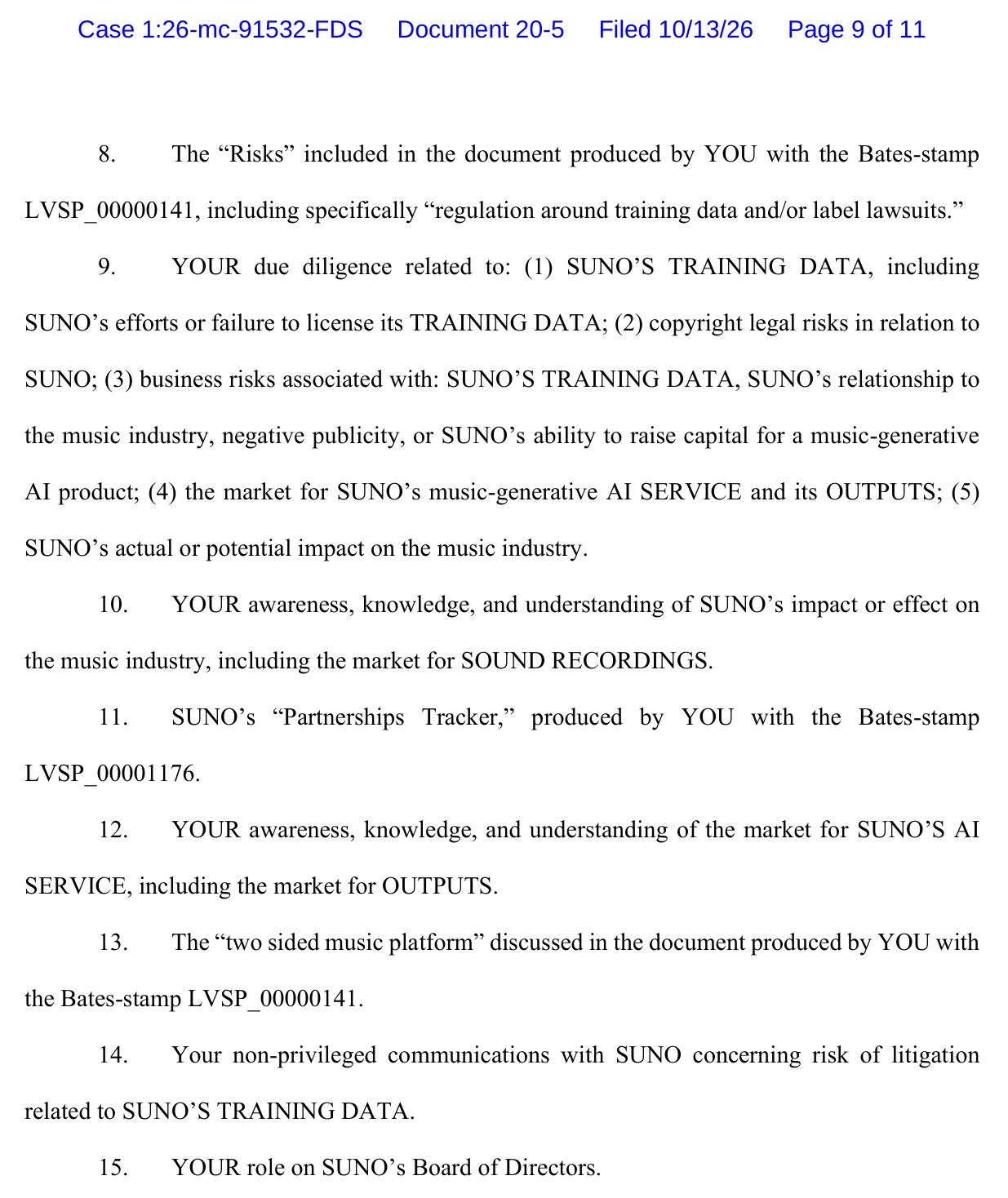
The document requests run from June 7, 2025 to today. They cover 6 categories Lightspeed already agreed to in 2025, including Suno’s training data and its “efforts or failure to license” it, the market for Suno’s outputs, and Suno’s impact on the music industry.
The labels asked the court to order the documents within 7 days and the deposition within 14 days after that. So why does a venture fund’s paperwork matter this much? Start with the money.
How Lightspeed kept backing Suno after the labels sued
Lightspeed led Suno’s $125 million Series B in May 2024. About a month later, on June 24, 2024, Universal, Sony and Warner sued Suno for copyright infringement.
Lightspeed then invested again in the Series C in November 2025 and in the Series D in June 2026, which raised more than $400 million at a $5.4 billion valuation. “After Plaintiffs sued Suno for copyright infringement on a massive scale, Lightspeed doubled and tripled down,” the labels wrote.
Lightspeed was never quiet about the bet, either. Its May 20, 2024 post announcing the Series B said Suno’s v3 model “can generate full length songs worthy of top 40 radio airplay in mere seconds.”
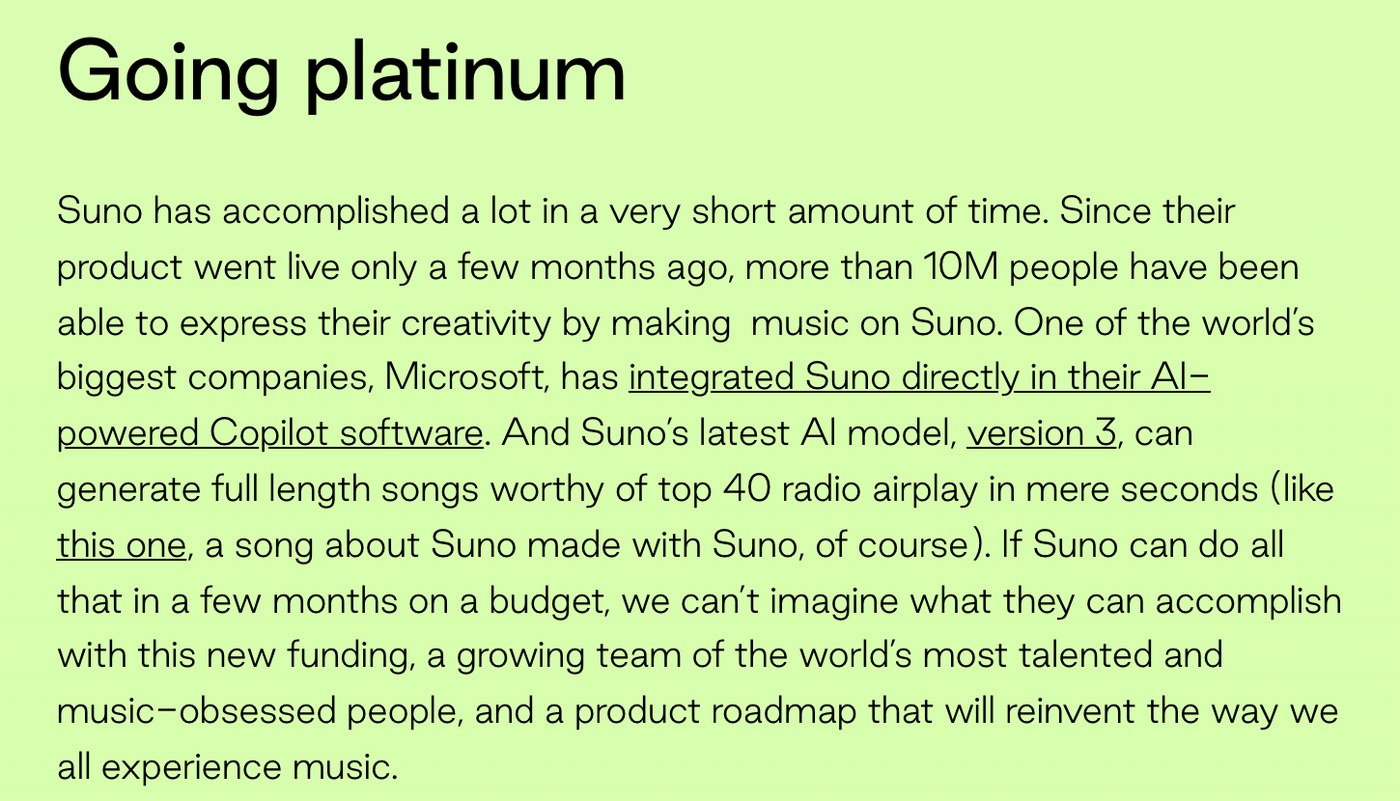
The labels argue that kind of competition is the problem: under fair use, a court asks whether AI songs substitute for the recordings they were trained on.
Why Universal and Sony say Suno’s investor files are fair use evidence
Suno’s main defense is fair use. One of the 4 factors a US court weighs is whether the copying hurts the market for the original recordings, and the labels call investor files “among the best evidence” for that question.
“A company raising capital tells its investors, candidly and in detail, what market it is targeting, whose share it intends to take, how fast it is growing, and what risks, including legal risks, it faces,” their brief says.
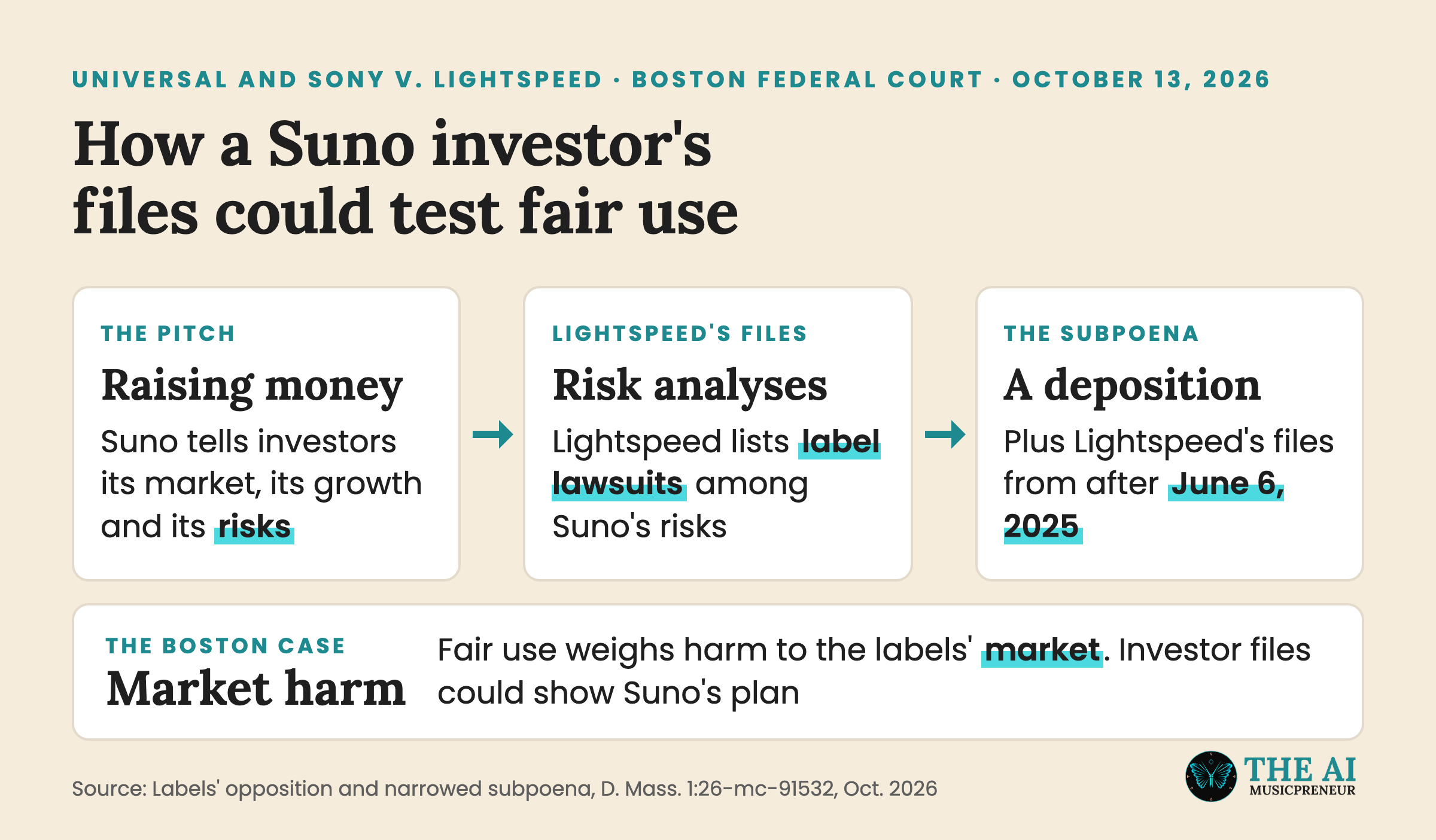
The labels add willfulness. If Suno knew the infringement risk it was running, that matters for damages, because willful infringement carries statutory damages of up to $150,000 per work.
The most specific parts are blacked out, though. The public brief says Lightspeed’s “own analyses concede” something about Suno, then redacts it.
On October 14, Judge F. Dennis Saylor IV granted the labels’ unopposed motion to impound the unredacted papers, which hold material Lightspeed marked “Highly Confidential–Attorneys’ Eyes Only” plus material 2 other Suno investors, Institutional Venture Partners (IVP) and Founder Collective, marked confidential.
What the labels did say in public: “investor productions in this case have already yielded evidence of Suno’s knowledge and market strategy that Suno itself never produced.” They cite Suno’s Speech beta and its Believe and TuneCore partnership as Suno extending its reach, and warn that “the longer this case goes on, the more Suno’s footprint expands.”
And they have a precedent. In the Udio case, Magistrate Judge Kandis Westmore in California ordered a16z, Udio’s lead investor, to hand over the same categories of documents in September 2025.
Why Lightspeed wants the Suno subpoena quashed, and what Judge Levenson said in August
Lightspeed’s motion calls the subpoena untimely, repetitive and too costly. It says it already produced 152 documents totaling “1,259 pages…across six agreed-upon categories,” according to Digital Music News, and that the deposition topics are either covered by those documents or better put to Suno. Lightspeed and Suno share a law firm, Latham & Watkins.
The labels answer that the newer files didn’t exist yet. Suno’s Series C and D closed after the June 2025 cutoff, and “Plaintiffs could not have compelled the production of materials that did not yet exist.”
Their bigger point is that this was already argued. In August, Suno asked Magistrate Judge Paul G. Levenson for a protective order covering subpoenas to 4 of its investors, including Lightspeed, and Levenson didn’t grant it after an August 26 hearing.
I don't get why investors in Suno would be irrelevant to a consideration of what is Suno's anticipated or ongoing behavior in the marketplace.
He wasn’t sold on everything, though. “I assume that this is fishing,” Levenson said, according to the transcript excerpt the labels filed, and he kept the deadlines tight so it wouldn’t go on forever.
He also recalled that an investor had discussed whether Suno’s data would be “essentially mined or farmed from YouTube.” Suno has since admitted it took YouTube audio with YT-DLP.
Lightspeed’s reply is due October 20 under the schedule both sides proposed, and no hearing date is public yet. The labels filed their brief a day before their DistroKid motion to compel, so 2 companies outside the case are now refusing the labels’ Suno subpoenas at once. I log every step on the Suno lawsuit tracker.
If the labels win this one, the firm that called Suno’s songs radio-ready in 2024 could end up explaining under oath what it knew about Suno’s training data, and when.
Frequently asked questions
Is Lightspeed Venture Partners a defendant in Universal and Sony's lawsuit against Suno?
No. Lightspeed is a non-party, and a subpoena is how a party to a lawsuit gets documents or testimony from someone it isn't suing. The fight over it runs as a separate miscellaneous case, In re Subpoena to Lightspeed Venture Partners, No. 1:26-mc-91532, in Boston federal court.
Which Suno investors besides Lightspeed Venture Partners have produced material to Universal and Sony?
The labels' October 13, 2026 impoundment motion covers material that Institutional Venture Partners (IVP) and Founder Collective designated confidential, which means both have produced material in the Suno case. Suno had asked Magistrate Judge Paul Levenson to block subpoenas to 4 of its investors, but the public filings don't name all 4.
Did a court order Andreessen Horowitz to hand its Udio investor files to the record labels?
Yes. On September 9, 2025, Magistrate Judge Kandis Westmore in the Northern District of California granted the labels' motion to compel a16z, Udio's lead investor. She found that information about Udio's market and its impact on the music industry was relevant to fair use and willfulness.
When will the Boston court rule on Lightspeed Venture Partners' motion to quash the Suno subpoena?
No date is set. Under a schedule Lightspeed and the labels proposed jointly, Lightspeed can file its reply by October 20, 2026. The case is assigned to Judge F. Dennis Saylor IV, who can refer it to Magistrate Judge Paul Levenson.
About the author

Covering AI music tools, industry shifts, and news for music creators and professionals. Twice-weekly newsletter at aimusicpreneur.com.