A Grammy-winning drummer and a Suno-funded tech group told the court AI training is fair use, as the RIAA filed against OpenAI
My stack My fav 6 tools for AI music after testing 70+
-
 ElevenMusic · Music generation
-
 Moises · Stem separation
-
 Controlla · Voice swap & cloning
-
 Cryo Mix · Mixing + mastering
-
 Neural Frames · Music videos
-
 ONCE · Distribution
Some links are affiliate links — I earn a commission at no cost to you. Every tool here is one I run myself and truly believe in. This stack is proven.
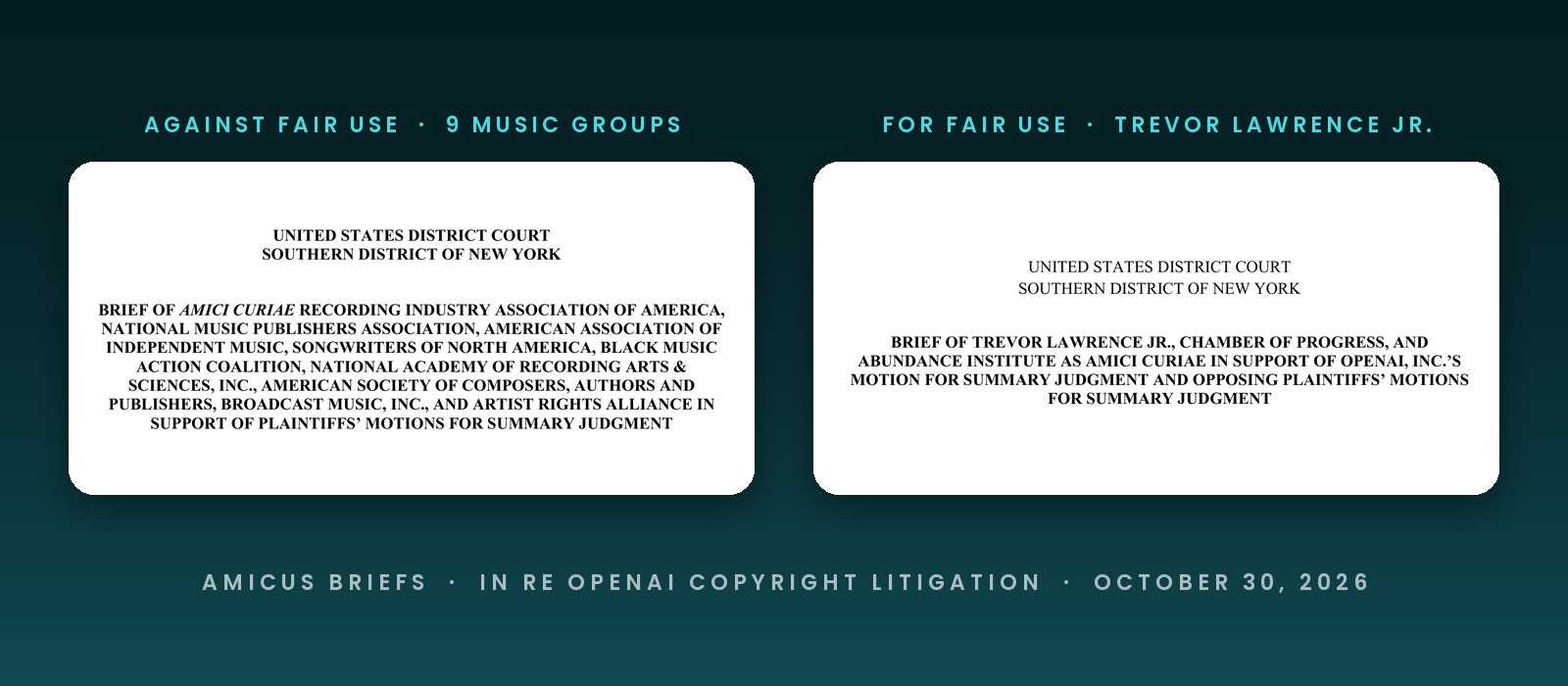
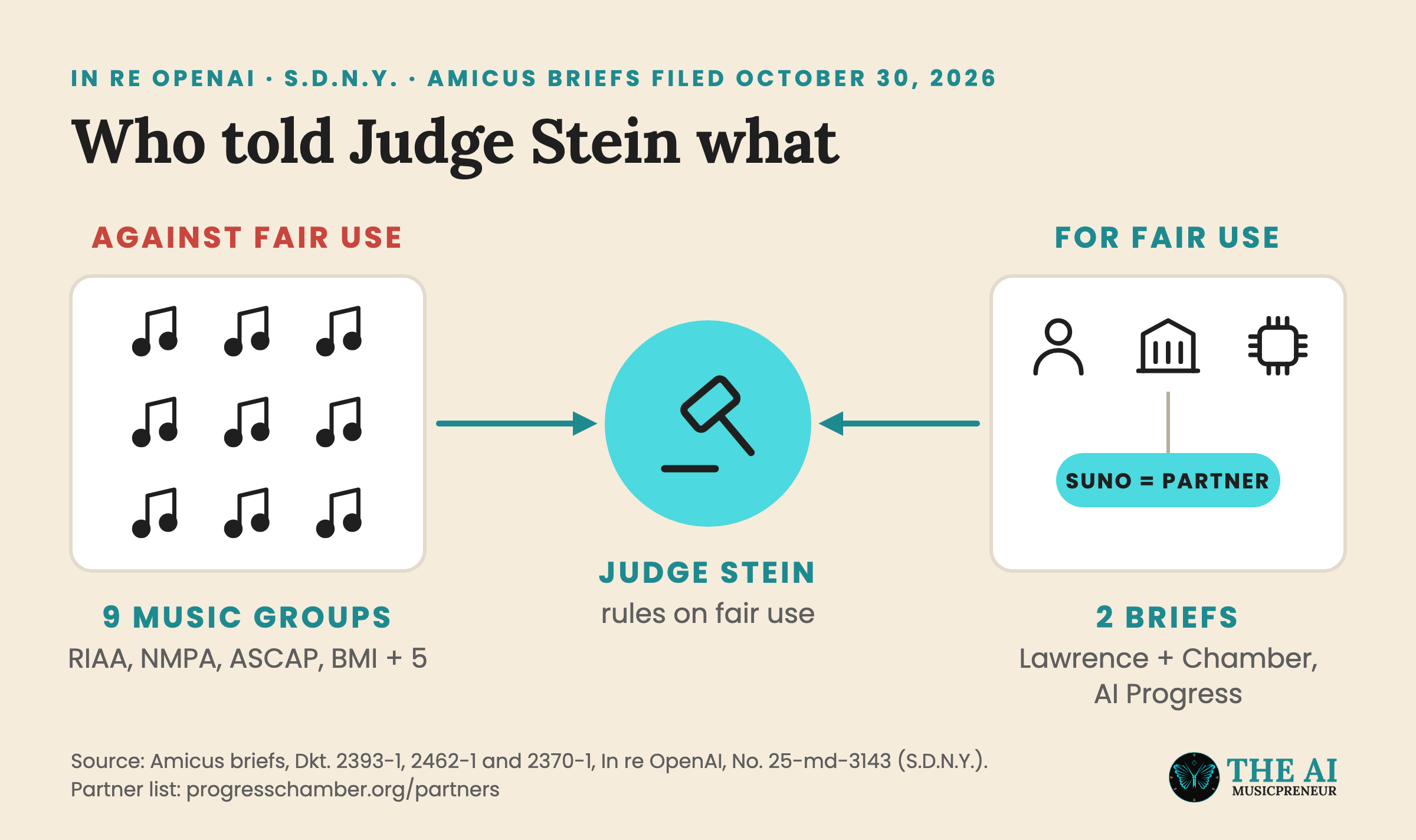
On October 30, 2026, 9 music organizations led by the RIAA asked Judge Sidney Stein to reject OpenAI’s fair use defense. The same day, Grammy-winning drummer Trevor Lawrence Jr. filed a brief telling him the opposite, together with Chamber of Progress, a tech group whose corporate partners include Suno.
Both briefs sit in In re OpenAI Copyright Infringement Litigation, the New York federal case where authors and the New York Times are suing OpenAI and Microsoft over AI training. It’s about books and news, not songs. But the question both sides want Judge Stein to settle without a trial, whether training AI on copyrighted work without a license is fair use, is the same one Suno, Udio and Anthropic are fighting the music business over.
A third brief, from the AI developer coalition A.I. Progress, also backed OpenAI. So the music industry now has its arguments on file in the biggest AI copyright case in the US, and so does a group that Suno helps fund.
Law-abiding authors pay for the modest universe of works that inspire them. They do not steal them by the millions and encode copies on their brains like an AI system does.
What the RIAA music brief tells Judge Stein about AI training
The music brief is signed by the RIAA, NMPA, A2IM, Songwriters of North America, the Black Music Action Coalition, the Recording Academy, ASCAP, BMI and the Artist Rights Alliance. Together, it says, their members “own or control the majority of music consumed in the United States.”
It names 3 defects in OpenAI and Microsoft’s fair use defense:
- Fair use exists to get humans making creative work, and the brief says copying songs to “generate digital imitations” does the opposite.
- On whether the use is “transformative”, it says the court has to look at the specific copying, not AI in general: “An AI model does not ingest romance poetry or bluegrass to learn about language or music at large, but rather to generate substitutes that read and sound like them in practice.”
- On market harm, it says AI “has the unique capacity to output endless content that displaces the market for and diminishes the value of the copyrighted works on which it trained.”
Then it points at deals. To prove there is “a robust marketplace for licensing music to train AI models,” the brief lists 6 of them, from KLAY and Stability AI to ElevenLabs and Spotify. Suno is on the list too, because Warner, BMG and Believe all licensed music to it (Warner’s deal came with its November 2025 settlement).
So Suno shows up in these filings twice: once as the music industry’s proof that licensing works, and once as a partner of the group arguing that training needs no license at all.
Why Trevor Lawrence Jr. backs OpenAI’s fair use defense
The Lawrence brief calls him a “multi-Grammy-winning drummer, producer, and developer” with credits for Dr. Dre, Eminem, Kendrick Lamar, Bruno Mars and Alicia Keys, plus the Super Bowl LVI halftime show. He filed with Chamber of Progress and the Abundance Institute, a nonprofit that works on emerging technology.
Its pitch is that “the outcome of this case is likely to shape music tools in addition to the generative AI tools that are the subject of this lawsuit.” And it makes the case with things every producer knows. Drum machines didn’t end drumming, because “talented drummers have continued to work, thrive, and create.”
Stem separation gets the same treatment. Engineers used “EQ, filters, and phase tricks” for decades to pull drums out of a mix, and AI now does it “more quickly and efficiently.” (That’s the job stem splitters like iZotope’s new Photon do.) The brief calls the activity underneath, “taking a recording apart to understand its construction and learn from individual performances,” older than any of these tools.
Most of the music evidence comes from Lawrence’s own podcast, The TrevBeats Show. One footnote cites session drummer Ash Soan describing clients who send him Suno-generated drum demos to show the feel they want, then ask him to play it himself.
On money, Chamber of Progress lists Suno, OpenAI, Google, Apple and Amazon among its partners. The brief says those partners “do not sit on its board of directors and do not have a vote on, or veto over, its positions.” It also takes “no position on how Defendants obtained the works,” so it defends the training and stays silent on the downloading.
A.I. Progress shows Amazon, Anthropic, Cohere, Google, Meta, Microsoft and OpenAI on its website, and its brief is docket 2370-1. That puts Anthropic, which music publishers are suing over lyrics, behind a brief that never names a song.
IFPI chief executive Victoria Oakley answered the cancer argument at Music Ally Connect in London in January 2025, as Music Ally reported: “You could go away and use generative AI now to help find a cure for cancer without requiring legislation that enables you to ingest all Taylor Swift’s music for free.”
How Judge Stein’s fair use ruling could reach Suno, Udio and Anthropic
Judge Stein sits in the Southern District of New York. So does Sony Music’s fight with Udio, across 2 lawsuits in front of Judge Alvin K. Hellerstein. The labels’ Suno case is in Massachusetts, and the publishers’ Anthropic case is in California.
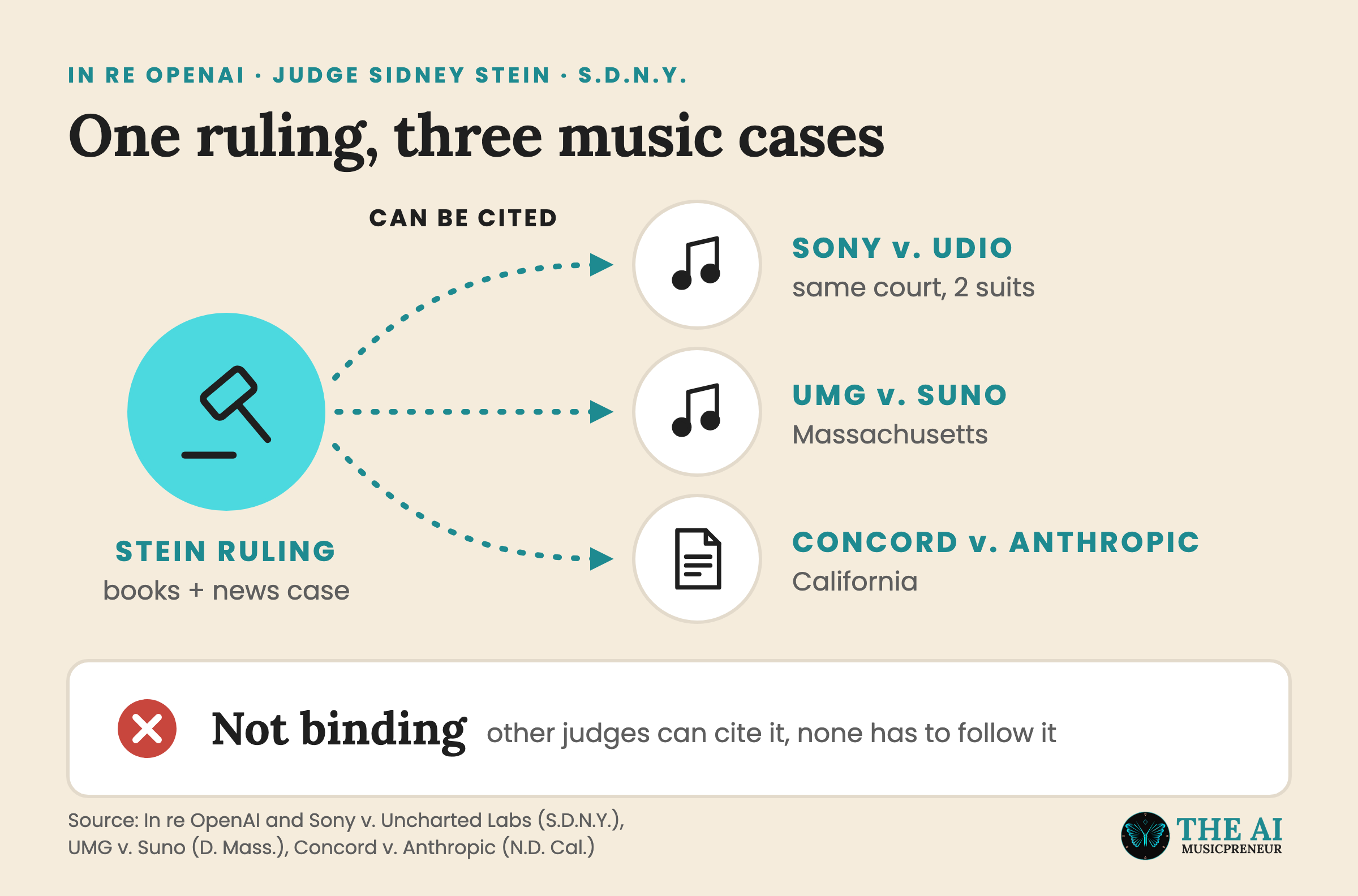
None of those judges has to follow Judge Stein, because a district court ruling binds only the case it’s made in. But, as Music Business Worldwide points out, a win for OpenAI would give Suno, Udio and Anthropic a fair use decision from a New York federal court to quote in their own defense. A loss would hand the labels and publishers the same thing.
That’s why the docket is this crowded. The Justice Department backed OpenAI on September 1. The AFM, SAG-AFTRA and the Writers Guilds filed against it on October 29, and the Music Artists Coalition joined Cate Blanchett’s licensing brief a day later.
The RIAA and NMPA have done this before. They filed in Thomson Reuters v. ROSS, the first US appeals ruling to reject fair use for AI training, and in the Anthropic lyrics case in April.
What the OpenAI fair use briefs mean for musicians who use AI tools
If you split stems, sketch drum parts in Suno, or hear your demo in another genre before you arrange it, the Lawrence brief is using your workflow as its evidence. That’s the part I’d pay attention to. It treats the tools you already use as proof that training on copyrighted music should stay fair use.
The RIAA brief’s target is unlicensed training. Its proof that licensing works names platforms many of you already use: Suno, Udio and ElevenLabs.
Honestly, the drummer’s brief and the RIAA brief agree on more than they let on. Both accept that AI music tools are here, and the RIAA brief even lists the licensed ones. Where they split is whether the songs inside those tools had to be paid for.
Judge Stein hasn’t ruled yet. When he does, I’d expect lawyers in the Suno, Udio and Anthropic cases to quote him fast, whichever way it goes.
Frequently asked questions
Who is Trevor Lawrence Jr., and why did he file a brief supporting OpenAI?
The brief describes him as a multi-Grammy-winning drummer, producer and developer whose credits include Dr. Dre, Eminem and Kendrick Lamar. He filed on October 30, 2026 with Chamber of Progress and the Abundance Institute, arguing that AI tools like stem separation and drum demos support human creativity, so training on copyrighted works is fair use.
Is Suno connected to the Chamber of Progress brief in the OpenAI case?
Suno is listed among Chamber of Progress's corporate partners, which support the group's work. The brief says partners do not sit on its board and have no vote on or veto over its positions. Suno is not a party to the OpenAI case and did not sign the brief.
Which music organizations signed the RIAA amicus brief in the OpenAI case?
9 groups signed it: the RIAA, NMPA, A2IM, Songwriters of North America, the Black Music Action Coalition, the Recording Academy, ASCAP, BMI and the Artist Rights Alliance. It was filed on October 30, 2026 as docket 2393-1, in support of the plaintiffs' summary judgment motions.
Would Judge Stein's OpenAI fair use ruling decide Sony Music's lawsuits against Udio?
No. A district court ruling binds only the case it is made in. Sony's 2 Udio lawsuits sit in the same court, the Southern District of New York, but before Judge Alvin K. Hellerstein. Udio could cite a ruling for OpenAI, and Sony could cite a ruling against it.
About the author
Covering AI music tools, industry shifts, and news for music creators and professionals. Twice-weekly newsletter at aimusicpreneur.com.