Alphabet shareholder sues Pichai, Page and Brin, says Google trained Lyria on copyrighted songs to pay damages later
My stack My fav 6 tools for AI music after testing 70+
-
 ElevenMusic · Music generation
-
 Moises · Stem separation
-
 Controlla · Voice swap & cloning
-
 Cryo Mix · Mixing + mastering
-
 Neural Frames · Music videos
-
 ONCE · Distribution
Some links are affiliate links — I earn a commission at no cost to you. Every tool here is one I run myself and truly believe in. This stack is proven.
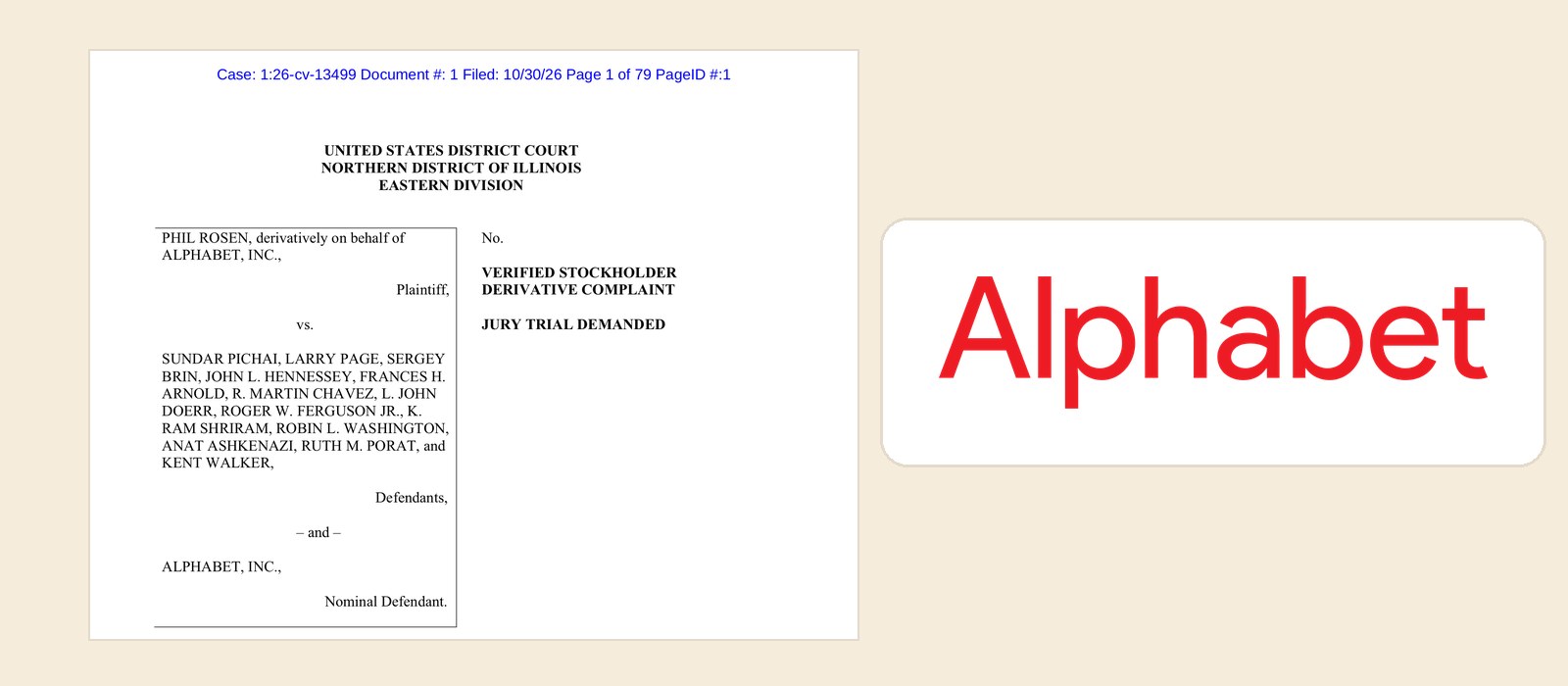
Google’s own leaders are now being sued over how Google trained its music AI. And the person suing them owns Alphabet stock.
Phil Rosen, an Alphabet shareholder, filed a 79-page complaint in Chicago federal court on October 30, 2026 against Sundar Pichai, Larry Page, Sergey Brin and 10 other directors and executives. It says they built Google’s AI, including the Lyria music models, on copyrighted songs on purpose, and planned to deal with the lawsuits later. Music Business Worldwide obtained and published the filing on November 2.
The strategy was carefully crafted to avoid spending the time and money necessary to obtain lawful licenses or permission from the copyright holders, and instead to simply pay damages later.
The case is Rosen v. Pichai, case 1:26-cv-13499 in the Northern District of Illinois. It names no damages figure, and Rosen wants a jury trial.
What is a shareholder derivative suit, and why Rosen’s damages would go to Alphabet
A derivative suit is a shareholder suing on the company’s behalf. The idea is simple: if the people running a company hurt it, and they won’t sue themselves, a shareholder can step in and do it for the company.
So Rosen isn’t asking for money for himself. Any damages the 13 defendants are ordered to pay would go to Alphabet, which sits in the case as the “nominal defendant”.
Normally a shareholder has to ask the board to sue first. Rosen argues that would be pointless, because the board would be deciding whether to sue itself.
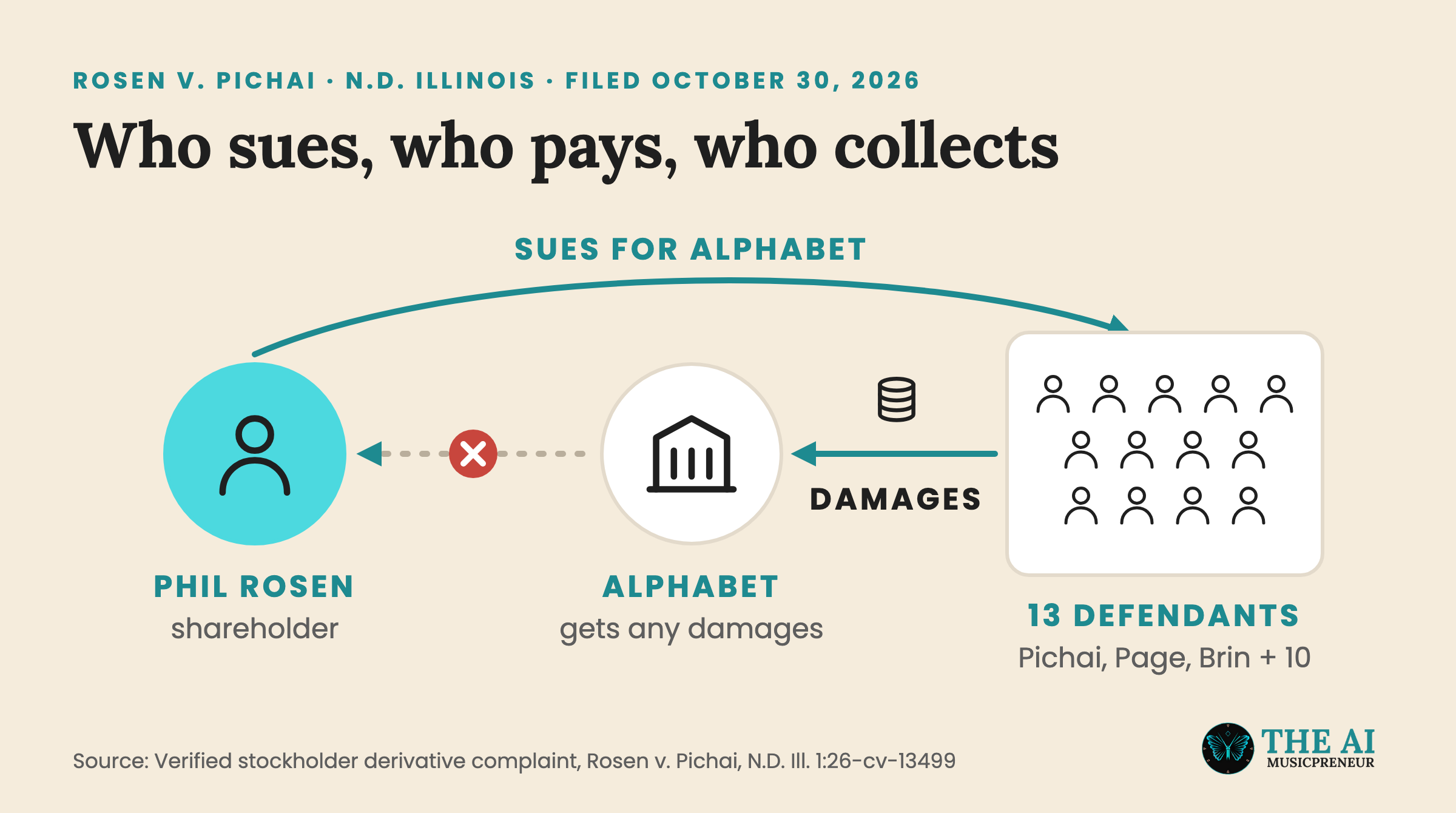
The complaint brings 3 claims: breach of fiduciary duty, unjust enrichment, and misleading proxy statements under Section 14(a) of the Securities Exchange Act. Besides Pichai, Page and Brin, it names Alphabet chair John L. Hennessy and 6 other directors, CFO Anat Ashkenazi, President and Chief Investment Officer Ruth M. Porat, and Kent Walker, Alphabet’s President of Global Affairs and Chief Legal Officer.
Rosen asks for 3 things. Damages paid to Alphabet, compensation handed back, and governance changes that “ensure the establishment of effective oversight of compliance with copyright and BIPA laws.” BIPA is Illinois’ Biometric Information Privacy Act, which covers voiceprints.
The pay part isn’t small. According to the complaint, Pichai received more than $30 million in compensation from 2023 to 2025.
Which brings it to the music.
What the Rosen complaint says about Lyria’s training data
The music section is short and blunt. “Alphabet and Google have engaged in copying millions of copyrighted sound recordings, musical compositions, and lyrics,” it says, and those copies “were used to build Lyria, Lyria 2, Lyria 3, Mulan, and MusicLM.”
Here’s the process as the complaint tells it. Google pulled audio from YouTube videos, converted it into machine-readable formats and cut it into clips for training. It also “stripped out all copyright information that identified the artists and their copyright notices.”
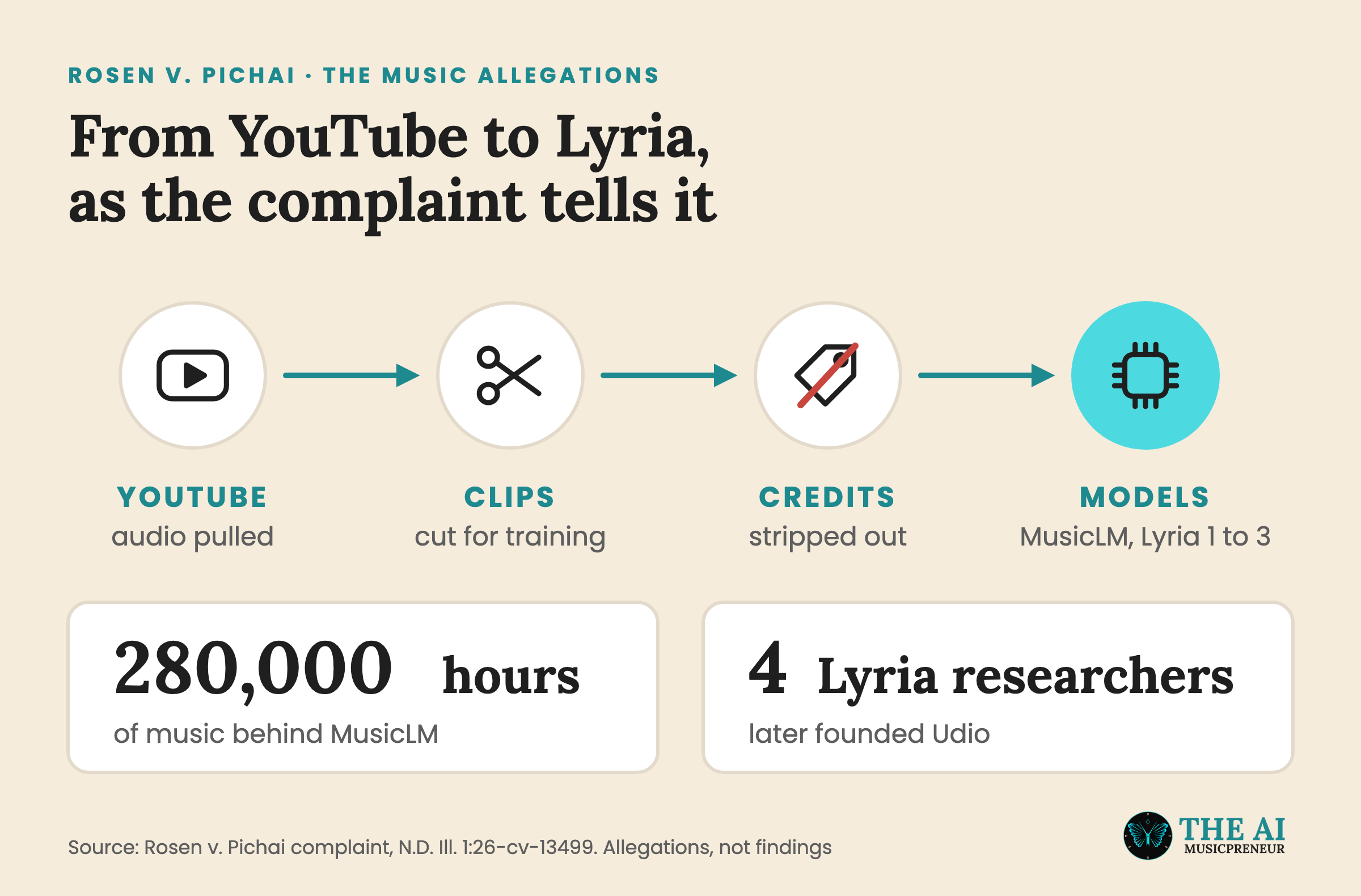
The complaint also points out that Google’s Lyria 3 model card says it “was trained on audio data” without saying whose. Lyria 3 is the model behind song generation in the Gemini app, launched in February 2026.
Then there’s the Udio link. When Google announced Lyria in November 2023, it credited 4 researchers as core contributors. According to the complaint, all 4 later left to launch Udio, which the major labels sued in June 2024 in the RIAA v. Udio case.
The complaint leans on a January 2024 Billboard report that Google trained its music model on copyrighted major-label recordings. It says Google later asked for permission only from “the largest and most sophisticated players in the industry and not individual copyright holders.”
One caveat: MBW notes that much of this section draws on the proposed class action independent musicians filed against Google in the same court in March 2026, and some passages repeat its wording. Google has asked that court to throw the musicians’ case out, arguing that YouTube’s terms already license uploads for AI training.
Why Rosen says Alphabet’s board misled shareholders about AI
Rosen also goes after what the board told investors. In its 2024 proxy statement, Alphabet said its board got regular updates from managers “immersed, on a daily basis, in the implementation of our AI Principles.”
That passage disappeared from the 2025 and 2026 proxies. The complaint’s reading: “The Director Defendants eliminated these statements because they were well aware that they should not have been placed in the 2024 Proxy Statement.”
It also quotes the board’s 2025 reply to a shareholder proposal on AI data use. Google, the board said, annotates “all AI assets with detailed tracking of data origins and usage (auditable lineage).” Rosen calls that false and misleading too.
The complaint calls the wave of AI lawsuits “blazing red flags” the board ignored. It lists the labels’ cases against Suno and Udio and the publishers’ cases against Anthropic, whose IPO filing lists 5 music lawsuits as risk factors.
It gets one of those wrong, though. It credits Anthropic’s $1.5 billion payment to the publishers’ first lawsuit. As MBW points out, Anthropic paid that sum in September 2025 to settle a separate class action by book authors.
Walker has argued the other side in public. In June he published a Google policy paper arguing that training on public web data is “a transformative, non-expressive use,” like “an art student taking inspiration from walking through a gallery,” per MBW.
And this isn’t the first suit of its kind. In August, a shareholder of the same name filed a similar derivative suit against Apple’s executives and board, MBW reported, citing Bloomberg Law.
Does Rosen v. Pichai get musicians paid for Lyria’s training?
No. Even if Rosen wins every claim, the money goes to Alphabet. Not to the artists whose recordings the complaint says went into Lyria.
The musicians’ own route to payment is the March class action, and that one turns on whether uploading to YouTube gave Google a license. Rosen v. Pichai leaves that question to the musicians’ case.
The one demand that touches training directly is the governance one: court-ordered copyright oversight of how Google picks its training data. For anyone with songs on YouTube, that’s the closest this case comes to your catalog.
For now it’s a complaint filed 4 days ago, and every claim in it is still an allegation.
Frequently asked questions
Who is suing Alphabet's directors over AI training in Rosen v. Pichai?
Phil Rosen, an Alphabet shareholder, filed the case on October 30, 2026 in the Northern District of Illinois, case 1:26-cv-13499. He sues 10 directors and 3 executives, including Sundar Pichai, Larry Page, Sergey Brin and Kent Walker, on Alphabet's behalf.
Which Google music models does the Rosen v. Pichai complaint name?
The complaint names Lyria, Lyria 2, Lyria 3, MuLan and MusicLM. It says all of them were built on audio drawn from YouTube videos, and that MusicLM was trained on 5 million clips totaling 280,000 hours of music.
Would Phil Rosen get paid if his Alphabet derivative suit wins?
Not in damages. In a derivative suit the shareholder sues on the company's behalf, so any money the 13 defendants are ordered to pay goes to Alphabet. Rosen also asks for clawed-back pay and court-ordered copyright oversight of Google's AI training.
How is Rosen v. Pichai different from the independent musicians' Lyria lawsuit against Google?
The musicians' March 2026 case is a proposed class action by rights holders who want payment for their own songs. Rosen v. Pichai is a shareholder suing Alphabet's leaders for exposing the company to those claims, and it reuses some of the musicians' wording.
About the author

Covering AI music tools, industry shifts, and news for music creators and professionals. Twice-weekly newsletter at aimusicpreneur.com.