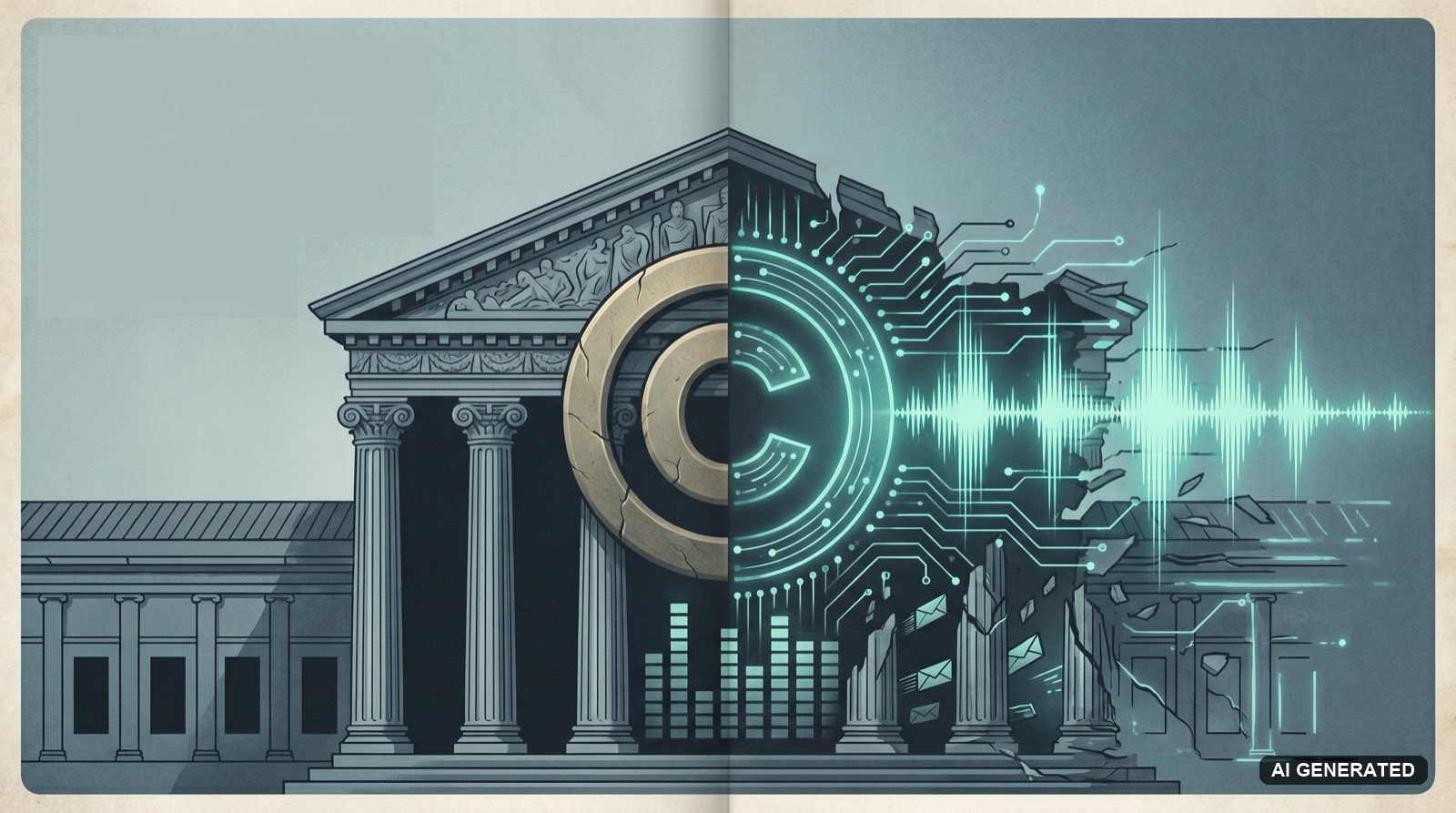
IFPI asks the EU to make AI companies disclose every song they trained on

IFPI wants AI companies to say which songs went into their models, song by song, and it wants Brussels to make that a legal duty.
The global record industry body put the ask in its Music in the EU 2026 report, launched at an event in Brussels on September 10. CEO Victoria Oakley used her introduction to press EU governments on a single point. The AI Act is already written. Now it has to be applied.
What IFPI wants added to the EU AI Act transparency template
The AI Act already tells the companies behind general-purpose AI models to publish a summary of what they trained on. The European Commission hands them a form to fill in for it, called the transparency template, and the code of practice behind it sets a minimum baseline rather than a full accounting.
IFPI says the baseline is too thin to act on. Its fix is a mandatory second tier, and the report spells out both levels:
- Tier one stays public. Enough detail for a rightsholder to work out whether their recordings were likely caught up in the training data.
- Tier two opens on request. A rightsholder trying to license or enforce gets a detailed record of the content used, including the copyright-protected material.
On top of that, the report asks for song-by-song disclosure of the works used, or a full list of the data sources a developer reached for.

Why IFPI says EU member states could still water down the AI Act
The worry behind the report is not the text of the law. It is what happens after Brussels hands the law to 27 national governments to put into practice, which is where earlier EU rules the music industry welcomed got softened or slowed down.
So the report goes past the Commission and asks member states for their own measures. It wants national rules on liability when an AI developer ignores its AI Act duties, procedures that force disclosure, and rules that lighten the evidence burden on rightsholders in court when a model provider has not been open about its training data. It points to a proposal in France as the working example.
Only by applying the rules as they were intended can we properly evaluate their effectiveness and then make informed decisions about whether, and how, the framework should evolve.
That last line is aimed at a live argument in Brussels over whether the AI Act should be reopened and loosened before it has been tested. Oakley’s answer is to run the rules as written first.
What song-level training disclosure would mean for independent artists
The honest version: tier two would be used by whoever can afford to use it. A major label or a collecting society has lawyers to send that request and read what comes back. An independent artist would be leaning on a distributor or a society to ask on their behalf.
The reason it still matters to you sits one step earlier in the chain. Nobody can price a licence for a catalogue, or prove a track was used, without first knowing what went into the model. IFPI puts it flatly in the report: without effective transparency, there is no effective licensing of copyright, and no effective enforcement.
That is the same wall the transparency rules that took effect in August ran into. The duty to mark AI audio landed on the tool makers, and the training-data question was left to a summary whose depth the Commission never pinned down.
How the AI-Generated and AI-Assisted labels fit IFPI’s Brussels ask
The report pairs the disclosure demand with the labelling work the industry is already doing on its own. It points to a framework that would let listeners tell an “AI-Generated” track from an “AI-Assisted” one while streaming, and to global rules deciding when an AI-made recording can chart.
Both already have a paper trail. The two-tag system arrived through a joint RIAA and IFPI proposal, and the chart rules have started landing in national markets, with Finland’s official chart shutting out AI music unless humans did most of the work with licensed tools. Listeners have asked for the labels too, with 77% of Nordic respondents saying AI tracks should be marked.
Platforms are moving at their own pace, and Apple Music’s Made With AI tag still leans on what an artist declares at upload. A label a listener can see does nothing about what a model was fed. That is the gap IFPI took to Brussels, and it is the one the transparency template would have to close.
Oakley’s report went out the same day AIM boss Gee Davy told the UK government much the same thing in London, per Music Ally. Two industry bodies, two capitals, one message about rules that already exist.
Frequently asked questions
What is the IFPI Music in the EU 2026 report?
It is the annual policy report from IFPI, the global body representing record companies, launched at a Brussels event on September 10, 2026. It sets out what record companies say they contribute to the European music economy and what they want EU policymakers to do next. The 2026 edition puts the EU AI Act at the centre of its asks.
What is the two-tier transparency template IFPI wants under the EU AI Act?
Tier one would stay public, giving rightsholders enough information to judge whether their music was likely used to train a model. Tier two would open on request, handing a rightsholder who wants to license or enforce a detailed record of the training content. The AI Act already requires a public training-data summary, and IFPI argues the existing form is too shallow to act on.
What did Victoria Oakley say about enforcing the EU AI Act?
The IFPI chief executive wrote that the strategic priority must be the absolute and uncompromising implementation and enforcement of the AI Act rules, including giving rightsholders practical means to enforce them. She added that only by applying the rules as intended can their effectiveness be judged before deciding whether the framework should change.
Does the EU AI Act make AI music companies list the songs they trained on?
Not song by song. The Act requires developers of general-purpose AI models to publish a sufficiently detailed summary of the content used for training, and the European Commission's template sets a minimum baseline for that summary. IFPI is asking for work-by-work disclosure, or a full list of data sources accessed, on top of what the template asks for today.
About the author

Covering AI music tools, industry shifts, and news for music creators and professionals. Twice-weekly newsletter at aimusicpreneur.com.