After beating Suno, GEMA wants AI music output to pay songwriters, says general counsel Kai Welp
My stack My fav 6 tools for AI music after testing 70+
-
 ElevenMusic · Music generation
-
 Moises · Stem separation
-
 Controlla · Voice swap & cloning
-
 Cryo Mix · Mixing + mastering
-
 Neural Frames · Music videos
-
 ONCE · Distribution
Some links are affiliate links — I earn a commission at no cost to you. Every tool here is one I run myself and truly believe in. This stack is proven.

GEMA beat Suno in a Munich court in July. Now its top lawyer says that win won’t get songwriters paid on its own.
Dr. Kai Welp, GEMA’s general counsel, told Music Ally’s Joe Sparrow what GEMA wants next on the Music Ally Focus podcast, episode 189, published November 2, 2026. Asked where he wants things to be in 5 years, he named one thing first.
The most important thing is that we get an output remuneration for the authors and for the publishers.
Music Ally’s write-up carries that line. The other quotes below are my transcription of the 23-minute episode.
What is output remuneration, and who would pay GEMA for AI music?
Output remuneration means songwriters get paid each time AI music is made or used, on top of any license fee for training.
Welp splits AI music into 2 cases. If you can hear the original songs in the output, like in remix tools built on licensed catalogs, he wants normal licenses per work, from publishers and from collecting societies like GEMA.
The hard case is the other one, where nobody can trace the output back to a song. “Then you need some kind of collective management, because you cannot attribute the output to an individual rights holder,” he said.
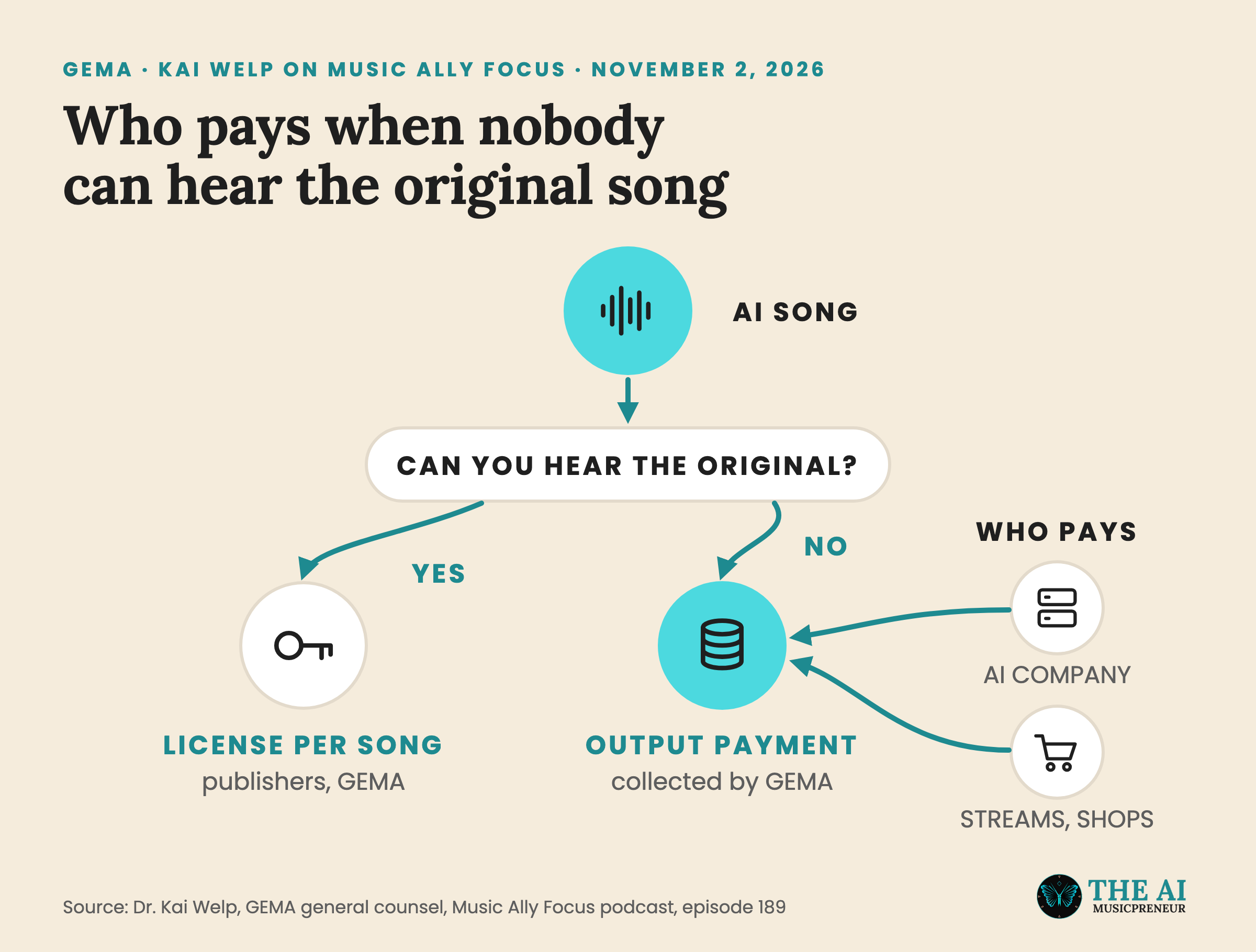
So who pays? Welp named 2 payers.
The AI company, when its model generates the music. And users who play it, “for example, on Spotify or as background music in supermarkets.”
GEMA already licenses that second group, streaming services and shops. “So that would be our job to collect the money from such a claim,” Welp said. (If that sounds familiar, it works a lot like the levy Germany already charges on devices and blank media, paid into a pot because nobody can track what you copied.)
His reason is background music. If people use AI music as background music, they “do not have to pay a licence fee,” he told Music Ally, so songwriters “will lose a lot of money and we need a compensation for that.”
Why can’t the courts just fix this?
Why Kai Welp says GEMA’s Suno win won’t fix AI training
GEMA won its Munich case against Suno on July 31, 2026. Welp explained how: GEMA typed lyrics into Suno, found the original songs in what came out, and brought in an expert to compare the compositions.
But he was blunt about the limits. “To be honest, we do not believe that our court cases will really resolve the problem with copyright and AI,” he said.
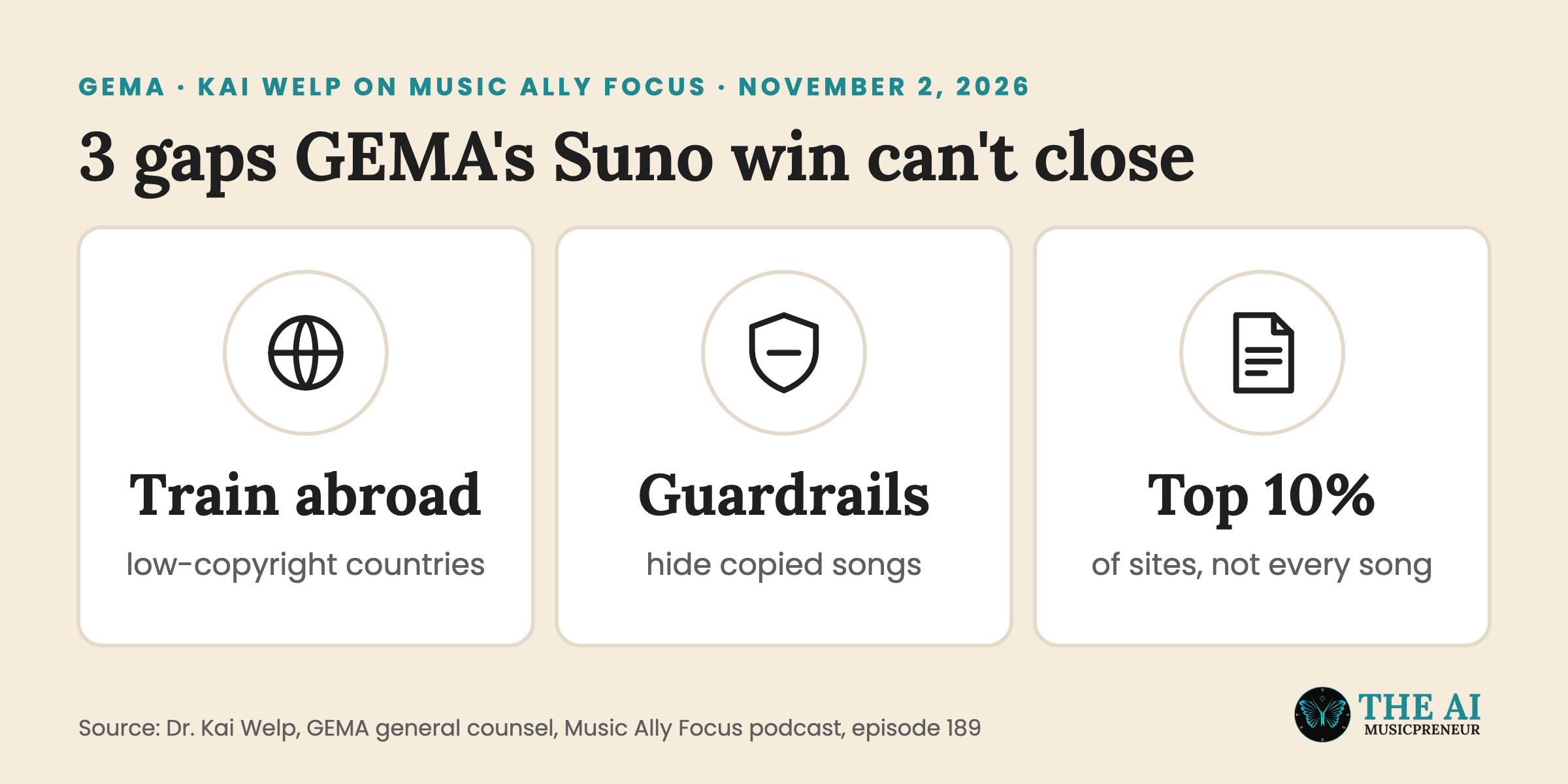
The first gap is geography. AI companies can still train in countries with weak copyright protection, and under GEMA’s own ruling, no training money would come from that.
The second is the output. GEMA’s cases rely on finding protected songs in what a model spits out. With guardrails in place, a model trained on GEMA’s works might never output anything GEMA can point to.
There’s one upside. The Munich case covers 6 works and isn’t final yet. If it becomes final, Welp said GEMA could sue Suno over its whole repertoire, because Suno “publicly admitted that they trained with the world repertoire of music.”
You can follow that in my GEMA v. Suno tracker.
Why GEMA calls the EU AI Act really not sufficient for AI music
The third gap is the law that was meant to help. Under the EU AI Act, AI model makers have to publish a summary of their training data, using a template from the European Commission.
Welp’s problem is that the template asks for the top 10% of scraped website domains. “What we need to sue them is information on a work-by-work basis,” he said. (The IFPI asked the EU for song-by-song disclosure in September, too.)
He also said he couldn’t find a summary on Suno or Udio, and that by his reading of the Commission’s guidelines, AI music companies aren’t under the obligation at all.
And GEMA can’t enforce it either. It’s “just public law and can only be enforced by the AI office,” Welp said, not by rights holders or collecting societies.
What he wants instead is new law: a fix for training abroad, real transparency, and a new right on the output side that collecting societies can enforce together. He expects GEMA to lobby for it once the Commission starts its legislative process, but he isn’t promising speed. “People say it takes seven years for the legislation in the European Union,” he said.
What GEMA wants from AI licensing deals like Warner’s with Suno
GEMA doesn’t know what’s in the label deals. Welp said that about licenses like the Warner and Suno deal and Universal’s Udio platform.
What GEMA does know: remixes need the songwriters’ consent, and the deals seem to use an opt-in for that. Training rights are the open question. And Welp said the current deals only cover Anglo-American repertoire, while GEMA wants to license European songs too.
It already does that on a small scale. PLAI by GEMA is a licensed set of 178,000 audio files for AI tools that don’t generate music, and its first customer is Klangio, which turns audio into sheet music.
Welp’s other worry is synthetic data, meaning AI models trained on the output of earlier AI models. The further training drifts from human-made music, the harder it gets to prove anything in the output.
He doesn’t accept the label, though. “I don’t like the term synthetic data because it’s not synthetic, because the basis was human-made, otherwise it wouldn’t exist,” he said.
Frequently asked questions
What is output remuneration in GEMA's AI music proposal?
It is a payment owed when AI music is generated or used, on top of any license fee for training. GEMA's general counsel Kai Welp says it should cover AI output that can't be traced to individual songs, and be collected collectively for songwriters and publishers.
Who would pay GEMA's proposed output remuneration for AI music?
Kai Welp named 2 payers on Music Ally Focus in November 2026: AI companies when their models generate music, and users who play that music, such as streaming services or shops using it as background music. GEMA would collect through the licensing channels it already runs.
Can GEMA sue Suno over its whole repertoire after the Munich ruling?
Not yet. The July 31, 2026 Munich ruling covers 6 works and isn't final. Kai Welp said that if it becomes final, GEMA could sue Suno over its whole repertoire, because Suno has said it trained on the world repertoire of music.
Can GEMA enforce the EU AI Act's training data summary itself?
No, according to GEMA's general counsel Kai Welp. He says the summary duty is public law, so only the EU AI Office can enforce it, not individual rights holders or collecting societies like GEMA.
About the author

Covering AI music tools, industry shifts, and news for music creators and professionals. Twice-weekly newsletter at aimusicpreneur.com.