
Musicians' union AFM joins SAG-AFTRA and WGA in asking a judge to reject OpenAI's fair use argument
My stack My fav 6 tools for AI music after testing 70+
-
 ElevenMusic · Music generation
-
 Moises · Stem separation
-
 Controlla · Voice swap & cloning
-
 Cryo Mix · Mixing + mastering
-
 Neural Frames · Music videos
-
 ONCE · Distribution
Some links are affiliate links — I earn a commission at no cost to you. Every tool here is one I run myself and truly believe in. This stack is proven.
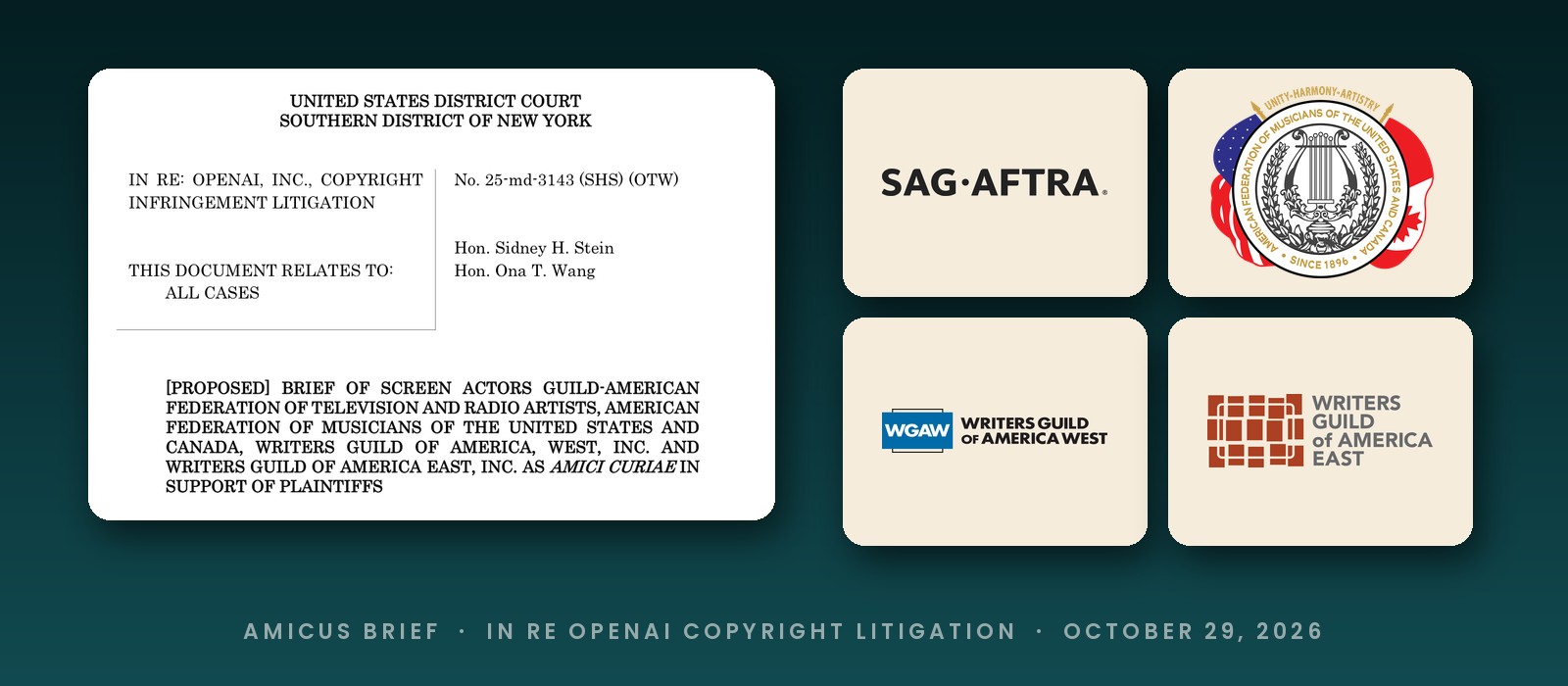
The American Federation of Musicians has joined SAG-AFTRA and the Writers Guilds of America West and East in asking a federal judge to throw out OpenAI’s fair use defense. The 4 unions filed a 34-page proposed amicus brief on Thursday, October 29, 2026, in the consolidated copyright case against OpenAI and Microsoft in New York.
An amicus brief is a filing from someone who isn’t in the case but wants the judge to hear their side. Here, that’s more than 250,000 working writers, actors, singers and musicians, and they want Judge Sidney H. Stein to say no to the idea that training AI on their work is automatically fair use.
What the AFM, SAG-AFTRA and WGA brief asks Judge Stein to do
The case is called In re OpenAI, Inc. Copyright Infringement Litigation, and it bundles the lawsuits from the New York Times, The Intercept, the Authors Guild and writers like George R.R. Martin, John Grisham and Jodi Picoult. OpenAI argues that training its models on their work is fair use, the legal defense that lets you copy without permission in some cases.
The unions’ ask is simple: don’t decide that for everyone at once. The brief says this AI training dispute is “no more than an ordinary copyright case” and should be judged case by case. That line comes from the Third Circuit’s ROSS ruling from September 29, 2026, the first US appeals decision that AI training was not fair use.
The unions also argue a blanket rule would “effect a potentially enormous transfer of value” from the people who make the work to the companies that train on it. They point at the size gap on purpose: the brief puts OpenAI’s valuation at about $1.4 trillion and Microsoft’s above $2.7 trillion.
It also answers the US government directly. In September, the Justice Department told the same court that training is fair use and called license fees “large subsidies for old mainstream media companies.” The unions’ reply is that those payments are wages and health care, and they exist because the unions bargained for them.
So the brief is mostly about writers and the news business. Musicians get their own section, though.
Why a fair use ruling for OpenAI would reach musicians’ recordings
A ruling in OpenAI’s favor wouldn’t stay inside books and newspapers. The brief says a foundation model “trained on everything” powers products that make “scripts, songs, voices, and video,” so a categorical ruling “would reach all uses across all industries.”
A musician's sound, tone, and technique are their most important professional asset, and every recording they play on captures it.
The brief backs that up with music numbers. It cites Deezer’s July 2026 figures, where fully AI-generated tracks passed half of daily uploads, about 90,000 tracks a day. It also cites a CISAC study projecting that AI music could take about 60% of music library revenues by 2028, with roughly a quarter of music creators’ revenues at risk.
For the AFM, this is the second case about AI training without pay. It’s already suing Universal and Warner for licensing session recordings to Suno and Udio, and the brief notes the AFM added AI safeguards for musicians in its 2024 agreement, including pay when their work is used to generate AI output.
Now the part that explains why unions care about this case at all.
How the unions’ AI licensing deals depend on OpenAI’s fair use argument failing
In their 2026 contracts, SAG-AFTRA and the WGA won a notice-and-bargaining right whenever studios license covered work to train commercial AI. In plain words: if a studio sells your work as training data, the union has to be told and gets a seat at the table.
That deal only means something if training is something you have to license. The brief says it straight: a ruling that training is categorically fair use “would render moot the terms the unions and the industry agreed to at the bargaining table.”
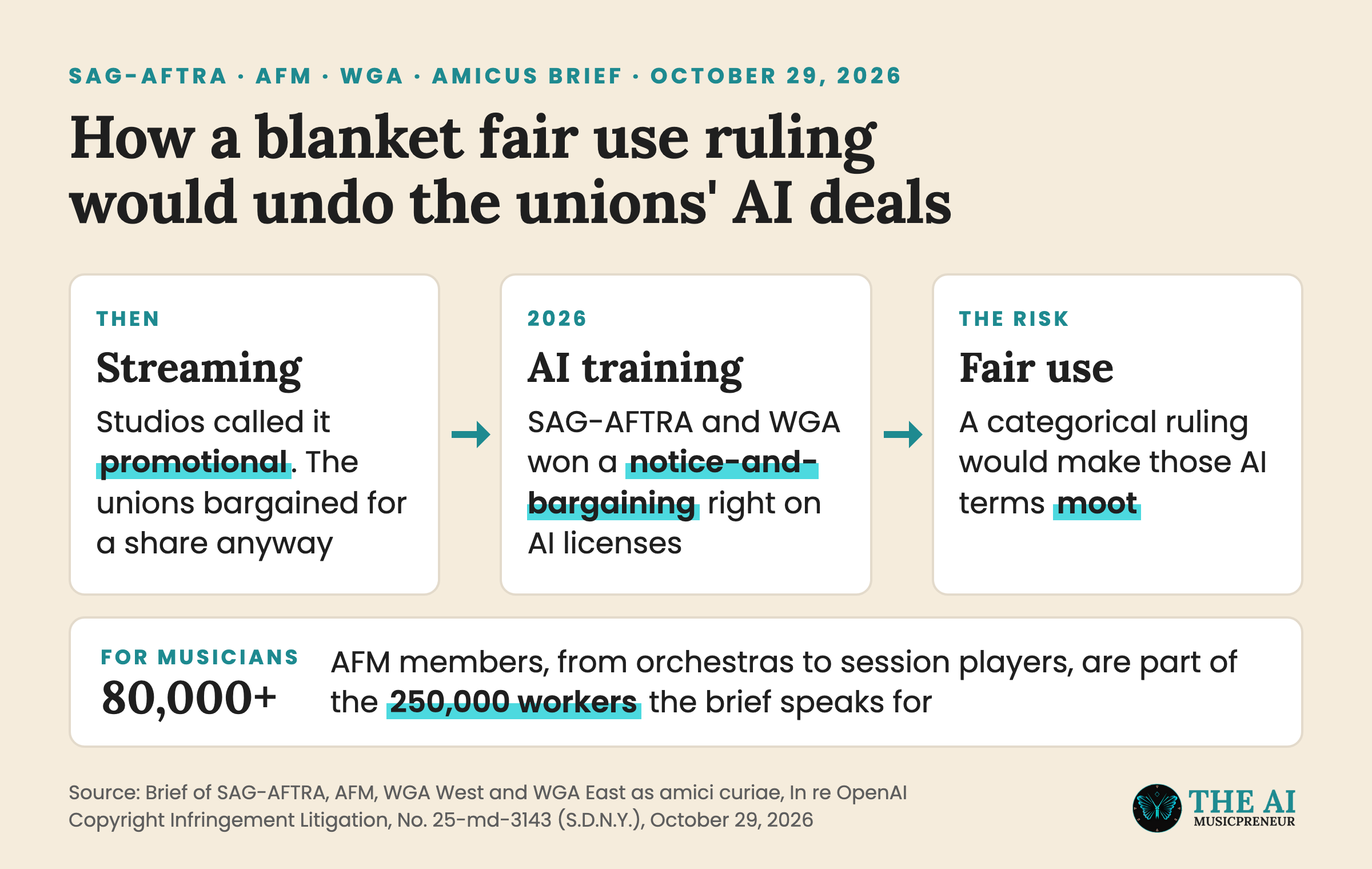
The unions point to streaming as proof. When studios started streaming shows, they called it “just promotional.” The unions bargained for a share anyway, and the brief says streaming payments are now a key part of members’ pay. Their read on AI training data is the same: small and speculative today, a real market tomorrow. Or as the brief puts it: “The Unions have heard all this before. Repeatedly.”
The AFM’s own contract cycle is still open. The brief says its current collective bargaining agreement runs until mid-2027, and the union is pushing its Human Made, Human Paid campaign into label talks that resume on November 3, 2026. A fair use win for OpenAI could hand the labels’ side an argument at that table too.
What happens next in In re OpenAI Copyright Infringement Litigation
The filing is marked “proposed,” so Judge Stein first decides whether to accept it into the record. If he does, it sits next to the government’s statement and the parties’ own fair use briefs when he rules.
Music has its own version of this fight running at the same time. Judge Eumi Lee is weighing fair use in Concord v. Anthropic, and the AFM case against Universal and Warner has its own case tracker. Whichever judge rules first, the other one will have that ruling on the desk.
Frequently asked questions
Is the American Federation of Musicians a party to the OpenAI copyright case?
No. The AFM signed on as an amicus curiae, a friend of the court that isn't suing anyone. The plaintiffs are news outlets and authors, including the New York Times, The Intercept, the Authors Guild and writers such as George R.R. Martin and John Grisham.
Does Judge Sidney Stein have to accept the unions' amicus brief in the OpenAI case?
No. The filing is labelled a proposed brief, so the court decides whether to accept it into the record. It was filed on October 29, 2026 by lawyer Danielle S. Van Lier, whose admission to the New York court was still pending.
Which unions in the OpenAI amicus brief represent musicians and singers?
The American Federation of Musicians represents over 80,000 musicians, from orchestras and backup bands to session players on film, TV and record dates. SAG-AFTRA's 160,000 members include recording artists, singers and DJs, so both unions cover people whose recordings end up in training data.
About the author

Covering AI music tools, industry shifts, and news for music creators and professionals. Twice-weekly newsletter at aimusicpreneur.com.