Concord v. Anthropic: publishers cite almost 120,000 AI lyric prompts as Judge Lee weighs fair use
My stack My fav 6 tools for AI music after testing 70+
-
 ElevenMusic · Music generation
-
 Moises · Stem separation
-
 Controlla · Voice swap & cloning
-
 Cryo Mix · Mixing + mastering
-
 Neural Frames · Music videos
-
 ONCE · Distribution
Some links are affiliate links — I earn a commission at no cost to you. Every tool here is one I run myself and truly believe in. This stack is proven.
Almost 120,000 prompts asking Claude to write “new” song lyrics. That is the evidence the music publishers put in front of US District Judge Eumi K. Lee in San Jose on Wednesday, October 21, 2026, to argue that Anthropic’s AI competes with the songwriters it learned from.
Anthropic’s answer is that training Claude on the lyrics to 499 songs is fair use, and that nothing in the record shows harm to the music business. Lee heard both sides’ summary judgment motions over several hours, aimed much of her questioning at market harm, and has not ruled.
It is the first time a federal district judge has heard summary judgment arguments on AI training and fair use since the Bartz v. Anthropic and Kadrey v. Meta rulings in 2025, according to the litigation tracker ChatGPT Is Eating the World. So every lawyer in the AI music cases waiting behind this one will read her ruling closely.
What happened at the Concord v. Anthropic fair use hearing on October 21, 2026
Lee came to court with 8 binders of case material, Bloomberg Law reported, and pressed both sides on whether this becomes the first AI copyright case to reach trial.
Matthew Oppenheim argued for the publishers: Concord, Universal Music Publishing Group and ABKCO, 8 publishing companies in all. He told the court Claude reproduces their lyrics, sometimes verbatim, according to Courthouse News.
He went after 2 kinds of output. Mashups, where Claude mixes real lyrics into its answers. And “synthetic” songs written in an artist’s style, which he said end up competing with human songwriters.
“It’s not curing cancer, it’s to create other lyrics,” he said. “It couldn’t do it if it didn’t have the lyrics in the database.”
Lee asked the obvious follow-up: would that give the publishers a monopoly, where nobody, AI included, can write in an old song’s style without a licence? Oppenheim didn’t back off.
Copyright is a monopoly by nature. That's not a bad word in the context of copyright.
Sonal Mehta, arguing for Anthropic, said users are the ones “pushing the button” when they ask for lyrics, or for a song like Taylor Swift’s, so Anthropic only carries secondary liability. Claude doesn’t take lyrics specifically, she said, it learns from “vast, vast amounts” of content.
Lee took the motions under submission without saying which way she leans. And one day wasn’t enough: according to The Epoch Times, the parties didn’t get through all their motions, and Lee asked them about continuing on dates later in October or in early November.
What the publishers and Anthropic asked Judge Lee to decide in Concord v. Anthropic
Summary judgment means a judge decides a claim without a trial, because the facts aren’t really in dispute and only the law is left. Both sides think they deserve that here, which is why these are called cross-motions.
The publishers filed first, on March 23, 2026, and their motion is public, with redactions. They say nobody disputes that Anthropic copied the lyrics to their 499 songs into Claude’s training data and then into Claude’s answers, and that fair use fails for both.
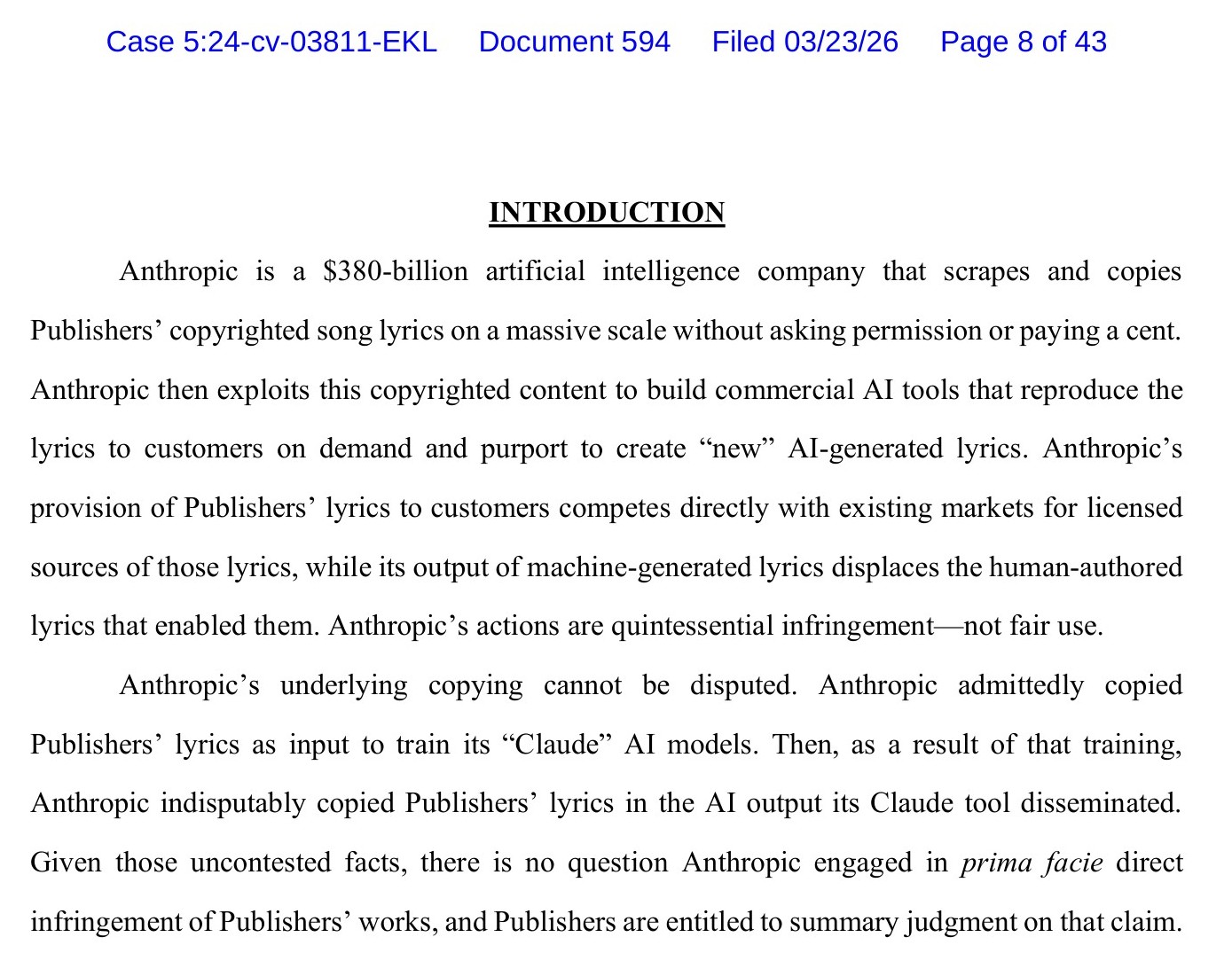
Anthropic filed its own motion in April. “Anthropic’s use of lyrics to Publishers’ 499 songs (along with billions of other copyrighted works) to train Claude is ‘transformative,’ fair use,” it opens, as Digital Music News reported. It also argues that copyright owners shouldn’t get a veto over a technology like Claude.
Two side fights were on the calendar too. Daubert motions decide whether an expert witness gets to testify at all, and the docket shows the publishers trying to exclude or narrow at least 7 experts.
The other is the DMCA claim that Anthropic stripped title and credit data from the lyrics. On October 12, Lee asked both sides for extra briefs on what the Ninth Circuit’s new ruling in Doe 1 v. GitHub, the GitHub Copilot case, means for that claim.
Is training Claude on song lyrics fair use? The 4 questions in Concord v. Anthropic
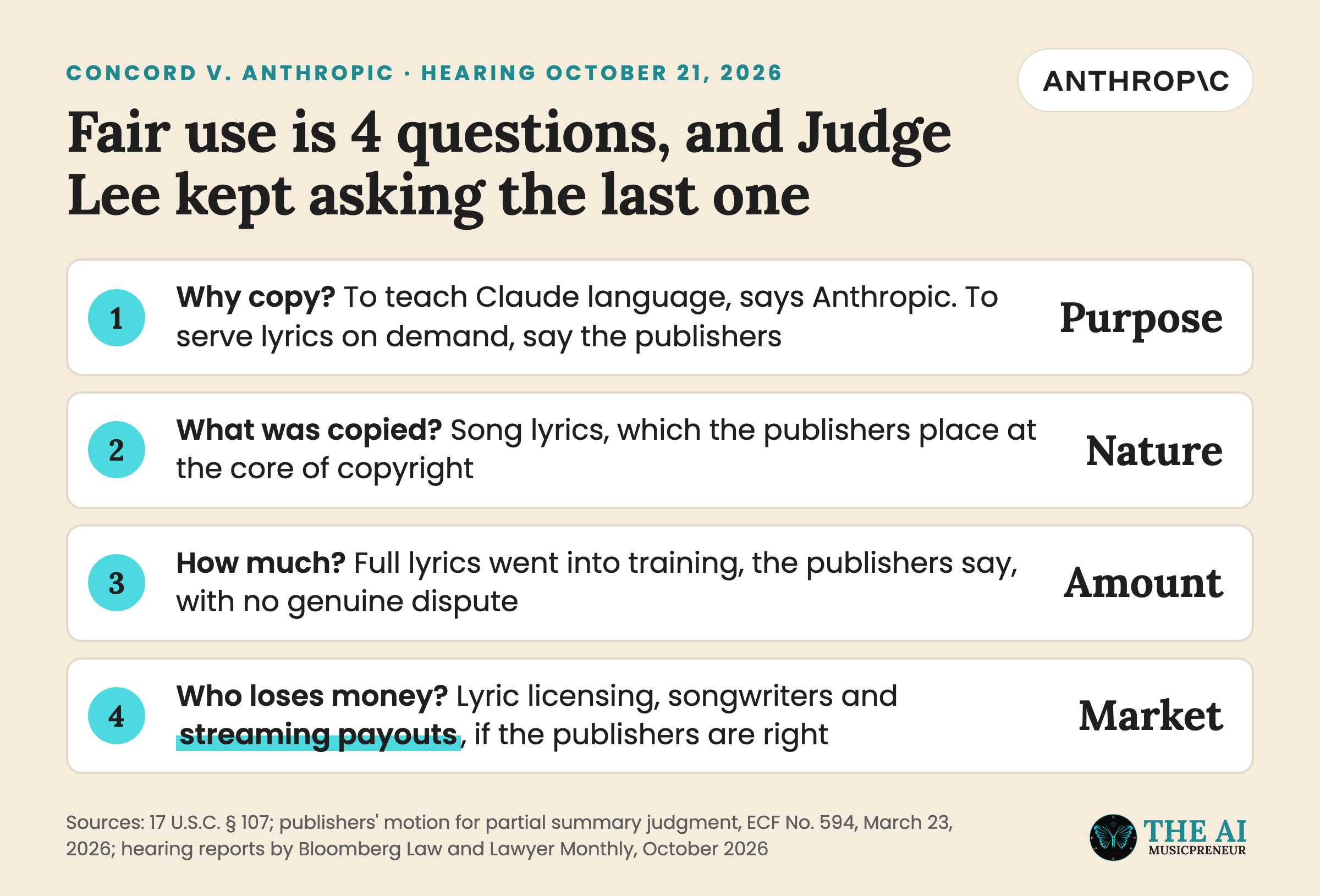
Fair use is the part of US copyright law that lets you copy without permission in some cases, like quoting a lyric in a review. Judges weigh 4 questions written into Section 107 of the Copyright Act: why you copied, what you copied, how much you took, and whether your copy costs the owner money.
Two California judges ruled on books in June 2025. Judge William Alsup called Anthropic’s training on books “exceedingly transformative” in Bartz, and Judge Vince Chhabria sided with Meta in Kadrey because the authors brought no real evidence of market harm.
In neither case did the books come back out of the model. The publishers say Claude does exactly that with their lyrics.
The only appeals court to rule so far went the other way. In September 2026 the Third Circuit held in Thomson Reuters v. ROSS that training a legal research AI on Westlaw’s headnotes was not fair use. It doesn’t bind a California court.
Lee has ruled on training in this case once before. In March 2025 she refused to block Anthropic from training on lyrics while the case ran, without deciding whether that training is legal. That’s the question she now has to answer.
Why market harm decides Concord v. Anthropic
The Supreme Court called the 4th factor “undoubtedly the single most important element of fair use” in Harper & Row v. Nation Enterprises in 1985, and Lee spent much of Wednesday on it. The publishers’ motion lists 3 ways they say Claude costs them money:
- Lyrics on demand. When Claude answers “give me the lyrics”, it stands in for licensed sources like LyricFind, Musixmatch and Genius, which pay for that right.
- AI lyrics that compete. Synthetic songs flood and dilute the market, the risk Chhabria warned about in Kadrey, and on streaming services that pay from one shared royalty pool, every AI track takes a share from human songwriters.
- Training licences. Publishers already license their works for AI training, including to Udio and Klay Vision, so skipping the licence undercuts a market that already exists.
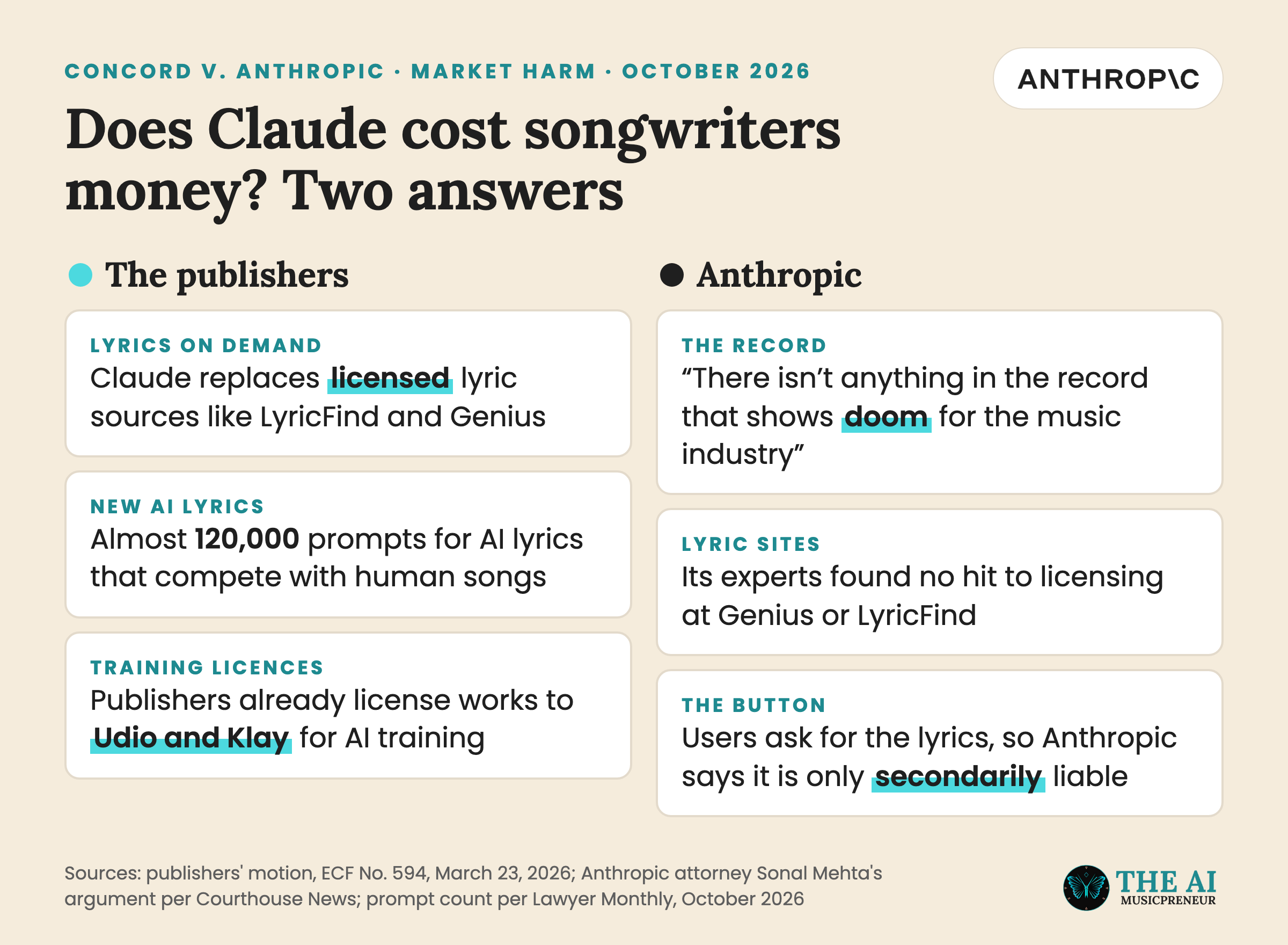
At the hearing, Oppenheim said Claude received nearly 120,000 requests to generate “synthetic” lyrics over a 6-month period, Reuters reported. Their March filing had blacked those counts out.
Anthropic’s answer was blunt. “There isn’t anything in the record that shows doom for the music industry,” Mehta said. Its experts found no hit to licensing and no effect on Genius or LyricFind, she added, and the synthetic songs are new material that doesn’t push human artists out.
The law doesn’t stop at money already lost, though. It also counts harm to the potential market, and the publishers rely on exactly that. If Claude’s kind of use became widespread, their motion argues, it “would destroy Publishers’ ability to license lyrics in the future.”
What a Concord v. Anthropic ruling could mean for your lyrics and your AI tracks
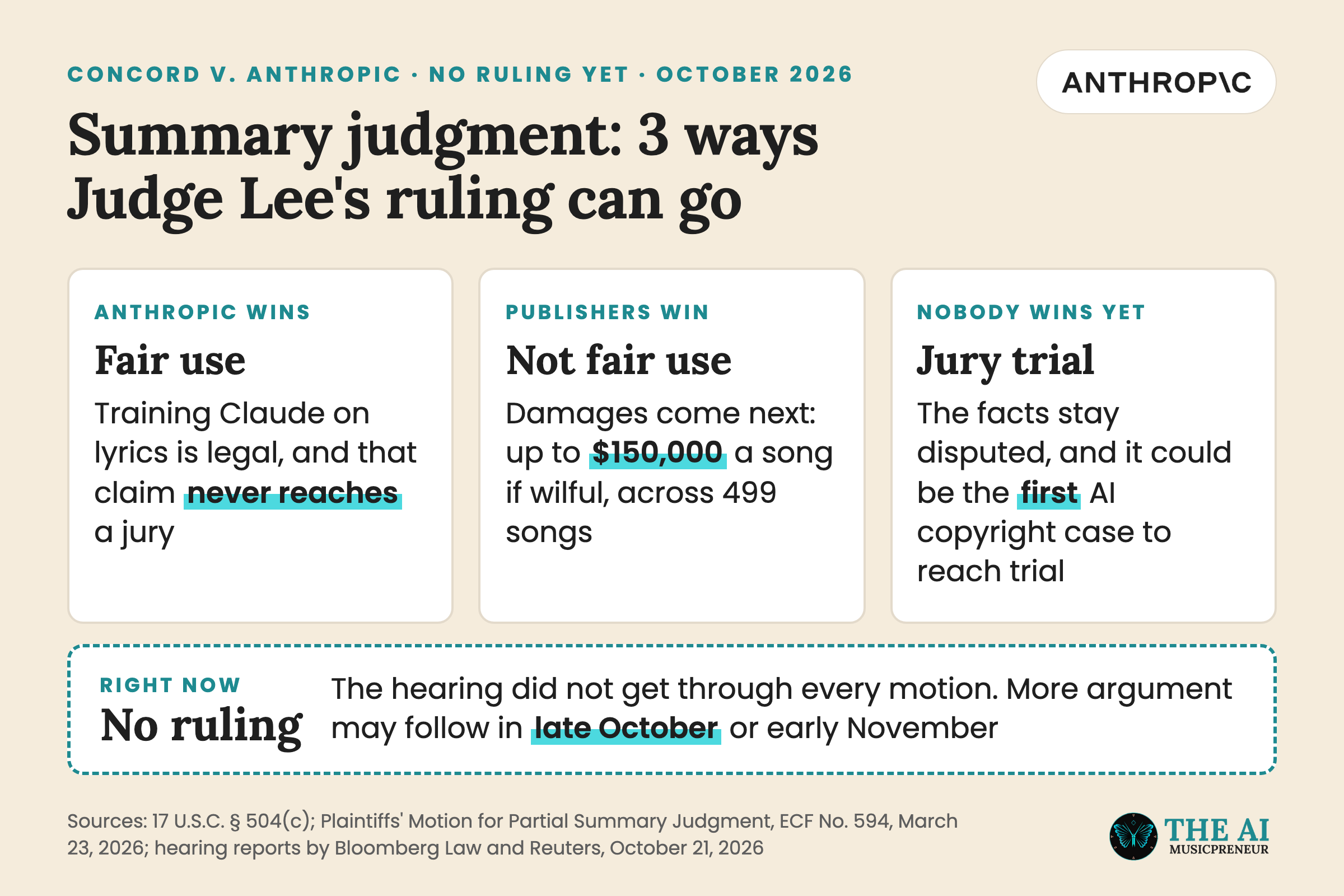
Lee can also split it, ruling one way on training and another on Claude’s output.
If you write songs and have a publisher, your publisher is the side suing, and the training-licence argument is about your money. A publisher win puts a price on lyrics as AI training data. The NMPA’s deals with Udio and Klay already split AI income 50/50 between songs and recordings, and your share depends on your publishing contract.
If Lee rules training is fair use, she would be the third California judge after Alsup and Chhabria to say so, and the first about song lyrics. That binds no other court, but every AI company will quote it. Claude’s lyric guardrails, agreed in January 2025, still apply while the case runs.
If you make songs in Suno or Udio, the dilution argument is about tracks like yours. Nobody is asking the court to stop you uploading. But if Lee accepts that a flood of AI songs counts as market harm, every rights holder suing an AI music company gets a tested argument to use.
This is reporting, not legal advice. I’ll update the Concord v. Anthropic case tracker the day Lee rules, alongside the publishers’ separate $3 billion torrenting suit, which is still running in the same court.
Frequently asked questions
Who argued for the music publishers and for Anthropic at the October 21, 2026 Concord v. Anthropic hearing?
Matthew Oppenheim of the law firm Oppenheim + Zebrak argued for the publishers, led by Concord Music Group. Sonal Mehta argued for Anthropic. The publishers' side is 8 publishing companies, including Concord Music Group, Universal Music Corp. and ABKCO Music.
What are the Daubert motions in Concord v. Anthropic?
Daubert motions ask a judge to keep an expert witness's testimony out, or to narrow it, before a jury ever hears it. The public docket shows the publishers asking to exclude or limit testimony from at least 7 experts, including Colin Stokes and Julie Davis. They were set for the October 21, 2026 hearing alongside the summary judgment motions.
Why did Judge Lee ask about Doe 1 v. GitHub in the Concord v. Anthropic case?
On October 12, 2026 Judge Eumi K. Lee ordered each side to file a supplemental brief of up to 3 pages on what the Ninth Circuit's 2026 decision in Doe 1 v. GitHub means for Anthropic's summary judgment motion on the DMCA claim. That claim says Anthropic stripped copyright management information, the title and credit data attached to a lyric. Both sides filed on October 16.
When did the music publishers file their summary judgment motion against Anthropic?
The publishers filed their motion for partial summary judgment on March 23, 2026, as docket entry 594 in case 5:24-cv-03811. It was first noticed for a July 15, 2026 hearing. Anthropic filed its own motion for summary judgment on fair use in April 2026, and Judge Lee heard both on October 21, 2026.
Could Concord v. Anthropic become the first AI copyright case to go to trial?
It could, if Judge Eumi K. Lee finds that real factual disputes remain. Bloomberg Law reported she pressed both sides at the October 21, 2026 hearing to help her decide whether the case will become the first AI copyright case to reach trial. Her summary judgment ruling settles that question.
About the author

Covering AI music tools, industry shifts, and news for music creators and professionals. Twice-weekly newsletter at aimusicpreneur.com.