AFM launches 'Human Made, Human Paid' to win AI consent and pay before label talks resume on November 3, 2026
My stack My fav 6 tools for AI music after testing 70+
-
 ElevenMusic · Music generation
-
 Moises · Stem separation
-
 Controlla · Voice swap & cloning
-
 Cryo Mix · Mixing + mastering
-
 Neural Frames · Music videos
-
 ONCE · Distribution
Some links are affiliate links — I earn a commission at no cost to you. Every tool here is one I run myself and truly believe in. This stack is proven.
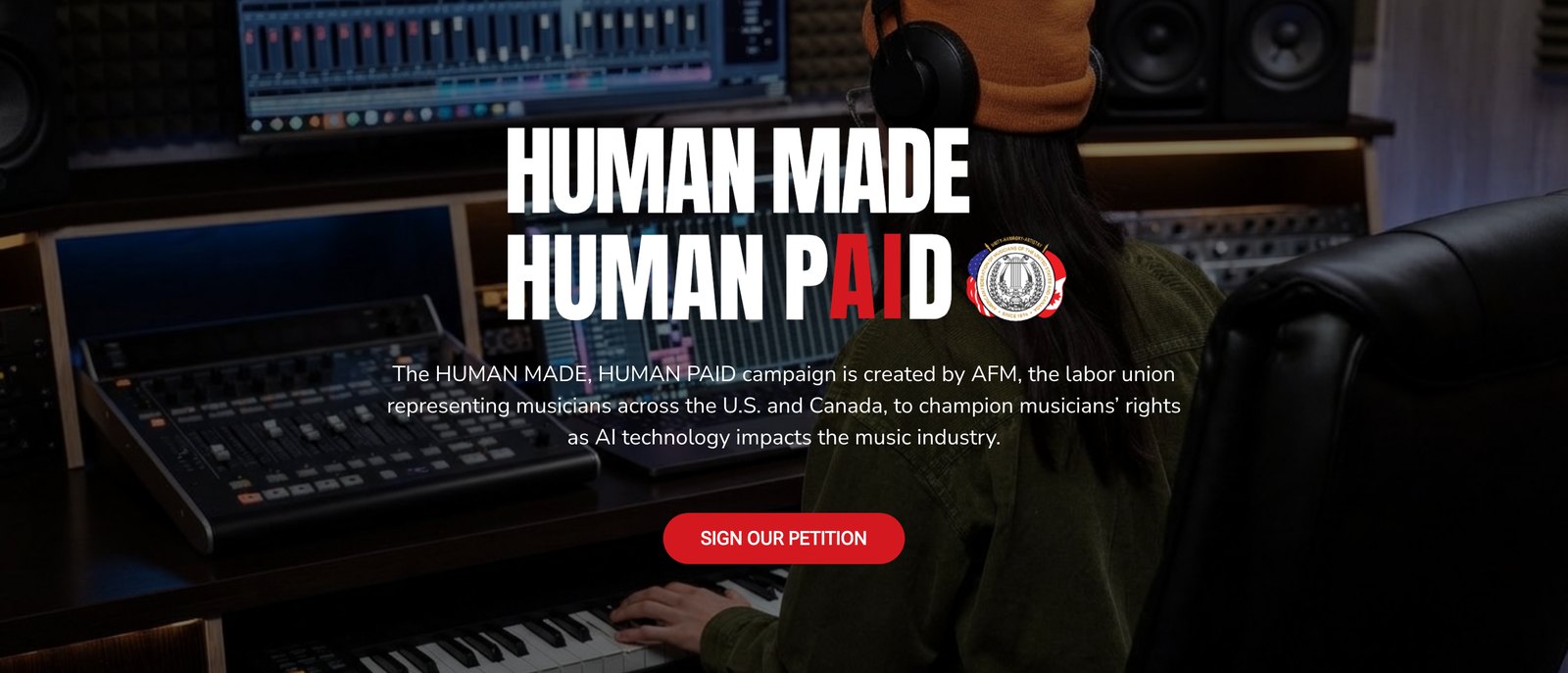
The American Federation of Musicians launched a public campaign called “Human Made, Human Paid” on Tuesday, October 20, 2026. It wants consent, credit and compensation whenever musicians’ work is used to train AI or to generate music.
The campaign is timed to the label talks. On November 3, 2026, the AFM goes back to the bargaining table with Universal Music Group, Sony, Warner and Hollywood Records, Disney’s label.
The record labels cannot pocket profits built on the backs of human artistry while cutting working musicians out of the equation.
What the AFM’s Human Made, Human Paid campaign asks the major labels for
Gagliardi gave the statement to Rolling Stone, and the demands break down into 3 parts:
- Consent: musicians get the right to approve or refuse the use of their music to train AI models.
- Credit: clear credit when their work feeds into AI.
- Compensation: payment for AI use, and a share when labels license their catalogs to AI companies.
The campaign has its own site, humanmadehumanpaid.com, with a petition anyone can sign. It says the AFM is “not here to fight technology or tools for music creation.”
AFM member Will Wells, a composer and producer who has worked with Cynthia Erivo and on Netflix’s Emily in Paris, put it more simply: “We are pro-human creators and pro compensation for our labor.”
What the Sound Recording Labor Agreement is, and why November 3, 2026 matters
The Sound Recording Labor Agreement, or SRLA, is the union contract that decides how musicians get paid for playing on major-label records. It sets things like royalty rates and healthcare, and the campaign site says it covers all major-label recordings in the US and Canada.
So whatever AI rules end up in the next SRLA apply to every session player on a UMG, Sony, Warner or Hollywood Records release. That’s why the campaign went live 2 weeks before the talks resume.
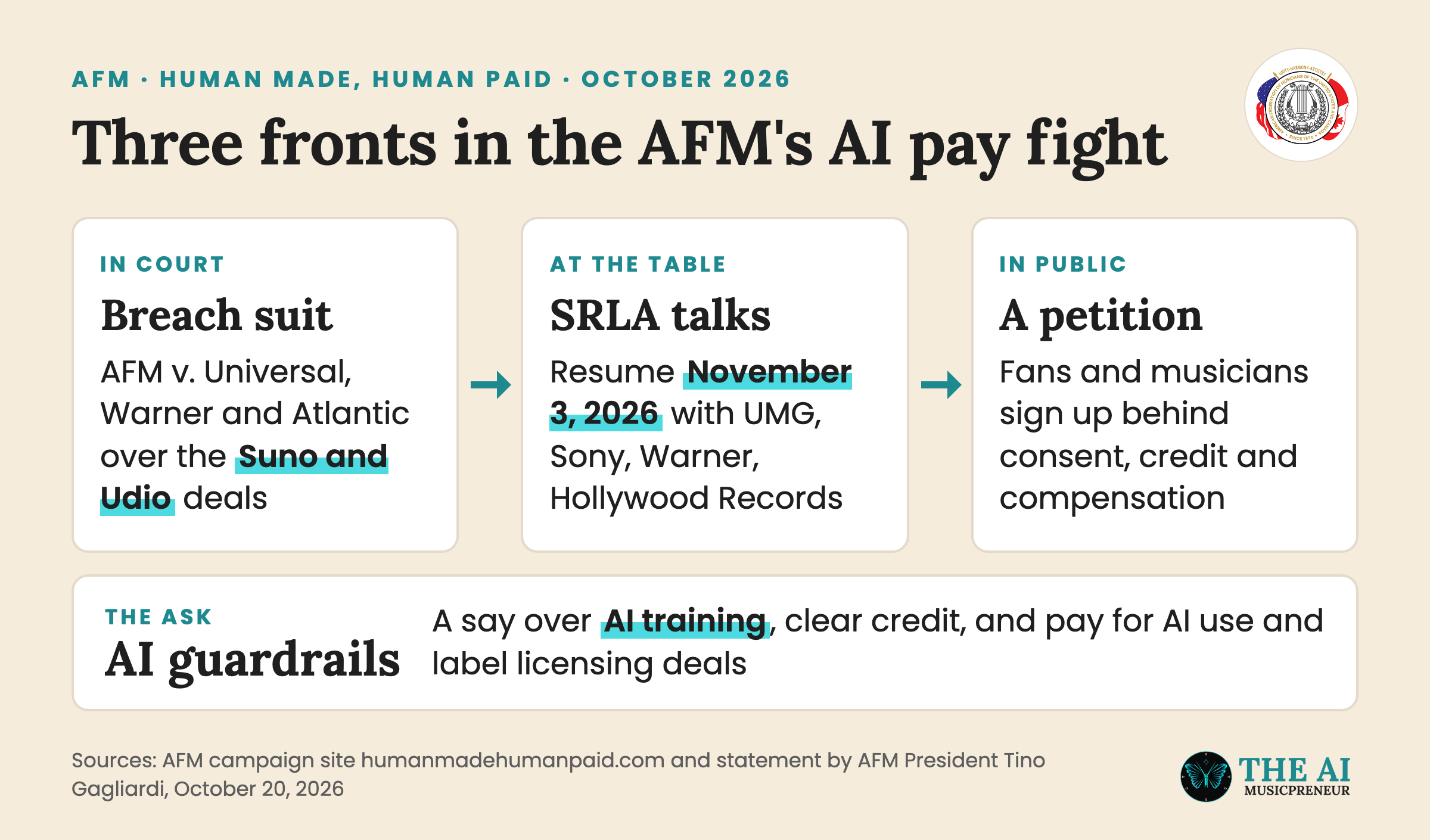
The table is only one of the 3 fronts. In court, the AFM is already suing Universal, Warner and Atlantic for licensing session recordings to Suno and Udio without paying the musicians who played on them. Both labels say the contract never covered AI, and they filed their closing written answers in September.
Whatever happens in that case, the next contract can settle the question for future recordings. The full timeline sits on my AFM v. Universal and Warner case tracker.
The AFM isn’t the only group pushing labels on this. In June 2026, 31 creator organizations demanded consent and fair pay before labels sign AI deals, and the Protect Working Musicians Act would let independent artists and labels negotiate AI licensing as a group. The next date to watch is November 3, when the SRLA talks resume.
Frequently asked questions
How many musicians does the American Federation of Musicians represent in 2026?
The AFM's campaign site says it represents 70,000 professional musicians in the United States and Canada, while Rolling Stone reported more than 80,000. The union was founded in 1896, is affiliated with the AFL-CIO and is led by President Tino Gagliardi.
Who can sign the AFM's Human Made, Human Paid petition?
Anyone can sign it on humanmadehumanpaid.com, not just union members. The form asks for a name, email and postal code, and whether you're an AFM member. The AFM sponsors the petition and says it supports the union's position in its label negotiations.
Is the AFM's Human Made, Human Paid campaign against AI music tools?
No. The campaign site says the AFM is not there to fight technology or tools for music creation. AFM member Will Wells told Rolling Stone the union doesn't want to stop the advancement of technology, only to keep music a viable career.
About the author

Covering AI music tools, industry shifts, and news for music creators and professionals. Twice-weekly newsletter at aimusicpreneur.com.