Universal and Warner say one answer the AFM gave in July ended its own AI pay case
My stack My fav 6 tools for AI music after testing 70+
-
 ElevenMusic · Music generation
 -
 Moises · Stem separation
 -
 Controlla · Voice swap & cloning
 -
 Cryo Mix · Mixing + mastering
 -
 Neural Frames · Music videos
 -
 ONCE · Distribution
Some links are affiliate links — I earn a commission at no cost to you. Every tool here is one I run myself and truly believe in. This stack is proven.
On July 21, a judge in New York asked the musicians’ union a direct question, and the union gave a one-word answer. Universal and Warner have now built their entire case on it. Both filed their closing written answers on September 11, 2026, and both argue that the American Federation of Musicians talked itself out of its own lawsuit two months ago, according to filings reported by Music Business Worldwide.
The case is about whether session players, the hired musicians on a record rather than the featured artist, get a cut when a label licenses their recordings to Suno and Udio.
The answer the AFM gave in July that both labels now quote
Judge Edgardo Ramos asked whether any AFM agreement exists that covers AI use.
“No. So, there is no underlying agreement for AI use. We conceded that,” union counsel Eyad Asad answered, according to the transcript Universal quotes.
“That concession ends this case,” Universal’s lawyers wrote. “Discovery cannot change that fact, much less create the missing agreement.”
A payment obligation measured by an agreement that does not exist is no payment obligation at all.
Why Universal says a missing rate means a missing duty
The fight runs through one clause, Article 21(a) of the Sound Recording Labor Agreement. It covers what the contract calls a new use, meaning a recording used “for a purpose not covered by this Agreement.”
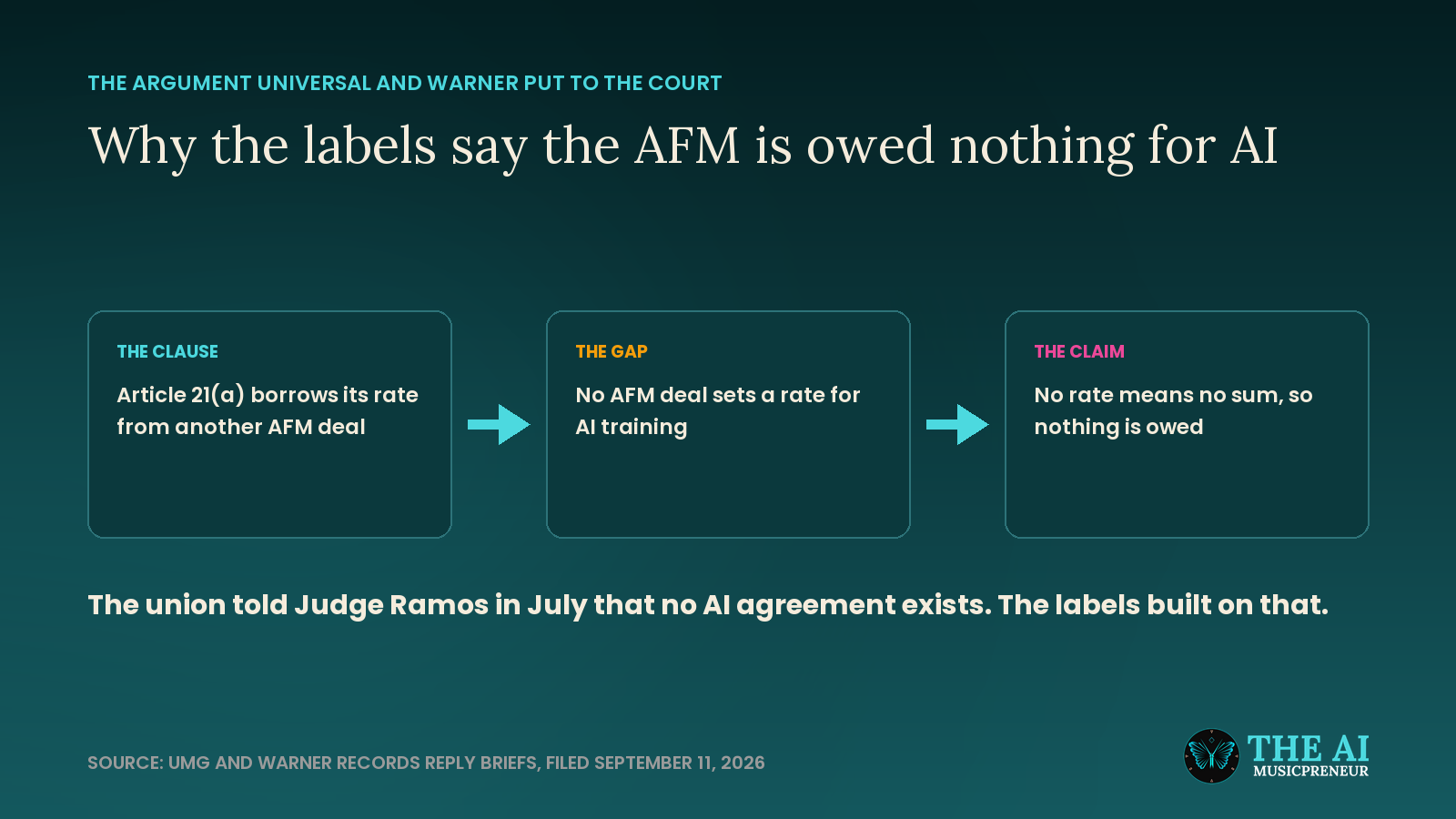
Universal reads the clause as a pointer rather than a price. “Article 21(a) does not state a rate,” its lawyers wrote. “It imports one from the separate AFM agreement governing the new purpose. And AFM has conceded that no such agreement exists for the AI Use.”
The union’s answer in early September was that the clause can be read more than one way, which at this stage is all it needs. Universal called that a tactic.
“Ambiguity is a property of contractual text, not a litigation strategy,” its lawyers wrote. “AFM cannot manufacture it simply by offering multiple theories that the text does not reasonably support.”
The union also argued that the words “shall pay” create a duty whatever the rate turns out to be. Universal answered that you cannot separate the two. “The measure is not an accessory to the obligation; it is the obligation,” the brief says. “AFM cannot enforce the verb while deleting its object.”
Warner’s argument that the session players were already paid
Warner Records and Atlantic filed the same day, and their strongest line is about money that already changed hands.
“AFM’s contorted reading of the SRLA should be rejected, not least of all because AFM members were already paid those session scale rates AFM contends they would be owed under its newly devised theory,” Warner’s lawyers wrote.
The brief says the musicians on the recordings at issue were paid the contract’s base rates when the sessions happened. “They were paid those base rates, which is precisely what they are entitled to under the SRLA,” it states. “They do not have a right to the additional payments AFM now seeks.”
Warner also says the union cannot take back what it has already told the court. Its opposition “does not, and cannot, walk back its two fatal admissions,” the filing says: that AI use is not covered by the contract, and that no AI agreement exists.
The arguments both labels call brand new
Universal says the union’s streaming and sampling theories never appeared in the complaint it is actually defending. The union asked for permission to add a sampling claim in a footnote, and Universal gave that the shortest answer in either brief: “A footnote is not a motion.”
Warner made the same point by counting. “The word ‘sample’ is not mentioned once in the FAC,” its lawyers wrote, and added that the union’s own complaint describes whole recordings being licensed, not pieces of them.
Warner closed on where it thinks this belongs. It told the court the union is “using this lawsuit to obtain more favorable contractual rights than it currently possesses, but collective bargaining on this very issue is currently underway.”
Both labels want the case ended permanently, not sent back for a rewrite. “Amendment is futile where the defect lies in the contract rather than the pleading,” Universal wrote, “no pleading can create an agreement the parties never made.”
Nothing is decided yet, because the written arguments are now finished and the judge has not ruled. If you play sessions for a living, the practical read is simple: until either this case or the current bargaining round produces an AI rate, there is no number attached to your recording when it ends up in a training set.
Frequently asked questions
What did the AFM's lawyer concede at the July 21 conference?
Judge Edgardo Ramos asked whether an AFM agreement exists covering AI use. Union counsel Eyad Asad answered "No. So, there is no underlying agreement for AI use. We conceded that." Universal quoted the transcript in its September filing and called that answer the end of the case.
What are the two admissions Warner calls fatal to the AFM case?
Warner's lawyers say the union admitted that AI use "is not a purpose covered by the SRLA" and that "there is no underlying agreement for AI use." Warner argues the union cannot walk either one back now that both are on the record.
Were AFM session musicians already paid for the recordings in the Suno and Udio deals?
Warner says yes. Its filing states that musicians on the recordings at issue were paid the base session rates set by the union contract, and that those payments are exactly what the contract entitles them to. The union argues they are owed a further payment because the recordings were later licensed for AI.
Why do Universal and Warner say the court should not set an AI rate itself?
Warner argues that fixing a price would push the court into a role it does not hold, quoting Justice Scalia on courts acting as central planners. It also notes that the union and the labels are in collective bargaining on this very issue right now.
What does it mean that Universal and Warner want the AFM case dismissed with prejudice?
They are asking the judge to end it permanently rather than let the union try again with a rewritten complaint. Universal's filing argues that no pleading can create an agreement the parties never made, so a rewrite would change nothing.
About the author

Covering AI music tools, industry shifts, and news for music creators and professionals. Twice-weekly newsletter at aimusicpreneur.com.