Anthropic scanned songbooks and threw the paper away, and publishers want the titles
My stack My fav 6 tools for AI music after testing 70+
-
 ElevenMusic · Music generation
 -
 Moises · Stem separation
 -
 Controlla · Voice swap & cloning
 -
 Cryo Mix · Mixing + mastering
 -
 Neural Frames · Music videos
 -
 ONCE · Distribution
Some links are affiliate links — I earn a commission at no cost to you. Every tool here is one I run myself and truly believe in. This stack is proven.
Anthropic bought printed books, tore the bindings off, scanned every page, kept the files and threw the paper away. A federal judge found that last year. Music publishers now say some of those books were songbooks and sheet music collections holding their songs, and on September 11, 2026 they asked a California court to make Anthropic open up the program, as Music Business Worldwide reported. Anthropic told the same court the question can wait.
What Project Panama did to a printed songbook
Anthropic gave the program an internal name, Project Panama, and the mechanics are not complicated.
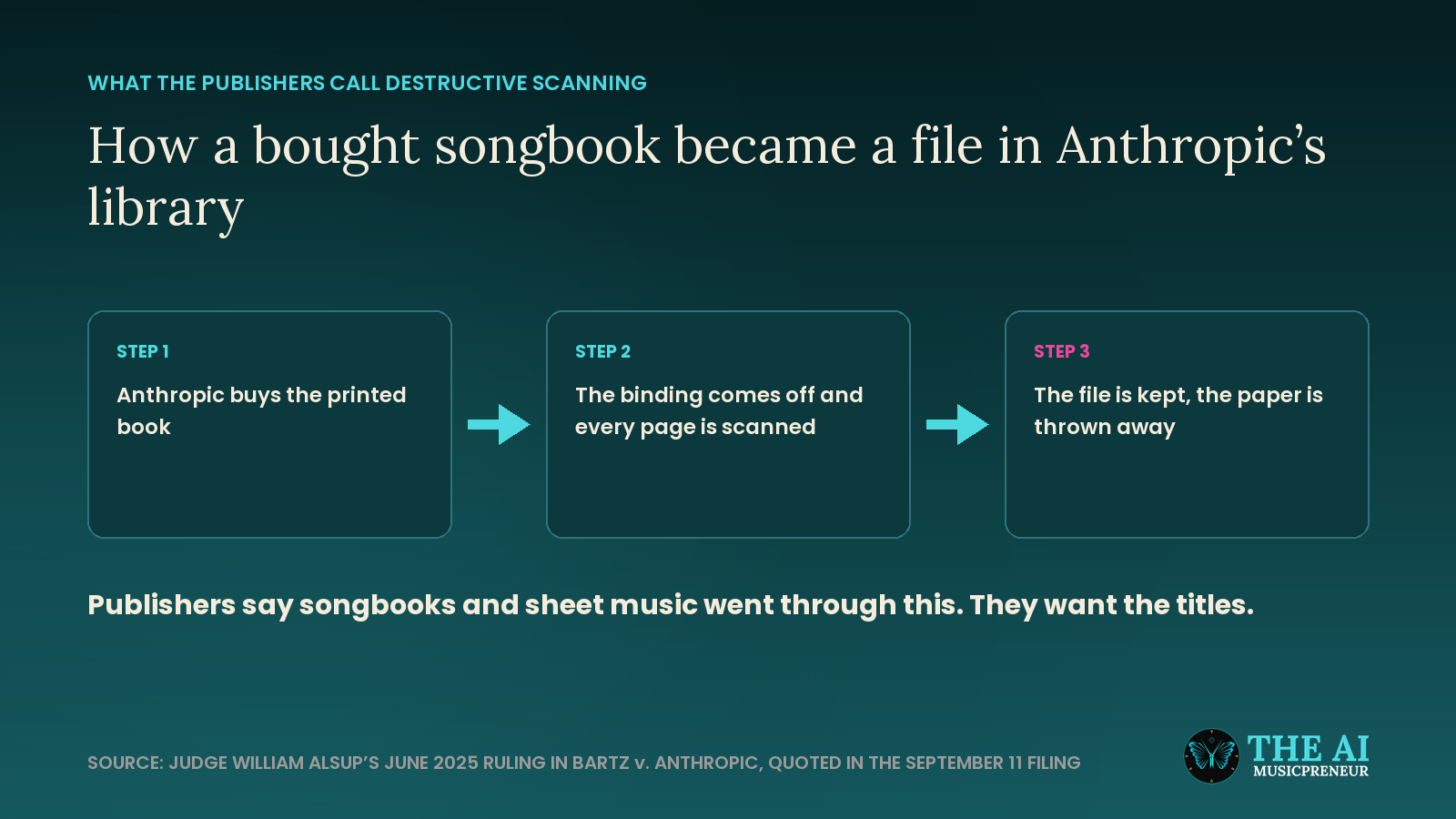
The publishers say the company “commenced an unauthorized scanning and digitization program” that copied “hundreds or more songbooks and sheet music collections” containing their works. Their filing says Anthropic did it by “purchasing physical books, reproducing them as digital files without authorization, and adding those copies to its central library.”
The stated goal, quoted from Anthropic’s own documents, was to gather “all the books in the world” while dodging as much “legal/practice/business slog” as possible.
Why the publishers are fighting over the order, not the facts
Judge Eumi K. Lee split the evidence gathering into two rounds. Lawyers call that stage discovery, the part of a case where each side has to hand over its documents.
Round one covers the claim that Anthropic downloaded pirated books from shadow libraries. Round two covers the claim that it trained Claude on the publishers’ works, and that round is paused until the judge rules in the older of the two cases.
The publishers want scanning in round one. Anthropic wants it in round two.
Their reason is that scanning and torrenting are cousins. Both, in the publishers’ words, “involve copying books containing Plaintiffs’ works, rather than scraping Plaintiffs’ lyrics from the internet.”
They also told the court that waiting “would serve no purpose but delay,” and pointed out that the pending motions in the first case “address neither torrenting nor destructive scanning.”
Anthropic’s answer is that it already handed this over
Anthropic’s filing runs the other way. “Because those allegations relate entirely to Publishers’ training claim (Count II), they should be addressed in Phase Two,” it states.
The company argues the coming ruling in the first case “will provide important guidance on the book scanning allegations,” so opening the file now risks doing the work twice.
Then it points at size.
Anthropic also says the publishers have been here before. It says they already took evidence on Project Panama in the first case, where the company produced “an extensive index of scanned books,” and that its data acquisition lead Thomas Turvey “testified extensively” about how the program ran and how much it took in.
The words Anthropic’s filing never uses
The two sides do not even name the practice the same way. The publishers call it destructive scanning. Anthropic calls it book scanning, and never once writes songbook or sheet music.
That is not a small thing when the fight is over which books were in the pile.
The publishers lean on a 2024 appeals court ruling against the Internet Archive, which held that scanning and lending copyrighted books without permission was not fair use. Anthropic leans on Judge William Alsup’s June 2025 ruling in the book authors’ case, which held that buying books, scanning them and binning the originals was fair use. Alsup drew his line at keeping pirated copies, and Anthropic settled that case for $1.5 billion.
We don't want it to be known that we are working on this.
What happens next in the Anthropic music cases
BMG picked a side. Its lawyers signed the September 11 statement jointly with the other publishers, having added the phrase destructive scanning to its own complaint the night before the filings were due.
The queue keeps growing. Anthropic and CEO Dario Amodei have each asked the court to throw out parts of the case, with a hearing set for November 4. Sony Music Publishing and Warner Chappell sued on August 28 over second-hand books, Round Hill filed on August 17, and the parties owe the court a plan for running all of it together by September 23.
Judge Lee had not ruled on the scanning question as of September 17.
If you write songs and your work sits in a printed folio, this is the case that decides whether anyone ever tells you it was scanned. Right now the only people who know which songbooks went through Project Panama are the people who ran it.
Frequently asked questions
What is Project Panama at Anthropic?
Project Panama is the internal name for Anthropic's program of buying printed books, removing the bindings, scanning every page into digital files, and discarding the paper. The program surfaced publicly in the book authors' case against the company and is now at the centre of a fight over evidence in the music publishers' case.
What is destructive scanning in the music publishers' case against Anthropic?
It is the publishers' term for buying a physical book, cutting it apart to scan it, and throwing away what is left. Anthropic uses the plainer phrase book scanning in its own filing. The publishers say songbooks and sheet music collections containing their works went through the process.
Why do the publishers want songbook scanning examined in phase one?
They argue scanning and torrenting are the same kind of claim, because both involve copying whole books rather than scraping lyrics off the internet. Handling them together, they say, saves the court and the parties from running the same exercise twice.
Did a judge already rule that scanning purchased books was fair use?
Judge William Alsup ruled in June 2025, in the book authors' case Bartz v. Anthropic, that buying print books, scanning them and discarding the originals was fair use, and that training on copyrighted books was too. He drew the line at keeping pirated copies in a permanent library. Anthropic later settled that case for $1.5 billion.
How many works are in each Anthropic claim the publishers are fighting over?
According to Anthropic's filing, the torrenting claim covers 714 works and the training claim covers a further 20,517. Anthropic uses that gap to argue that folding scanning into the first phase would widen the work considerably.
About the author

Covering AI music tools, industry shifts, and news for music creators and professionals. Twice-weekly newsletter at aimusicpreneur.com.