What are the Manchester Principles? The UK music industry's 3 demands for AI
My stack My fav 6 tools for AI music after testing 70+
-
 ElevenMusic · Music generation
-
 Moises · Stem separation
-
 Controlla · Voice swap & cloning
-
 Cryo Mix · Mixing + mastering
-
 Neural Frames · Music videos
-
 ONCE · Distribution
Some links are affiliate links — I earn a commission at no cost to you. Every tool here is one I run myself and truly believe in. This stack is proven.
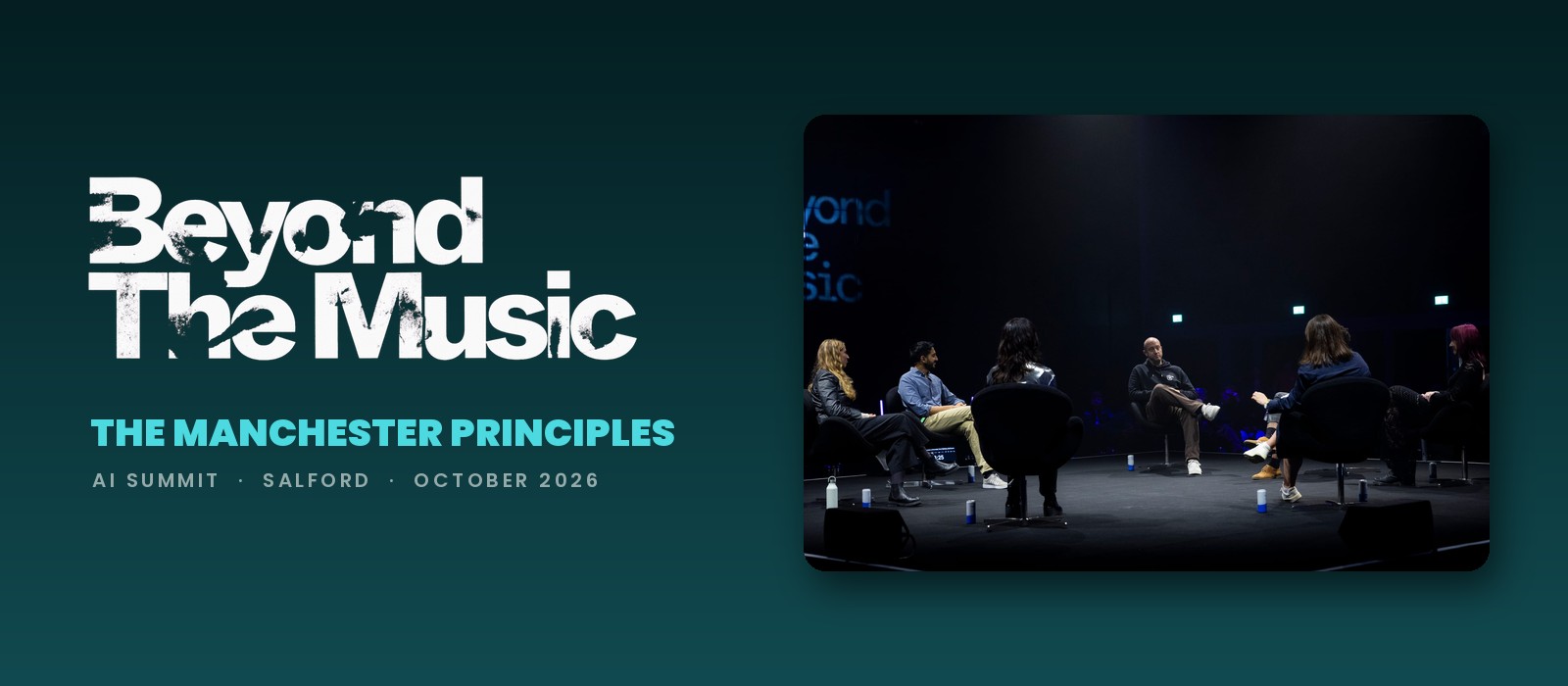
The Manchester Principles are the UK music industry’s new plan for living with AI. They came out of the Creative Industries AI Summit at the Beyond The Music festival in MediaCity, Salford, on October 9, 2026, and the short version is 3 demands: consent before your work trains AI, a way to track where it went, and credit and pay when it shows up in AI output.
They sit on top of 5 broader principles, from fair value to respect for creators. NME’s write-up on October 30 calls the whole thing a first-of-its-kind, industry-wide plan to get creators, rights holders, tech platforms, AI labs and policymakers on the same page.
The UK music industry’s 3 AI demands in the Manchester Principles
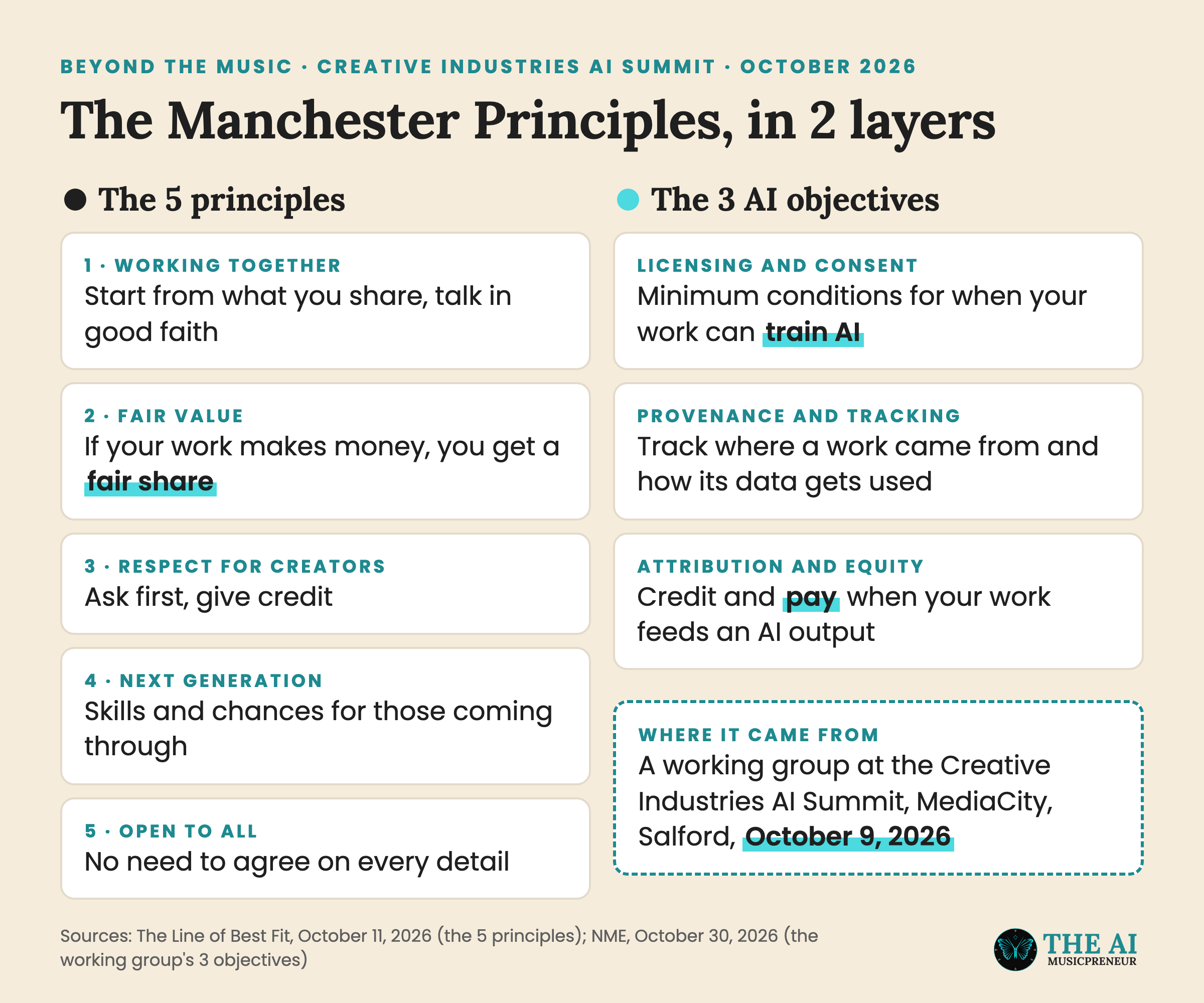
A working group at the summit agreed 3 AI objectives. In NME’s words, and then in plain English:
- Licensing and consent: “minimum conditions and clear frameworks for when and how human-created works can be used to train generative AI models.” Basically, nobody trains on your songs until there’s a deal you agreed to.
- Provenance and tracking: “protecting and tracking the origin of creative works and data usage.” That means a record that travels with your recording, so you can see if it went into a dataset.
- Attribution and equity: “ensuring proper human credit and economic compensation” when your work feeds into AI output. Your name on it, and money when it’s used.
None of the 3 is new on its own. What’s new is putting them on one page in a room with a government minister, Manchester’s council leadership and trade bodies like UK Music.
The 5 Manchester Principles agreed at Beyond The Music 2026
The 3 AI demands are the specific part. The principles underneath are broader, and The Line of Best Fit printed them in full after the summit:
- Working together: start from what you share, and talk in good faith.
- Fair value: if your work makes the money, you get a fair share, big or small.
- Respect for creators and their works: ask first, give credit, and treat people and what they’ve made properly.
- Investing in the next generation: skills and chances for those coming through.
- Open to all: everybody’s welcome, and you don’t need to agree on every detail to have a seat.
They were drafted after a week of conversations at the festival, and the idea is that everyone in the room takes them home and applies them in their own corner of the business. So who was in the room?
Who shaped the Manchester Principles at the 2026 AI summit
Prime Minister Andy Burnham, a Beyond The Music co-founder, convened the summit but didn’t turn up on the day. Bev Craig gave the Manchester Principles keynote, and Creative Industries Minister Ian Murray opened the talks by saying “we cannot ask our creators to choose between embracing innovation and protecting their rights.”
One idea kept coming back all day: a UK-owned AI model. Clive Dickens, founder of Absolute Radio and now CEO of The Meliora Company, argued that “the UK must own more than the playlist” and pitched “Fair GPT”: models that are fair-governed, fair-powered and fair-trained. He even named one, “Hope V.1”, and set it the challenge of being ready by November 2027, when Manchester hosts the G20.
On provenance, Massive Attack’s chief technical officer Andrew Melchior, who also runs Genotone, described “inaudible provenance markers” inside audio files, which he called a “birth certificate” for the media you create. UK Music CEO Tom Kiehl called scraping, consent and deepfakes “deeply personal to artists.”
Lose copyright and you lose the means of earning a living, lose control of your work and you lose control of its meaning.
Summit chair Cliff Fluet closed the day by saying the sector wants “creative sovereignty”, with “consent, fair pay, transparency, and enforcement that works for everyone.”
What the Manchester Principles change for UK musicians right now
Honestly, nothing changes in the law yet. The Manchester Principles are a shared position, not a bill, and nobody is forced to sign them.
They do land at a moment when the UK is still deciding its AI copyright rules. The government already scrapped its AI training opt-out plan in March, and Baroness Keeley has urged Burnham to rule out a commercial AI training exception. Before the summit, Beyond The Music’s co-founder warned that the UK was “lagging behind” on AI protections for musicians.
The next step on the summit programme was a session with Imogen Heap and IV.AI’s Vince Lynch on taking the principles from Manchester to a global alliance through open standards. If that happens, the 3 AI demands could become something your distributor and your label get asked to sign, and that’s when they start to matter for your releases.
Frequently asked questions
Who convened the 2026 Creative Industries AI Summit where the Manchester Principles were agreed?
Prime Minister Andy Burnham, a Beyond The Music co-founder, convened it, but he didn't attend on the day according to The Line of Best Fit and DMY. Summit chair Cliff Fluet, a media and entertainment lawyer, closed the day.
Are the Manchester Principles legally binding in the UK?
No. They are an industry-wide action plan and rights-based roadmap, not law. The idea is that creators, rights holders, tech platforms, AI labs and policymakers sign up to them and apply them in their own part of the industry.
What is Fair GPT from The Meliora Company?
Fair GPT is Clive Dickens' idea of AI models that are fair-governed, fair-powered and fair-trained. That means regulation and pre-approval before release, renewable energy for data centres, and training with provenance, consent and pay for the sources.
About the author

Covering AI music tools, industry shifts, and news for music creators and professionals. Twice-weekly newsletter at aimusicpreneur.com.