UK is “lagging behind” on AI protections for musicians, industry warns ahead of Andy Burnham's 2026 AI summit
My stack My fav 6 tools for AI music after testing 70+
-
 ElevenMusic · Music generation
 -
 Moises · Stem separation
 -
 Controlla · Voice swap & cloning
 -
 Cryo Mix · Mixing + mastering
 -
 Neural Frames · Music videos
 -
 ONCE · Distribution
Some links are affiliate links — I earn a commission at no cost to you. Every tool here is one I run myself and truly believe in. This stack is proven.
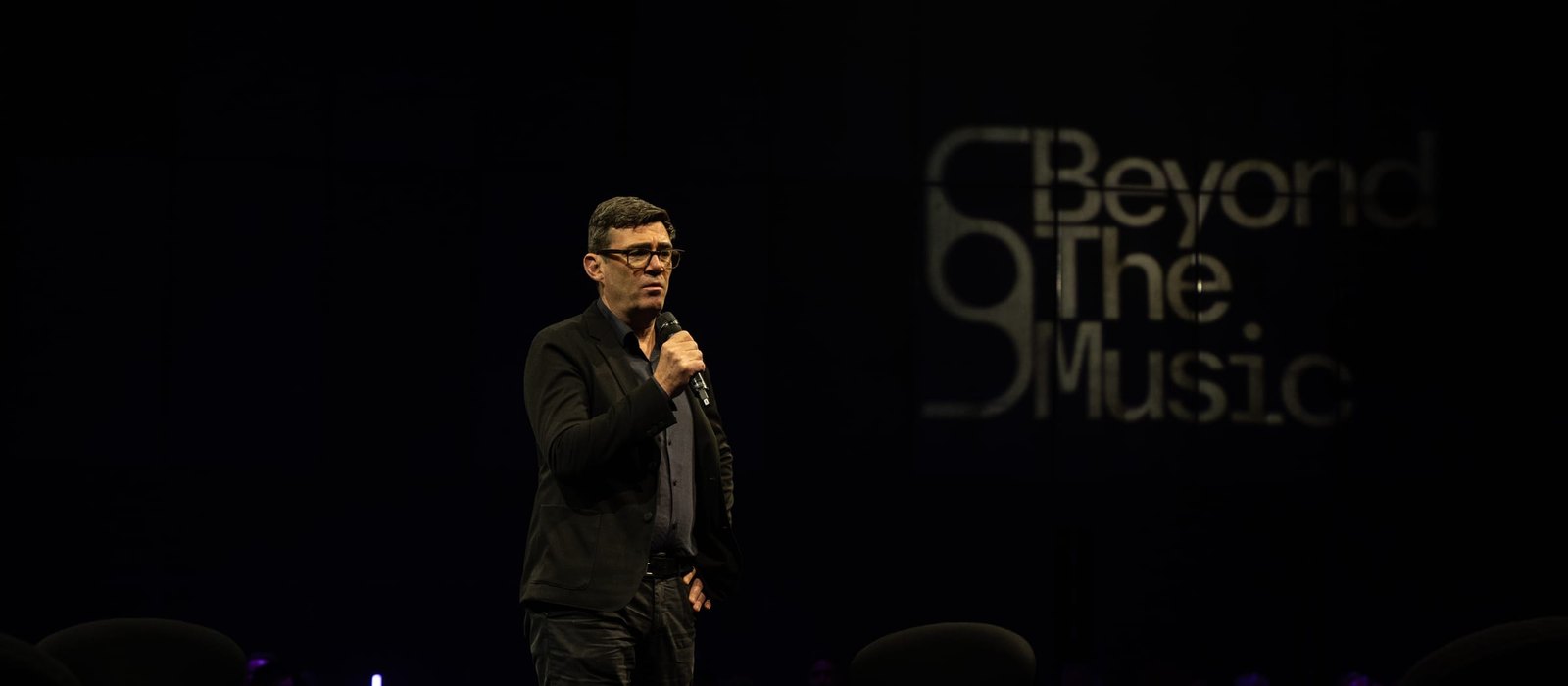
The UK is “lagging behind” on protecting musicians from AI. That’s the warning from Sarah Pearson, co-founder and organiser of Beyond the Music, who told The Independent on October 8, 2026 that the UK still has “an enormous amount to do”.
She said it one day before Beyond the Music hosts the Creative Industries AI Summit at MediaCity in Salford on Friday, October 9. Prime Minister Andy Burnham convened the summit, and he co-founded the festival while he was still Mayor of Greater Manchester.
Meanwhile the fakes keep coming. Sony Music has asked platforms to remove more than 260,000 AI tracks impersonating its artists, including Harry Styles and Adele, which is nearly double the 135,000 it had flagged by the end of March. Sony told the Financial Times it is “becoming an uphill struggle.”
So what does UK law actually do for you if someone clones your voice next week? Less than you’d hope.
Beyond the Music, the BPI and the Ivors Academy say the UK is lagging behind on AI
Pearson’s complaint is the missing legal framework, the rules that would tell creators exactly how AI can use their work and their identity.
She also warned that panic has overtaken practical solutions in the AI debate, and said the summit is meant to move the industry “from fear and uncertainty towards practical solutions”.
It is difficult to ask people to embrace change when they don't yet feel protected within it.
Tom Gray, chair of the Ivors Academy, was blunter. He said unregulated generative AI “feels like an innovative way to make a bad problem much, much worse” and summed it up as “skint musicians only getting skinter.”
Dr Jo Twist, CEO of the BPI, pointed at a “worrying rise” in AI deepfakes, AI slop and streaming fraud, which she said moves royalties away from creators and often into the pockets of fraudsters. She wants artists and rightsholders to be “properly recognised and compensated” when their work is used.
Lagging behind whom? The Independent points to Tennessee, which passed a law in March 2024 making it illegal to replicate an artist’s voice without consent. Australia’s chart body ARIA banned wholly AI-generated songs from its charts in August. And on September 30, a Tokyo court ruled that a voice is a publicity right, a first for Japan.
What protections do UK musicians have against AI in 2026?
UK AI copyright law protects your songs and recordings far better than it protects your voice, and there is no general image right to fall back on. Here’s the split.
Training first. Under section 29A of the Copyright, Designs and Patents Act 1988, the only text and data mining exception in UK law covers non-commercial research. So a company training a commercial music model on your catalogue in the UK needs a licence. The government dropped its opt-out plan in March 2026, and its May 15 response to the House of Lords said AI developers “must seek permission and acquire licences” unless an existing exception applies.
The catch is the border. In Getty Images v Stability AI, decided on November 4, 2025, Getty dropped its training claim because it couldn’t show the copying happened in the UK. The High Court also held that the trained model isn’t an “infringing copy”, because it doesn’t store the images it learned from. An appeal is due later in 2026, according to Reed Smith’s September review.
Your recordings are on firmer ground. If an AI track copies your actual master, or a recording of your performance, copyright and performers’ rights cover it like any other copy.
Your voice is the gap. English law has no standalone right to control the commercial use of your name, image, likeness or voice, as Reed Smith partner Nick Breen sets out. The nearest tool is passing off, and that needs an existing commercial reputation plus a fake that implies you endorsed something. A cloned voice on a new track, with no fake endorsement attached, mostly falls outside it.
That’s the shape of FAMM’s complaint about Haven’s “I Run”: the label said the vocal was an AI clone trained on Jorja Smith’s voice, and no copy of one of her masters was involved.
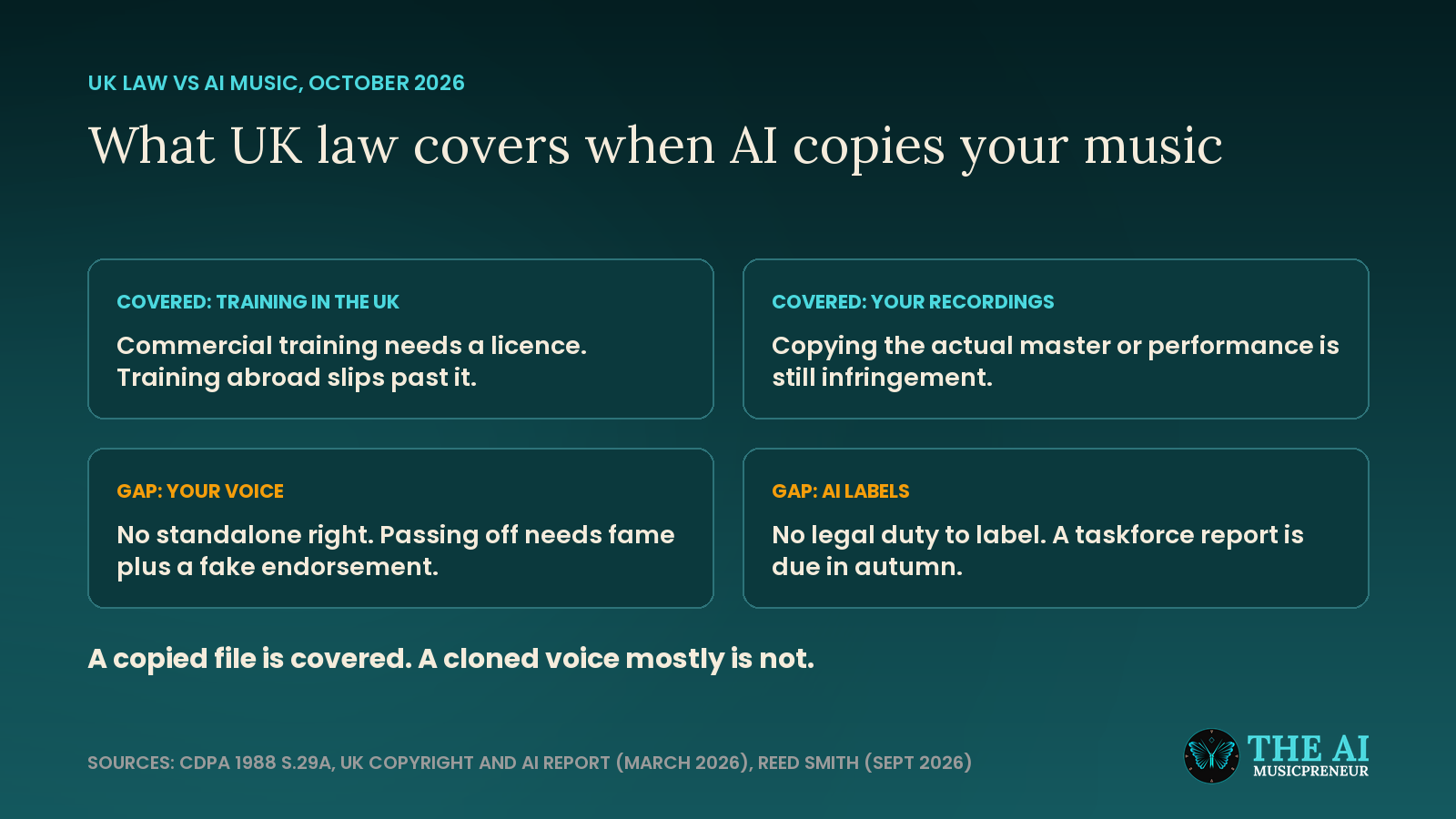
Labelling is the last gap. No UK law requires AI-generated music to carry a label yet. The industry’s own AI chart eligibility rules, proposed in July, are voluntary.
What the UK government has promised on AI and music since March 2026
The government has promised action on both gaps. None of it is law yet.
Culture Secretary Lisa Nandy’s Turn It Up plan for music, published on July 13, 2026, committed to a consultation on “digital replicas” in the summer, plus a taskforce on AI labelling with an interim report due in autumn. The digital replicas consultation had already been promised in the May 15 response.
Summer came and went. As of Reed Smith’s September 30 review, the consultation still hadn’t been published.
In the meantime, more than 80 performers, including Hugh Bonneville, Nicola Coughlan and Matt Lucas, wrote to Burnham in late August asking for a statutory right to own their voice. The Save Our Voices Now campaign behind that letter wants AI developers to carry the burden of proving consent. Baroness Keeley made a related ask in August, when she urged Burnham to rule out a commercial AI training exception.
What the Creative Industries AI Summit at Beyond the Music 2026 is meant to agree on October 9
The Creative Industries AI Summit runs all day on Friday in Conference (HQ2) at MediaCity. Burnham convened it, and Ian Murray MP, the Minister for Creative Industries, gives the government address at 10:15. Murray, Greater Manchester Mayor Bev Craig and the DCMS are taking the summit forward.
The summit page lists 4 anchors for what it calls a rights-and-integrity-first position on AI: licensing, provenance, attribution and enforcement. Every Beyond the Music summit closes with a delegate vote, and this one ends at 17:00 with a summation of the Manchester Principles.
The panel closest to the voice gap is “Performance, Likeness & The Human Voice”, with YouTube’s head of AI and music policy, Suzana Carlos, and Equity’s Liam Budd. Jo Twist and Tom Gray sit on the licensing and attribution panels, Imogen Heap is in conversation after lunch, and Voice-Swap CEO Ausrine Skarnulyte joins the enforcement and digital replicas panel.
How UK artists can report an AI clone of their song while the law catches up
Until the digital replicas consultation turns into law, a platform takedown is the fastest fix for a fake of your song.
Search your artist name on every service once a week. Report the fake through Spotify’s content mismatch form or a YouTube privacy complaint, then get your distributor or label to file the formal takedown. That’s the route labels like Sony run at scale.
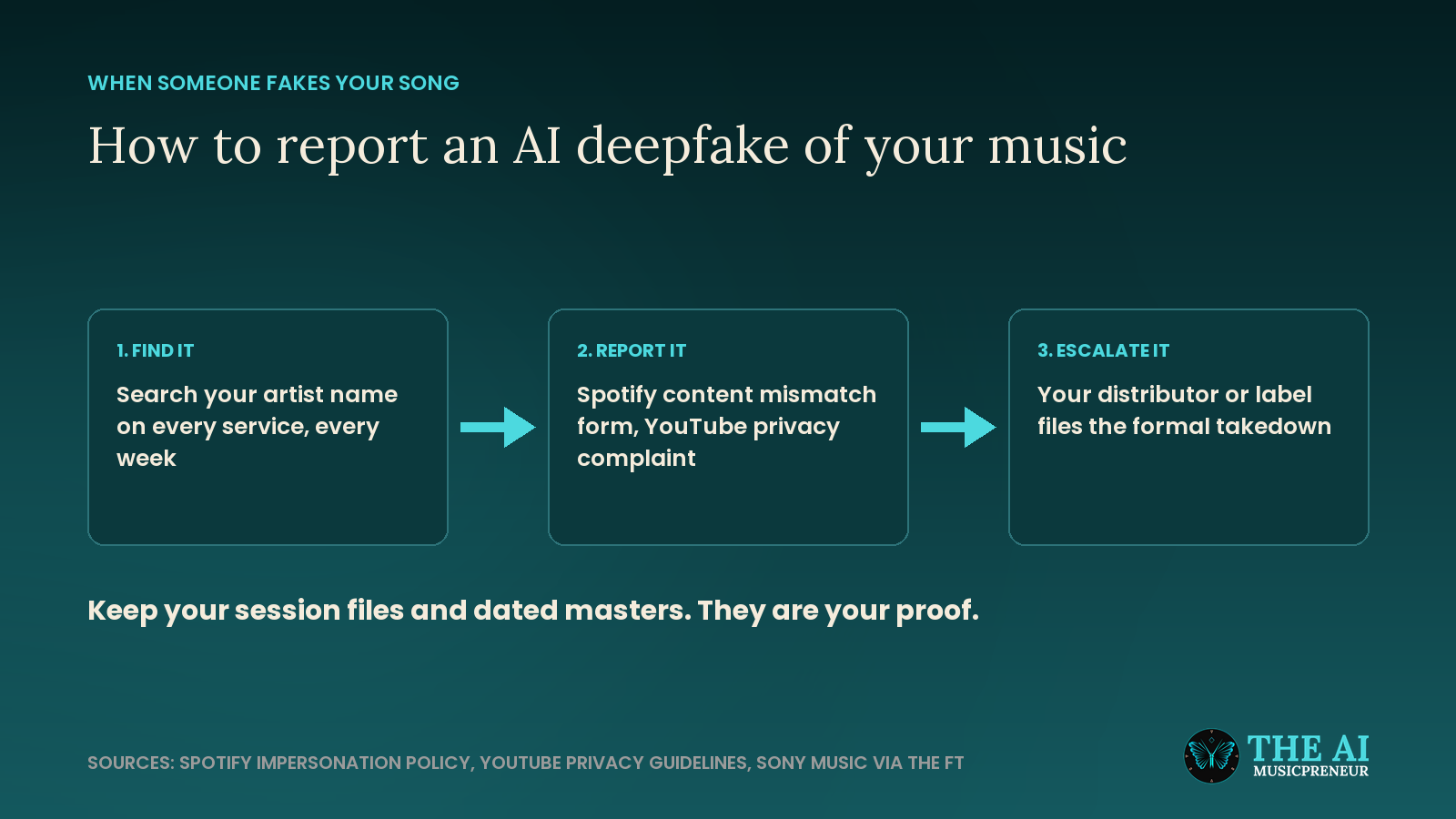
Keep your session files and dated masters too. If a dispute ever reaches a lawyer, they’re the proof the song and the voice are yours.
A delegate vote in Salford won’t change the law on its own. Whether the Manchester Principles turn up in the digital replicas consultation, once it finally opens, is the part I’d keep an eye on.
Frequently asked questions
When and where is the Creative Industries AI Summit at Beyond the Music 2026?
It runs all day on Friday, October 9, 2026, in Conference (HQ2) at MediaCity, Salford, as the closing day of the Beyond the Music festival. Registration opens at 9:30, the summit closes at 17:00 with a summation of the Manchester Principles, and delegate passes start at £99.
What is the Save Our Voices Now campaign asking the UK government for?
Save Our Voices Now wants a statutory right for every person to own their voice as personal intellectual property. It also wants AI developers to carry the burden of proving consent, and the right to be enforceable in UK courts against any platform serving UK users. More than 80 performers, including Hugh Bonneville, Nicola Coughlan and Matt Lucas, backed its letter to Prime Minister Andy Burnham in August 2026.
When will the UK government's digital replicas consultation open?
There is no confirmed date. The government promised the consultation for summer 2026, first in its May 15 response to the House of Lords Communications and Digital Committee and again in the July 13 Turn It Up plan for music. Law firm Reed Smith reported on September 30, 2026 that it still had not been published.
Did Getty Images v Stability AI decide whether AI training infringes UK copyright?
No. In the High Court judgment of November 4, 2025, Getty dropped its training claim because it could not show the copying took place in the UK, and the court held that the trained Stable Diffusion model is not an infringing copy because it does not store the images it learned from. Whether training on copyright works inside the UK is infringement remains untested, with an appeal due later in 2026.
About the author

Covering AI music tools, industry shifts, and news for music creators and professionals. Twice-weekly newsletter at aimusicpreneur.com.