Kilo Kent and Zemi use Suno to mask their own vocals on tracks with millions of Spotify plays
My stack My fav 6 tools for AI music after testing 70+
-
 ElevenMusic · Music generation
 -
 Moises · Stem separation
 -
 Controlla · Voice swap & cloning
 -
 Cryo Mix · Mixing + mastering
 -
 Neural Frames · Music videos
 -
 ONCE · Distribution
Some links are affiliate links — I earn a commission at no cost to you. Every tool here is one I run myself and truly believe in. This stack is proven.
Kilo Kent’s “40’s” has 2,732,522 plays on Spotify, and TikTok commenters are convinced it’s AI. By his own account, they’re half right: the song is his, and the voice runs through Suno.
He told Solomon Pace-McCarrick at Dazed, in a feature published October 8, 2026, that he started using Suno in early 2025 to “mask his voice”. Zemi, the French-language singer who shows up first in Kilo Kent’s Fans also like row on Spotify, uses it the same way: “Yes, the voice is AI, but all the rest is produced by me.”
Both keep their faces hidden, both did their Dazed calls with the camera off, and both are signed to Isekai Records. That’s the London label that released Haven’s “I Run”, the 2025 hit that streaming services pulled after complaints that its voice impersonated Jorja Smith.
What Kilo Kent and Zemi told Dazed about using Suno on their vocals
Both artists describe Suno as a studio effect, like reverb or auto-tune: it changes how the singer sounds, and the songwriting stays theirs.
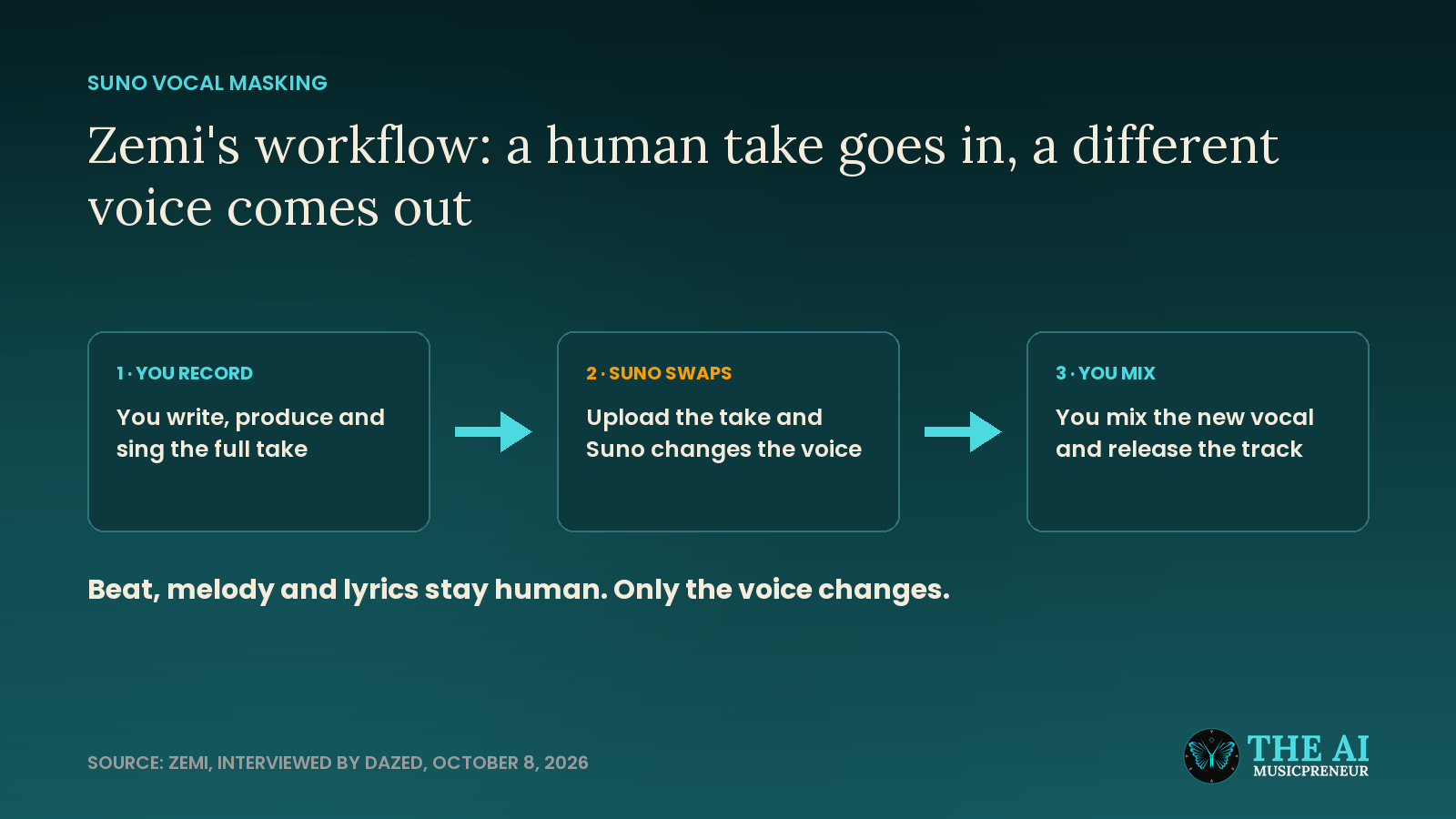
Zemi gave the most specific version: he sings the song, brings the recording into Suno to change the voice, then mixes it himself.
He’s Paris-born, of Albanian heritage, and says he had a long career as a producer before Zemi, with “almost one billion streams” for acts including Marshmello and Justin Bieber. He won’t share his old producer alias, so that number can’t be checked. He has since cast an actor to play Zemi on social media.
Kilo Kent says he wrote for “big rappers” in the UK and never wanted the fame that comes with it. His Suno explanation is a kitchen one: you chop, salt and prepare the dish yourself, and the oven only finishes it. A freezer-aisle microwave lasagna is the AI slop he says he can’t stand.
That's not oven-generated food.
Honestly, it’s a fair point. One line sits awkwardly next to it, though. Kilo Kent’s Spotify bio reads “No character to play. No image to explain.” for an artist who keeps both his face and his real voice off the record.
And the label behind both of them has done this before.
Isekai Records, the label behind Haven’s “I Run”, signed Kilo Kent and Zemi
Isekai Records launched in August 2024 as a joint venture with Broke Records, which is owned by Create Music Group. Dazed reports it calls itself a “next-gen label” that turns social media hype into streams. On Spotify, Zemi’s new single “Lela”, out October 2, 2026, carries a “℗ 2026 Isekai / broke” credit.
Isekai’s breakout was “I Run”. Producer Harrison Walker told the BBC the vocal was his own, run through Suno, and called it “AI-assisted vocal processing”. His partner Jacob Donaghue said AI gave their vocal “a female tone”.
Fans heard Jorja Smith, and Spotify removed the track in November 2025 over impersonation concerns. A re-recorded version with singer Kaitlin Aragon came out on November 21, and Dazed puts it at more than 250 million streams. I covered Smith’s side in my piece on FAMM’s compensation claim.
When Pace-McCarrick refused to let Isekai vet his article, the label accused him of building a “false narrative” and told Dazed to cancel the piece. Dazed ran it anyway.
So how does that swap actually work inside Suno?
Can Suno change your singing voice? How Zemi’s workflow runs in Suno
Yes. Dazed doesn’t name the Suno feature Zemi uses, so here’s the closest documented route.
Suno Covers takes any audio you upload, down to a voice memo, keeps the melody and the lyrics, and generates a new version in whatever style you prompt. The vocal on that new version is Suno’s, so your prompt decides who it sounds like. From there you can split the new vocal out as a stem and mix it over your own beat.
Don’t confuse this with Suno Voices, which goes the other direction: it learns your own voice from a sample and makes Suno sing new songs as you, with a spoken verification phrase so you can’t load somebody else’s (my Suno Voices tutorial walks through it).
Is a Suno voice swap AI-assisted or AI-generated music?
By most definitions it’s AI-assisted, though the line moves depending on who draws it.
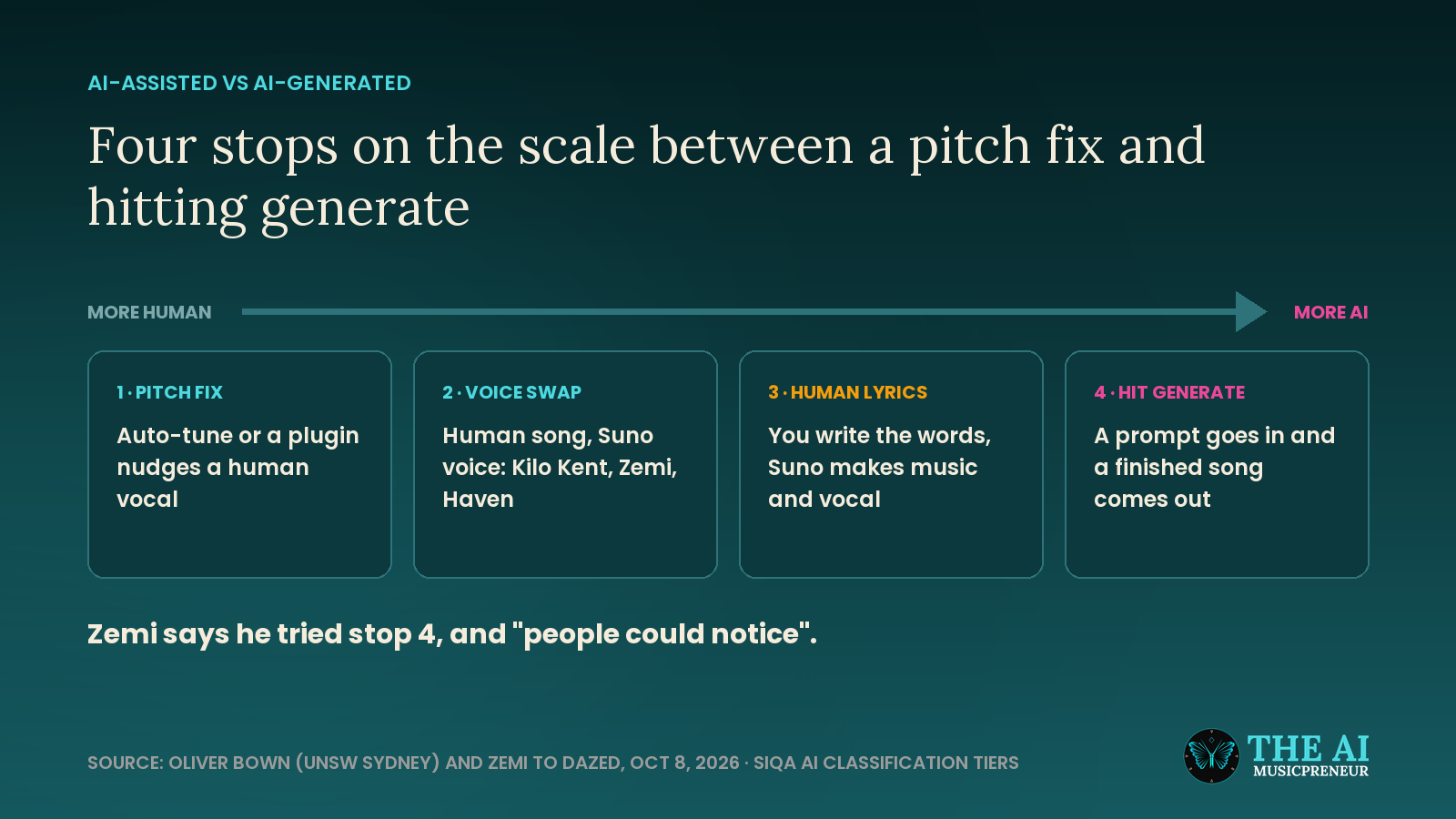
In plain terms, AI-assisted means a human made the song and AI did one job inside it, like fixing the pitch or changing the voice. AI-generated means the AI made the song and the human typed the request.
Oliver Bown, an associate professor at UNSW Sydney who researches music and AI, told Dazed there’s no clean line between the two, only a continuum from auto-tune-style tweaks to mass-generated slop. He warned that “if the musician doesn’t exist, the entire persona becomes a commodity”. He said he couldn’t comment on whether that’s true of Kilo Kent and Zemi, but that hiding the artist’s face invites the suspicion.
SIQA draws the line in one specific place: a track counts as AI-Assisted when a human wrote the lyrics, even if Suno made the music and the vocal (more in my SIQA and major-label comparison). By that test, Kilo Kent and Zemi sit on the assisted side, as long as their account of the process holds.
The catch is that every one of these scales runs on trust. Near the end of his interview, Zemi told Dazed he once “tried to only [hit] generate and not do anything human, but people could notice.”
And the platforms that are supposed to sort this out mostly look at something else.
Why Spotify’s AI Persona badge doesn’t flag a Suno voice swap
Spotify’s AI Persona badge started showing up in mid-September 2026, and badged artists drop out of editorial, algorithmic and personalized recommendations by default.
When I checked both profiles on October 8, neither carried an AI Persona or Likely AI Persona badge. Zemi had 294,980 monthly listeners, Kilo Kent had 110,826, and Zemi sat first in Kilo Kent’s Fans also like row, which is a recommendation surface.
Spotify’s review asks whether an artist’s name and imagery look like a photorealistic AI-generated identity, starting with artists above audience thresholds, so I can’t tell you whether Zemi clears that bar. The voice on the record isn’t part of the test, and Zemi’s mix of an AI avatar, a hired actor and a real producer sits in a gap nobody labels yet.
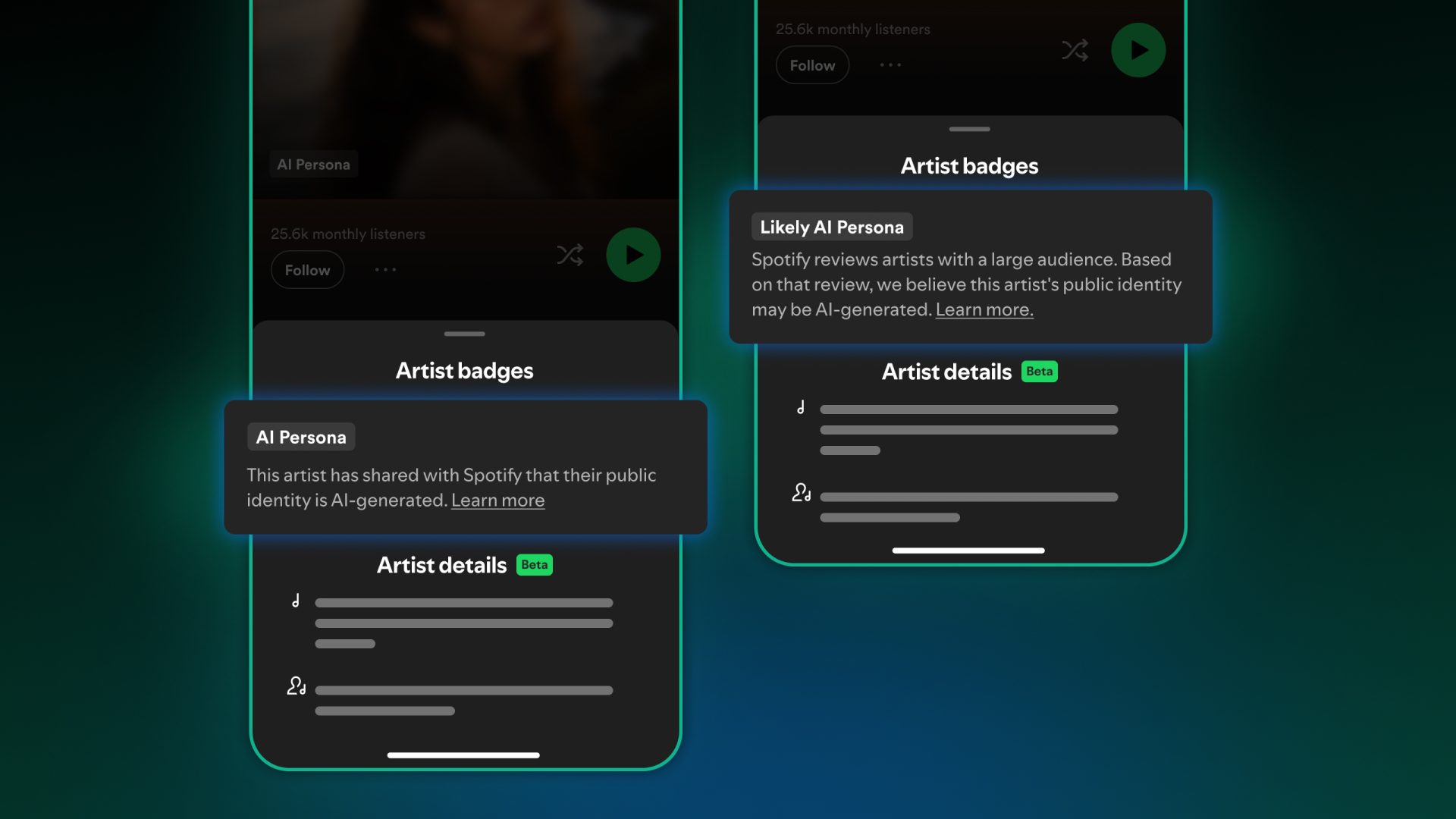
The rule that did bite Isekai was impersonation. “I Run” came down after takedown notices said the track impersonated another artist, so if you mask your own voice with Suno, the voice you end up with is what that rule checks. Disclosure everywhere else is still self-reported, like Apple Music’s Made With AI labels, which only show up when labels and distributors tag the tracks themselves.
Dazed’s headline calls Suno the new auto-tune. Fair enough, but T-Pain put his name and his face on his.
Frequently asked questions
Who are the artists Kilo Kent and Zemi?
Kilo Kent is a masked rapper whose Spotify bio places him in Tottenham, London, with 110,826 monthly listeners on October 8, 2026. Zemi is a Paris-born producer of Albanian heritage who releases French-language songs fronted by an AI avatar, with 294,980 monthly listeners on the same day. Both are signed to Isekai Records and told Dazed they use Suno to change their vocals.
Who founded Isekai Records?
Isekai Records was founded by music managers Ewan Jenkins and Jack Mangan together with artist RJ Pasin. It launched in August 2024 as a joint venture with Broke Records, which is owned by Create Music Group, and its first release was "Embrace It" by Ndotz.
How many Spotify plays does Kilo Kent's song "40's" have?
"40's" had 2,732,522 plays on Spotify on October 8, 2026, which makes it Kilo Kent's most played track. His next biggest, "BANDS", had 1,142,620. TikTok commenters are convinced the song is AI, and Kilo Kent told Dazed he has used Suno to mask his voice since early 2025.
Who wrote Dazed's "Suno is the new auto-tune" feature on Kilo Kent and Zemi?
Solomon Pace-McCarrick wrote the feature, which Dazed published on October 8, 2026. It includes separate interviews with Kilo Kent and Zemi, comments from UNSW Sydney associate professor Oliver Bown, and an account of Isekai Records asking to vet the article before publication.
About the author

Covering AI music tools, industry shifts, and news for music creators and professionals. Twice-weekly newsletter at aimusicpreneur.com.