Eight Mile Style's amended Suno complaint adds 108 outputs of 26 Eminem songs, 29 of them 'Lose Yourself'

My stack My fav 6 tools for AI music after testing 70+
-
 ElevenMusic · Music generation
-
 Moises · Stem separation
-
 Controlla · Voice swap & cloning
-
 Cryo Mix · Mixing + mastering
-
 Neural Frames · Music videos
-
 ONCE · Distribution
Some links are affiliate links — I earn a commission at no cost to you. Every tool here is one I run myself and truly believe in. This stack is proven.
Eminem’s publisher just handed the court 108 more Suno songs. On November 19, 2026, Eight Mile Style and co-plaintiff Martin Affiliated filed a First Amended Complaint against Suno, 13 days after they first sued over 269 Eminem songs.
The new evidence is a folder of recorded Suno outputs called Collective Exhibit C. It covers 26 of the songs in the case, from a jazz take on “Lose Yourself” to a reggae “Mockingbird”, and 29 of the 108 recordings are versions of “Lose Yourself” alone.
The songs, the claims and the money stay the same. The case still covers 269 works and asks for up to $47.75 million in statutory damages. Digital Music News reported the amendment on November 20, and I compared the 37-page amended complaint with the 36-page original to see what’s actually new.
What Eight Mile Style changed in its amended Suno complaint
Most of the case stays as it was. Exhibit A still lists 269 Eminem compositions, and the 3 claims are the same as on November 6: copyright infringement, getting around access controls under the DMCA, and stripping copyright management information, which is the songwriter and publisher data attached to a song.
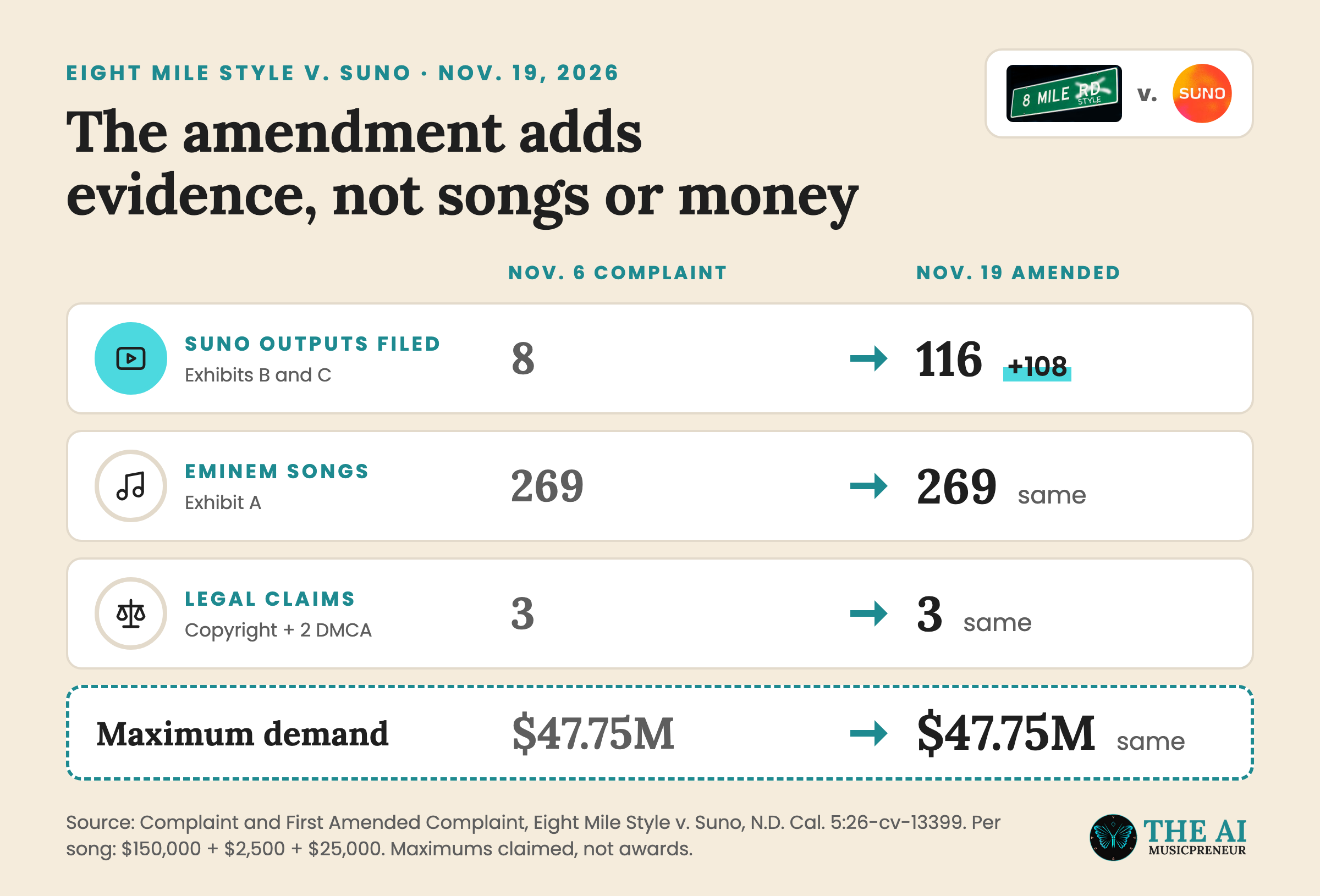
The money is worth a closer look, because the early number was off. The complaint asks for up to $150,000 per song for willful infringement, which for 269 songs is $40.35 million. On top of that come $2,500 per song for the access-control claim, $672,500 in total, and $25,000 per song for the stripped credits, another $6.725 million.
That adds up to $47.75 million, in the November 6 complaint and in the amended one. Early reports, my first piece on the case included, put the demand at about $41 million because they counted only the first 2 figures. Digital Music News puts it at $47.8 million, rounded up.
What did change is the evidence, plus 2 new opening paragraphs. The first cites Chart Masters to call Eminem the ninth best-selling artist of all time, ahead of Frank Sinatra, AC/DC, Elton John and Led Zeppelin. The second answers Suno’s press statement after the original filing, and that’s where the 108 new outputs come in.
The 108 Suno outputs of 26 Eminem songs in Collective Exhibit C
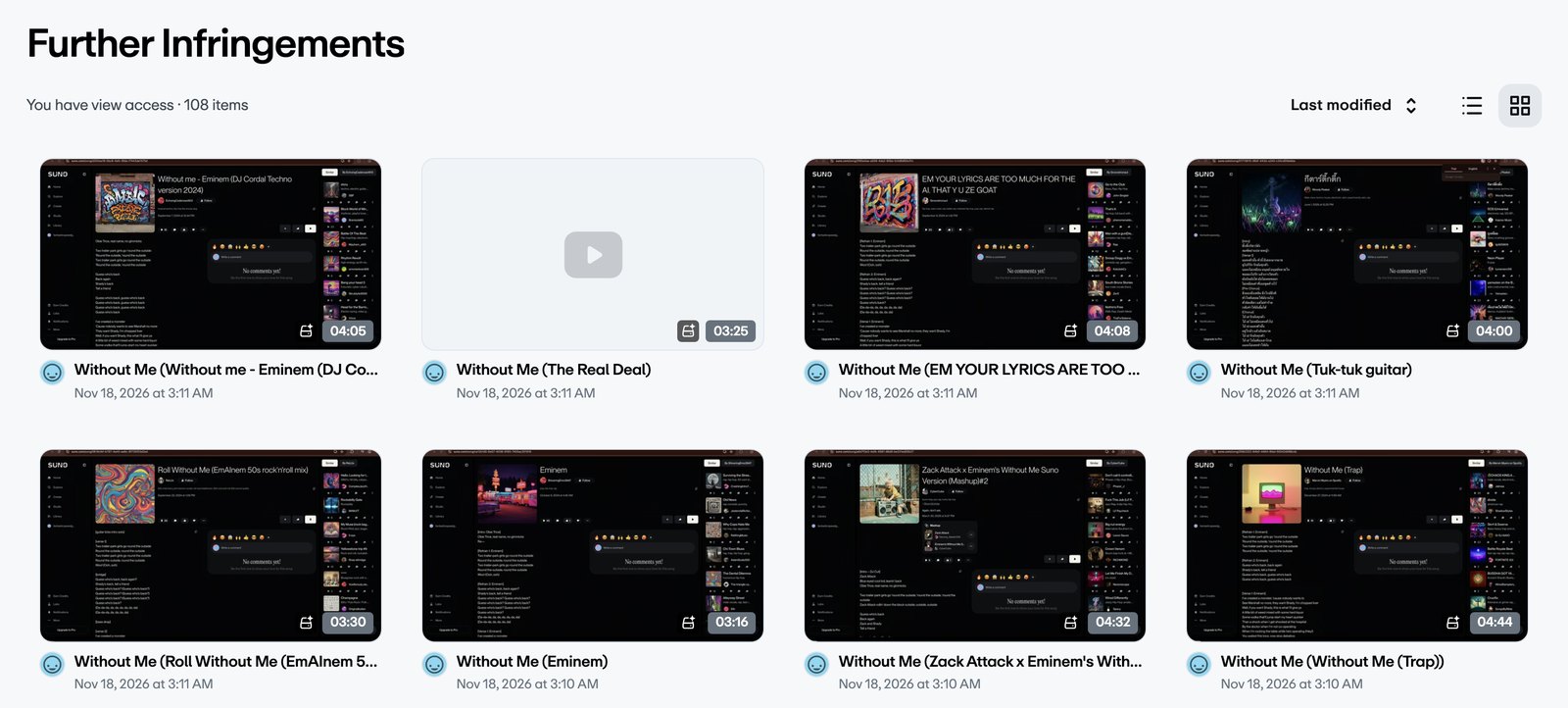
The complaint links Collective Exhibit C as a public Vimeo folder called “Further Infringements”. Each video shows a Suno song page and is labeled with the Eminem song it’s said to copy. Together they run about 6 hours and 48 minutes.
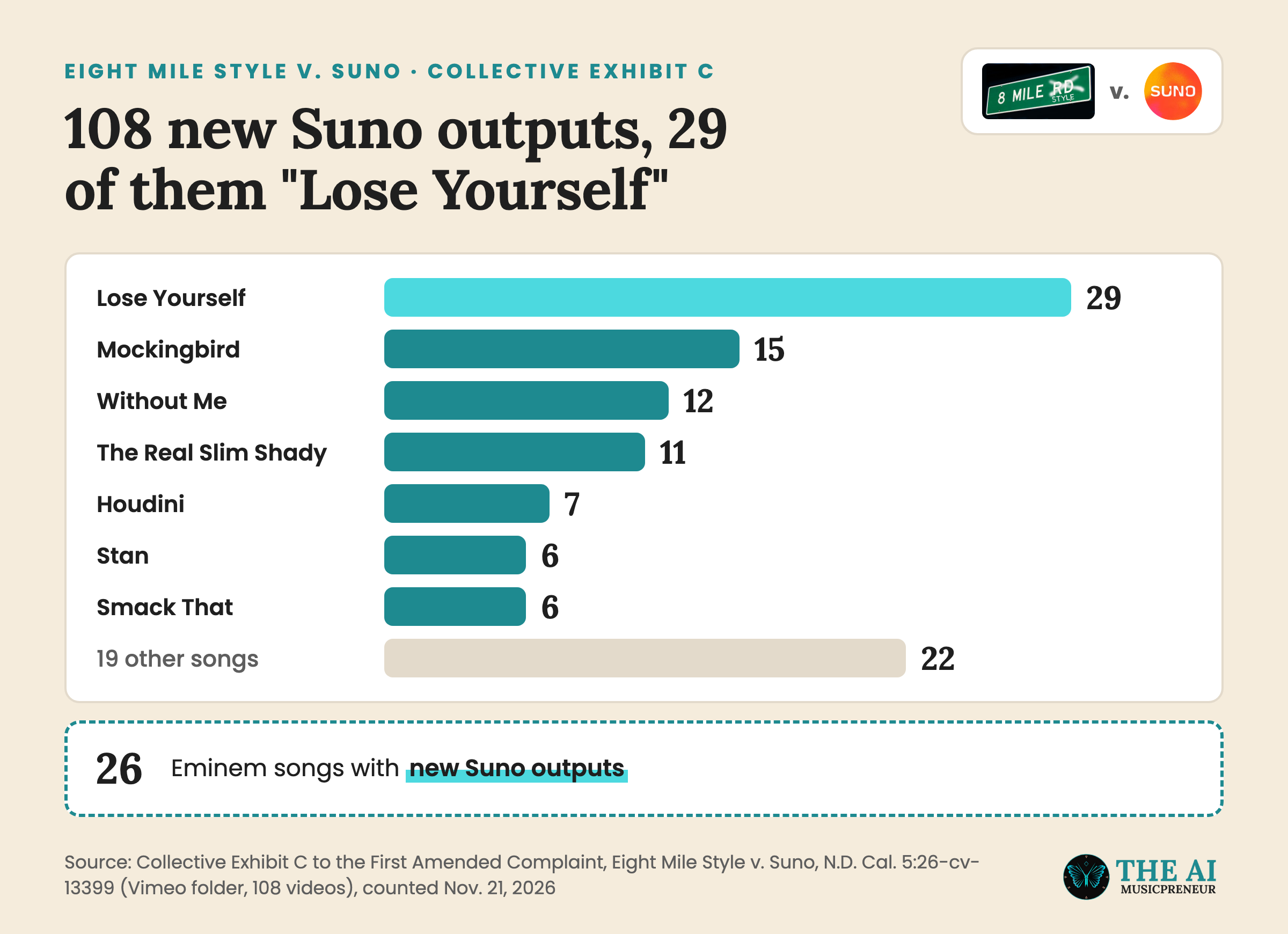
I went through all 108 and grouped them by song. 4 songs account for 67 of them: 29 versions of “Lose Yourself”, 15 of “Mockingbird”, 12 of “Without Me” and 11 of “The Real Slim Shady”. The other 41 spread across 3 songs with 6 or 7 each, and 19 songs with 1 or 2.
The titles show how far apart the genres go. There’s “Lose Yourself - in the Jazz”, a “Lose Yourself Metal Cover”, an “Eminem 1950’s Motown Doo-Wop Swing - Lose Yourself”, a reggae “Mockingbird” and a “DJ Cordal Techno version” of “Without Me”. Digital Music News describes another as a “heavy alternative rock” take on “The Real Slim Shady”.
27 of the 108 video titles carry Eminem’s name, or a spelling of it like “EmAInem”. And the list goes beyond Eminem’s own releases: 6 outputs copy “Smack That”, Akon’s 2006 hit featuring Eminem, and others cover songs like “Many Men” and “Thugs Get Lonely Too”. All 26 are among the works Eight Mile Style says it owns or controls.
The complaint says many of these outputs are “in the voice of Eminem”, and the amendment puts that voice right at the top.
Why Eight Mile Style’s amended complaint leans on Eminem’s voice without a voice claim
The new opening says more about Eminem’s voice than the original did. Right after the copyright allegations, it adds this line:
But that is not all, Suno also stole without care, Eminem's likeness, including his voice, as also discussed below.
That’s why DancehallMag writes about “the NIL side of the case”, NIL being name, image and likeness. But the claims didn’t change. There’s no right-of-publicity count like the one Elvis Presley Enterprises brought under Tennessee’s ELVIS Act, only copyright and the 2 DMCA claims.
Eight Mile Style controls compositions, the words and music of the songs. Eminem, the person whose voice it is, isn’t a party to the case. So his voice comes up in the description of the outputs and in the complaint’s answer to Suno’s public statements.
After the first suit, Suno told press outlets that it doesn’t “trade on anyone’s name or likeness” and doesn’t allow “prompts for specific artists’ names and songs”. The amended complaint calls those statements false and says they repurpose what Suno wrote in its motion to dismiss Jason Isbell’s lawsuit. Elvis Presley Enterprises made the same argument in its own amended complaint 6 days earlier.
The original 8 exhibits already had one voice example, a Suno track called “Slim shady x Rosefalls” that the complaint says uses “a voice clearly derived from Eminem’s actual voice”. It’s still in Exhibit B.
What happens next in Eight Mile Style v. Suno
The judge changed the day before the amendment. The case first went to Magistrate Judge Joseph C. Spero, and on November 18, after Eight Mile Style filed its form on whether to go ahead before a magistrate judge, the court randomly reassigned it to District Judge Beth Labson Freeman.
That’s why the case number now reads 5:26-cv-13399-BLF. The reassignment also took the initial case management conference set for February 10, 2027 off the calendar. Judge Freeman is also hearing Reservoir’s lyrics case against Anthropic.
An amended complaint replaces the original, so the November 19 version is the one Suno has to answer. Under Rule 15 of the Federal Rules of Civil Procedure, Suno’s response is due 14 days after it’s served with the new version, or later if its original deadline runs longer.
Suno hasn’t filed anything on the CourtListener docket yet. 2 entries from November 20, a notice and an order, aren’t public there so far.
Richard Busch, the lawyer behind the case, also filed Reservoir’s amended Suno complaint on November 11 and Elvis Presley Enterprises’ on November 13. All 3 amendments added recorded Suno outputs as evidence. Nobody in this case is suing Suno users.
I log every filing in this case on the Eight Mile Style v. Suno tracker.
Frequently asked questions
Why does Eight Mile Style's Suno lawsuit add up to $47.75 million and not $41 million?
The complaint asks for up to $150,000 per song for willful copyright infringement, $2,500 per song for getting around access controls and $25,000 per song for removing copyright management information. Across 269 songs that is $40.35 million, $672,500 and $6.725 million. Early reports of about $41 million left out the $6.725 million claim, and the November 19 amendment keeps all 3 figures.
Where can the public watch the Suno outputs in Eight Mile Style's Collective Exhibit C?
The First Amended Complaint links Collective Exhibit C as a public Vimeo folder titled Further Infringements. It holds 108 videos of Suno song pages, each labeled with the Eminem song it is said to copy. The plaintiffs also lodged the files with the court.
Which judge is hearing Eight Mile Style v. Suno after the November 2026 reassignment?
District Judge Beth Labson Freeman of the Northern District of California. The case was first assigned to Magistrate Judge Joseph C. Spero, then randomly reassigned on November 18, 2026, so it now runs as 5:26-cv-13399-BLF. The reassignment vacated the initial case management conference that had been set for February 10, 2027.
Does Eight Mile Style's amended complaint name Bright Data as a defendant alongside Suno?
No. Suno, Inc. is the only defendant. The complaint describes Bright Data as the company whose scraping tools and proxy services Suno allegedly used, citing a 404 Media report on leaked Suno source code that it says shows millions of songs and lyrics scraped from YouTube Music, Deezer and Genius.
About the author
Covering AI music tools, industry shifts, and news for music creators and professionals. Twice-weekly newsletter at aimusicpreneur.com.