Suno asks a judge to throw out Jason Isbell's identity lawsuit, saying an artist's name is just shorthand for a style

My stack My fav 6 tools for AI music after testing 70+
-
 ElevenMusic · Music generation
-
 Moises · Stem separation
-
 Controlla · Voice swap & cloning
-
 Cryo Mix · Mixing + mastering
-
 Neural Frames · Music videos
-
 ONCE · Distribution
Some links are affiliate links — I earn a commission at no cost to you. Every tool here is one I run myself and truly believe in. This stack is proven.
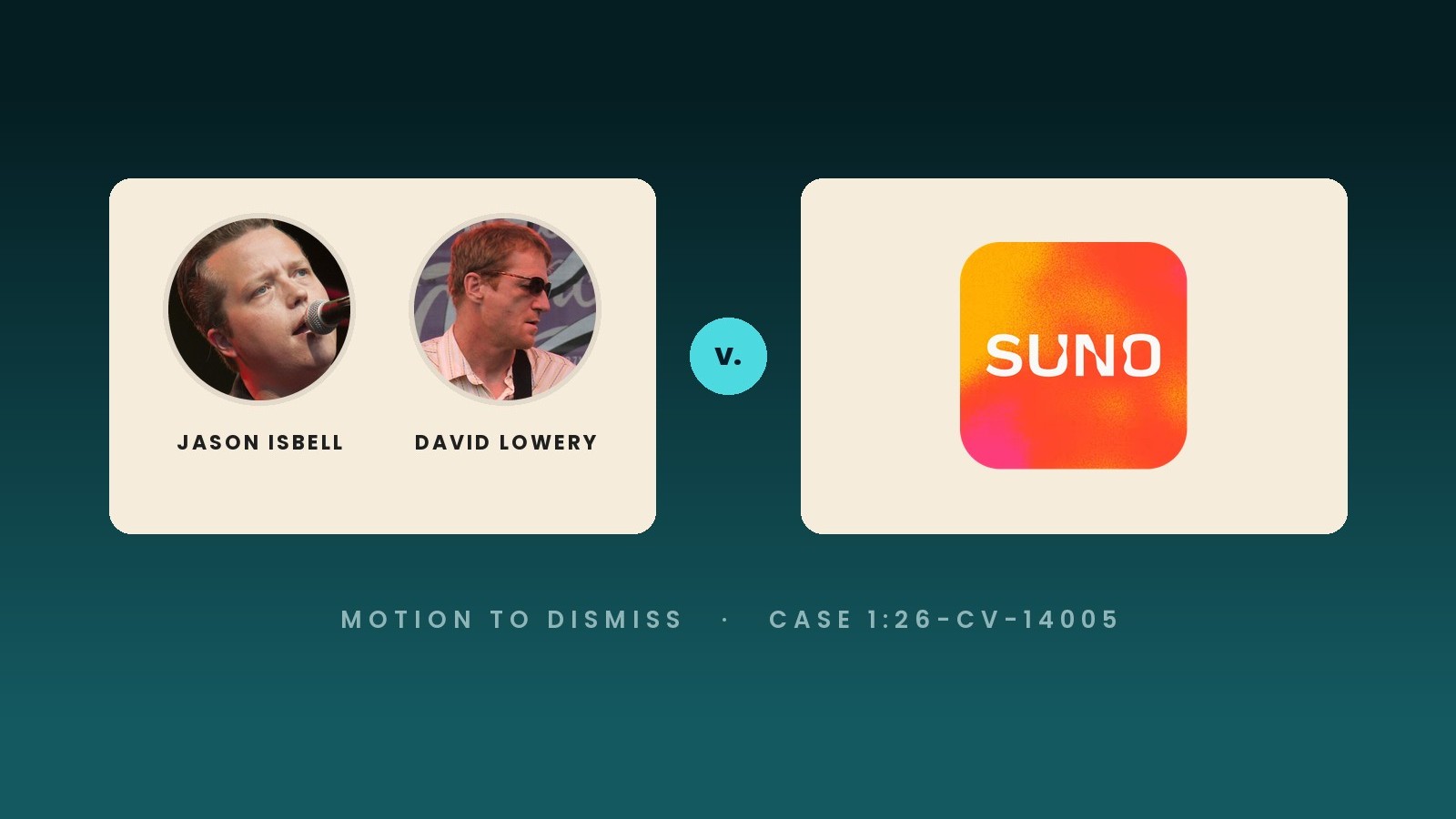
Suno has asked a federal judge in Boston to throw out the identity class action brought by Jason Isbell and David Lowery, arguing there is “nothing unlawful” about using a musician’s name to describe a style. The motion, first reported by Billboard on November 3, 2026, is Suno’s first major response to the case.
The lawsuit, Lowery v. Suno (case 1:26-cv-14005), was filed on August 31 by Isbell, Lowery, Texas blues musician Guy Forsyth and Florida saxophonist Eduardo Calle. It runs 17 counts under state publicity laws and Illinois’ biometric privacy law, and it has no copyright claim at all.
Suno’s answer comes in two layers. First, the First Amendment: naming an artist is how people describe music. Second, if that fails, copyright law already decided that a style belongs to nobody, so state law can’t hand it to the artist.
No state confers a right of publicity that prohibits a musician in a studio from saying to their producer, 'Let's go for something here with more of a Jason Isbell vibe,' and actually achieving that result without infringing any copyright or creating a likelihood of confusion over the identity of the performer.
Suno’s First Amendment argument: an artist’s name is shorthand for a style
“When people describe styles of music, they often use artists’ names as shorthand for the genre they perform in,” Suno’s lawyers wrote, according to Billboard. “This case turns on the premise that the law somehow condemns that universal practice. In reality it does not; the First Amendment would not allow it to.”
The motion goes past prompts and defends the tool itself: “The law does not prevent people from using names to find or describe information, nor does it prevent building a tool capable of recognizing those references and acting on the information they supply.”
Suno also says none of its outputs could be mistaken for the musicians suing it, as Digital Music News reported. And it warns that the lawsuit attacks “ubiquitous methods of communicating ideas” and would hurt the “creative and cultural ecosystem” if it went ahead.
So the first question for the judge is whether typing a name into Suno is protected speech. Suno’s second argument only matters if the answer is no.
Suno’s preemption argument: copyright law already left style free
Preemption is the rule that federal law wins when a state law covers the same ground. Under section 301 of the Copyright Act, a state claim that protects the same thing copyright protects gets thrown out.
Suno says that’s what Isbell and Lowery are trying to do. “Congress made the considered policy choice not to confer intellectual property protection on an artistic style, precisely to allow subsequent creators to build on the prior works of a genre,” the motion says. Letting the case go on, it argues, “would create a shadow state law IP regime” that conflicts with the federal one.
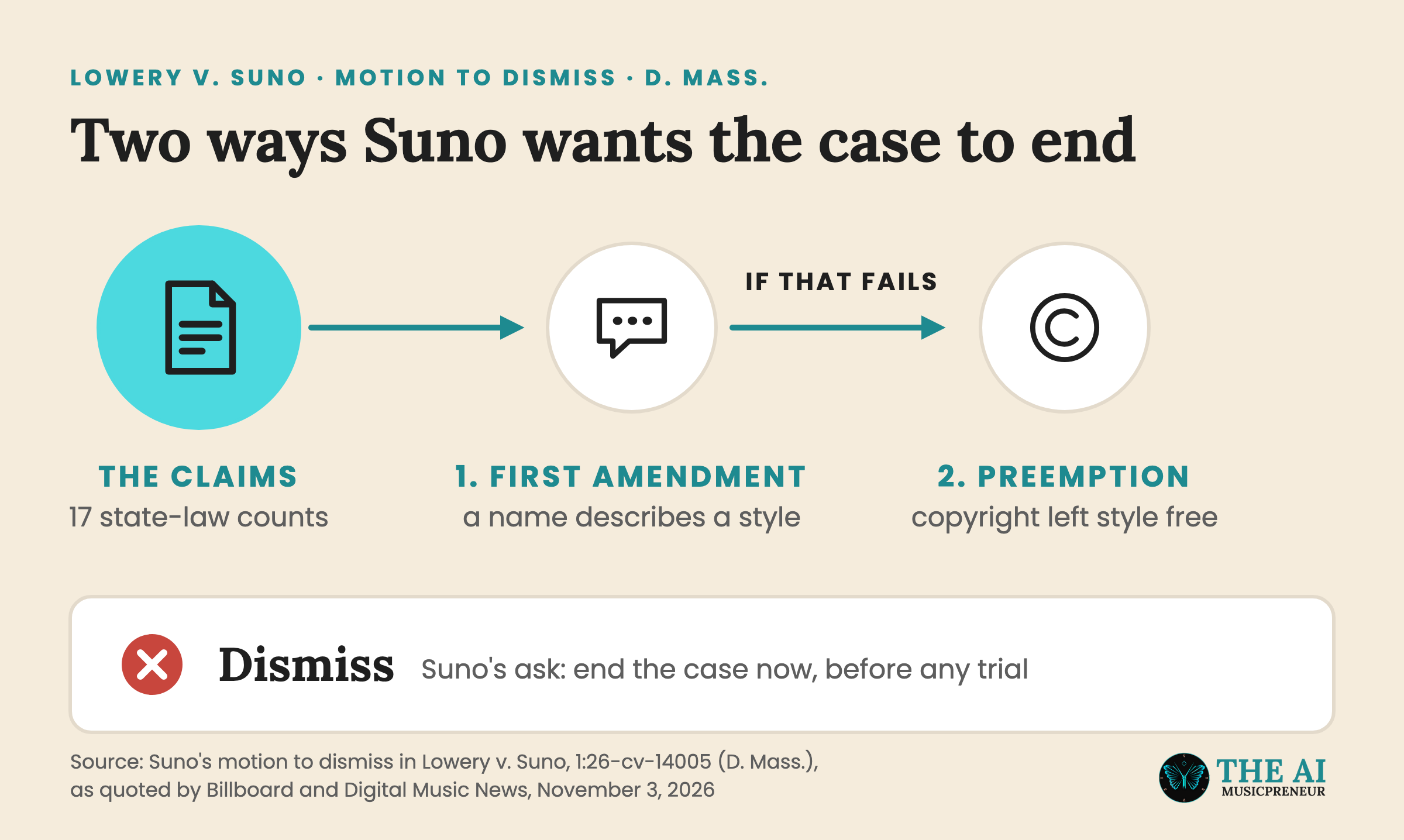
This argument has already worked against musicians once this year. In August, Judge Alvin K. Hellerstein threw out the indie artists’ unfair competition claim against Udio on preemption, then gave them 30 days to replead around voice and identity.
Isbell and Lowery wrote their complaint to sit outside that trap. It claims no song, no recording and no genre, and it says so: “Plaintiffs claim no ownership of country music, of Americana music, or of any genre, style, or musical idea.”
Can you use artist names in Suno prompts?
Yes, but the name doesn’t reach the model as a name. Suno told the court in its October 20 answer to the labels’ v6 lawsuit that users have been able to type an artist’s name since January 2026, and that the name gets converted into a style description before anything is generated.
Billboard’s example: “Duran Duran” becomes “New wave, Synth-pop, Pop rock.” Digital Music News gives another one, where “Pantera” turns into “aggressive metal.”
The complaint says that filter is easy to beat. Put spaces between the letters, “t a y l o r s w i f t” or “b a d b u n n y”, and the name gets through.
It also argues the translated version still trades on the artist: “Suno built and trained a model to index musicians by name. It encoded musicians’ identities into its AI model to create its commercial product without consent.”
Suno’s motion argues that using the name would be lawful either way, so its case doesn’t rest on the filter.
One gap: the reports on the motion focus on names and style. Neither Billboard nor Digital Music News spells out how Suno answers the Illinois voiceprint count, and the full motion sits behind DMN’s subscriber wall, so I’m working from the passages they quote.
What happens next in Lowery v. Suno
Isbell, Lowery, Forsyth and Calle now get to file an opposition. Under the District of Massachusetts local rules, that’s due 14 days after a motion is served, unless the judge sets a different schedule. No hearing date has been reported, and Billboard said an attorney for Isbell didn’t return a request for comment.
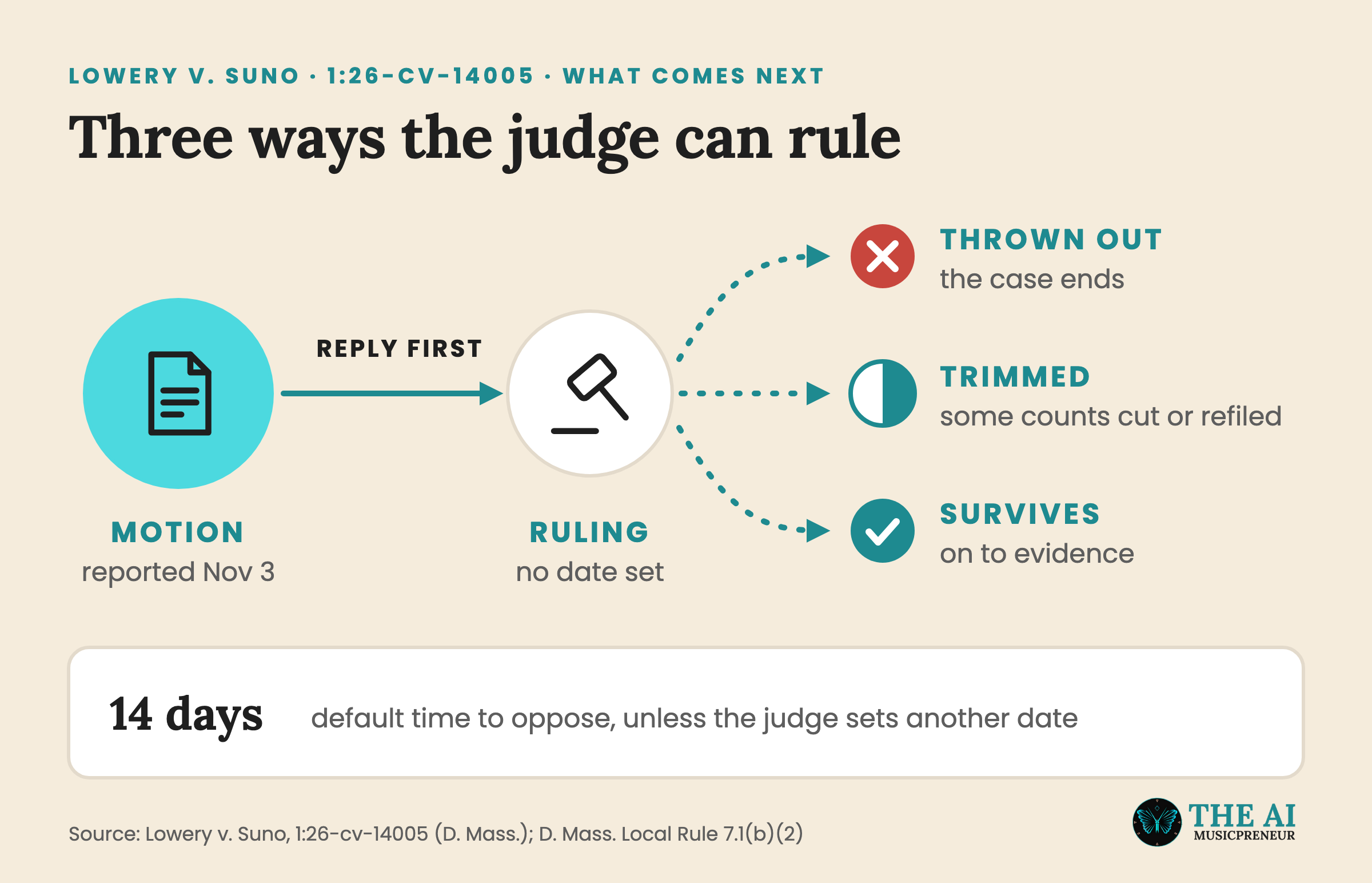
After that, the judge can throw the case out, keep it going, or land in between: cut some counts and let the musicians refile the rest, the way the Udio judge did in August.
The size of the case rides on that ruling. The complaint is written to cover every musician “whose names are or have been accepted as prompts in Suno,” and Billboard says that could mean “millions” of artists.
None of this touches the labels’ copyright case against Suno, which runs separately in the same Boston court. The Lowery v. Suno tracker has the full timeline.
The next filing to read is the musicians’ opposition. That’s where Isbell and Lowery have to explain why typing “jason isbell” into Suno is different from a producer asking for more of a Jason Isbell vibe.
Frequently asked questions
What does Suno's motion to dismiss mean by a 'Jason Isbell vibe'?
Suno's lawyers use the example of a musician telling a producer, 'Let's go for something here with more of a Jason Isbell vibe.' They argue no state publicity law forbids that, so naming an artist to describe a sound, whether to a producer or to Suno, is ordinary speech.
Does Suno's motion to dismiss the Isbell case affect the major labels' copyright lawsuits against Suno?
No. The labels' lawsuits are copyright cases over recordings they own, and they run separately in the same Boston federal court. Suno's motion only targets the identity and privacy claims Isbell, Lowery, Forsyth and Calle brought under state law.
Which state laws does the Isbell and Lowery lawsuit against Suno rely on?
It relies on right of publicity laws, including the Illinois Right of Publicity Act and California's common-law publicity right, and Billboard reports it also invokes laws in New York, Tennessee and other states. A separate count uses the Illinois Biometric Information Privacy Act over alleged voiceprints. There is no copyright claim.
About the author
Covering AI music tools, industry shifts, and news for music creators and professionals. Twice-weekly newsletter at aimusicpreneur.com.