CISAC counts a record €15.5bn in creator royalties for 2025, and calls AI its 'largest test'

My stack My fav 6 tools for AI music after testing 70+
-
 ElevenMusic · Music generation
-
 Moises · Stem separation
-
 Controlla · Voice swap & cloning
-
 Cryo Mix · Mixing + mastering
-
 Neural Frames · Music videos
-
 ONCE · Distribution
Some links are affiliate links — I earn a commission at no cost to you. Every tool here is one I run myself and truly believe in. This stack is proven.

Collecting societies took in a record €15.5bn in royalties for creators in 2025. That’s the headline of CISAC’s Global Collections Report 2026, published today, November 4, 2026, and it’s up 11.3% on 2024.
But about 52% of that increase comes from one new name in the count: The Mechanical Licensing Collective, the US body that collects mechanical royalties from streaming and download services. Without The MLC, collections grew 5.3%, the slowest rate of the last 3 years.
And the report opens with a warning. “Our confederation now faces its largest test with artificial intelligence, new business models and changing patterns of consumption,” writes Dean Ormston, CEO of APRA AMCOS and Chair of the CISAC Board, in his foreword.
How much of CISAC’s €15.5bn record came from The MLC
CISAC is the umbrella body for 225 collecting societies in 110 countries, the organisations that collect your royalties when your song is streamed, played on the radio or performed live. Every year it adds up what they all collected.
This year, The MLC is in that total for the first time. It contributed more than €800m to the Canada/USA figure alone, and CISAC’s own press release says the headline growth rate “is not a like-for-like comparison.”
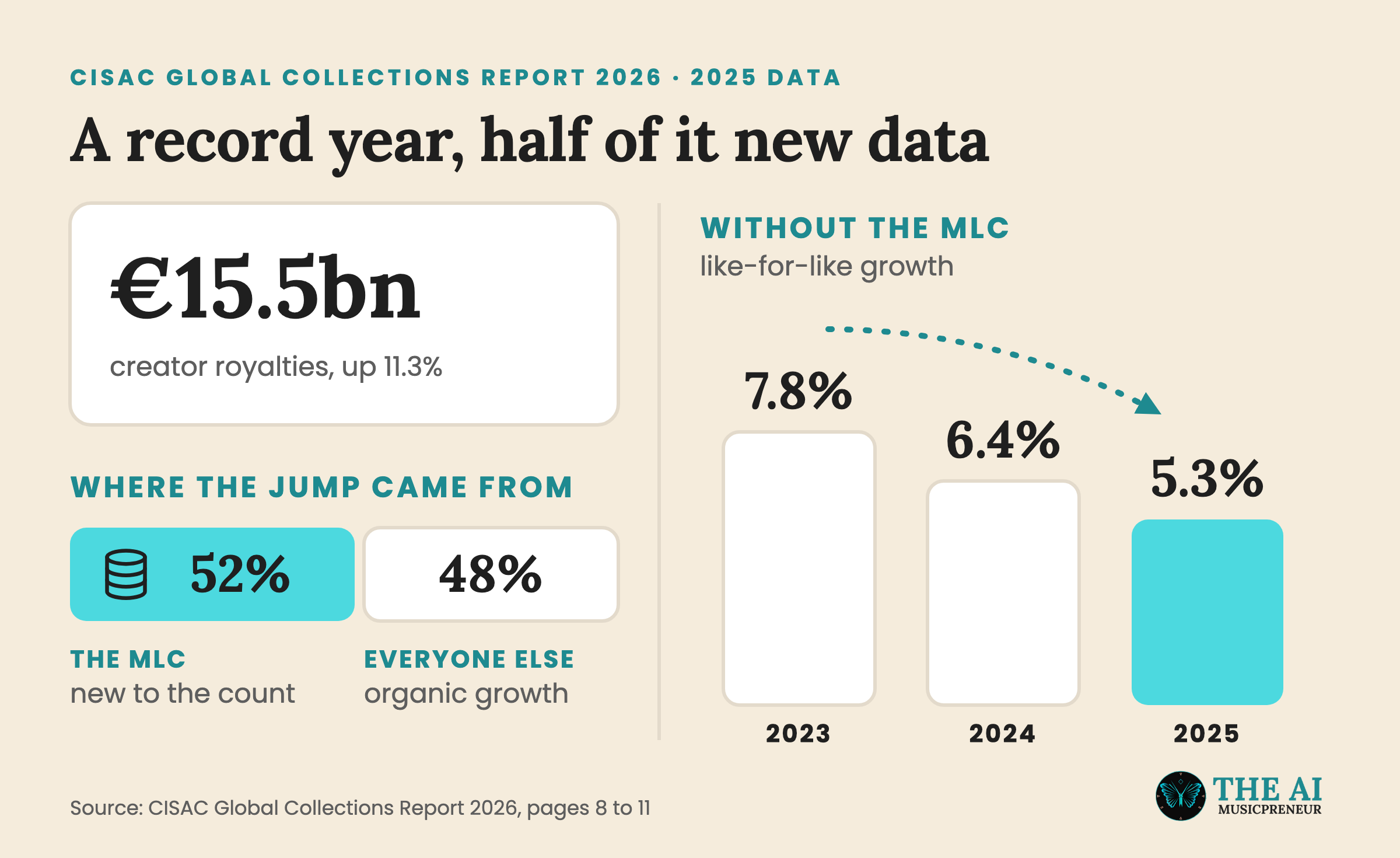
So here’s the like-for-like picture. Excluding The MLC, global collections grew 5.3% in 2025, after 6.4% in 2024 and 7.8% in 2023. Music on its own also grew 5.3% without The MLC, against 11.9% with it.
Billboard points out that even the 5.3% beats the 4.8% growth IFPI counted for recorded music in 2025. You can see the label side of that in my IFPI Global Music Report breakdown.
The MLC is having a busy year in AI music, btw. It’s also the body Suno and Udio are trying to force, in court, to hand over streaming data from 8 platforms.
Digital now brings in 45.6% of music royalties in CISAC’s count
Music is most of the €15.5bn. CISAC societies collected €14.06bn for music creators in 2025, up 11.9%, and 83.5% more than in 2016.
Digital is the biggest piece. Streams and downloads brought in €6.41bn, up 27.9%, or 11.2% without The MLC, which makes it 45.6% of all music royalties.
In some markets it’s far higher. In the 10 smaller markets the report singles out, digital is above 70% of collections, topping out at 89.3% in Honduras and 88.6% in Indonesia.
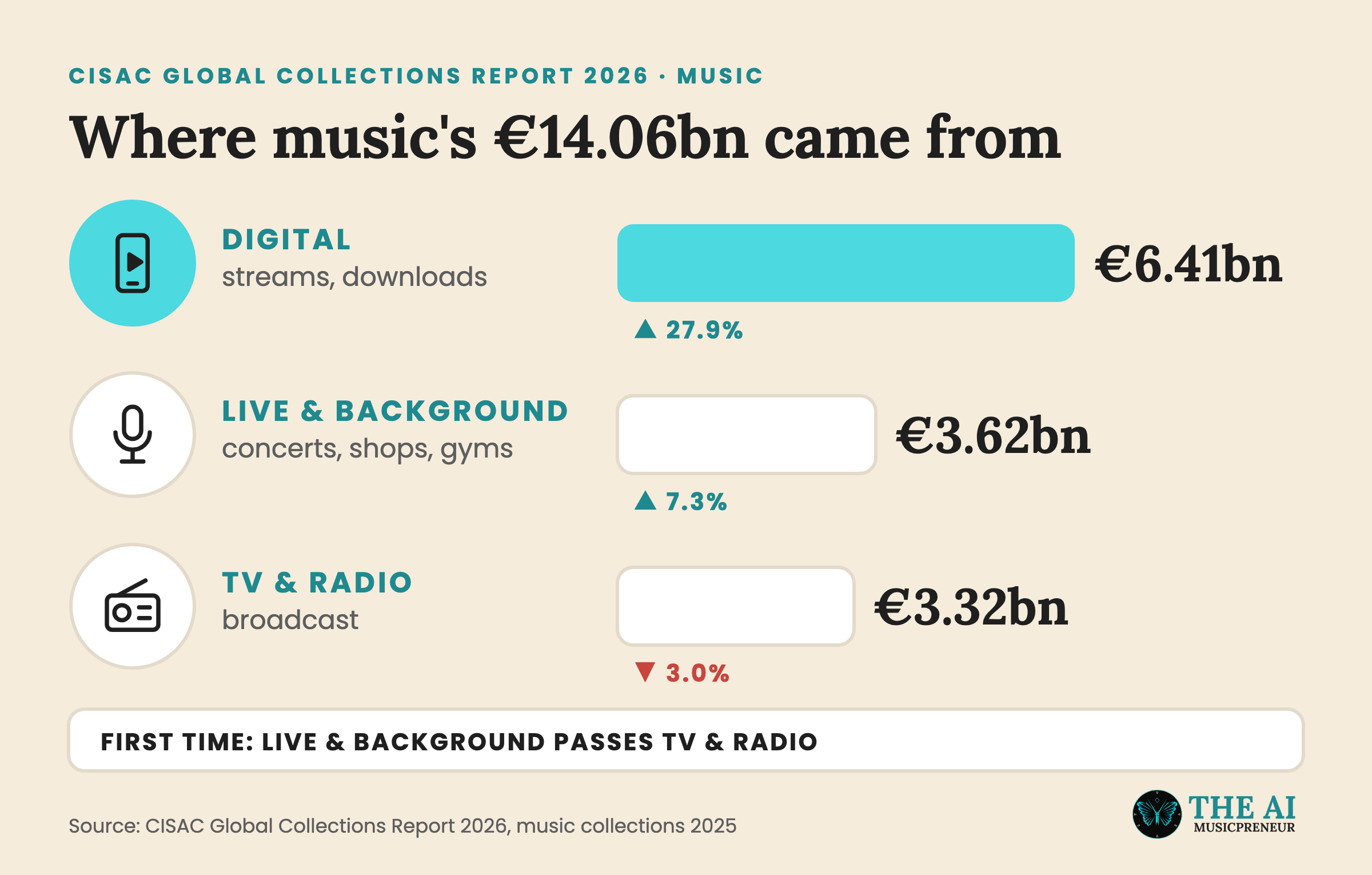
The second piece changed places this year. Live & Background is what CISAC calls public performance: concerts and festivals, plus music played in shops, restaurants, hotels and gyms. It grew 7.3% to €3.62bn and passed TV & Radio for the first time.
TV & Radio went the other way, down 3.0% to €3.32bn for music. As recently as 2021, it was the biggest source of collections across all repertoires.
What CISAC’s 2026 report says about AI
AI shows up in all 3 forewords. Ormston’s “largest test” line comes with a second half: “This technological change also means that the future can bring real opportunities for creators.”
CISAC director general Gadi Oron writes that “the issue is no longer whether AI will transform our industries, but whether the systems that protect creators’ rights are evolving quickly enough to keep pace.” He also writes that “pioneering licences between rights societies and AI developers have begun to emerge.”
Human creativity is not the enemy of artificial intelligence. It is the reason artificial intelligence exists.
Björn Ulvaeus uses his foreword to retell the year he spent on stages from CISAC’s centenary General Assembly in Paris, where societies adopted the Paris Commitment, to the UN’s AI for Good Summit in Geneva. His line for policymakers and tech companies: “creators are not asking to slow progress. We are asking to help shape it.”
The report’s market chapter, written with research firm Futuresource, is more cautious. It says AI “is also likely to reshape the digital market, although the scale and direction of its impact on consumption, licensing and collections remain difficult to assess.” Its one named example of an AI-assisted product is Spotify’s licensed remix features with Universal Music Group, the deal Spotify’s co-CEO called the controlled alternative to slop.
Deezer’s AI upload numbers in CISAC’s streaming chapter
The hardest AI number in the report isn’t CISAC’s. In its chapter on cultural diversity in streaming, the report cites Deezer: fully AI-generated tracks were 34% of the new tracks delivered to Deezer each day in November 2025, and more than half on peak days in June 2026.
CISAC adds the caveat itself. “These are upload figures, not measures of listening or royalties,” and Deezer keeps the AI tracks it identifies out of its recommendations. I covered Deezer passing 50% and starting to delete AI tracks in July.
The report uses the numbers to show how much material platforms now have to identify and organise as they help listeners find music.
When CISAC’s royalty reports could start measuring AI
Two years ago, in the 2024 edition, Oron wrote that the collection numbers didn’t show the impact of generative AI yet, and that “future editions in the years ahead will do so.” The 2026 edition’s market chapter still calls that impact difficult to assess, and the collection tables still have no AI line.
The closest thing to a number is CISAC’s own study with PMP Strategy from December 2024, which put 24% of music creators’ revenue at risk by 2028. That study also comes up in my piece on Latin music and AI training.
Meanwhile, the societies inside CISAC are moving on their own. GEMA, which beat Suno in a Munich court, now wants AI music output to pay songwriters too.
So the €15.5bn is a record built on streaming, live and one new US society in the count. Whether AI money ever shows up as its own line is the question the next report has to answer.
Frequently asked questions
Who wrote the 'largest test with artificial intelligence' line in CISAC's Global Collections Report 2026?
Dean Ormston, CEO of APRA AMCOS and Chair of the CISAC Board, wrote it in his foreword on page 5 of the report. Billboard attributed the line to CISAC director general Gadi Oron, whose own foreword on page 6 says the systems that protect creators' rights have to keep pace with AI.
How much have CISAC's music royalty collections grown since 2016?
Music collections by CISAC societies rose from €7.66bn in 2016 to €14.06bn in 2025, an increase of 83.5%. Part of the 2025 jump comes from The MLC being counted for the first time, so the 11.9% rise in 2025 is not a like-for-like comparison.
Which region collected the most creator royalties in CISAC's 2026 report?
Europe, with €8.09bn in 2025, up 6.2% and 52.2% of the global total. Canada and the USA grew fastest, up 26.5% to nearly €4.5bn, and Asia-Pacific passed €2bn for the first time.
How much did live concerts and background music each bring in, according to CISAC's 2026 report?
Royalties from live performances rose 14.9% to a record €1.4bn in 2025, the third year in a row above €1bn. Background music, meaning songs played in shops, restaurants, hotels and gyms, rose 5.6% to €1.2bn.
About the author
Covering AI music tools, industry shifts, and news for music creators and professionals. Twice-weekly newsletter at aimusicpreneur.com.