Latin music crossed $1bn in the US, and its catalogue is still training AI for free
My stack My fav 6 tools for AI music after testing 70+
-
 ElevenMusic · Music generation
 -
 Moises · Stem separation
 -
 Controlla · Voice swap & cloning
 -
 Cryo Mix · Mixing + mastering
 -
 Neural Frames · Music videos
 -
 ONCE · Distribution
Some links are affiliate links — I earn a commission at no cost to you. Every tool here is one I run myself and truly believe in. This stack is proven.

US Latin music revenue crossed $1bn for the first time in 2025. In the same stretch of years, The Atlantic found roughly 21.2 million tracks sitting inside AI training datasets, Bad Bunny’s catalogue among them, taken without permission or payment. José Valentino Ruiz put those two facts next to each other in The Hill on September 20 and asked who gets paid.
Ruiz teaches music business and entrepreneurship at the University of Florida and has won multiple Latin Grammys as a composer, producer and engineer. So the piece is written from inside the catalogue it is arguing about.
His opening example is the one most readers already know. Bad Bunny heard “Demo 5: Nostalgia”, a reggaeton track circulating on TikTok in a clone of his voice with fake Daddy Yankee and Justin Bieber verses, and told any fan who enjoyed it to leave his WhatsApp channel.
Why the Spanish-language catalogue is exposed twice over
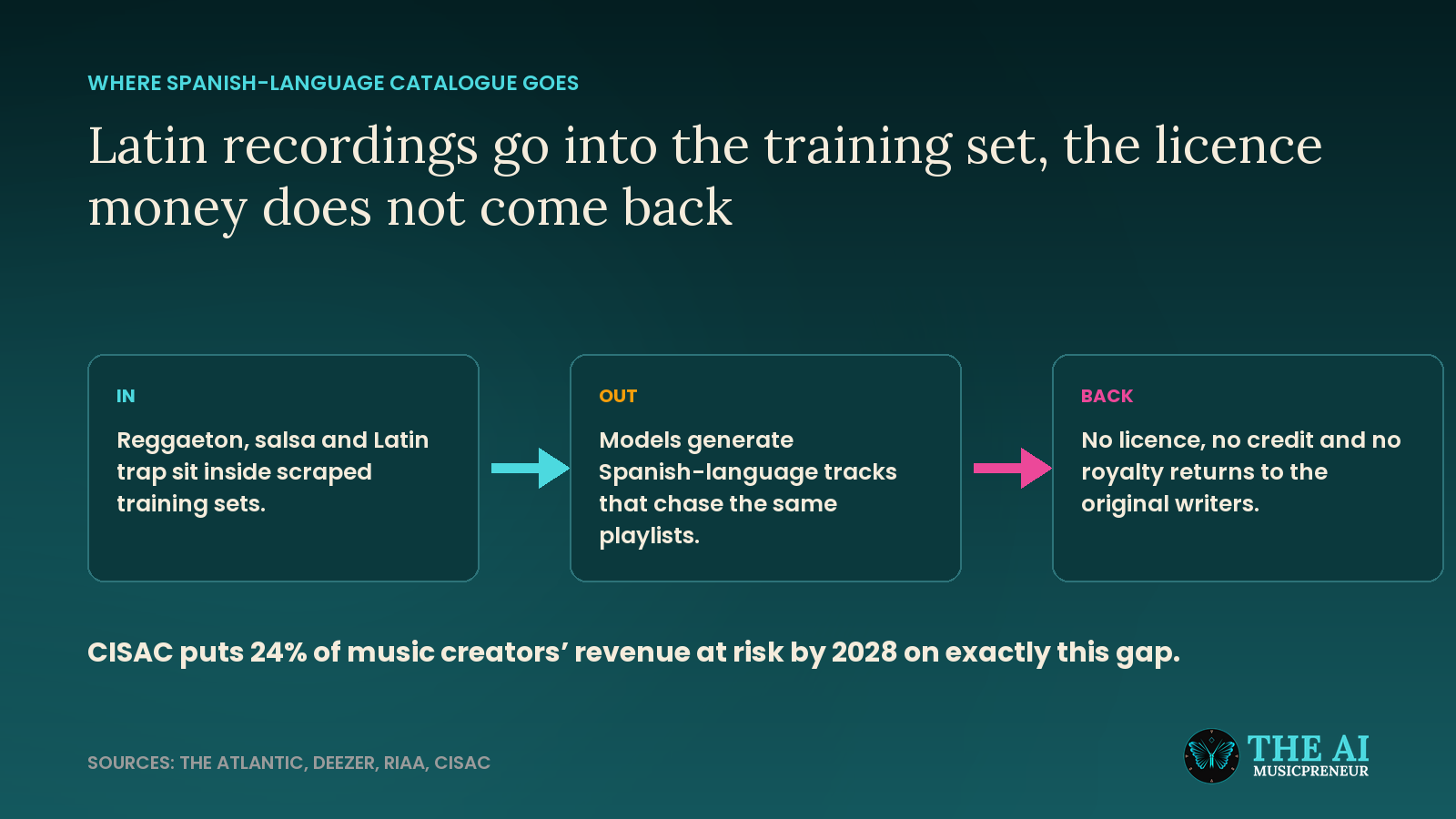
Most coverage of training data stops at the first exposure: the recordings go in. The second one is what Ruiz is actually pointing at. Models trained on reggaeton, salsa and Latin trap then generate Spanish-language tracks that compete for the same playlists as the originals.
The supply side of that is not theoretical. Deezer says close to half of its daily uploads are now AI-generated, a number I covered when it crossed 50% and the takedown policy changed. Every one of those uploads is chasing the same editorial slots and the same per-stream pool.
Universal Music and Sony are suing Suno over training data for the second time. Those suits run on major-label recordings, because that is where the money and the lawyers are, and not on whether a salsa writer in San Juan ever sees a licence fee.
Celebration without protection is just nostalgia with better lighting.
The detection gap that makes this worse for non-English catalogue
There is a mechanical reason Latin and other non-English repertoire loses here, and Ruiz doesn’t spend long on it. Detection and rights matching are built and tuned first on the English-language catalogue, because that is where the biggest rightsholders sit. I wrote about the same failure in Arabic repertoire when Anghami’s COO said detection tools can’t read it reliably.
A track that detection tools rate as clean is a track nobody bills for. The gap isn’t only about consent at the front door, it’s about whether the plumbing can even recognise the work later.
The legal route is starting to move in Spanish too. The Mexican label Gerencia 360 sued Suno and Bright Data over its Spanish-language catalogue, which is the first case I’ve seen run on regional repertoire rather than major-label recordings. One case is not a policy.
Ruiz’s practical ask lands on teaching rather than litigation: every student who records a vocal today should know the recording might train a model one day, and that the contract should decide that, not an unread checkbox. His close is the line to keep. AI has learned to sing in Spanish, and the open question is whether the people who taught it will get paid.
Frequently asked questions
Who wrote The Hill's "AI learned to sing in Spanish" opinion piece?
José Valentino Ruiz, an associate professor of music business and entrepreneurship at the University of Florida and an associate member of the AI for Health Institute at the UF College of Medicine. He is also a multiple Latin Grammy winner as a composer, producer and recording engineer. The piece ran in The Hill on September 20, 2026.
How much did Latin music earn in the United States in 2025?
US Latin music revenue crossed $1bn for the first time in 2025, according to the RIAA's year-end figures. Ruiz uses that number to set up his argument rather than to celebrate it. His point is that the commercial peak and the unlicensed training of models on the same catalogue are happening in the same years.
How much of music creators' revenue does CISAC expect generative AI to put at risk by 2028?
A study commissioned by CISAC from PMP Strategy puts 24% of music creators' revenue at risk by 2028, a cumulative loss of about €10bn over 5 years and roughly €4bn in 2028 alone. The study models the risk as substitution, meaning AI output competing for the same placements as human work. It covers music creators globally rather than Latin music specifically.
What did Bad Bunny do about the AI voice clone track "Demo 5: Nostalgia"?
The track circulated on TikTok as a reggaeton song sung in a convincing clone of his voice, with fake verses attributed to Daddy Yankee and Justin Bieber. Bad Bunny went to his WhatsApp channel and told any fan who enjoyed it to leave the group. Ruiz opens his argument with that reaction.
About the author

Covering AI music tools, industry shifts, and news for music creators and professionals. Twice-weekly newsletter at aimusicpreneur.com.