The NO FAKES Act loses 3 of its 4 lead Senate sponsors as Democrats win Congress in the 2026 midterms

My stack My fav 6 tools for AI music after testing 70+
-
 ElevenMusic · Music generation
-
 Moises · Stem separation
-
 Controlla · Voice swap & cloning
-
 Cryo Mix · Mixing + mastering
-
 Neural Frames · Music videos
-
 ONCE · Distribution
Some links are affiliate links — I earn a commission at no cost to you. Every tool here is one I run myself and truly believe in. This stack is proven.
Democrats won both chambers of Congress on November 3, 2026, and the bill that would protect your voice from AI clones came out of the night short on senators.
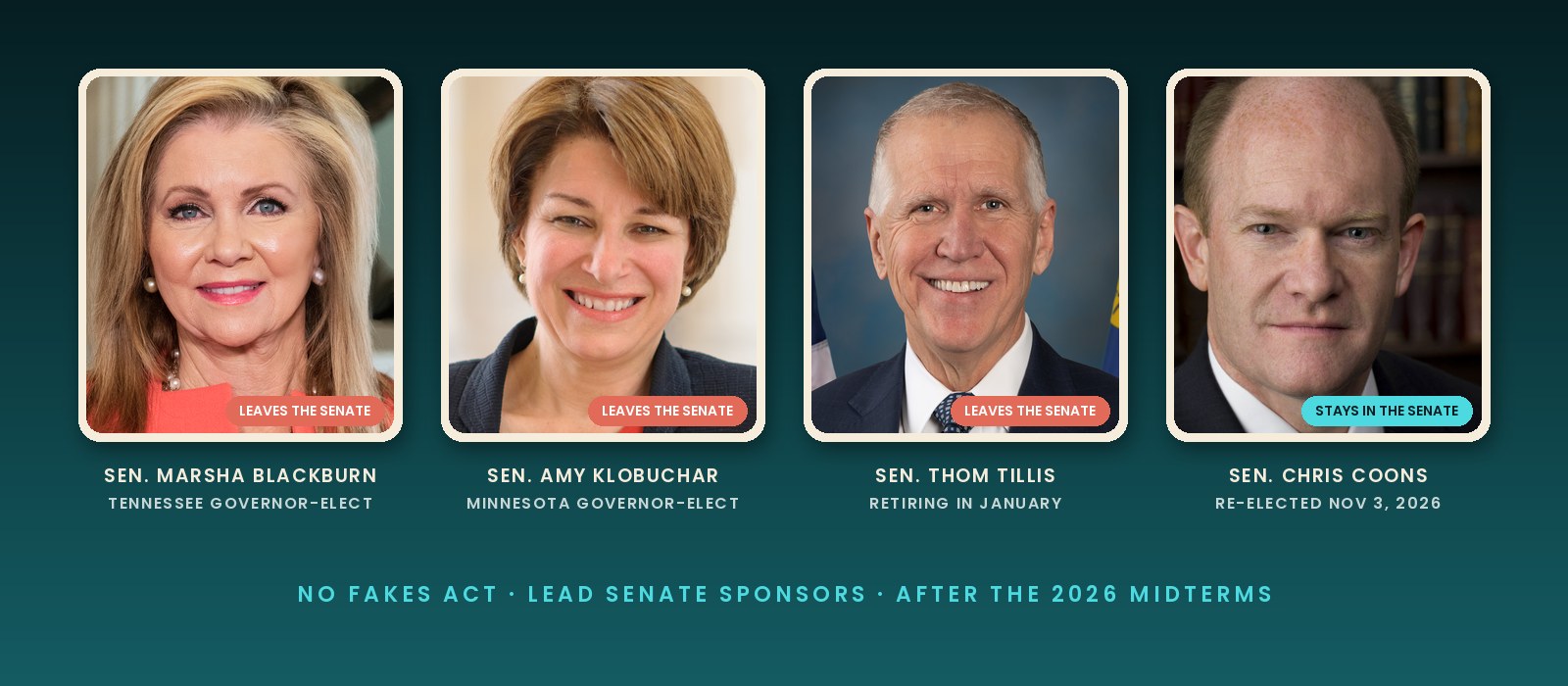
The NO FAKES Act has 4 lead sponsors in the Senate. 3 of them won’t be senators in 2027: Marsha Blackburn (R-TN) won Tennessee’s governor’s race, Amy Klobuchar (D-MN) won Minnesota’s, and Thom Tillis (R-NC) didn’t run again. Chris Coons (D-DE), who introduced the bill, won re-election.
Democrats secured at least 54 Senate seats, according to CBS News projections, with Alaska and Mississippi still uncalled on Wednesday morning. Billboard’s read on November 4 is that the new majorities change the hearings in Washington, not music’s legislative agenda. I checked the Senate sponsors of 3 AI music bills against the race calls, and for the voice bill it isn’t that simple.
Why the RIAA says the 2026 midterms won’t change the NO FAKES Act
Billboard expects the new Democratic majorities to use their gavels on live music first. That means hearings on the Justice Department’s settlement with Live Nation, which Democrats have called a “sweetheart deal”, and subpoena power from January for Rep. Robert Garcia (D-CA) in his probe of StubHub CEO Eric Baker’s ticket broker fund, Andro Capital.
The bills are a different story. Billboard calls music “a rare bipartisan issue in Congress”, and the 2 bills the business watches most, the American Music Fairness Act and the NO FAKES Act, have supporters in both parties.
RIAA chairman and CEO Mitch Glazier made the same point before the vote, on Billboard’s On the Record podcast in October.
It doesn't matter if the House changes or the Senate changes, or they both stay the same, or they both change; this bill will be on a trajectory for quick introduction and quick movement.
He also said the industry would lose 1 of its best advocates in Congress if Blackburn won in Tennessee, and she did. Glazier named 3 House members as “rising champions” for music: Reps. Nathaniel Moran (R-TX), Becca Balint (D-VT) and Laura Friedman (D-CA). I covered the rest of that interview in October, including his read that the bill has “a real shot” in the lame duck.
So who exactly is leaving, and which bills do they take their names off?
Which NO FAKES Act and TRAIN Act sponsors leave the Senate in January 2027
Blackburn is the loss Glazier warned about. She had just over 45% of the vote to Democrat Jerri Green’s 42.95% at 11 p.m. on election night, the Nashville Banner reported. She becomes governor in January, and she told the Banner before the primary that she’ll stay in the Senate until she’s sworn in, so she can appoint her own replacement.
Klobuchar won Minnesota’s governor’s race, according to the Washington Post’s race call. Tillis said in June 2025 that he wouldn’t seek re-election, and CBS News reports Democrats flipped his North Carolina seat. Coons won his Delaware race.
Here’s what that does to each AI music bill, going by its Senate sponsors:
- The NO FAKES Act, which covers AI copies of your voice and face, keeps Coons and loses Blackburn, Klobuchar and Tillis.
- The TRAIN Act, which would let you subpoena an AI company to find out whether it trained on your songs, loses Blackburn and keeps Peter Welch (D-VT), Adam Schiff (D-CA) and Josh Hawley (R-MO).
- The CLEAR Act, which would make AI companies file public reports on their training data with the US Copyright Office, keeps both of its sponsors, Schiff and John Curtis (R-UT).
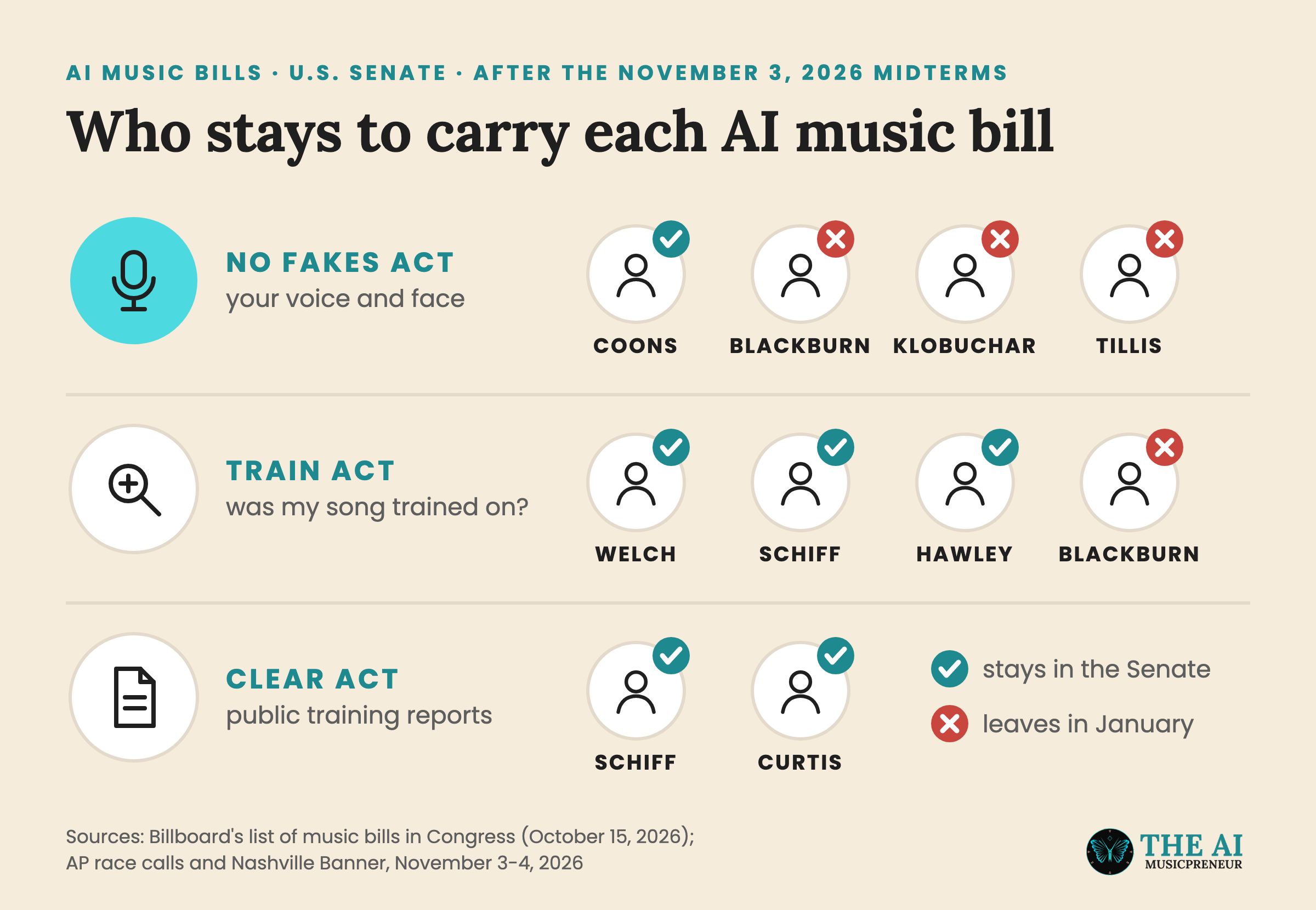
Welch, Schiff, Hawley and Curtis weren’t on the 2026 ballot, so the training bills keep most of their Senate backers. The voice bill is the one that needs new names.
What happens to the NO FAKES Act when the 119th Congress ends on January 3, 2027
Right now Congress is in its lame duck, the weeks between the election and January 3, 2027, when this Congress ends. Any bill that hasn’t passed by then dies and has to be introduced again.
The Senate version of NO FAKES, S. 4591, cleared the Senate Judiciary Committee in June. On September 30, Sen. Ted Cruz (R-TX) blocked Blackburn’s attempt to pass it by unanimous consent, and the House version, H.R. 8915, had seen no action since it was introduced on May 20 when I checked Congress.gov in October. So a lame-duck win would need a Senate deal and a House vote in about 8 weeks.
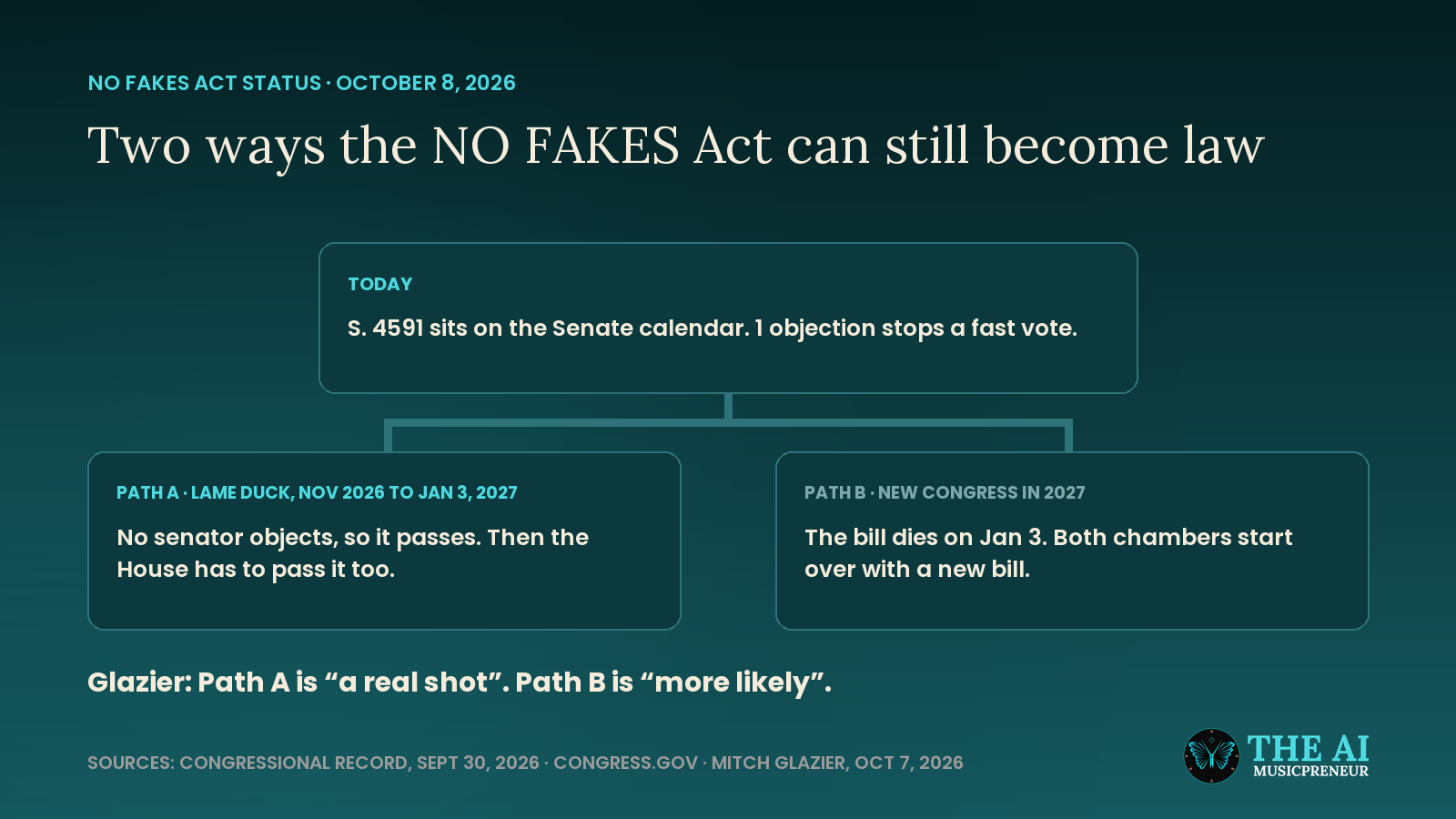
If it starts over in 2027, the new bill goes back through the Judiciary committees, and they’ll have Democratic chairs. TIME reports that Sen. Sheldon Whitehouse (D-RI) is expected to chair Senate Judiciary and that Rep. Jamie Raskin (D-MD) is likely to chair House Judiciary. The TRAIN Act already sits in both of those committees.
The Senate side of NO FAKES also needs a new Republican co-lead to replace Blackburn. As far as I could find, nobody had stepped into that role as of November 5.
AI voice clones in the 2026 midterm ads, and the labeling fight that follows
AI also mattered to the voters themselves. An NBC exit poll found 56% of voters called AI and data centers a “crucial or major factor” in their vote for Congress, TIME reported.
Some of the AI in this campaign sang. The pro-Trump PAC Citizens for Sanity ran an ad with an AI version of Texas Democrat James Talarico singing a rewritten “My Favorite Things”, Mediaite reported. On October 13, Blackburn’s own campaign account posted an AI video of her performing “Not Like Us”, 13 days after her NO FAKES push stalled.
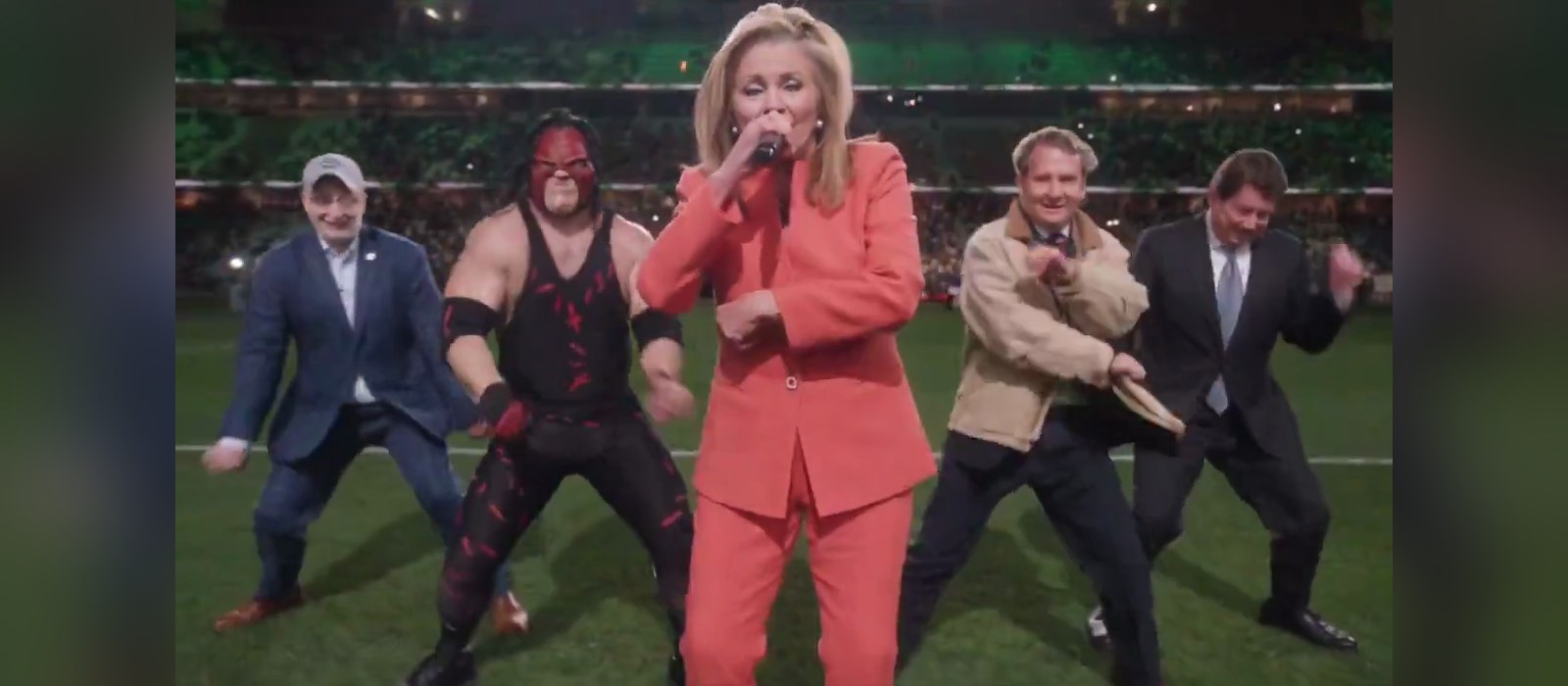
Spending on AI-generated political ads reached $137 million this year, up from $50,000 in 2024, according to a Wesleyan Media Project report cited by Yahoo News. Almost 70% of the AI ads Wesleyan tracked through early September carried no AI disclaimer, CT Mirror reported, because no federal law requires one. Democrats in Congress told Axios in May they’d push for that rule in 2027.
What the 2026 midterms change for your voice and your training data
For your voice, nothing changes on January 3. Until a federal law passes, your protection still comes from state laws like Tennessee’s ELVIS Act, platform takedown tools and your own contracts. The current NO FAKES text keeps state laws that existed on January 2, 2025, so the ELVIS Act would keep working alongside it.
State laws may carry more weight now. In TIME’s analysis, Democrats may not pass sweeping federal AI rules, but the ban on state AI regulation that Republicans have pushed “will be harder to enact”.
For your training data, the TRAIN Act and the CLEAR Act are the 2 bills that would tell you whether your songs went into a model. Both restart in 2027 if they don’t pass this year, and both keep most of their Senate sponsors.
My guide on how to protect your voice from AI has the steps that work today. Next to watch: who Blackburn picks for her Senate seat, and whether that senator takes her place on NO FAKES.
Frequently asked questions
Who will Marsha Blackburn appoint to her US Senate seat?
She hasn't said. Blackburn told the Nashville Banner before the primary that she would stay in the Senate until she is sworn in as governor, so she can make the appointment herself instead of outgoing Gov. Bill Lee. The Banner lists Knox County Mayor Glenn Jacobs, Rep. Tim Burchett and Pete Hegseth as rumored frontrunners.
Did Chris Coons win re-election to the Senate in 2026?
Yes. The Associated Press called Delaware's Senate race for Coons over Republican Mike Katz on November 3, 2026. Coons introduced the Senate version of the NO FAKES Act, S. 4591, on May 20, 2026, so the bill's lead Democrat stays in place.
Who is expected to chair the Senate Judiciary Committee in 2027?
TIME reported on November 4, 2026 that Sen. Sheldon Whitehouse of Rhode Island is expected to chair it once Democrats take the majority on January 3, 2027. Republican Chuck Grassley chairs it until then. The committee advanced the NO FAKES Act in June 2026 and also holds the TRAIN Act.
How many AI-made political ads ran in the 2026 midterms?
The Wesleyan Media Project counted 164 political ads made with AI through early September 2026, backed by at least $80 million, and its October report put AI ad spending for the year at $137 million. Almost 70% of the ads in the September count carried no disclaimer about AI use.
About the author
Covering AI music tools, industry shifts, and news for music creators and professionals. Twice-weekly newsletter at aimusicpreneur.com.