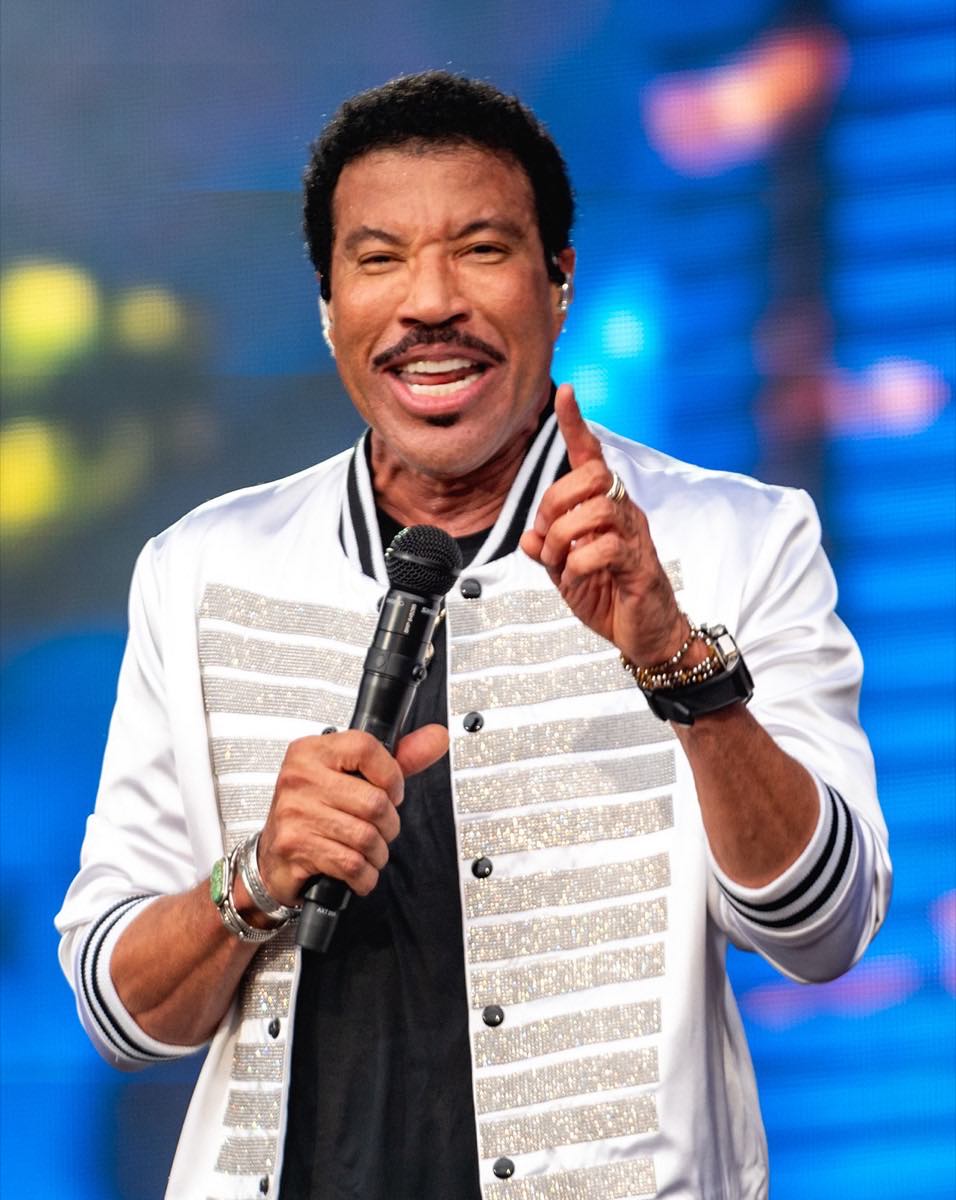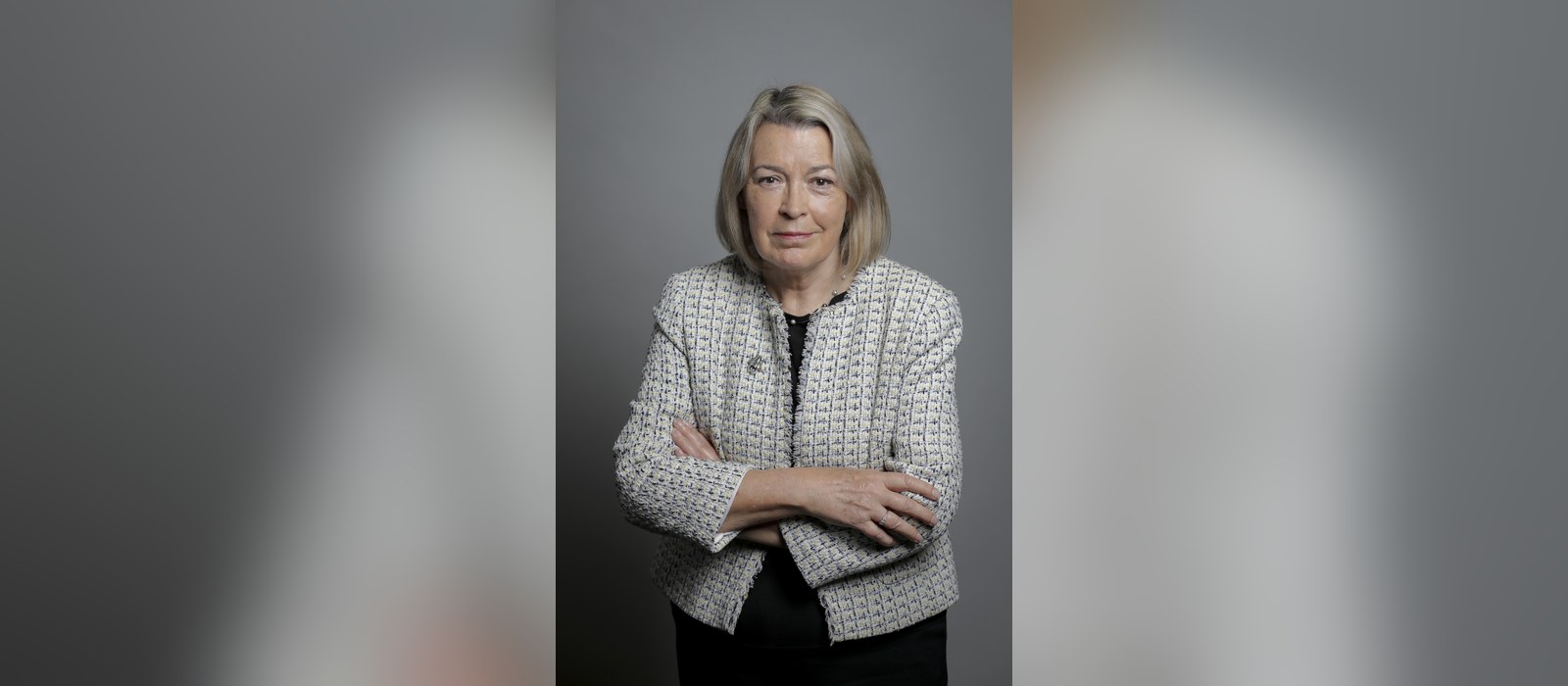
RIAA chief Mitch Glazier says the NO FAKES Act has 'a real shot' in the lame duck after Ted Cruz blocked it on the Senate floor
My stack My fav 6 tools for AI music after testing 70+
-
 ElevenMusic · Music generation
 -
 Moises · Stem separation
 -
 Controlla · Voice swap & cloning
 -
 Cryo Mix · Mixing + mastering
 -
 Neural Frames · Music videos
 -
 ONCE · Distribution
Some links are affiliate links — I earn a commission at no cost to you. Every tool here is one I run myself and truly believe in. This stack is proven.
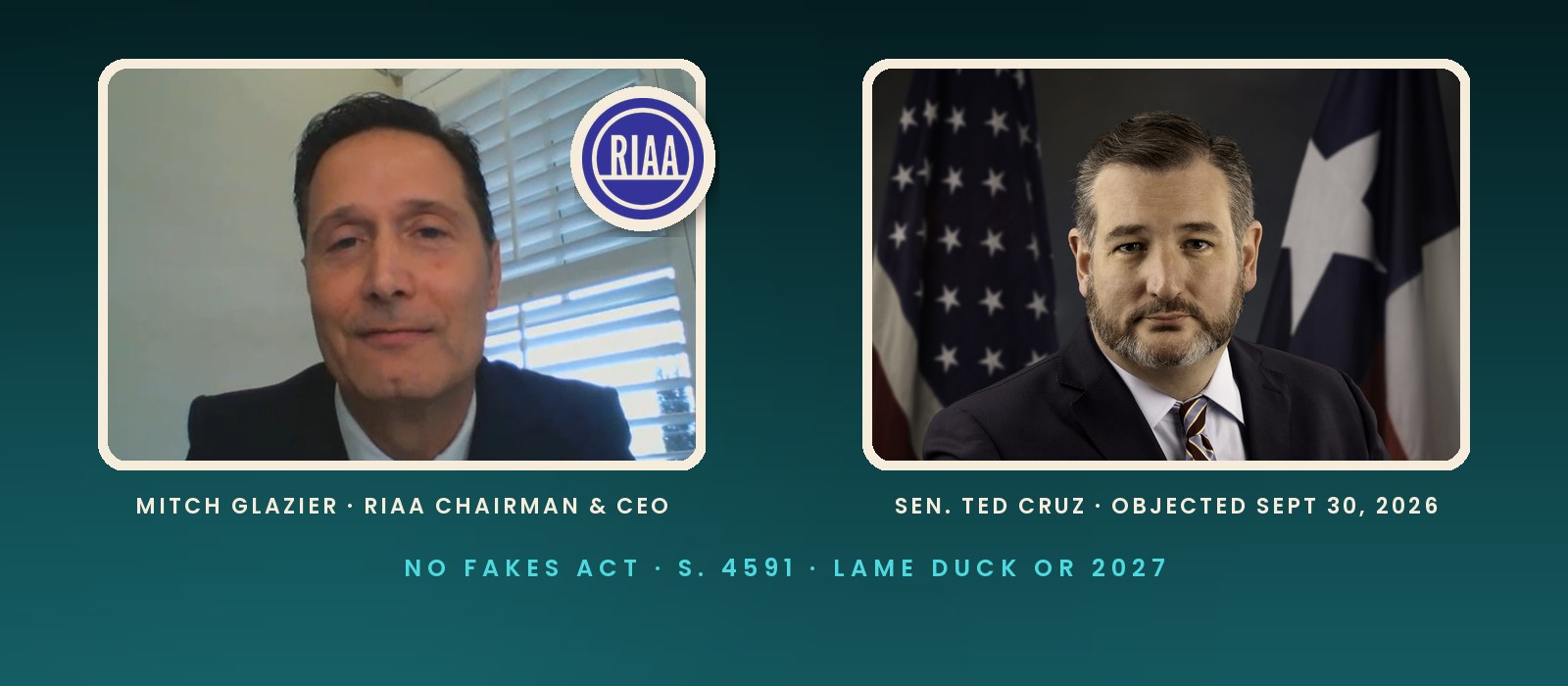
One senator was enough. On September 30, 2026, Sen. Marsha Blackburn (R-TN) asked the Senate to pass the NO FAKES Act by unanimous consent, and Sen. Ted Cruz (R-TX) objected.
The bill, S. 4591, has 15 cosponsors from both parties and cleared the Senate Judiciary Committee on June 18. It would give every person in the US a federal right over AI clones of their voice and face.
A week later, RIAA chairman and CEO Mitch Glazier sat down with Billboard’s Kristin Robinson for Billboard On the Record, published October 7, 2026. His read: “We have a shot in the lame duck [period], a real shot.” If that fails, the bill starts over in 2027.
What happened when Ted Cruz objected to the NO FAKES Act on September 30, 2026
Unanimous consent is how the Senate passes a bill without a vote. A senator asks, and if nobody objects, the bill passes. If one senator says no, it stops right there.
Blackburn and the bill’s lead sponsor, Sen. Chris Coons (D-DE), made their case first, according to the Congressional Record for September 30. Blackburn pointed to the bill’s exclusions for commentary, criticism, scholarship, satire and parody.
Then Cruz spoke. He said he voted for the bill in committee and wants it to pass, but that its parody exception “leaves it to Big Tech to make the decision” and could reach satire sites like The Babylon Bee or The Onion. His examples were political: Spencer Pratt’s AI ads mocking Karen Bass in the Los Angeles mayor’s race, and President Trump’s own AI posts.
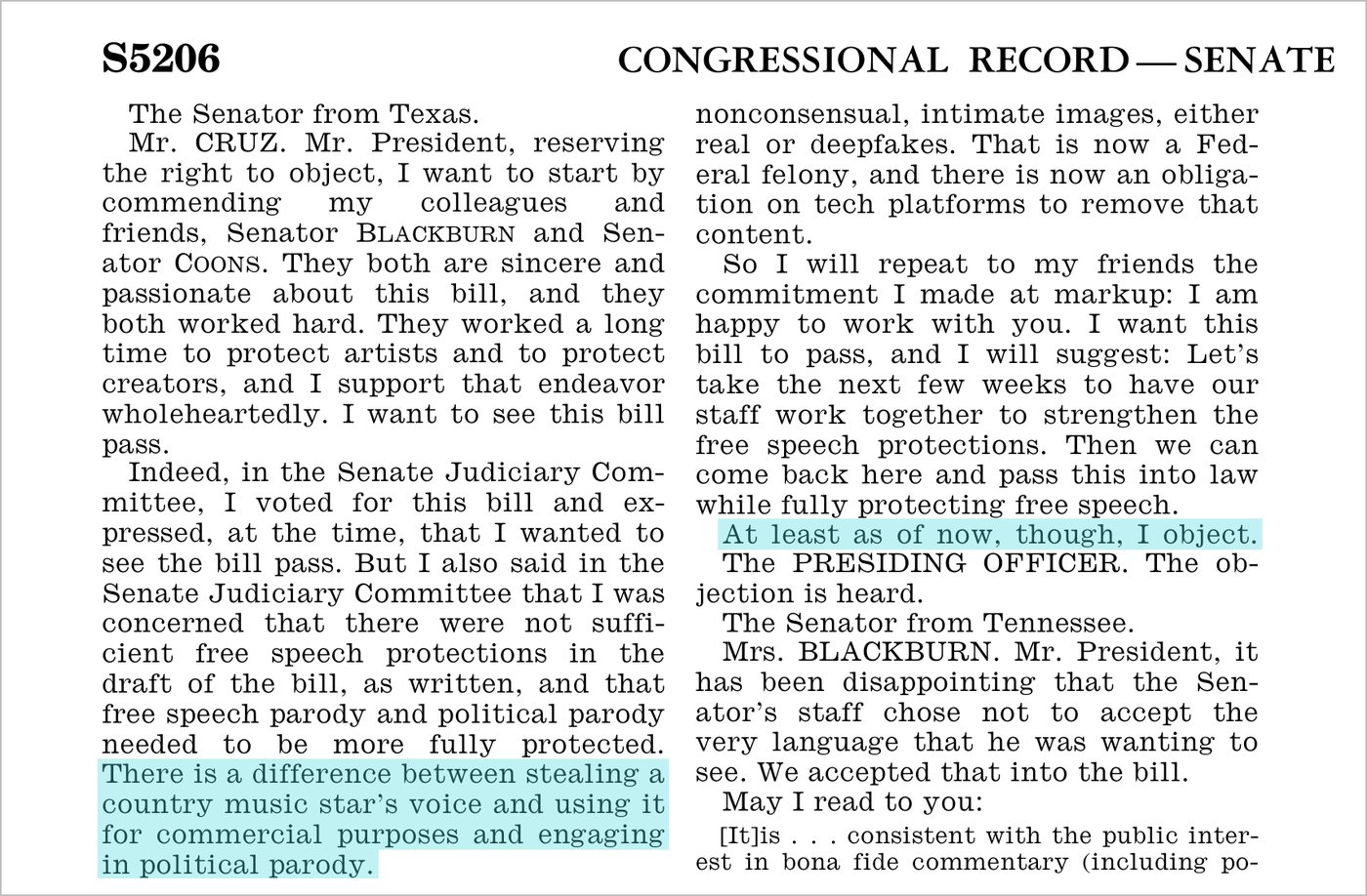
He asked for “the next few weeks” so staff could strengthen the free speech protections. Blackburn answered that the language he wanted, covering “bona fide commentary (including political commentary)”, was already in the bill. She added that anyone whose content gets pulled can file a counter-notice, and the takedown only sticks if the person who flagged it goes to court within 14 days.
Coons closed with: “We should not let the perfect be the enemy of the good.”
Mitch Glazier on why the NO FAKES Act “is really about AI cloning”
Robinson asked what a “digital replica” actually is, since the bill uses the phrase everywhere. Glazier said the definition is “pretty narrow, actually”: a highly realistic, computer-generated replica of your voice or likeness. “In other words, a clone, right?”
It's not a meme. It's not, like, The Onion. It's not a picture. It's not something on Saturday Night Live. It is really about AI cloning.
The odd part: Glazier named The Onion as something the bill doesn’t touch. On the Senate floor, Cruz named The Onion as something it could.
Both sides agree parody should be safe. The text as reported to the Senate already excludes uses “consistent with the public interest in bona fide commentary, criticism, scholarship, satire, or parody”. The fight is about who decides in the moment: a platform working through takedown notices, or a judge.
In the full episode, Glazier admitted it’s a tricky line: “when do I have the right to use your voice because I want to use it for my speech versus you having a right to your voice”. He also described Cruz’s worry as he understands it: a voice clone in an election ad gets taken down 3 days before the vote, and “before a judge can figure out whether it’s protected by the First Amendment, the election’s over.”
NO FAKES Act status: a lame-duck vote in 2026 or a fresh start in 2027
So can it still pass this year? Glazier thinks so, just about.
The lame duck is the stretch between the November 3 midterms and January 3, 2027, when this Congress ends. “If we can work out a couple of these last issues, I think it has a real shot at what we call unanimous consent,” he said. He also floated attaching it to a bigger bill, but said “we really don’t know” if one exists.
One thing his optimism skips: a Senate vote alone doesn’t make it law. The House version, H.R. 8915, was introduced by Reps. María Elvira Salazar and Madeleine Dean on May 20, 2026. Congress.gov shows no action on it since it went to the House Judiciary Committee that day, so a lame-duck Senate pass would still need a House vote.
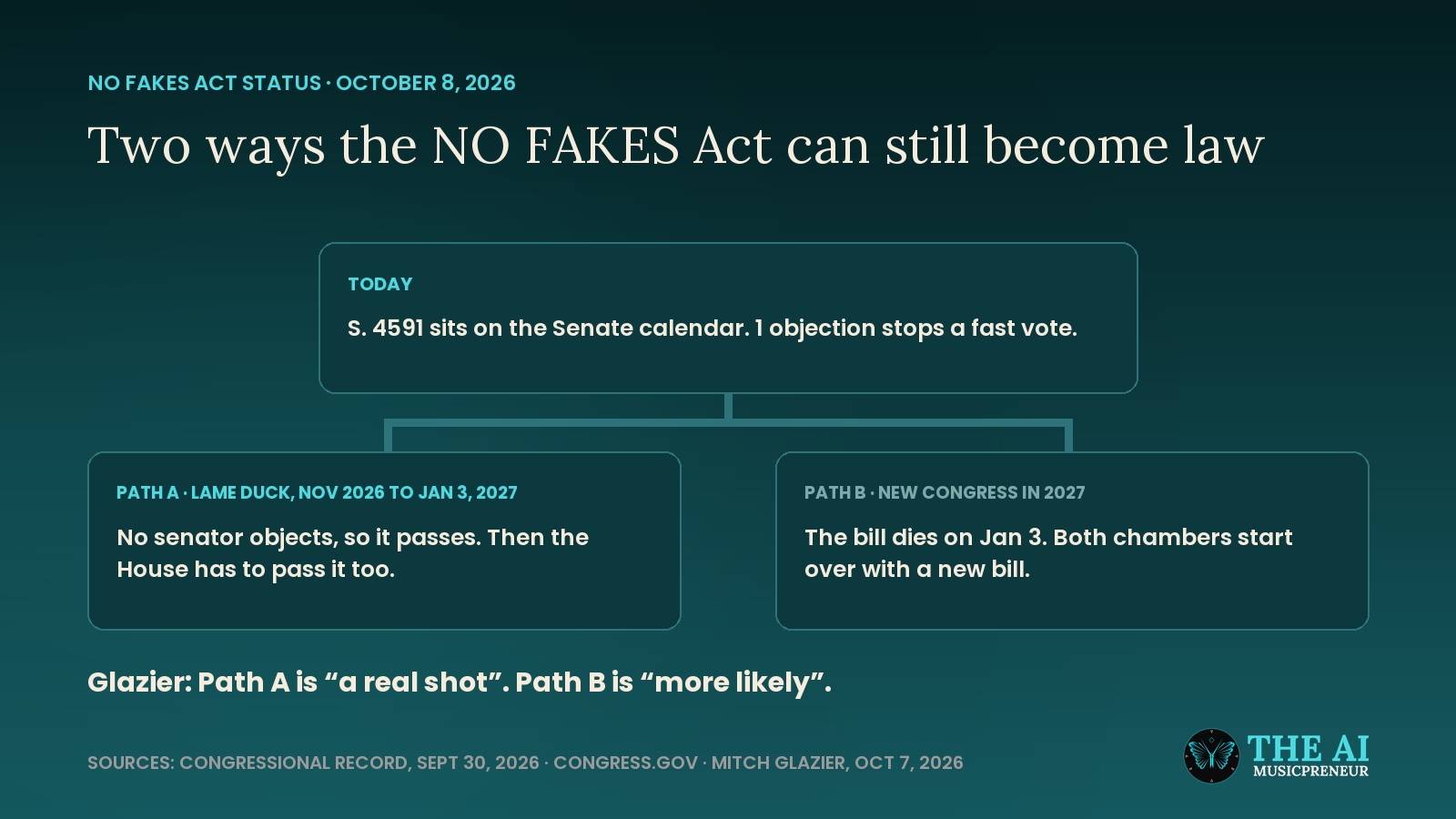
“More likely, it goes into the next Congress,” Glazier said. Then it has to be reintroduced in both chambers. He isn’t worried about who wins in November, because “our issues are completely bipartisan,” so he expects “quick introduction and quick movement.”
Asked earlier whether Republicans or Democrats are easier to win over, he put it shorter: “Music is a very bipartisan issue.”
The seat he is watching is Blackburn’s. She’s running for governor of Tennessee, and Glazier expects her to win, which would take the bill’s Republican lead out of the Senate.
He also said the Trump administration put its support for NO FAKES in its national legislative policy framework. The framework the White House released on March 20, 2026 calls for a federal right over digital replicas of a person’s voice and likeness, with safeguards for parody, satire and news. That’s the same exception Cruz says isn’t tight enough.
My breakdown of the framework’s 6 objectives covers what else it says about music.
What the NO FAKES Act would do for a musician whose voice gets cloned
None of this is law yet. But I read the bill text as reported to the Senate on June 24, 2026, and if it passes as written, this is what changes when someone releases a track with your cloned voice:
- You get a federal right to your voice and face. It covers every person, famous or not. You can license it, but you can’t sell it outright while you’re alive.
- A digital replica is a new, computer-generated, highly realistic copy that’s recognizably you, in a recording you never performed. Samples, remixes and remasters approved by the copyright holder don’t count.
- An “AI-generated” or “unauthorized” label doesn’t make a clone legal. The bill says a disclaimer is no defense.
- Distributors are on the hook too. Anyone who supplies a cloned recording to a streaming service can be liable, and so can a tool built mainly to clone a specific person.
- Your label can sue for you if it holds an exclusive recording contract or an exclusive distribution license for your recordings.
The takedown is the part you’d actually use:
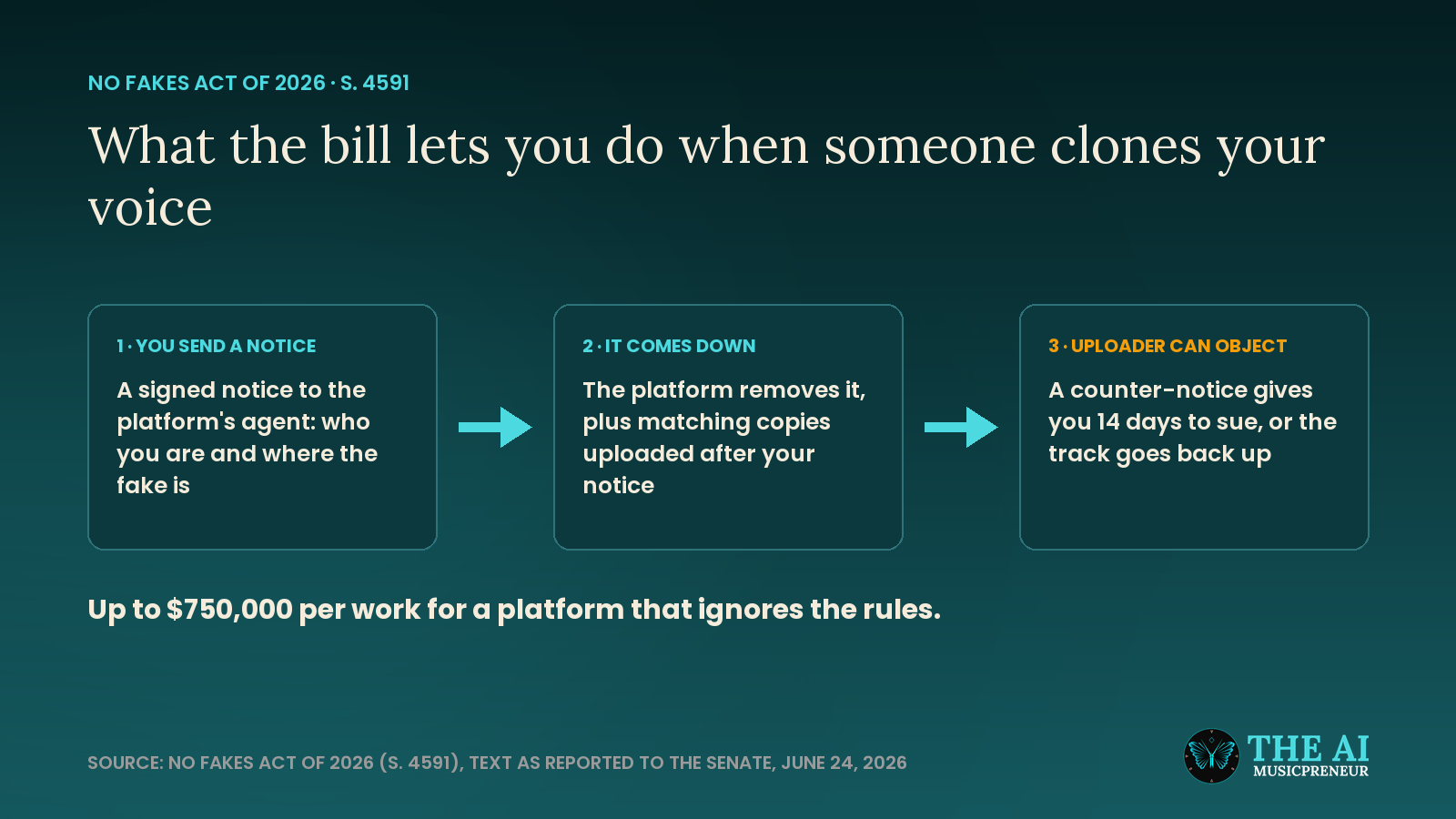
You send a signed notice to the platform’s registered agent. The platform takes the fake down, plus any later upload that matches its digital fingerprint (a unique ID the platform computes for the file, like a barcode). If the uploader files a counter-notice, you have 14 days to sue, or the track can go back up.
The person who made or shared the fake owes $5,000 per work, or your actual losses plus their profits if that’s higher. You’d have 3 years from finding the fake to file.
Until it passes, your protection comes from a mix of state laws like Tennessee’s ELVIS Act, platform takedown tools and your own paperwork. Sony Music alone has asked platforms to remove more than 260,000 tracks, and Jorja Smith’s label found out how hard it is to prove a voice was cloned. My guide on how to protect your voice from AI has the steps you can take today.
Mitch Glazier on AI training: “you’ve got to pay for what you do”
Voice clones are one of 3 AI fights Glazier listed in the full episode. The other 2 are training and transparency.
On training, he said the first priority is that when an AI company copies music to build a model, it respects “the copyright that goes along with making the copy. It’s pretty simple.”
AI companies call that fair use, because the model transforms what it learns from. His answer: “when you are creating a product that’s going to directly compete against the underlying work… you’ve got to pay for what you do.” That’s the labels’ argument in RIAA v. Suno and RIAA v. Udio.
He also flagged one exception inside the government: the Justice Department’s statement of interest backing OpenAI on fair use in the New York Times case, which he called “very different” from the rest.
Robinson asked if generative AI is music’s next Napster moment. “I don’t. I think it’s the opposite,” Glazier said. With Napster, the industry ended up suing its own fans. “AI’s the complete opposite. The fans, the people, they’re with us.”
On transparency, his proof is a number: fans want to know whether a song is AI, “like 92% in polls, focus groups”. He didn’t name the polls, and I couldn’t find the RIAA’s survey published, so treat 92% as the RIAA’s own unverified figure. It’s the same demand behind the RIAA and IFPI’s AI labelling proposal.
The full episode runs about an hour and also covers Trump’s Spotify playlist and the RIAA’s Napster-era lawsuits:
Frequently asked questions
Who interviewed Mitch Glazier for Billboard On the Record in October 2026?
Billboard's Kristin Robinson. The video episode and an edited Q&A were published on October 7, 2026, and the conversation covered the NO FAKES Act, the 2026 midterms, the Trump administration and generative AI.
Who sponsors the NO FAKES Act of 2026 in the Senate and the House?
Sen. Chris Coons (D-DE) introduced S. 4591 on May 20, 2026, with Sen. Marsha Blackburn (R-TN) as the lead Republican, and Congress.gov lists 15 cosponsors. Reps. María Elvira Salazar (R-FL) and Madeleine Dean (D-PA) introduced the House version, H.R. 8915, the same day.
Would the NO FAKES Act of 2026 override Tennessee's ELVIS Act?
No. The bill preempts state claims over digital replicas in expressive works, but it exempts state laws that already existed on January 2, 2025. Tennessee's ELVIS Act was signed on March 21, 2024, so it would keep working alongside the federal right.
How long can an artist license their voice under the NO FAKES Act of 2026?
For a living artist, a license can run for no more than 10 years, has to be in writing and signed, and has to describe the intended uses. After death, the estate holds the right for 10 years, renewable in 5-year blocks while the voice stays in active commercial use, up to 70 years.
About the author
Covering AI music tools, industry shifts, and news for music creators and professionals. Twice-weekly newsletter at aimusicpreneur.com.