Michael Smith gets 18 months in prison for his $8M AI streaming fraud, less than half what prosecutors wanted
My stack My fav 6 tools for AI music after testing 70+
-
 ElevenMusic · Music generation
 -
 Moises · Stem separation
 -
 Controlla · Voice swap & cloning
 -
 Cryo Mix · Mixing + mastering
 -
 Neural Frames · Music videos
 -
 ONCE · Distribution
Some links are affiliate links — I earn a commission at no cost to you. Every tool here is one I run myself and truly believe in. This stack is proven.
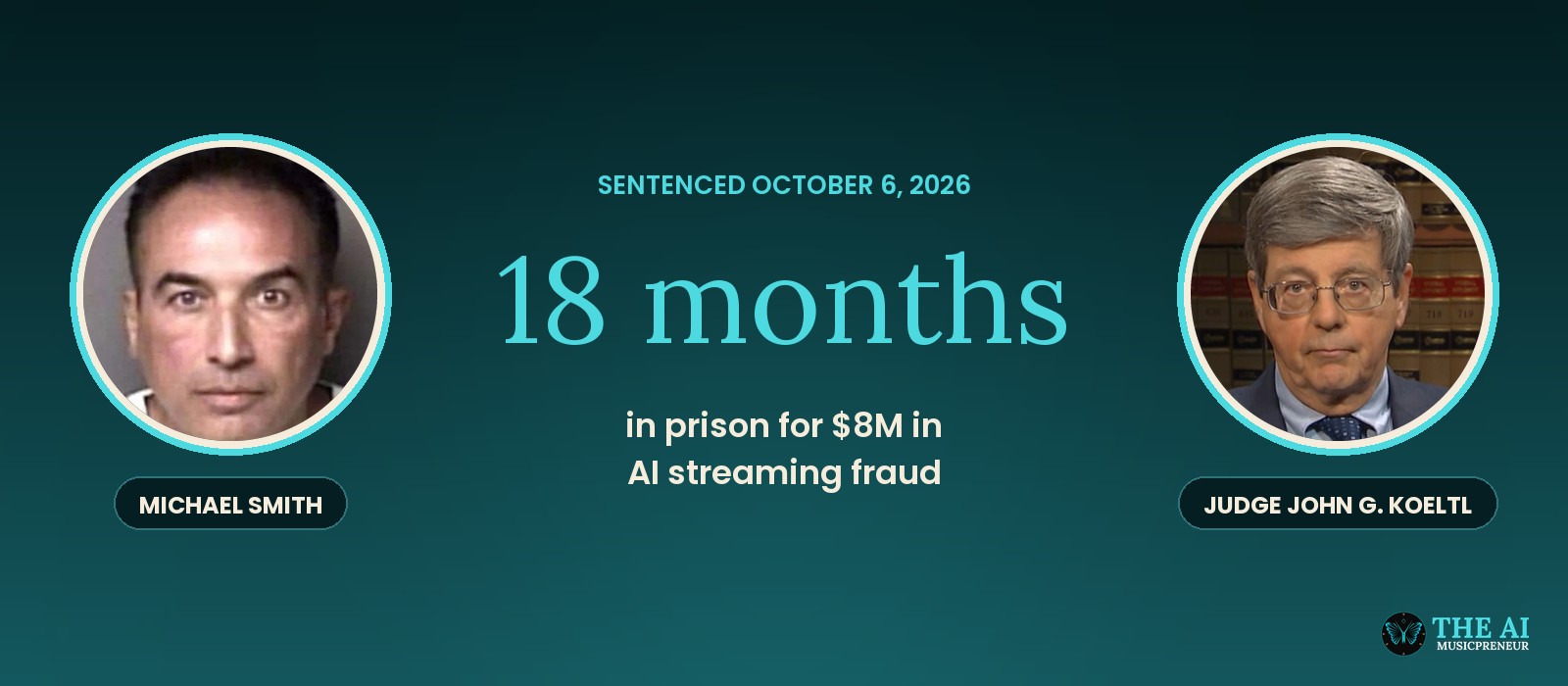
Michael Smith is going to prison for 18 months. That’s the sentence for the man who used AI-generated songs and bot accounts to collect more than $8 million in streaming royalties.
US District Judge John G. Koeltl handed it down in Manhattan federal court on Tuesday, October 6, 2026, the US Attorney’s Office for the Southern District of New York announced. Smith, 54, from Cornelius, North Carolina, also gets 2 years of supervised release and has to forfeit $8,091,843.64.
Prosecutors wanted at least 46 months, so Smith got less than half of that. It’s the first criminal sentence for streaming fraud in the US, and I’ve followed the case from his guilty plea in March to the prosecutors’ 46-month ask last week.
How Michael Smith’s 18-month sentence compares with what each side asked for
Judge Koeltl had a wide range to pick from. Every party in the case put a different number in front of him:
- Smith’s lawyers asked for probation, with no prison time at all.
- The US Probation Office recommended 24 months.
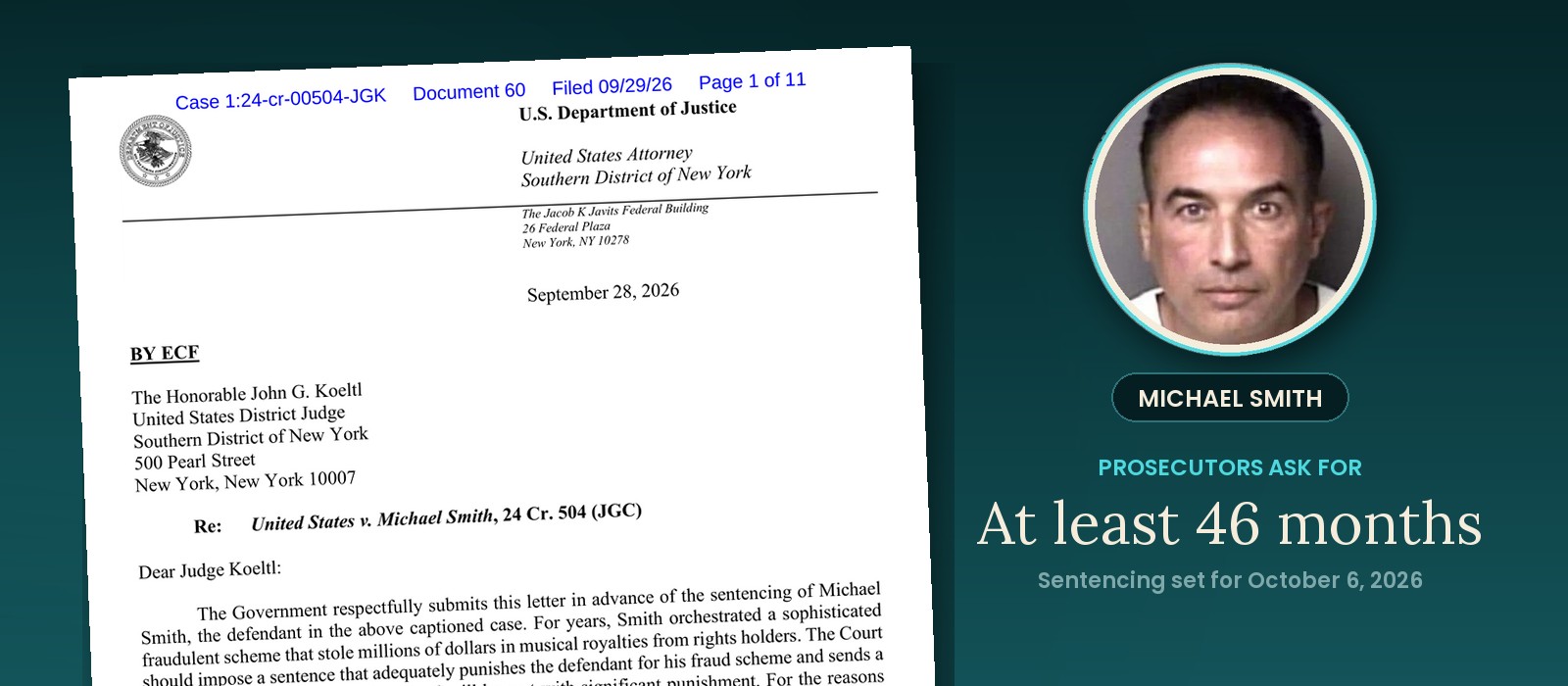
- Prosecutors asked for at least 46 months, the bottom of the 46 to 57 month guidelines range.
- The legal maximum for his charge, 1 count of conspiracy to commit wire fraud, is 60 months.
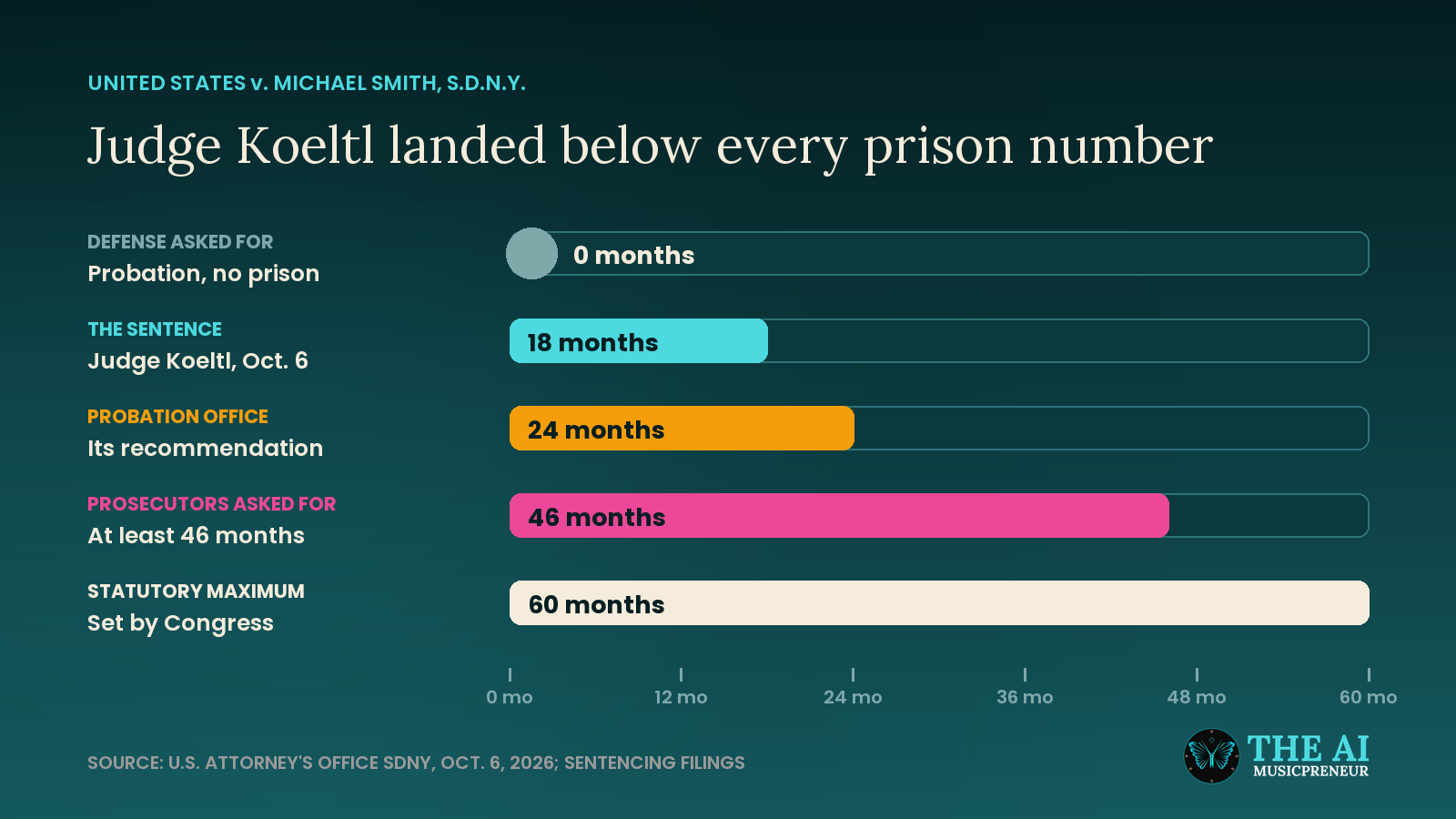
So the judge went below the probation office and far below the prosecutors, but he didn’t go for probation either. That makes 18 months the only US prison term for streaming fraud so far.
Before he got that number, Smith got to speak.
What Michael Smith told Judge Koeltl before he was sentenced
Smith addressed the court before the sentence, choking up at times, according to Rolling Stone’s report from the courtroom. The father of 6 said all he wanted in life was to be a good husband and father and to succeed in music.
He said that by “committing this crime,” he had “failed miserably,” and that he turned his love of music into a “perverse business model.”
I betrayed the music community I care so much about.
His lawyer Justine Harris argued that many streaming services didn’t ban bot streams in their terms when Smith started in 2017. She also said the damage to any single artist was hard to calculate and likely tiny, and that the only real fix for streaming fraud is structural reform, not prison.
Prosecutor Nicholas W. Chiuchiolo answered that small royalty checks still matter, and that for some artists they are the “only recognition” they get. After the sentence, Smith told the judge: “Thank you for your consideration on everything, Your Honor.”
The music industry didn’t wait long to respond.
How the RIAA, IFPI and the Music Fights Fraud Alliance reacted to the sentence
US Attorney Jamie McDonald said Smith “robbed millions in royalty payments from genuine artists and their fans” by flooding streaming services “with automated bots in the place of consumers, and fake songs in the place of creativity.”
Then the trade bodies weighed in, as Music Business Worldwide and Billboard reported:
- The RIAA said streaming fraud “harms creators and deceives fans” and thanked the court for recognizing it.
- IFPI said the result “sends a clear message that streaming fraud is a crime,” and pointed to the Streaming Integrity Initiative as the prevention side.
- Michael Lewan, executive director of the Music Fights Fraud Alliance, said the fight “is about more than one case.”
One detail stood out to me in the US Attorney’s announcement: it calls the case “super intelligence-assisted” fraud. The office’s March announcement of the guilty plea said “artificial intelligence” throughout, MBW noted.
Why Michael Smith’s fake streams cut the payout for every artist in the same pool
The defense kept saying no artist felt the loss. The reason the industry disagrees comes down to how streaming royalties are paid.
Services such as Spotify don’t pay a fixed rate per play. They put a share of their revenue into a pool, then split it by each track’s share of all streams in that period. So every fake stream Smith added made everyone else’s share of the same pool a little smaller.
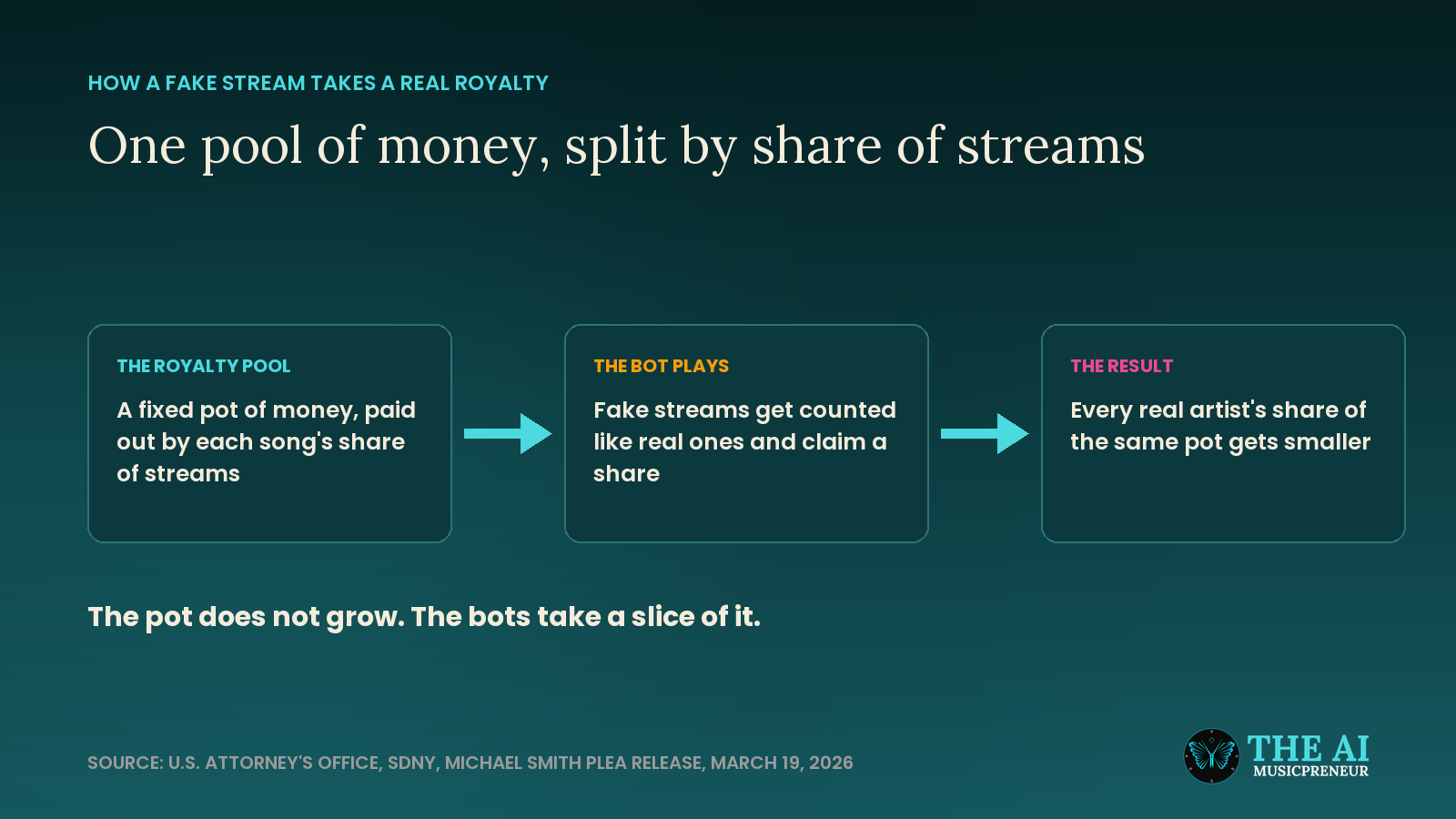
Spotify told MBW in 2024 that its fraud measures had limited Smith’s earnings from Spotify to about $60,000. Most of the money came from other services, and The MLC stopped his publishing payments in 2023.
There’s one more line in the defense’s final letter that’s worth knowing if you make music with AI.
What the Michael Smith case means if you release AI-generated songs
Smith’s lawyers wrote that “it is not inherently unlawful to use AI to create songs and place those songs on streaming platforms,” citing Spotify’s own statement that all music is treated equally for royalties, regardless of the tools used.
Nobody in the case disputed that. Smith didn’t go to prison for making AI songs. He went to prison for the bots, the fake accounts and the lies to distributors that kept the money coming.
So if you’re releasing Suno tracks, the line is the same one it always was: real listeners are fine, bought or botted streams are fraud. And now there’s an 18-month prison term on the record to show it, on top of distributors’ fraud checks that pull releases long before anything goes to court.
Smith was the first person sentenced for it in the US. IFPI, The MLC and the distributors are already looking for the next one.
Frequently asked questions
What did RZA write to the judge before Michael Smith's sentencing?
Wu-Tang Clan's RZA sent a letter asking Judge John G. Koeltl to consider the person he knew, according to Rolling Stone. He wrote that Smith "has always acted honestly with me" and used his connections to help people. The two had released music together, and RZA was a guest judge on One Shot, the rap competition Smith bankrolled.
Why did the US Attorney's Office call Michael Smith's case super intelligence-assisted fraud?
The October 6, 2026 announcement under US Attorney Jamie McDonald used the words "super intelligence" where the March 2026 guilty plea announcement, issued under then-US Attorney Jay Clayton, said "artificial intelligence", as Music Business Worldwide pointed out. The office hasn't explained the change. The facts of the case stayed the same.
How much did Michael Smith earn from Spotify itself?
Spotify told Music Business Worldwide in 2024 that its fraud measures limited Michael Smith's earnings from Spotify to about $60,000, out of the $10 million alleged at the time. Most of his royalties came from other services, including Amazon Music, Apple Music and YouTube Music.
Has anyone outside the US gone to prison for streaming fraud before Michael Smith?
Yes. In Denmark, a man convicted of using bots to inflate streams on 689 tracks was sentenced in March 2024 to 18 months in prison, with 3 months to be served. The Western High Court of Denmark raised that to 24 months in February 2025, again with 3 months to be served.
About the author
Covering AI music tools, industry shifts, and news for music creators and professionals. Twice-weekly newsletter at aimusicpreneur.com.