LANDR says Spotify-flagged fake streams fell 95%, and names the release patterns its fraud AI now checks
My stack My fav 6 tools for AI music after testing 70+
-
 ElevenMusic · Music generation
 -
 Moises · Stem separation
 -
 Controlla · Voice swap & cloning
 -
 Cryo Mix · Mixing + mastering
 -
 Neural Frames · Music videos
 -
 ONCE · Distribution
Some links are affiliate links — I earn a commission at no cost to you. Every tool here is one I run myself and truly believe in. This stack is proven.
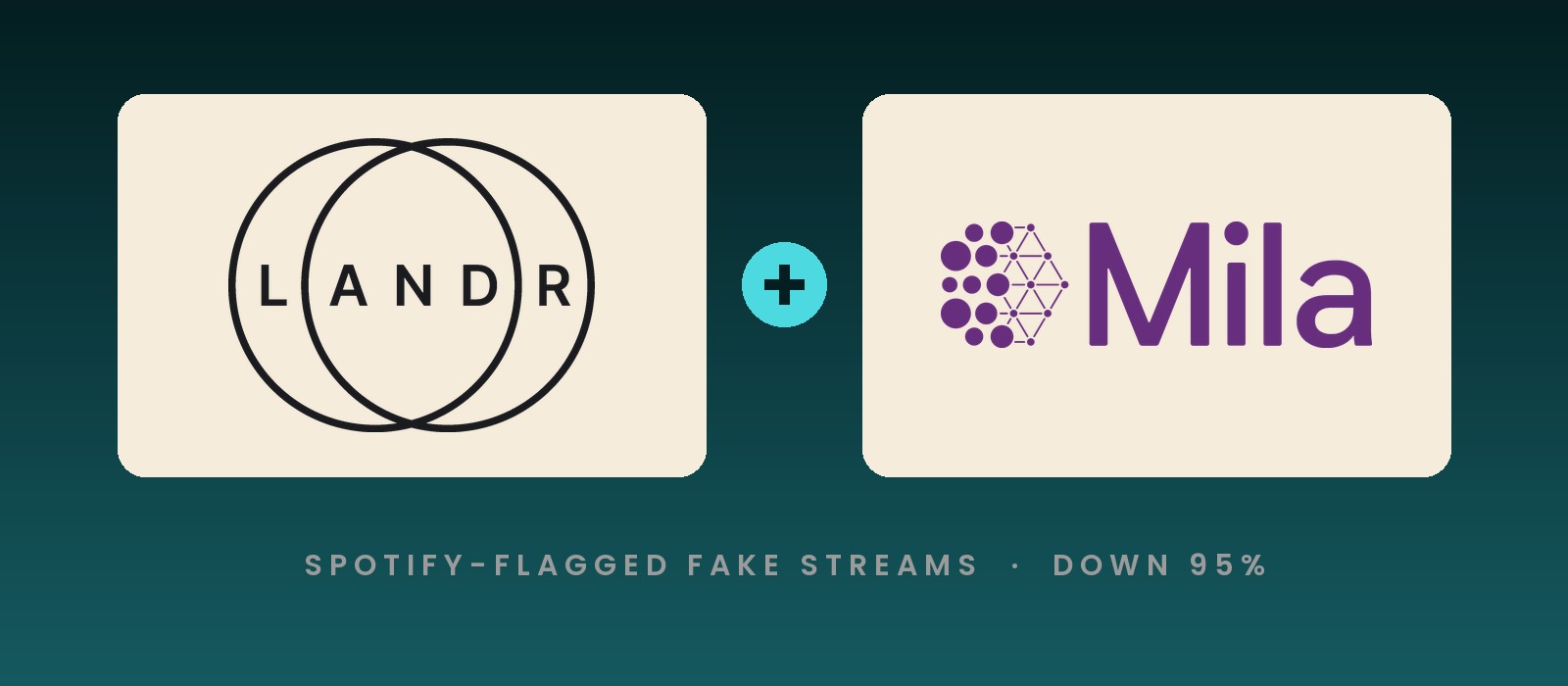
LANDR says artificial streams flagged by Spotify across the music it distributes fell 95% between Q1 2025 and Q2 2026. The Montreal distributor shared the number in a press release dated September 23, 2026, along with an expansion of the fraud-detection system it built with Mila, the Quebec AI institute founded by Yoshua Bengio.
LANDR doesn’t give Mila all the credit for the drop. It says the 95% followed several fraud-prevention steps, and the Mila-built models, deployed in February 2026, are one part of that.
The expansion is the part that touches your uploads. LANDR’s system now looks for 4 release patterns before music reaches streaming services: unusually high release frequency, catalogs that appear overnight, clusters of accounts sharing devices or payout details, and metadata designed to impersonate established artists.
The 2 fraud models LANDR built with Mila in 6 months
Both models came out of a 6-month internship. Édouard Demotes-Mainard, a student at Mila, designed them at LANDR, according to Mila’s write-up from February 23, 2026.
The first model scores accounts on their profile and behaviour data. The second reads listening activity for patterns a real audience wouldn’t produce, and Mila’s example is a song played on a loop 24/7 by the same device.
LANDR had a reason to move fast. Mila writes that Spotify holds distributors like LANDR responsible for fraud on their catalog, and a distributor that can’t keep its fraud rate under control risks a permanent ban. The pattern Mila describes, AI tracks streamed day and night by fraudulent accounts, is the scheme Michael Smith pleaded guilty to running with AI songs and 1,040 bot accounts.
“Finding fraud by hand at our scale was a needle-in-a-haystack problem. The first generation of the model turned that into something we could actually manage,” Tommy Desilets, CTO of LANDR, said in the release.
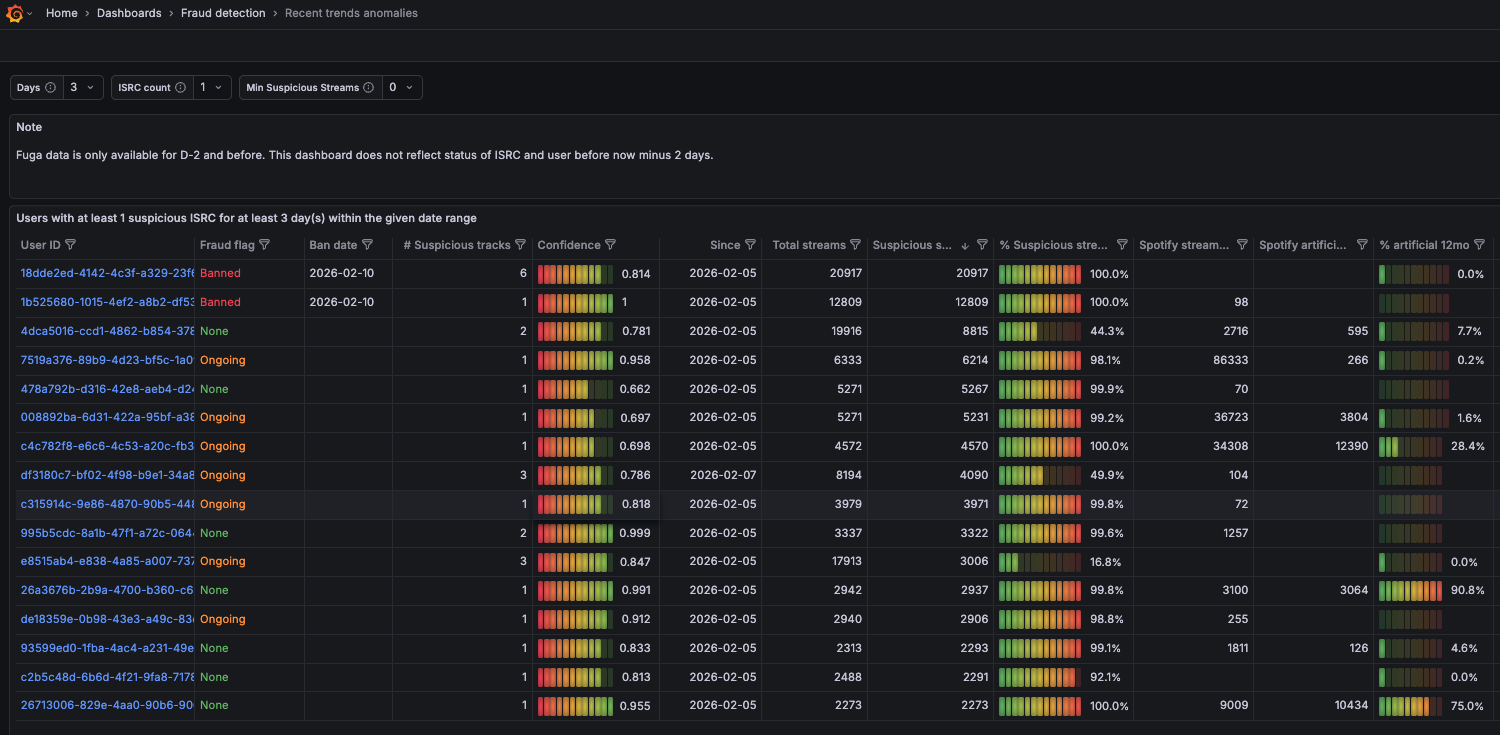
That screenshot, published by Mila, shows what the anti-fraud team works from. Each account gets a confidence score, a count of suspicious streams and a fraud flag of Banned, Ongoing or None. Since Demotes-Mainard left, LANDR’s own anti-fraud team has run and developed the system.
What LANDR’s fraud system now checks before a release reaches Spotify
The expansion moves those checks forward. “Now we’re moving those capabilities earlier in the distribution process, so our team has better signals before suspicious releases reach streaming services,” Desilets said.
Machine learning is one layer. The release lists the others:
- ACRCloud fingerprints recordings against commercial catalogs.
- Technology from IRCAM checks for altered recordings, including sped-up, pitch-shifted and re-recorded copies, plus acoustic markers associated with synthetic generation.
- Artists declare AI-generated content when they submit a release, and LANDR includes that in the metadata it delivers to streaming platforms.
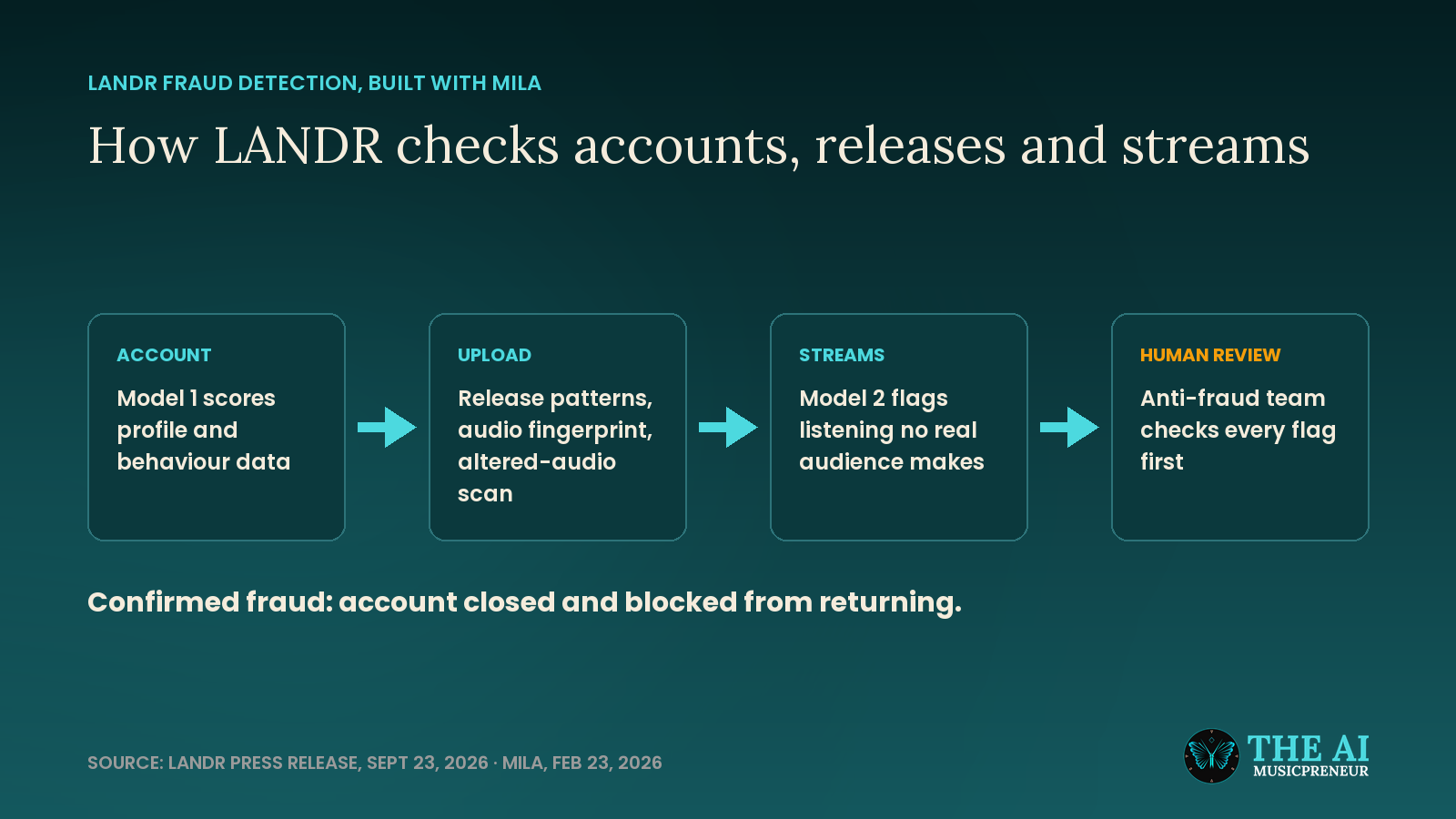
Every flag goes to people before anything happens. LANDR’s anti-fraud team reviews flagged activity first, accounts confirmed as fraudulent can be closed and blocked from returning, and each confirmed case feeds back into the models.
Why would a distributor flag my song for artificial streams?
If you make songs in Suno and release a lot of them, this is the section to read.
One reason distributors watch for fraud: Spotify bills them for it. Spotify’s artificial streaming page says it charges labels and distributors “when flagrant artificial streaming is detected on their content.” Spotify defines an artificial stream as one that “doesn’t reflect genuine user listening intent,” including bots and scripts.
At LANDR, 4 release patterns now draw a closer look:
- Unusually high release frequency.
- A catalog that appears overnight.
- Clusters of accounts sharing devices or payout details.
- Metadata designed to impersonate established artists.
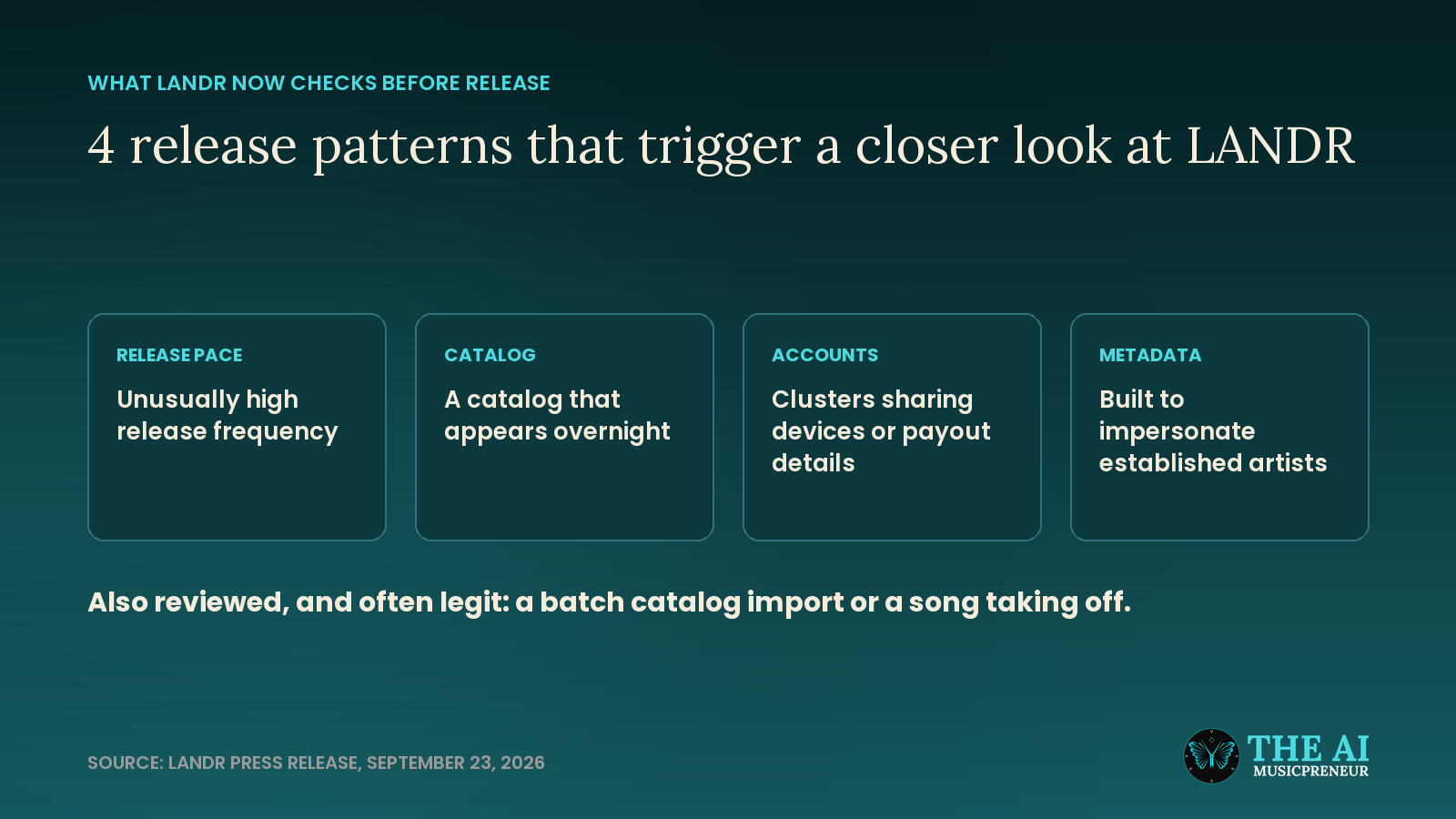
“An unusual pattern in the data isn’t proof of fraud,” the release says. A catalog imported in one batch, or a track that suddenly finds an audience, can trigger extra review while being entirely legitimate, and LANDR says that’s why human review sits between detection and enforcement.
Sometimes a song suddenly taking off is exactly that: an artist having a really good day. We're rooting for them, not trying to put a damper on their success.
Frequent releasers get one more step. LANDR is rolling out identity verification for accounts with frequent release activity, which it says lets the team add checks on higher-risk activity without creating unnecessary friction for most independent artists.
Spotify also lists signs you can spot in your own Spotify for Artists data:
- A sudden spike in streams for no apparent reason, followed by a drop.
- A spike from a location where your tracks haven’t been active before.
- Most streams coming from unexplained sources, such as “Other”.
- A sudden, short-lived jump in followers.
If you see those, Spotify’s advice is to tell your label or distributor and share details of any promotion services you hired. LANDR Distribution users get flagged releases in a dashboard called StreamScan.
What LANDR’s 95% figure does not tell you
LANDR didn’t publish the stream counts behind the 95%. Music Ally pointed that out, noting it’s unclear whether the flagged streams were “a big headache for the company or a minor issue.”
The Mila models also arrived late in the comparison. They went live in February 2026, more than a year after the Q1 2025 starting point, and LANDR credits “multiple fraud-prevention initiatives” for the drop, as Music Business Worldwide’s report spells out. Mila’s February write-up gives no number either, only that LANDR’s fraud rates “quickly dropped below the thresholds required by distribution platforms.”
The release also ties the expansion to IFPI’s Streaming Integrity Initiative. LANDR wasn’t among the 27 companies IFPI named at launch on September 14, 2026, and its release says it is advancing many of the same priorities.
LANDR’s number landed the same week Qobuz said 60% of streams on tracks it identifies as AI are currently deemed fraudulent. If you’re comparing distributors, my distribution services roundup puts LANDR next to the rest.
“Our goal is simple: stop fraud earlier without creating more barriers for legitimate artists,” Pilon said.
Frequently asked questions
What is LANDR's StreamScan dashboard for artificial streaming?
StreamScan is the dashboard inside LANDR Distribution that shows artists when a release has been flagged for artificial streaming. It pulls together the monthly data reports streaming services send to distributors, flags the affected releases and shows how severe the activity is. LANDR says artists get notified so they can act before their distribution or royalties are interrupted.
What happens to a LANDR account confirmed as streaming fraud?
LANDR says accounts confirmed to be fraudulent can be closed and blocked from returning. Every flag is reviewed by LANDR's anti-fraud team before any action is taken, and each confirmed case is used to improve the detection models.
Does LANDR check releases for AI-generated audio before distribution?
It checks for signs of it as one layer of its fraud system. LANDR says technology from IRCAM scans recordings for acoustic markers associated with synthetic generation, plus sped-up, pitch-shifted and re-recorded copies, while ACRCloud fingerprints recordings against commercial catalogs. Artists also declare AI-generated content when they submit a release, and LANDR includes that in the metadata it delivers to streaming platforms.
What does Spotify do with streams it flags as artificial?
Spotify says artificial streams earn no royalties, don't count toward public stream numbers or charts, and don't influence its recommendation algorithms. In more severe cases a song can be pulled from Spotify playlists or from Spotify altogether, and the distributor may issue warnings, charge a penalty fee, suspend the account or remove the music.
Did LANDR sign IFPI's Streaming Integrity Initiative?
LANDR was not among the 27 companies IFPI named when it launched the Streaming Integrity Initiative on September 14, 2026. In its September 23 press release, LANDR says its fraud work advances many of the same priorities, which IFPI groups under 5 areas: Verify, Vet, Act, Share and Measure.
About the author

Covering AI music tools, industry shifts, and news for music creators and professionals. Twice-weekly newsletter at aimusicpreneur.com.