Spotify subscribers threaten to cancel over the AI remix tool, and no announcement says if backing musicians get paid

SIQA Summit, LA, 12th November 2026 Ozzy Osbourne's former bassist is sharing a stage with Suno. I'm moderating:

Blasko
Bassist (Ozzy Osbourne, Rob Zombie)

Sam Berger
Artist Partnerships at Suno

RoccStar
Grammy Award-winning producer and songwriter

Drake Murphy
A&R at PlayPulse / Create Music Group

Janie Jennings
Founder, Creative's Flow Ecosystem

Chris Wieduwilt
Moderator
Limited capacity only
Spotify’s AI covers and remixes tool isn’t out yet, and some subscribers already say it will be the reason they leave. The Financial Times reported in October that it could cost $4 to $5 a month on top of Premium when it launches in early 2027.
“If @Spotify ends up going through with this, then I’ll be cancelling my subscription,” one X user wrote, who said they’d paid for Spotify since 2017. Mashable collected that post and others on November 8, 2026. A day later, Digital Music News added the questions musicians are asking, starting with one from the Future of Music Coalition: “But will backing musicians get paid for this new use?”
No Spotify announcement answers that yet.
Why some Spotify subscribers say the AI remix tool would make them cancel
The tool lets Premium subscribers turn a song into a new version with AI, say a slow ballad into a dance track, or the same song in another singer’s voice. I covered how the add-on would pay artists when the FT report came out.
The complaints Mashable and Digital Music News rounded up fall into 3 groups:
- More AI slop, on an app that already has too many features.
- Who the tool is even for.
- Whether the musicians behind the songs get a fair deal from it.
The remixes also stay inside Spotify. Digital Music News reports that a fan can’t take a remixed track and release it anywhere else.
On r/indieheads, users compared Tidal and Qobuz as replacements, or buying music on Bandcamp. One of them wrote: “It’s really not as hard to switch as people seem to think. It took me an hour max to port my playlists over to Qobuz and get things situated there.” The same user added that most of their friends still use Spotify “even though they morally disagree with how the platform is run and where their money goes.”
That’s the listener side, and it’s about what they’d pay for. The musician side is about what they’d be paid.
Will Spotify’s AI remix tool pay backing musicians?
Backing musicians are the session players and singers on a recording who aren’t the named artist: the drummer, the string section, the backing vocalists.
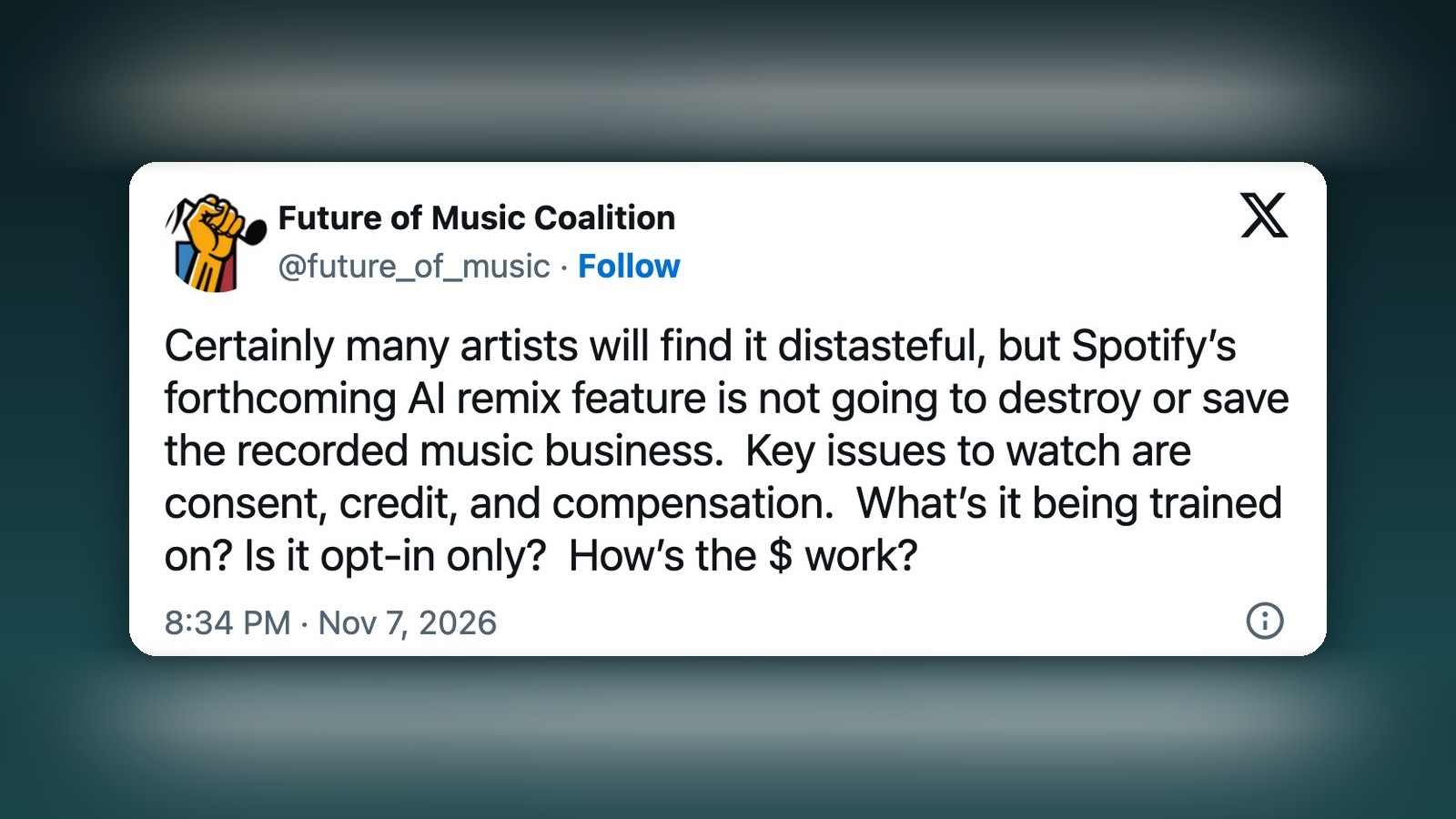
On November 7, the Future of Music Coalition posted on X that “many artists will find it distasteful,” but that the feature “is not going to destroy or save the recorded music business.” It named consent, credit and compensation as the issues to watch, and asked: “What’s it being trained on? Is it opt-in only? How’s the $ work?”
Some of that has answers. Artists opt in one by one, even when their label has signed. Believe and TuneCore artists have to say yes twice.
The backing musicians are the gap. Spotify’s October 20 announcement with Believe says remix streams pay “the participating artists and rights holders behind the original works.” It doesn’t mention the players on the recording, and Digital Music News asks what happens if one of them doesn’t want to take part.
“New use” is also the phrase the musicians’ union is suing over. In June, the AFM sued Universal and Warner, arguing their Suno and Udio deals are a new use of recordings that owes session players money. Universal was the first major to sign Spotify’s remix deal.
Abby North’s questions about Spotify AI remixes as derivative works
A derivative work is a new work built from an existing song, like a remix or a cover. Every one needs a title in the metadata and a split that says who owns what share.
In the Digital Music News piece, Abby North of North Music Group, which administers publishing rights, asks 3 questions about exactly that:
- “What are naming conventions for the resulting generated musical work?”
- “Who decides (and how) what percentage each work is entitled to of 100%?”
- “How are publishers alerted of [the] existence of a new derivative?”
Publishers are part of the deals. Kobalt signed in August and its songwriters opt in. North’s questions are about what happens after a fan hits generate, and the announcements so far don’t describe that step.
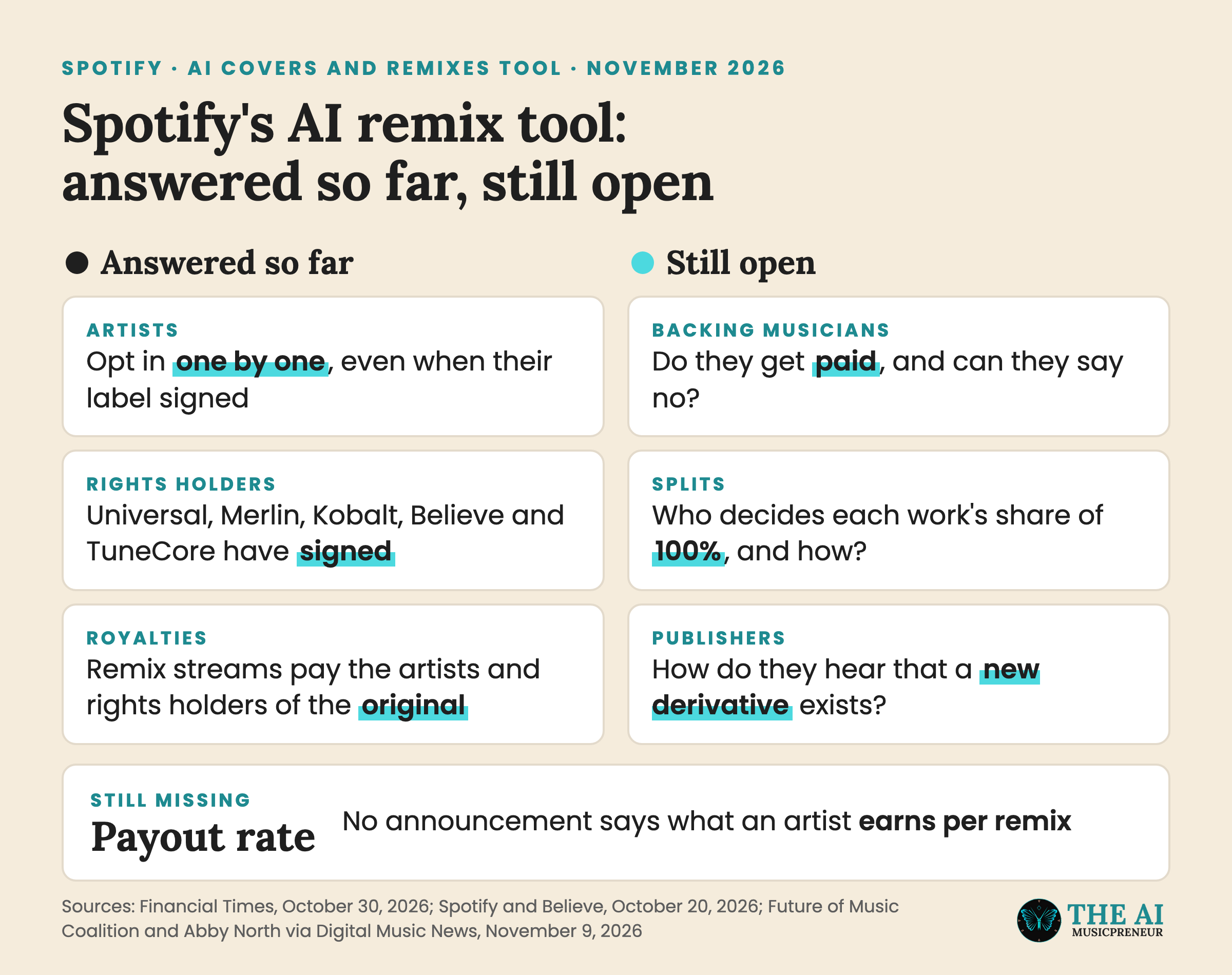
The payout rate is also still missing. Jermaine Dupri asked for artists to set the fee before launch, and no deal has published a rate since.
The FT’s sources put the launch in the first quarter of 2027, possibly around the Grammy Awards on February 7. Spotify hasn’t said when it will publish the payout terms.
Frequently asked questions
Can fans release remixes made with Spotify's AI tool outside Spotify?
No. Digital Music News reported on November 9, 2026 that remixes made with the tool stay inside Spotify, so a fan can't take a remixed track and release it anywhere else.
What does the Future of Music Coalition say Spotify's AI remix feature won't do?
In its November 7, 2026 post on X, the Future of Music Coalition said the feature is not going to destroy or save the recorded music business. It said many artists will find it distasteful, and that consent, credit and compensation are the issues to watch.
Who is Abby North of North Music Group?
Abby North runs North Music Group, a company that administers music publishing rights. Her Mondo.NYC speaker profile lists her as its president and says the company controls about 90,000 copyrights, including Unchained Melody.
About the author
Covering AI music tools, industry shifts, and news for music creators and professionals. Twice-weekly newsletter at aimusicpreneur.com.