14 EU countries ask the European Commission for a new AI copyright law, 3 more than first reported

My stack My fav 6 tools for AI music after testing 70+
-
 ElevenMusic · Music generation
-
 Moises · Stem separation
-
 Controlla · Voice swap & cloning
-
 Cryo Mix · Mixing + mastering
-
 Neural Frames · Music videos
-
 ONCE · Distribution
Some links are affiliate links — I earn a commission at no cost to you. Every tool here is one I run myself and truly believe in. This stack is proven.
14 EU countries now want a new copyright law for the age of AI. Not 11, as first reported. The final version of their note, Council document 15839/1/26 REV 1, is dated November 18, 2026, and adds Bulgaria, Hungary and the Netherlands to the list.
It asks the European Commission to present a legislative proposal “as soon as possible,” with 3 goals: an opt-out from AI training that you can actually enforce, more transparency about training data, and adequate pay for all creators.
The note went to the EU’s culture ministers, who met in Brussels on November 19 and 20.
Which 14 EU countries signed the November 2026 AI copyright note
Here’s the full list from the Council document: Austria, Bulgaria, Croatia, Cyprus, Denmark, Estonia, Germany, Hungary, the Netherlands, Poland, Portugal, Slovakia, Slovenia and Spain.
On November 17, Euronews reported the note with 11 names, and CMU repeated that count on November 19. The revised version picked up 3 more countries the day before the meeting.
It’s the second push this year. In May, 8 countries brought the same topic to the culture ministers: Austria, Estonia, Germany, Greece, Portugal, Slovenia, Slovakia and Spain. Greece isn’t on the November list, so 7 countries are new since May: Bulgaria, Croatia, Cyprus, Denmark, Hungary, the Netherlands and Poland.
Some big names are still missing. France and Italy aren’t on the list. Neither is Ireland, which holds the rotating Council presidency until the end of December, and where the Irish parliament has already debated using that presidency to push for AI copyright rules.
Euronews explains why the list is still short of a majority: inside many governments, the economy ministry sides with AI start-ups and the culture ministry sides with creators. Germany and Austria also brought a separate proposal to the same meeting, to force TikTok’s European business into European ownership.
So what exactly are the 14 asking for?
What the 14 EU countries want in a new AI copyright law
The note is 2 pages long, and the core of it is one sentence: swift action is needed “to improve the enforceability of reservation of rights, enhance transparency regarding training data, and ensure adequate remuneration for all creators across the board.”
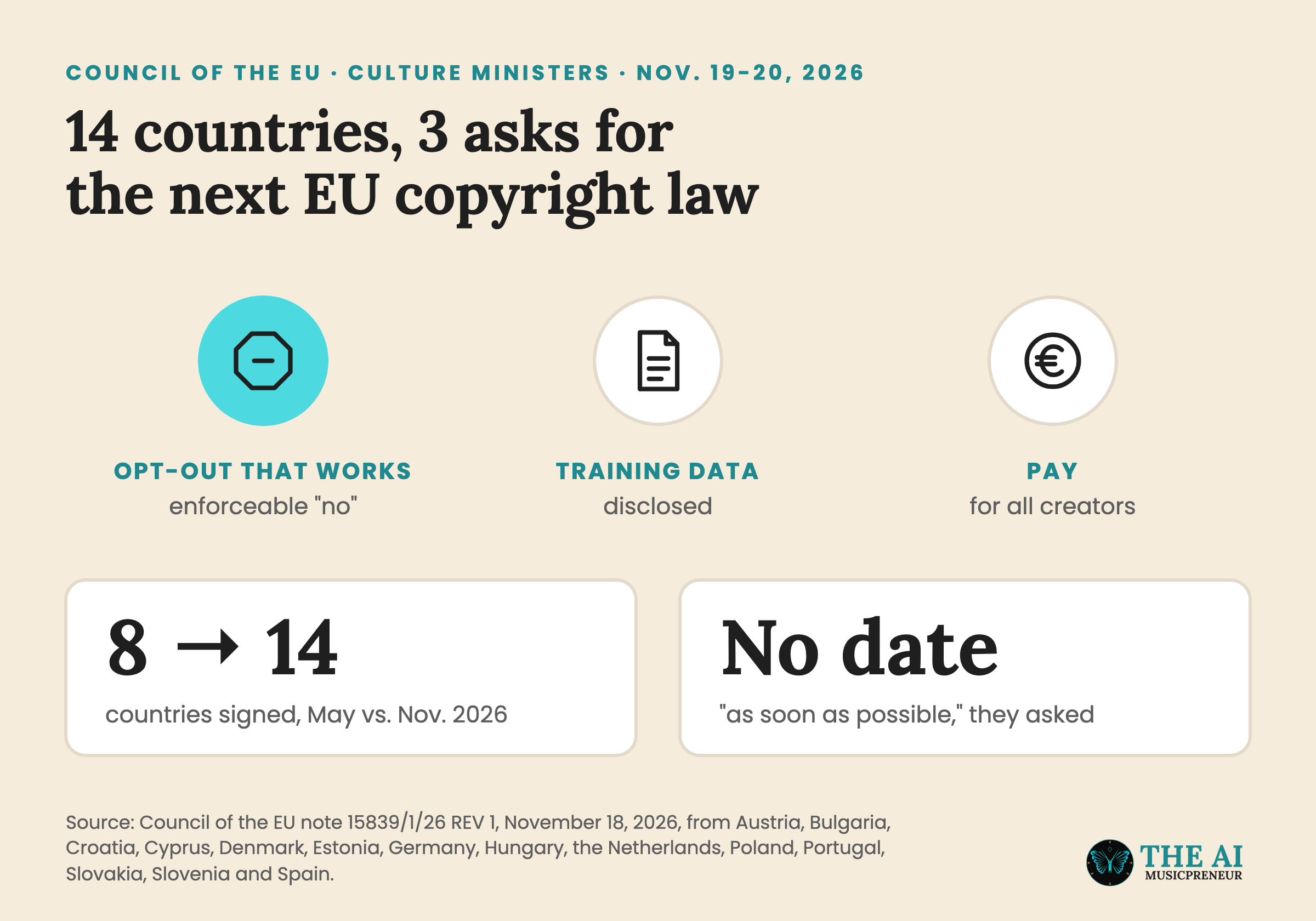
In plain words, that’s 3 asks:
- An opt-out that works. EU law already lets AI companies train on content unless the rights holder says no, which is what “reservation of rights” means. The problem is enforcing that no.
- Training data you can see. If you can’t find out what a model was trained on, you can’t prove your songs were in it.
- Pay for creators. Not just for big rights holders, but “for all creators across the board.”
Until a law exists, the 14 want the Commission to enforce the AI Act rules that already apply to general-purpose AI models, and they want the AI Office to check whether its training-data template does enough to push AI companies toward licensing. I covered those rules when the AI Act transparency duties took effect, and IFPI has asked for the same template to go further.
The note also wants the rules to apply “irrespective of where the AI was developed and, in particular, where it was trained.” That line matters for music, because the biggest music generators are American.
Since AI has moved from pure research into broad practical application, it has led to profound upheavals in human creative processes and the perception and experience of art and culture.
What the EU AI copyright push changes for your songs today
Nothing yet. The note was an “any other business” item, which informs the ministers but isn’t a vote, and only the Commission can propose an EU law. The 14 countries back the Commission’s own copyright initiative from May 13, 2026, and a European Parliament resolution from March 10, 2026, but there’s no draft law and no date.
What you have right now is the court route. In July, a Munich court ruled in GEMA’s lawsuit against Suno that training an AI music model on songs needs a licence. That’s one court in one country, and this note is about turning that kind of protection into rules across the EU.
And the pay part already has working models you can look at, like GEMA’s licensed PLAI dataset.
If you’re a songwriter or artist in the EU, the practical move hasn’t changed. Know which of your works sit with a collecting society like GEMA, because those societies are the ones fighting these cases and setting the licences.
Frequently asked questions
Which 14 EU countries signed the November 2026 note asking for an AI copyright law?
Austria, Bulgaria, Croatia, Cyprus, Denmark, Estonia, Germany, Hungary, the Netherlands, Poland, Portugal, Slovakia, Slovenia and Spain. The list comes from Council of the EU document 15839/1/26 REV 1, dated November 18, 2026. The first version reported by Euronews named 11 countries.
What did the 14 EU countries ask the European Commission to put in a new AI copyright law?
They asked for 3 things: better enforceability of the reservation of rights, which is the opt-out from AI training, more transparency about training data, and adequate remuneration for all creators. They also asked the Commission to enforce the AI Act transparency rules for general-purpose AI models in the meantime.
Is the November 2026 EU culture ministers' note on AI copyright binding on the European Commission?
No. It was an any other business item for the Education, Youth, Culture and Sport Council on November 19 and 20, 2026, which informs ministers but is not a decision. Only the European Commission can propose a new EU law, and the note sets no deadline beyond as soon as possible.
About the author
Covering AI music tools, industry shifts, and news for music creators and professionals. Twice-weekly newsletter at aimusicpreneur.com.