Warner Music posts its first $2 billion quarter and says Suno money starts showing up in fiscal 2027

My stack My fav 6 tools for AI music after testing 70+
-
 ElevenMusic · Music generation
-
 Moises · Stem separation
-
 Controlla · Voice swap & cloning
-
 Cryo Mix · Mixing + mastering
-
 Neural Frames · Music videos
-
 ONCE · Distribution
Some links are affiliate links — I earn a commission at no cost to you. Every tool here is one I run myself and truly believe in. This stack is proven.
Warner Music Group just had its first $2 billion quarter. Its results for the 3 months to September 30, 2026, published on November 19, show $2.001 billion in revenue, up 7% on a year earlier.
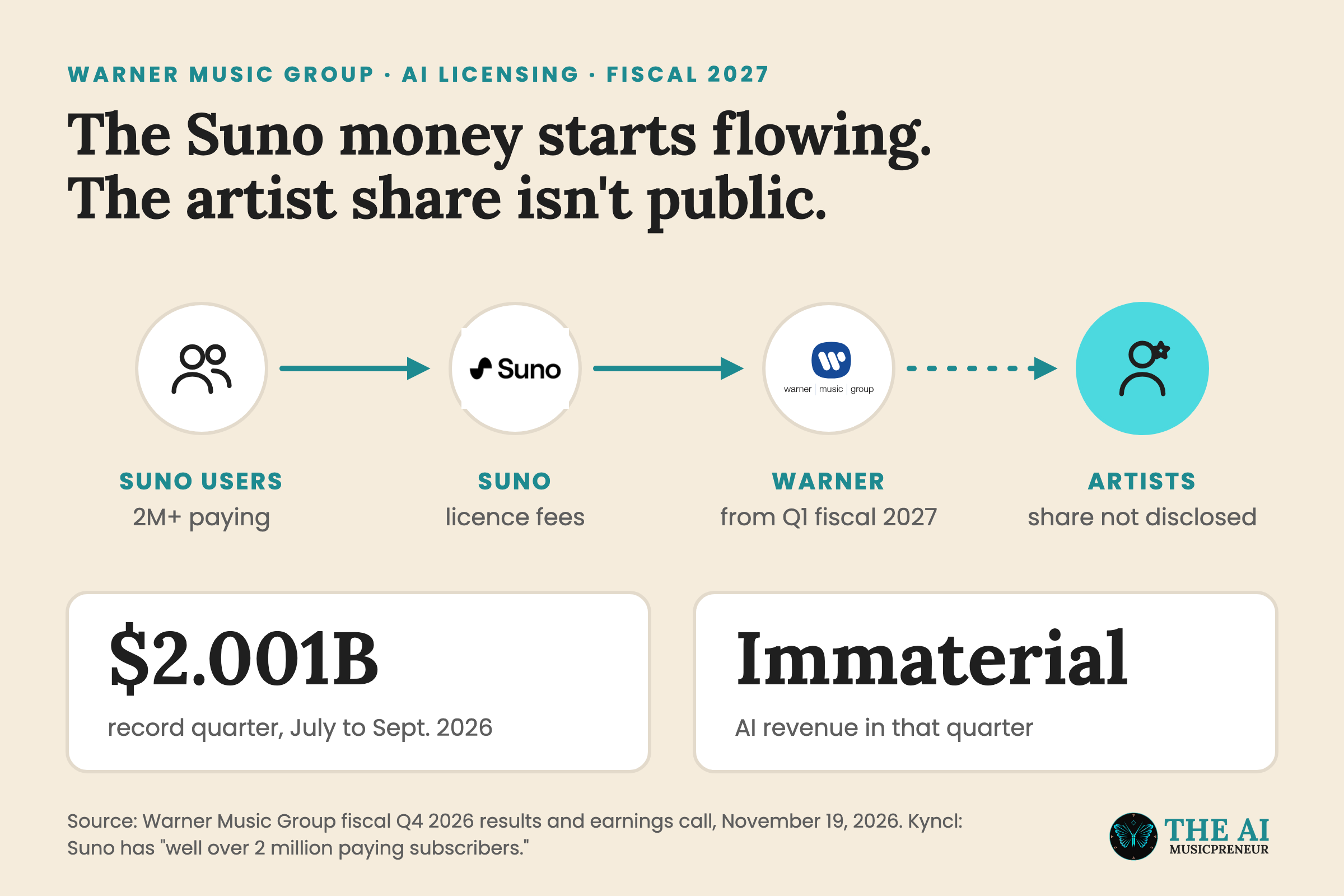
The AI part is the bit I was waiting for. On the earnings call the same day, CEO Robert Kyncl said the money from Suno was still immaterial in that quarter, but will become material in fiscal 2027, which started on October 1.
So Warner is now telling investors that AI licensing is a real line of income. What it hasn’t told anyone yet is how much of that reaches the artists.
Warner Music Group fiscal Q4 2026 results in numbers
Streaming did most of the work. These are the numbers from Warner’s results release for the quarter:
- Revenue rose 7% to $2.001 billion, from $1.862 billion a year earlier.
- Recorded music subscription streaming grew 15%, which Warner puts down to higher per-subscriber minimums in its deals with streaming services.
- Physical sales jumped 30% on releases from Madonna and Charli XCX, and strong sales in Japan.
- Adjusted OIBDA, Warner’s main profit measure, rose 18% to $477 million.
- Net income was $179 million, up from $109 million.
For the full fiscal year, revenue rose 11% and adjusted OIBDA rose 23% to $1.77 billion. Warner gave no revenue target for fiscal 2027, but lists “new and incremental growth vectors including AI licensing” among the reasons it expects to keep growing.
So AI licensing now sits in the highlights of Warner’s results release. In August, Kyncl only put a date on the AI money. On this call, he talked about Suno in much more detail.
What Robert Kyncl said about Suno, Sureel and Spotify on the November 19 call
Kyncl opened by calling the Suno deal “a watershed moment for the industry brought about by our efforts,” according to the call transcript. When an analyst asked how much AI revenue to expect, he went further:
This is the first time that generative AI company is paying out royalties to a music company. It's a watershed moment.
On the numbers, he said the impact in fiscal Q4 was immaterial “because it launched halfway through September,” meaning Suno’s licensed model, and that Suno has “well over 2 million paying subscribers.” So the money that reaches Warner starts with those subscriptions.
On permissions, Kyncl said Warner can’t manage who agreed to what for songs, names, likeness and voice “in spreadsheets.” That’s why it bought Sureel.ai in June, and he said Warner is now opening that tool to anyone in the music industry.
Asked how he pitches AI to artists who’ve spoken out against it, he said: “rule number one, you can’t force anyone to do anything.” He described AI as “UGC on steroids,” comparing it to user-generated content on YouTube, which he said started small and became a multibillion-dollar business.
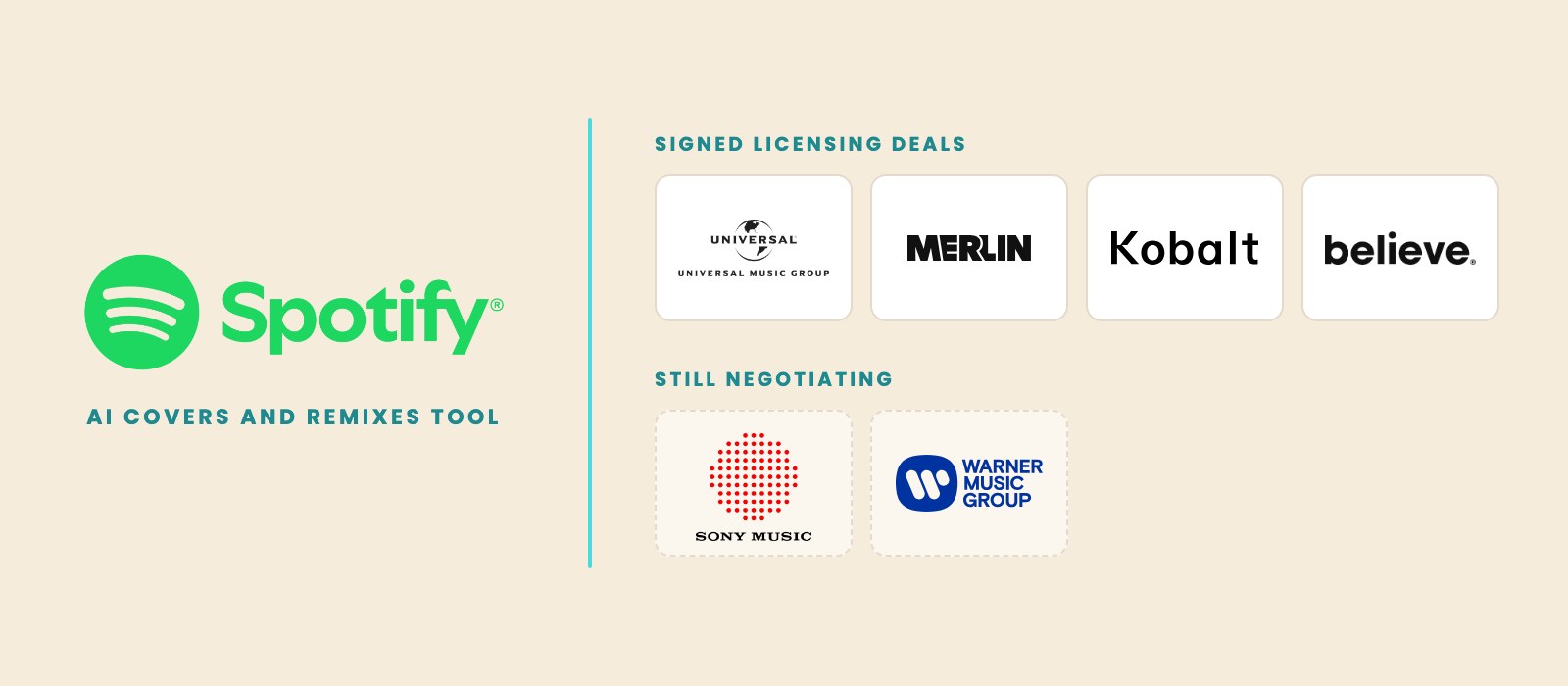
And on Spotify’s AI product, he said Warner is “working through the details” as part of its overall deal, with nothing to announce. Spotify plans to launch its AI covers and remixes tool in the first quarter of 2027, according to the Financial Times.
Will Warner Music artists get a share of the Suno money?
Warner hasn’t said. Not on this call, and not in the release.
When Warner settled with Suno, it said artists would opt in and keep control over their voice and music. But neither Warner nor Suno has published the split between the label and the artists whose songs and voices the deal covers.
Compare that with publishing. The NMPA’s deals with Udio and Klay split AI income 50/50 between songs and recordings, and they say so in public.
The players on those records are asking the same question. The AFM’s Human Made, Human Paid campaign demands AI consent, credit and pay from the major labels for the musicians on those recordings.
So if you’re signed to Warner, the most useful thing you can do before the first Suno money lands is ask your label 1 question in writing: what percentage of AI licensing income does my contract pay me, and where will it show up on my statement?
Frequently asked questions
How much revenue did Warner Music Group make in fiscal Q4 2026?
Warner Music Group made $2.001 billion in the 3 months to September 30, 2026, up 7% on the $1.862 billion it made a year earlier. It's the first quarter in which Warner's revenue passed $2 billion. Full-year revenue rose 11%.
How many paying subscribers did Robert Kyncl say Suno has in November 2026?
Well over 2 million. Robert Kyncl, Warner Music Group's CEO, gave the figure on Warner's fiscal Q4 2026 earnings call on November 19, 2026. He said the Suno revenue was immaterial in that quarter because the licensed model launched halfway through September, but will be material in fiscal 2027.
What is Sureel and how does Warner Music use it for AI permissions?
Sureel.ai is a company Warner Music bought in June 2026 to manage AI permissions for songs, names, likeness and voice in one place and pass them to AI partners through APIs. Robert Kyncl said on November 19, 2026 that Warner is opening the tool to the rest of the music industry.
About the author
Covering AI music tools, industry shifts, and news for music creators and professionals. Twice-weekly newsletter at aimusicpreneur.com.