UMG is the first major label to license TYGER, which uses AI to make songs react to gameplay
My stack My fav 6 tools for AI music after testing 70+
-
 ElevenMusic · Music generation
-
 Moises · Stem separation
-
 Controlla · Voice swap & cloning
-
 Cryo Mix · Mixing + mastering
-
 Neural Frames · Music videos
-
 ONCE · Distribution
Some links are affiliate links — I earn a commission at no cost to you. Every tool here is one I run myself and truly believe in. This stack is proven.
Universal Music Group just licensed its music to TYGER, a San Diego app that makes songs react to what you do in a video game. The deal was announced on October 22, 2026, and both companies say UMG is the first major music company to license TYGER.
Select recordings and songs from UMG’s recorded music and publishing catalogs are coming to TYGER’s paid, on-demand subscription. Some UMG recordings will also play on the free, ad-supported tier. Neither company has given a date for the songs or a figure for the deal.
Today TYGER’s library holds more than 400,000 songs, mostly from independent artists.
What does TYGER’s AI actually do to a licensed UMG song?
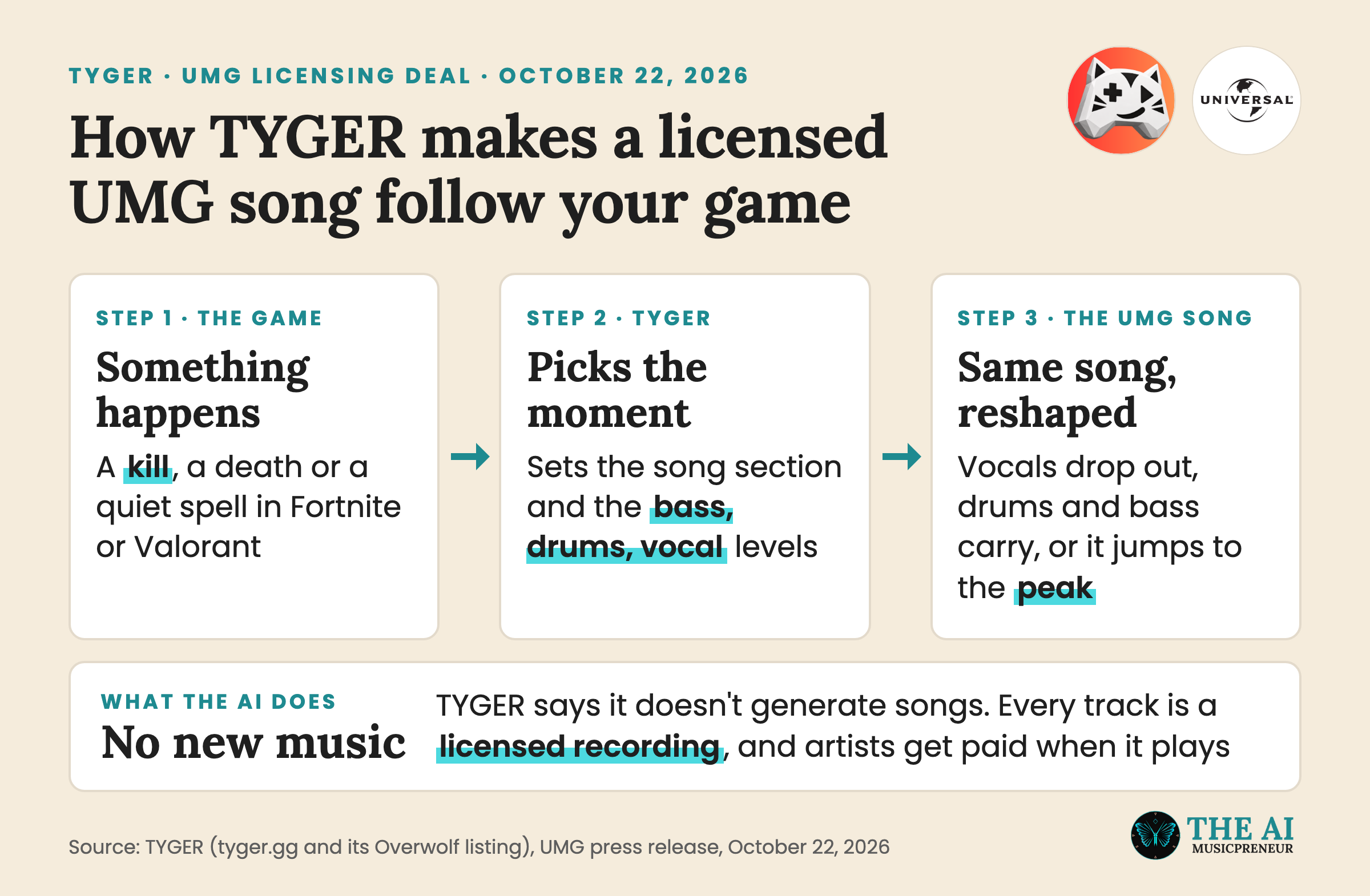
TYGER’s AI changes how an existing recording plays. It doesn’t write new songs, and CEO Nick Venti says so plainly on the company’s stance on generative AI: “we don’t make AI-generated music.”
The engine takes the artist’s track and reshapes it as your match changes. TYGER’s AI DJ explainer lists 3 moves:
- It drops the vocals when you need to focus.
- It strips the song down to drums and bass while the tension builds.
- It jumps to the song’s biggest moment when you land a headshot or win the round.
In the app, each game event gets its own settings. A kill can call up a chosen part of the track and set levels for bass, drums, vocals and the rest of the mix.
TYGER calls this its patented technology, and the press release says it needs no integration from game studios. In Venti’s words, “The music stays the artist’s.”
How do you use TYGER today, and what does it cost?
Right now TYGER is a desktop app on the Overwolf app store, so it runs on PC only. The press release says TYGER is built for PC, console and mobile, but console and mobile aren’t live yet.
You install it, pick your game and switch Adaptive Music on. Adaptive audio works in Fortnite, Valorant, Apex Legends, Rainbow Six and others. In any other game, TYGER plays music like a normal player.
The free tier is ad-supported, with curated playlists and streamer-safe playlists for Twitch and YouTube. TYGER Club costs $3.99 a month in early access, rising to $5.99 at full release, and adds the full 400,000-song catalog, custom playlists and no ads.
UMG’s songs go to the paid, on-demand subscription, with some UMG recordings on the free tier. Both tiers get an update when TYGER relaunches later this year.
Why is UMG licensing TYGER for gaming?
Sir Lucian Grainge pitched this idea 7 months ago. On March 17, 2026, UMG’s chairman and CEO became the first music executive on stage at NVIDIA’s GTC conference, and he picked gaming as his example of hyper-personalization.
So, when they're driving, they make a turn on a racetrack, it syncopates to the chorus or the verse or the lyric, that means something to them.
TYGER joins a run of licensed AI deals at UMG: the Udio settlement in October 2025, Hook’s fan remix app in August 2026 and ElevenLabs on September 10. Michael Nash, UMG’s EVP and Chief Digital Officer, said UMG believes “music has a more integral role to play in gaming.”
TYGER isn’t the only company here. Reactional Music sells its engine to game developers, who build it into their games. TYGER runs next to the game instead, which is how a player can switch it on without the studio doing anything.
TYGER calls that a “direct route” for artists and songwriters to reach players. What a play pays is the one number neither company has shared yet.
Frequently asked questions
Which games work with TYGER's adaptive music?
TYGER's Overwolf listing names Fortnite, Valorant, Apex Legends and Rainbow Six among the games with adaptive audio, and the press release puts the beta at more than 20 titles. In any other game, TYGER plays music like a standard player, and the app shows when a game doesn't support adaptive audio.
When will Universal Music Group songs be available on TYGER?
The October 22, 2026 press release says select UMG recordings will be available soon, without a date. TYGER plans to relaunch later in 2026 with an updated ad-supported tier and subscription once the UMG music is added.
Do artists get paid when their songs play on TYGER?
TYGER says every song on the service is licensed and that artists get paid when their music is played. Neither TYGER nor Universal Music Group has published a per-play rate or the financial terms of their deal.
Does TYGER work on PlayStation, Xbox or mobile?
Not yet. The press release says TYGER is built to work across PC, console and mobile, but today it runs only as a PC desktop app installed through the Overwolf app store.
About the author

Covering AI music tools, industry shifts, and news for music creators and professionals. Twice-weekly newsletter at aimusicpreneur.com.