
Suno admits it hasn't deleted all the recordings it trained on, in its answer to UMG and Sony's v6 lawsuit
My stack My fav 6 tools for AI music after testing 70+
-
 ElevenMusic · Music generation
-
 Moises · Stem separation
-
 Controlla · Voice swap & cloning
-
 Cryo Mix · Mixing + mastering
-
 Neural Frames · Music videos
-
 ONCE · Distribution
Some links are affiliate links — I earn a commission at no cost to you. Every tool here is one I run myself and truly believe in. This stack is proven.

Suno still has at least some of the recordings it trained its AI on, and now it says so in a court filing. Its 44-page answer, filed on October 20, 2026 in Boston federal court, admits that Suno “has not deleted all of the sound recordings it has used to train its AI models.”
That’s Suno’s formal reply to the second lawsuit Universal Music Group and Sony Music filed on September 18, the one that says Suno’s v6 models “launder” the infringement of the older ones. Suno adds that keeping the files is “consistent with Plaintiffs’ demand in correspondence prior to the Original Action that Suno retain ‘data sets used to train’” its models.
What Suno doesn’t say in any of those 6 passages is that it stopped using the recordings. And that’s the part the labels’ case against v6 leans on.
Why Suno’s retained training recordings matter to the v6 laundering claim
The labels’ complaint argues in a chain. Older Suno models trained on their recordings, users made songs with those models, and v6 learned from those songs and from the users’ picks between versions.
“Training a ‘new’ model on the outputs of an infringing model does not eliminate the infringement; it launders it,” the complaint says. In the same paragraph, number 49, it adds that Suno “has never claimed to have destroyed or ceased using” its copies and “on information and belief it retains and continues to use them.”
Suno’s reply to paragraph 49 opens with 2 admissions: it “has not claimed to have destroyed or deleted copyrighted works,” and it hasn’t deleted all of its training recordings. On the “continues to use” part, it only denies “any remaining allegations of this paragraph,” as Music Business Worldwide pointed out.
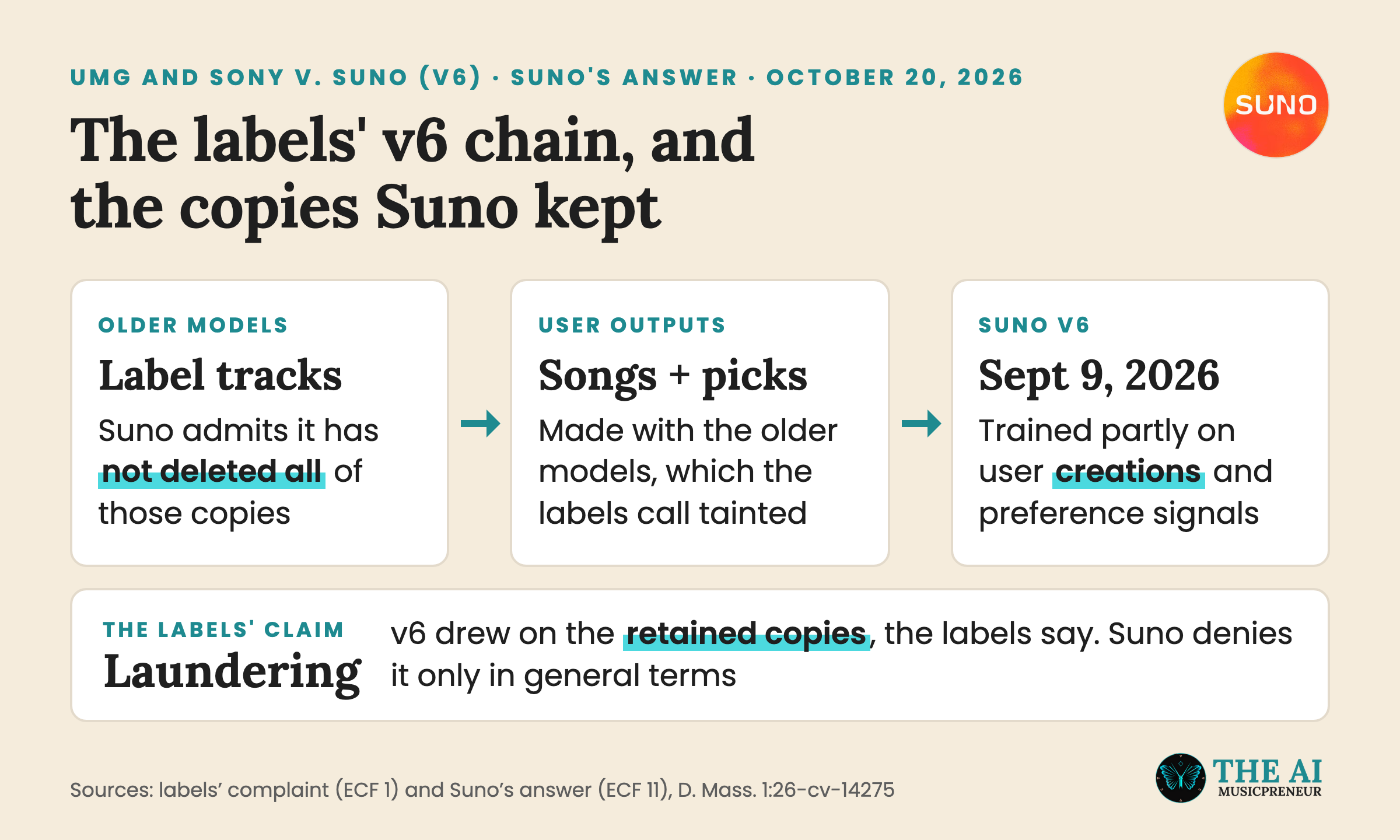
That matters because the complaint also alleges, on information and belief, that Suno’s work on v6 “drew on these retained copies.” Suno has now confirmed the copies exist. Whether v6 drew on them is what the labels still have to prove.
Did the labels ask Suno to keep its training data?
Suno’s answer says yes, but it doesn’t identify the correspondence. The complaint describes one from April 25, 2024, 2 months before the first lawsuit, in which the labels asked Suno to “cease and desist from copying or otherwise using” their recordings and to list everything it used to build its models.
So the letter the complaint describes asked Suno to stop using the recordings, and Suno points to a request to keep them.
Suno had already told the court it kept the data. Its August 2024 answer in the first case promised the labels they would get to see it in discovery.
Plaintiffs will have ample opportunity to comb through the relevant data, all of which has been preserved, once discovery commences.
And they did. The new answer admits the labels inspected Suno’s source code and training data in that case, and that their Audible Magic scan “purported to identify millions of copyrighted works” they claim in Suno’s dataset, including the 60,202 recordings in this suit.
What Suno admits and denies about how v6 was trained
Suno repeats its public line about v6 several times: the model “was trained on content licensed from our partners, interactions including creations and preference signals from our community, and the accumulated learnings from our team.”
It also admits that Suno “uses information about user responses to its service to improve its service” and “maintains certain data concerning user-generated outputs and their preference signals.”
It denies “that each of its models was trained on the same corpus of sound recordings,” which the complaint alleged about every model from v4 to v5.5. It never names the complaint’s knowledge distillation theory, and says it lacks the knowledge to admit or deny that paragraph, so it denies it.
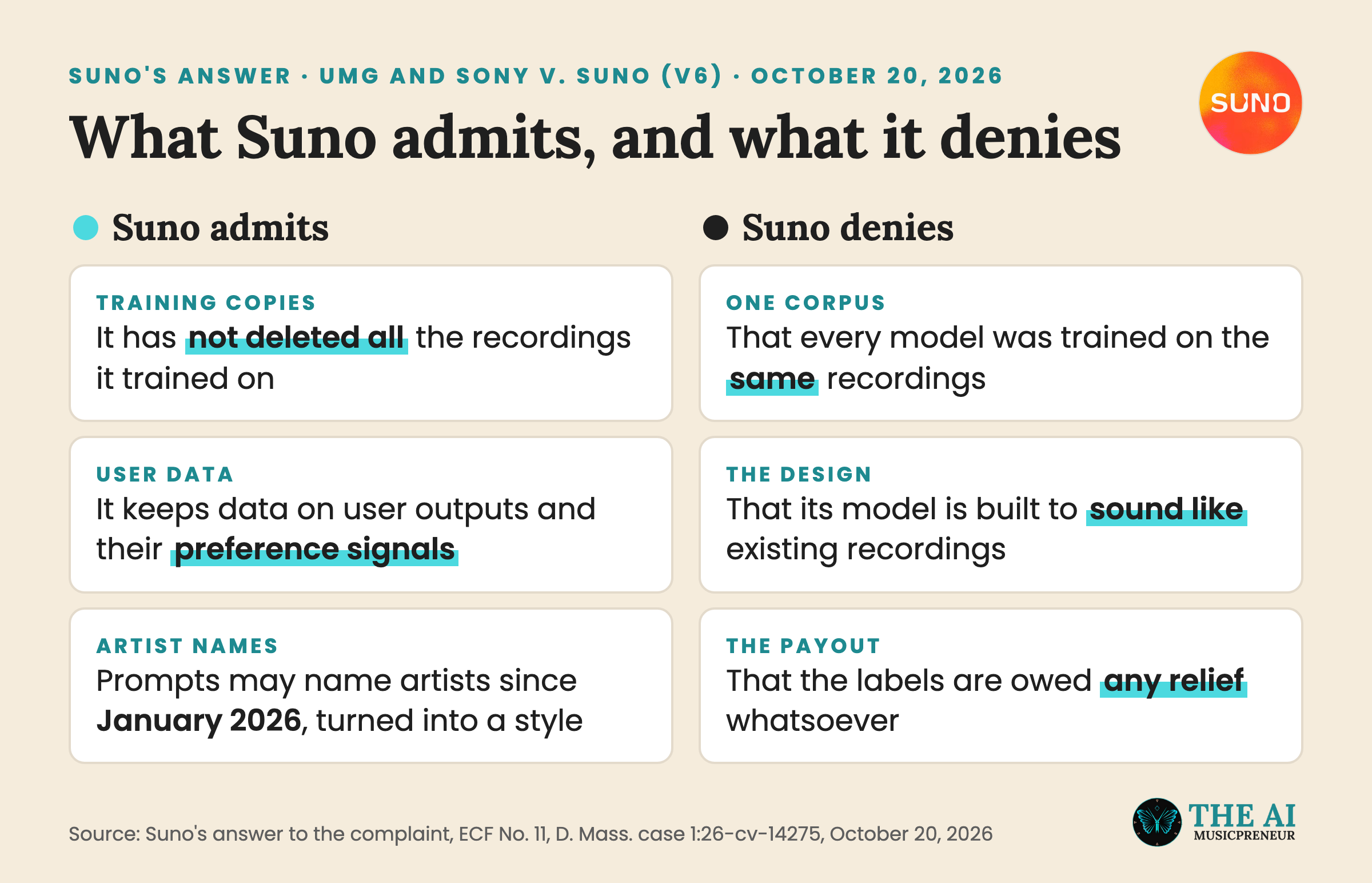
One admission touches how you use Suno today. Suno blocked artist names in prompts until January 2026, and users have been allowed to include them since. Suno says the name gets converted into a style description first, and it denies that it “switched off” a design meant to “generate completely new outputs.”
Artist names count in another Suno case too. The Isbell and Lowery class action is written to cover musicians whose names Suno has accepted as prompts.
Suno’s 13 affirmative defenses, from fair use to $200 per song
Suno answered the complaint instead of moving to dismiss it. Its 13 defenses are the same 11 it pleaded in the first case in 2024, plus the 2 standing defenses against the YouTube stream-ripping claim from its September 1 answer. Fair use comes first, and it ends on the same line as before: “This is quintessential fair use.”
The seventh one puts a number on it. If the court finds infringement, Suno argues it was innocent, which would let the judge cut statutory damages “to an amount as low as $200 per work infringed” under 17 U.S.C. § 504(c).
Across 60,202 recordings, that floor comes to about $12 million. At the $150,000 the law allows for each willfully infringed work, the ceiling is just over $9 billion.
Neither number is on the table until a court finds Suno liable, and no court has done that in either case yet. I log every filing on the UMG and Sony v. Suno (v6) tracker.
Frequently asked questions
Does Suno keep data on the songs its users generate?
Yes. In its October 20, 2026 answer to Universal Music Group and Sony Music, Suno admits it maintains certain data concerning user-generated outputs and their preference signals, and that it uses information about user responses to improve its service. Suno has said v6 was trained partly on creations and preference signals from its community.
Since when can Suno users type an artist's name into a prompt?
Since January 2026, according to Suno's October 20, 2026 court answer. Suno blocked prompts with artist names before that, and it says a name is now converted into a style description before any output is generated.
Did Suno ask the court to dismiss Universal Music Group and Sony Music's v6 lawsuit?
Suno filed an answer on October 20, 2026 instead of a motion to dismiss. The answer asks the Boston federal court to enter judgment for Suno, dismiss all of the labels' claims with prejudice and award Suno its attorneys' fees and costs.
Which law firm represents Suno in Universal Music Group and Sony Music's v6 lawsuit?
Latham & Watkins. Shlomo Fellig of the firm's Boston office filed the October 20, 2026 answer, with Andrew M. Gass, Brittany N. Lovejoy, Joseph Wetzel, Ivana Dukanovic and Grace McLaughlin listed with pro hac vice admission pending.
About the author

Covering AI music tools, industry shifts, and news for music creators and professionals. Twice-weekly newsletter at aimusicpreneur.com.