Universal and Sony sue Suno again over 60,202 songs, and Suno says v6 trained on user creations
My stack My fav 6 tools for AI music after testing 70+
-
 ElevenMusic · Music generation
 -
 Moises · Stem separation
 -
 Controlla · Voice swap & cloning
 -
 Cryo Mix · Mixing + mastering
 -
 Neural Frames · Music videos
 -
 ONCE · Distribution
Some links are affiliate links — I earn a commission at no cost to you. Every tool here is one I run myself and truly believe in. This stack is proven.
Universal Music Group and Sony Music Entertainment sued Suno for the second time on September 18, 2026. The new complaint names 60,202 recordings and goes straight at v6, the model Suno launched 9 days earlier with Warner Music, BMG and Believe as partners.
Then on September 22, Suno answered with a statement. It said v6 was trained on content licensed from those partners, on “interactions including creations and preference signals from our community”, and on what its own team had learned.
So the songs Suno users made are part of what v6 learned from. That is exactly the part the labels are now suing over.
Why Universal and Sony filed a second Suno lawsuit
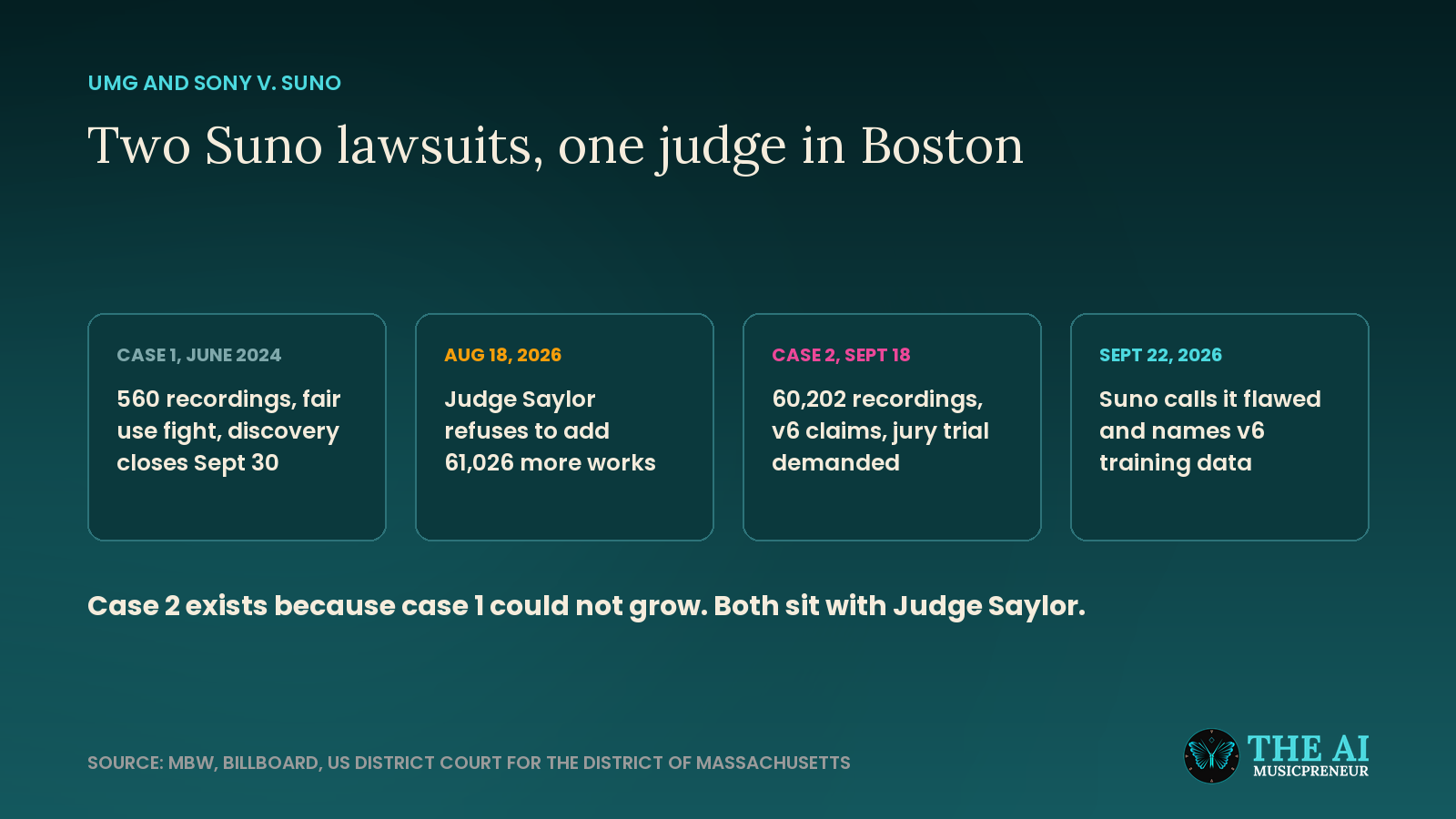
The first case has been running in Boston since June 2024, and it covers only 560 recordings. In May 2026 the labels asked to add 61,026 more after discovery suggested Suno trained on far more of their catalogue.
Judge F. Dennis Saylor IV said no on August 18. He denied the expansion because it would delay a case he wants decided on fair use, and he pointed the labels toward a separate lawsuit instead.
That is what arrived on September 18. The complaint was assigned to Saylor too, so one judge now has both cases.
The money on paper is big. US law allows up to $150,000 per willfully infringed work, so 60,202 recordings put the ceiling at just over $9 billion.
The labels also want up to $2,500 for each time Suno allegedly got around YouTube’s download protection, which adds roughly $150 million if applied once per recording. They asked for a jury trial and a court order stopping any further use of their music.
Sony already ran this play against Udio. It filed a second Udio lawsuit on July 20 with the 30,117 recordings a judge had kept out of its first case.
The “poisoned tree” argument against Suno v6
At launch, Suno’s Chief Product Officer Jack Brody told MBW that v6 was trained “entirely from scratch, from the ground up”, on data that “doesn’t include data from Universal or Sony.” You can read what changed in my Suno v6 launch breakdown.
The labels say v6 is still infringing, and their argument has 3 steps.
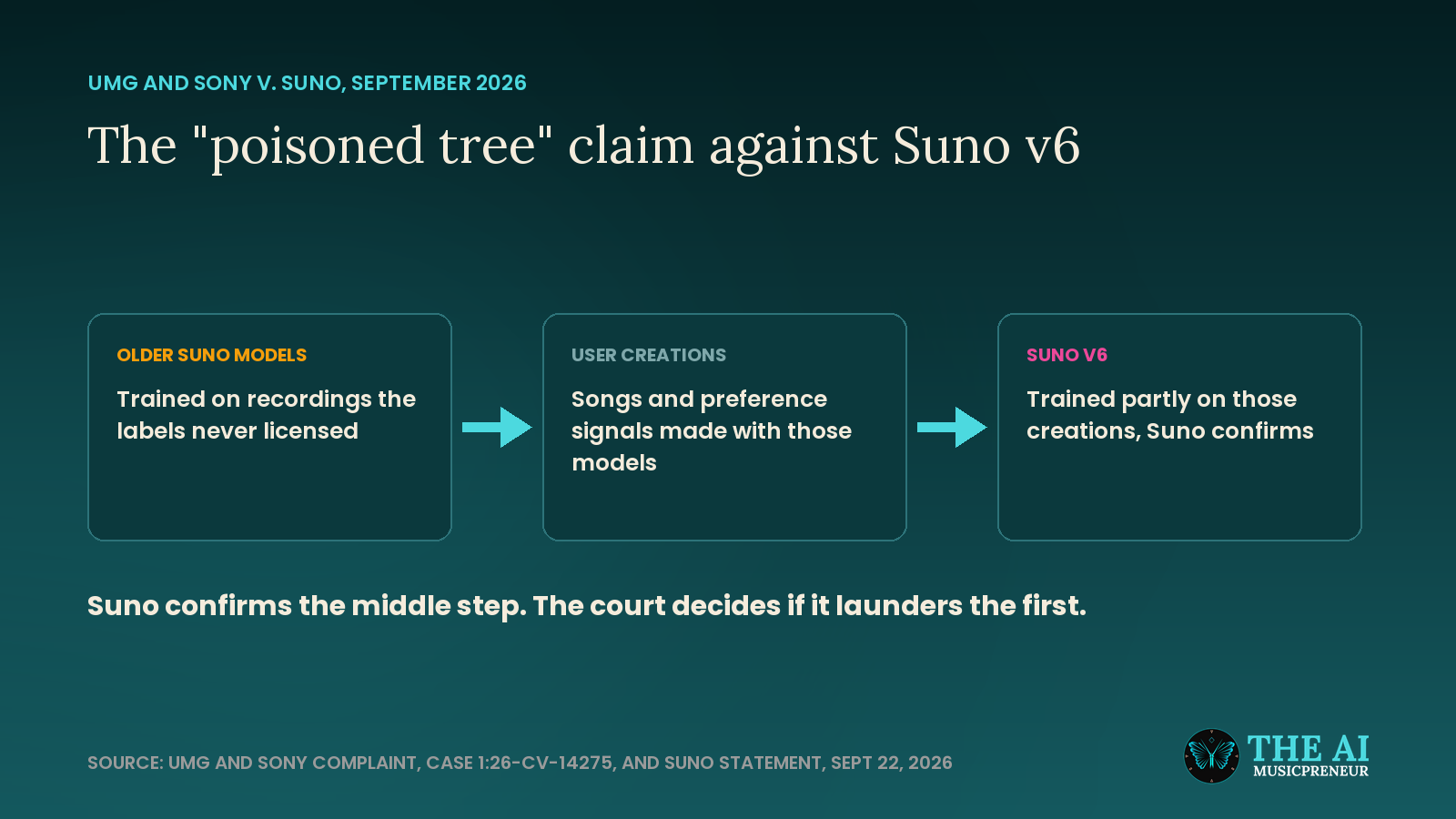
Step one: older Suno models were trained on their recordings without a licence. Step two: users made songs with those models, and picked their favourite of the 2 versions Suno generates each time. Step three: v6 learned from those songs and those picks.
Training a 'new' model on the outputs of an infringing model does not eliminate the infringement; it launders it.
The complaint also carries a second theory, again on information and belief. It says Suno may have used knowledge distillation, where a new “student” model is trained to copy the behaviour of an older “teacher” model.
And it turns Suno’s licensing deals against it. Three deals with three major rightsholders in less than a year, the labels write, prove “a functioning market exists” for licensing music to train AI, which hurts Suno’s fair use defence.
What Suno said went into v6
Suno’s reply went out to media on September 22 and was reported by Music Business Worldwide. It calls the claims “fundamentally flawed on both the facts and the law.”
Then it lists the ingredients.
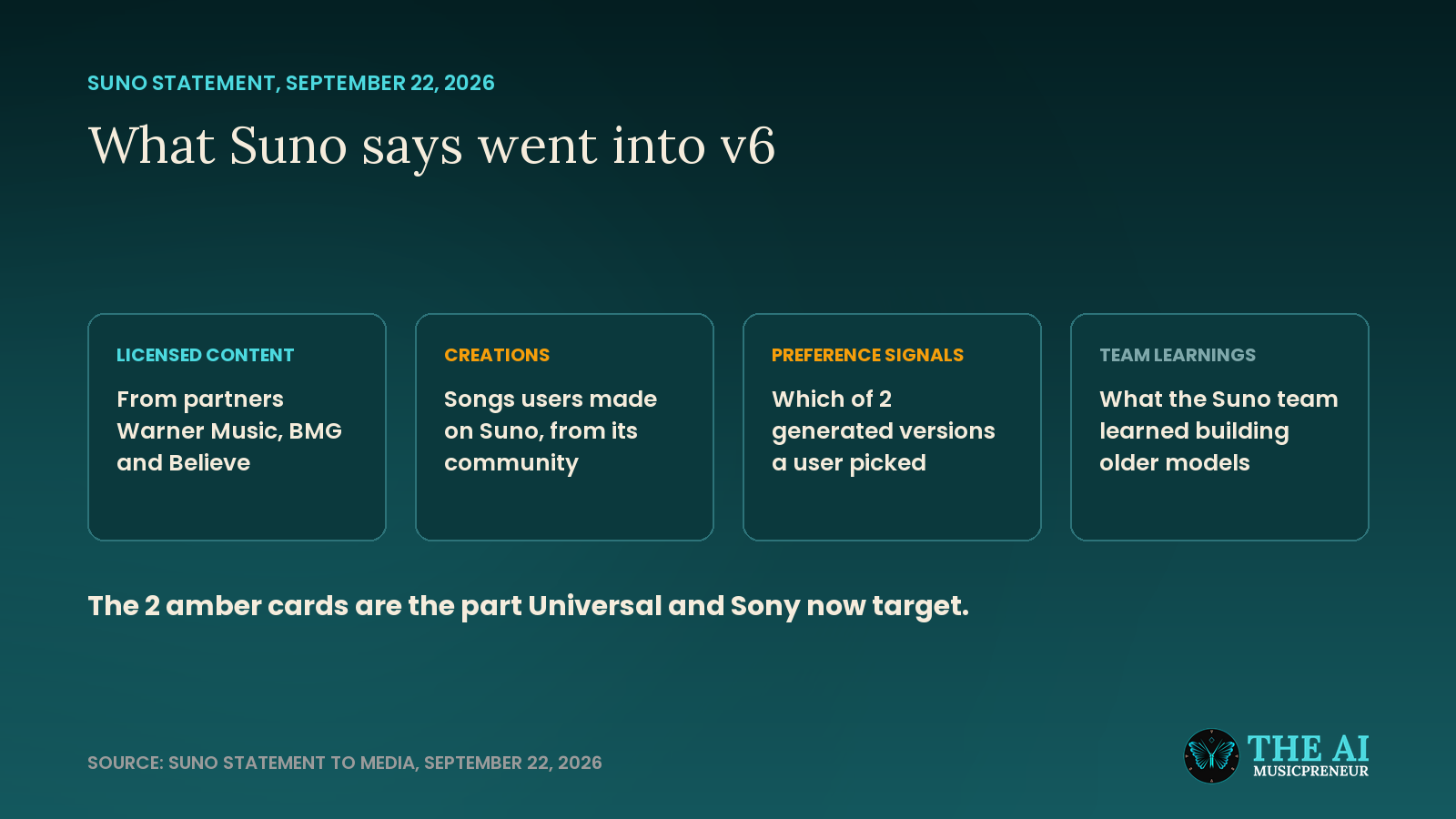
The detail worth reading twice is the word “creations”. At launch, Suno told MBW the user data behind v6 was preference data and not audio users had uploaded. The new statement puts creations next to preference signals as their own item.
This also explains part of the v6 backlash from a different angle. Users argued the licensed data made v6 sound worse. The labels argue the user data makes v6 infringing. Both are arguments about the same training set.
What Suno’s terms say about the songs you make
If you make music on Suno, this is the part that touches your own tracks. Suno’s terms of service have given it a “perpetual, irrevocable” license over “any and all Content” since at least January 2024.
In the version in effect since September 3, 2026, that content covers what you type in and the output Suno generates from it. The stated purposes include the “improvement” of the models behind the service.
The lawsuit asks a separate question: whether a model built partly on those songs carries the problems of the models that made them.
Suno still has to file its formal answer, and the first case keeps moving too, with fact discovery there set to close on September 30. I’m tracking both in the UMG and Sony v. Suno (v6) tracker and the original RIAA v. Suno tracker.
Frequently asked questions
Why did Universal Music Group and Sony Music sue Suno a second time in September 2026?
Judge F. Dennis Saylor IV refused on August 18, 2026 to add 61,026 more recordings to the labels' first Suno case, saying it would delay a case he wants decided on fair use. He noted the labels could bring those works in a separate suit, and they did on September 18 with 60,202 recordings and new claims aimed at Suno v6.
What does Suno mean by creations and preference signals in its v6 training statement?
Creations are the songs users make on Suno. Preference signals are the choices users make between the 2 versions Suno generates for each prompt. Suno said on September 22, 2026 that both went into training v6, next to licensed content from Warner Music, BMG and Believe.
How much could Suno owe in the second Universal and Sony lawsuit?
US law allows up to $150,000 per willfully infringed work, so 60,202 recordings carry a theoretical ceiling of just over $9 billion. The labels also ask for up to $2,500 per act of bypassing YouTube's download protection, which adds roughly $150 million if applied once per recording. No court has found Suno liable for anything yet.
Do Suno's terms of service let it train models on songs made by its users?
Suno's terms have granted it a perpetual, irrevocable license over user content since at least January 2024. In the version in effect since September 3, 2026, that covers both what users submit and the output generated from it, including for improving the models behind the service.
About the author

Covering AI music tools, industry shifts, and news for music creators and professionals. Twice-weekly newsletter at aimusicpreneur.com.