Suno users are cancelling over v6, and they blame the licensed training data
My stack My fav 6 tools for AI music after testing 70+
-
 ElevenMusic · Music generation
 -
 Moises · Stem separation
 -
 Controlla · Voice swap & cloning
 -
 Cryo Mix · Mixing + mastering
 -
 Neural Frames · Music videos
 -
 ONCE · Distribution
Some links are affiliate links — I earn a commission at no cost to you. Every tool here is one I run myself and truly believe in. This stack is proven.
Suno spent a year getting the music industry to stop suing it, and shipped v6 on September 9, 2026 as the first model family built with label partners. Nine days later its own paying users are the ones calling it a downgrade. MusicRadar collected the response from Suno’s Reddit community on September 17, and it reads like a churn warning: muffled, generic, soulless, and a run of people saying they have cancelled.
What Suno subscribers say v6 got worse
The complaints cluster on two things, and both are about listening rather than features.
The first is audio quality. One user described the output as “muffled, dull and strangely lifeless”, with vocals buried, the high end almost gone, and the whole mix carrying a “blanket over the speakers” feeling.
The second is sameness. Users report results that are flatter and more alike from prompt to prompt, one calling them “overproduced, heavily compressed and limited tracks that lack even a semblance of melody, grit or soul”.
I've published two albums made with V5.5. I spent the two days of free usage trying all the same styles and prompts in V6 and found it produced muffled, generic, soulless garbage by comparison.
Why the licensed training data is getting the blame
Suno used to describe its training set as all music files of reasonable quality accessible on the open internet. That was the sentence that got it sued.
v6 was built with Warner Music, BMG and Believe catalogues plus user data instead. Suno has not published the scope, and users are doing the obvious arithmetic: a licensed catalogue is smaller and less varied than the open internet, so the model heard less.
That is speculation on the users’ part, not a disclosure. It is also the only explanation on the table, because Suno described v6 as faster, more expressive and higher quality, and a large part of the paying base disagrees.
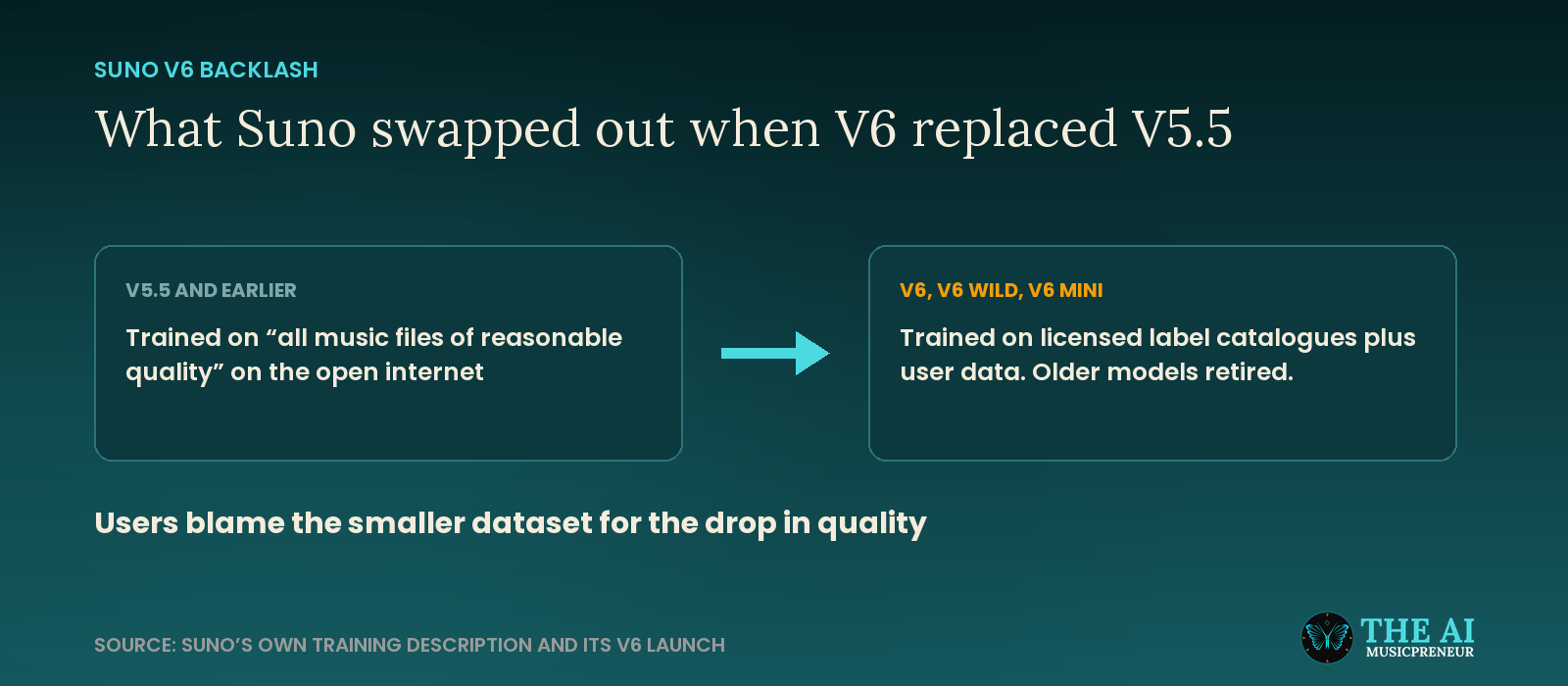
Samori Coles, who tested the models himself, reads it the same way. “Because Suno has the licensing deal with Warner Music Group and BMG, the training data I think is more condensed,” he says in his comparison video. “Before, Suno was trained on all of these different records, so the pool of information the generations were coming from was more vast. The sound just seemed to have more variety to it.”
There is no rollback, because every old model retired
This is the detail that turns a bad update into a cancellation. Suno retired every previous model at the v6 launch, so a user who preferred v5.5 cannot switch back.
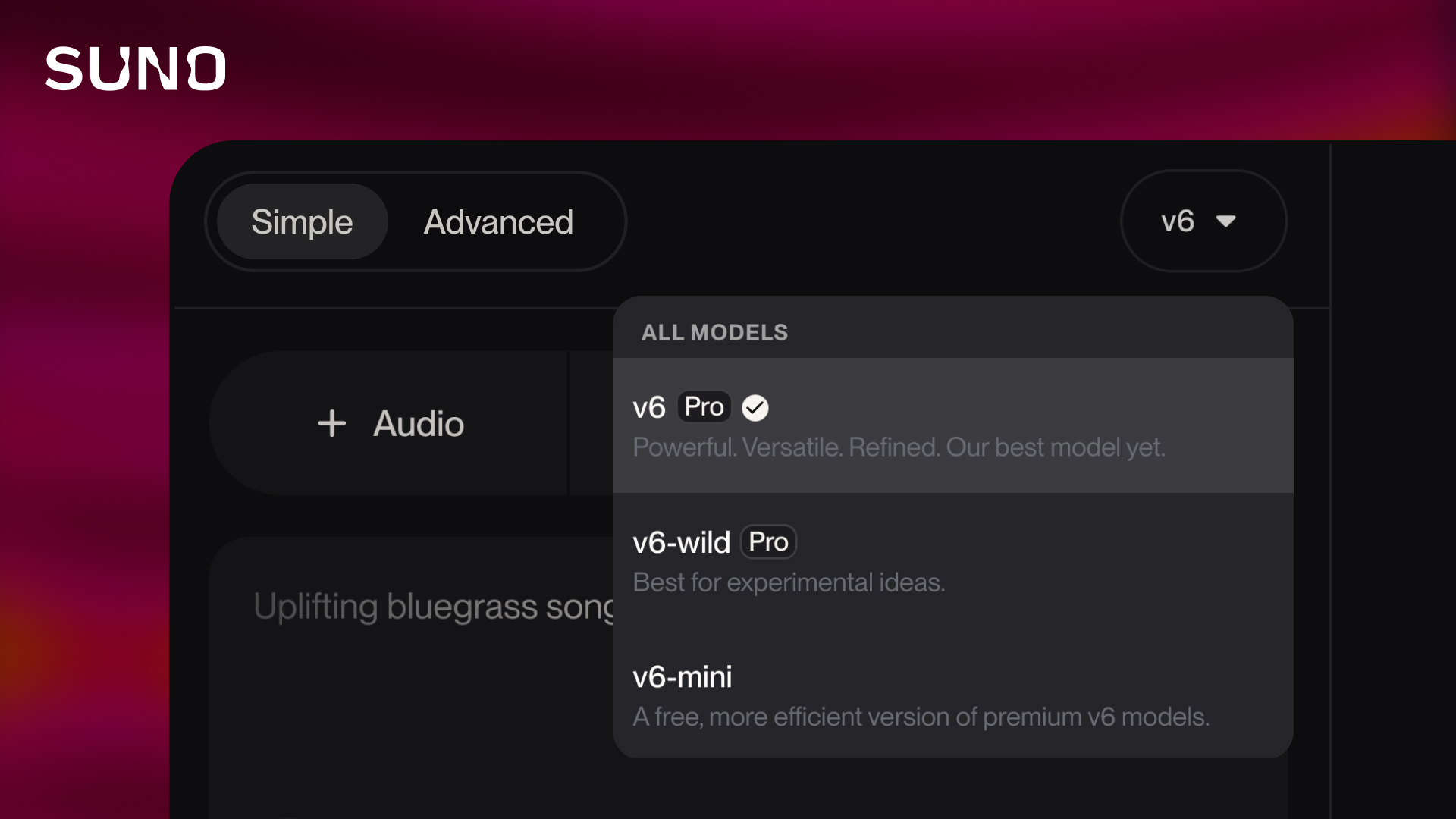
Threads asking for the old models to return are among the loudest in the response, and there is a decent reason Suno cannot simply grant it. Models trained on scraped audio are the subject of the cases Universal Music and Sony Music are still pressing, so putting v5.5 back on the model picker would be handing the other side an exhibit.
A Grammy voting engineer graded v6 and split the verdict
Samori Coles has spent 30 years as an audio engineer, producer and educator, owns Little Drummer Boy Recordings in Philadelphia, and votes in the Producers and Engineers Wing of the Recording Academy. He ran the same songs, lyrics and prompts through v5.5 and all three v6 models, and his verdict does not fit either camp in the argument.
On sound, he gives it to v6 without much hesitation.
Sonically, V6 was better than 5.5. It's warmer, it's wider, the low end hits harder, and there's more depth in the mix. If you put the two side by side on a good system, V6 was the more finished record. That part's not close.
On performance he takes it straight back. His model-by-model calls:
- v6 wins the mix and loses the feel. The vocals do not groove the way v5.5 did on the same prompt, and they feel rushed.
- v6-wild gave him the best v6 vocal on an Afrobeats track, then smeared an R&B vocal and put phase on a hip hop snare. He calls it the model you audition for feel and check with your ears before you commit.
- v6-mini sounds like a demo, and that is what it is for. Sketch on it, do not finish on it, though it held up on a gritty hip hop instrumental.
- Max mode does what Suno says it does, keeping a cover closer to the original. Worth the double credits on anything over 2 minutes.
- The one-word lyric swap is the feature he thinks songwriters will use more than anything else in the update.
Then he makes the point that most of the argument is missing: “The people in the comments who hear smear in the vocals, they’re not wrong. I hear it too. But that’s an engineer listening. A listener who’s never made music is going to hear V6 and say it sounds good, and for most of what people are using it for, that’s the test that counts.”
What my own 7 genre tests of Suno v6 found
I ran my own comparison before Suno pulled v5.5: one lyric, one clone of my voice, 7 style prompts, every v5.5 file generated before the switch. The whole run-through is in the video below.
v6 took all 7 tests on the three questions I graded on camera: which vocal performs better, which arrangement sounds more real, and which model delivered the structure the prompt asked for.
Fidelity is a fourth question I never asked on camera, so I went back and measured all 7 matched pairs. The numbers that back the people complaining:
- Energy below 120 Hz is up in 6 of 7 pairs.
- The top octave is more noise-like in all 7.
- Left to right correlation drops in 5 of 7.
- Micro-punch inside 50 millisecond windows drops in 5 of 7.
The numbers that back v6:
- Transient peaks stand further above the surrounding level in all 7.
- The loud-to-quiet range across a whole song is wider in all 7.
- The 2 kHz to 10 kHz harshness band is down in all 7.
- Loudness is equal or quieter in 5 of 7, so v6 is not winning by being louder.
The finding that surprised me: v6 holds a voice steadier than v5.5 through the first half of a track in all 7 pairs, and that lead is gone by the second half. In 5 of 7 the second half wobbles more, relative to its own first half, than v5.5 did. v6 also writes longer songs, so there is more track to drift through.
Which Suno v6 model I would use, and when
- Sketch on mini. It is a rough draft engine and it is priced like one.
- Chase attitude on wild. It pulls away from the obvious version of a song, which is the whole reason to reach for it.
- Finish on v6. The flagship is the one that gives you a record rather than an idea.
My own pick is v6-wild, and you should weigh that knowing my taste. I am a sucker for math rock and arrangements that go somewhere the ear did not expect, so wild pulling away from formula is exactly what I want from it, and formula is what I like least about generated music. If you want predictable and controlled, take my pick with a pinch of salt.
Three things from the same test that have nothing to do with the backlash:
- The guitar and bass stems are still unusable.
- Metal is still the weakest genre in the set.
- The voice clone does not sound like me on any model, and a quiet verse shows how much of your voice survived while a big chorus hides it.
Suno has never paid me anything, which is why I can write those three lines and the scores above them in the same article.
If your last good results came from v5.5, the practical situation is that your tool changed under you and there is no version pin. Give it a week of real re-prompting before you decide, because a model family usually ships rough and gets patched, and if your output is still worse after that, the cancellation threads have a point.
Frequently asked questions
Why are Suno users unhappy with the v6 update?
The complaints centre on audio quality and sameness. Users on Suno's Reddit community describe v6 output as muffled and lifeless, with buried vocals, missing high end and tracks that sound more alike than v5.5 output did.
Why can't unhappy Suno users roll back to v5.5?
Every older model was retired at the v6 launch, so there is nothing to switch to in the model picker. Restoring a model trained on scraped audio would also sit badly with Suno while Universal Music and Sony Music are still litigating over that training data.
Was Suno v6 trained on different data than v5.5?
Yes. Suno described its earlier training set as all music files of reasonable quality accessible on the open internet. v6 was developed with licensed catalogues from its label partners plus user data, and the company has not published the full scope.
What did Samori Coles conclude about Suno v6 versus v5.5?
That v6 is the better sounding record and the weaker vocal performance. He calls v6 warmer, wider and deeper in the mix, then says the vocals do not groove the way v5.5 did on the same prompt, and that v6-mini is a sketching model rather than a finishing one.
Which Suno v6 model should you finish a song on?
v6 for finishing, v6-wild when you want attitude and are willing to audition the result, and v6-mini for sketching. Max mode is worth the double credits on anything longer than 2 minutes, where consistency across the track matters.
About the author

Covering AI music tools, industry shifts, and news for music creators and professionals. Twice-weekly newsletter at aimusicpreneur.com.