
I compared Suno v6 vs. v5.5 – here's what you need to know:
My stack My fav 6 tools for AI music after testing 70+
-
 ElevenMusic · Music generation
 -
 Moises · Stem separation
 -
 Controlla · Voice swap & cloning
 -
 Cryo Mix · Mixing + mastering
 -
 Neural Frames · Music videos
 -
 ONCE · Distribution
Some links are affiliate links — I earn a commission at no cost to you. Every tool here is one I run myself and truly believe in. This stack is proven.
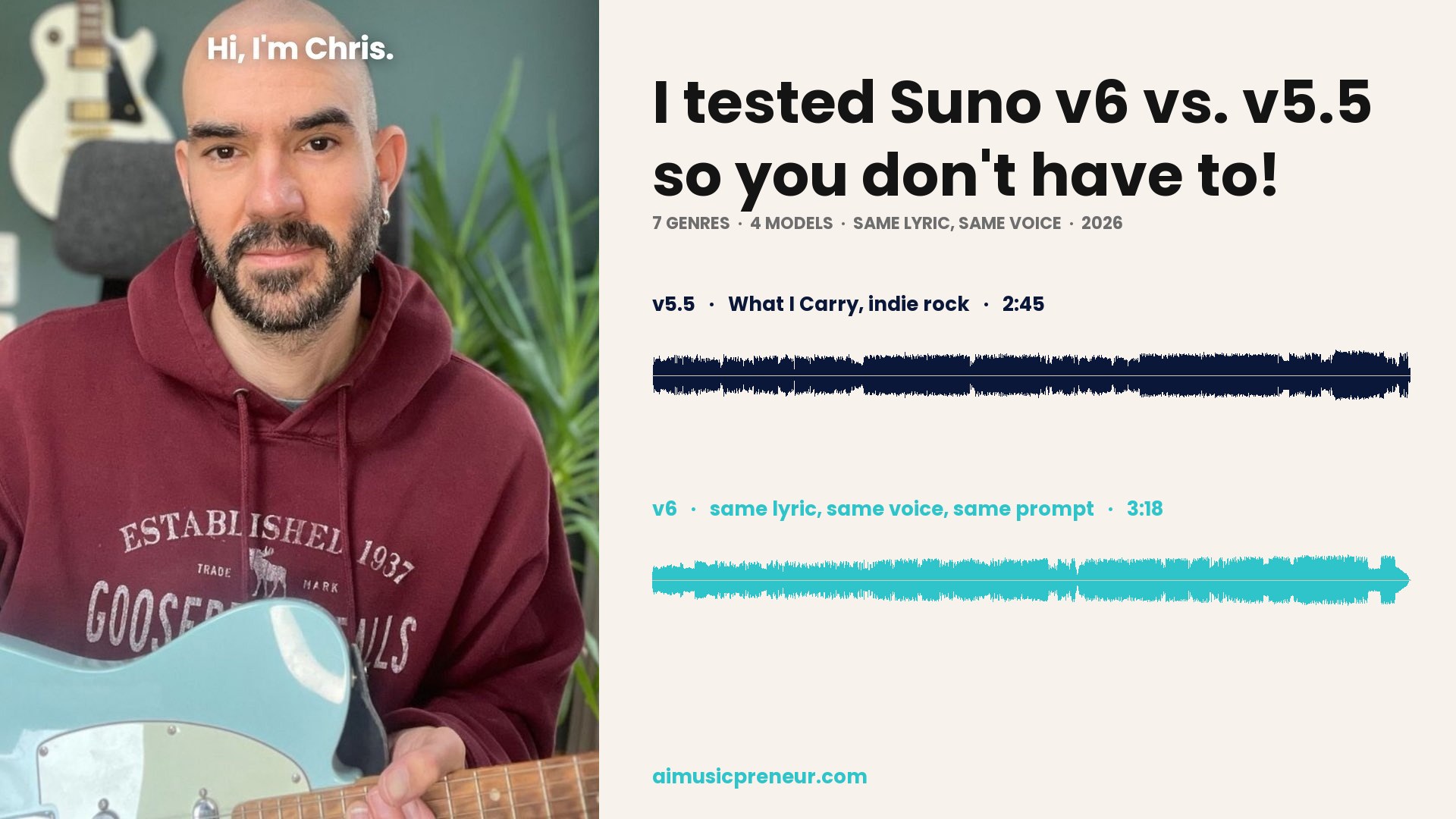
Suno v6 sounds better than Suno v5.5. I ran the same lyric, the same clone of my own voice and the same 7 style prompts through both, plus the 2 other v6 models, and came out with 27 audio files and one clear answer to the question every AI music creator was asking: going licensed did not cost Suno quality.
It also isn’t a leap. The vocals are the big step. Songwriting nuance, instrumental breaks and generation speed improved. The stems still need a producer. I kept hearing glimpses of a much better model, and then a guitar stem would remind me where the ceiling is.
Every pair below was made before v5.5 goes away. Suno launched v6 as 3 models on September 9, 2026 and is retiring every earlier model for new generations, per its August 10 policy post. Once that happens, nobody can rebuild this comparison. Treat it as the record.
I also filmed the whole comparison, so you can hear every pair instead of reading about them.
The short version, 4 verdicts:
- Best on a budget and for prototyping: v6-mini. The free model landed close to v5.5, a shade ahead to my ear, so you can sketch a direction without spending a credit on the flagship.
- Best for edgy genres and experimentation: v6-wild. It pulled away from formula on indie rock, R&B and metal, and it’s the one I’d hand a metal track to.
- Best for the finished tune once you’ve sketched it: v6. Same prompt, same clone, more control and a fuller arrangement, and you only spend the credits on takes worth keeping. The Suno tool page has the plan details.
- Best for stems you’ll keep: none of them. Drums are usable, guitar and bass are sketches to re-record. See the Voices tutorial for how the clone I sang these with gets trained.
How I tested Suno v6 against Suno v5.5
One lyric, one voice, one set of prompts, four models. Everything that could be held constant was.
The lyric is my own song, “What I Carry,” 7 sections long. I picked it because the chorus repeats word for word, which shows whether a model re-sings a repeated section consistently, and because the bridge is a single long unrhymed line, which is where phrasing and breath control break first.
The voice is a Voices clone I trained the same morning from a fresh recording of myself singing “Stand by Me.” Suno verifies that an uploaded sample matches the account holder’s voice before it will train on it, so you can’t feed it someone else’s vocal. That check is what makes this a like-for-like test. The same clone sang every take on every model.
This is the sample I trained it on, so you can hear my untouched voice before you hear what each model did with it.
Me singing "Stand by Me," recorded the morning of the test. Every take you hear below started here.
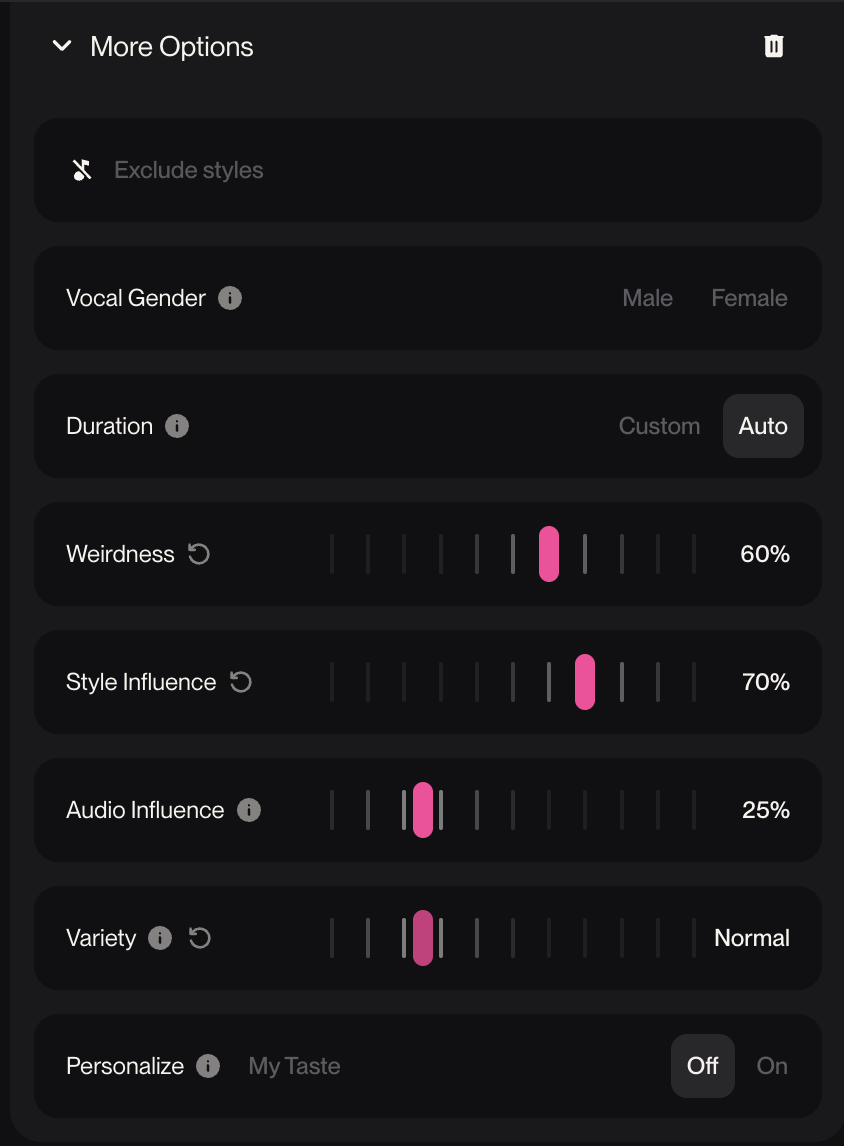
The settings never moved. Advanced mode, no vocal gender selected because the clone supplies the voice, Duration on Auto, Weirdness 60%, Style Influence 70%, Audio Influence 25%, Variety on Normal, My Taste off. Audio Influence at 25% is a light hand. If you want the clone pulled closer to your sample, that’s the slider to raise, and it’s the one variable I’d change in a second round.
The matrix: 7 style prompts, each run on v5.5 and v6. That’s the headline test, 14 generations. Then 5 of the 7 prompts on v6-mini and v6-wild as well, 10 more. Each prompt carries genre tags, instrumentation, vocal placement, a tempo and one arrangement instruction, so prompt density is constant and the instruction doubles as an adherence test. Timing was checked on every run.
One thing to know before you read the clips. Under Variety Normal, Suno returns 2 clips per generation and displays a rewritten style line for each that differs from what you typed. The prompt boxes below show the prompt as typed, never the line Suno shows back.
Suno v5.5 vs Suno v6 at a glance
| Suno v5.5 | Suno v6 | |
|---|---|---|
| Status | Retired for new generations at the v6 launch | Current, 3 models: v6, v6-wild, v6-mini |
| Training data | Undisclosed | Suno calls it licensed, built with Warner Music, BMG and Believe; training set not published |
| Plan | Pro and Premier | v6 and v6-wild on Pro and Premier, v6-mini free |
| Voice clone | Works, timbre close but strained on wide range | Works, sits better in the mix, transformed further from the sample |
| Generation time | Noticeably slower on the same prompt | 10 to 20 seconds for a full song |
| Track length on Auto | 2:35 to 3:48 across 7 prompts | 2:30 to 3:41, longer than v5.5 in 5 of 7 genres |
| Stems in Studio | Not split in this test | Drums usable, guitar and bass not |
| Experimental mode | Weirdness slider only | Weirdness slider plus a dedicated v6-wild model |
| My score | 62 / 100 | 74 / 100 |
Suno v5.5: what the outgoing model does well
v5.5 shipped on March 26, 2026 with Voices, Custom Models and My Taste. Suno called it its most personal model, and for 6 months it was the best distribution-grade output on the platform, with clean 44.1 kHz audio and fewer artifacts than v5.
What it still does well: it follows a style prompt faithfully, its vocals stay close to the uploaded timbre, and its arrangements are predictable in a way that makes editing easy. What it doesn’t: it strains on wide vocal range, its instrumental breaks are short or missing, and it is slow next to v6.
Best for: nothing new, as of this week. Its job now is the baseline.
Suno v6, v6-wild and v6-mini: what changed
v6 is the first model Suno calls licensed. It arrived as a family, which Suno has never done. The picker copy is Suno’s own: v6 is “Powerful. Versatile. Refined. Our best model yet.” v6-wild is “Best for experimental ideas.” v6-mini is “A free, more efficient version of premium v6 models.”
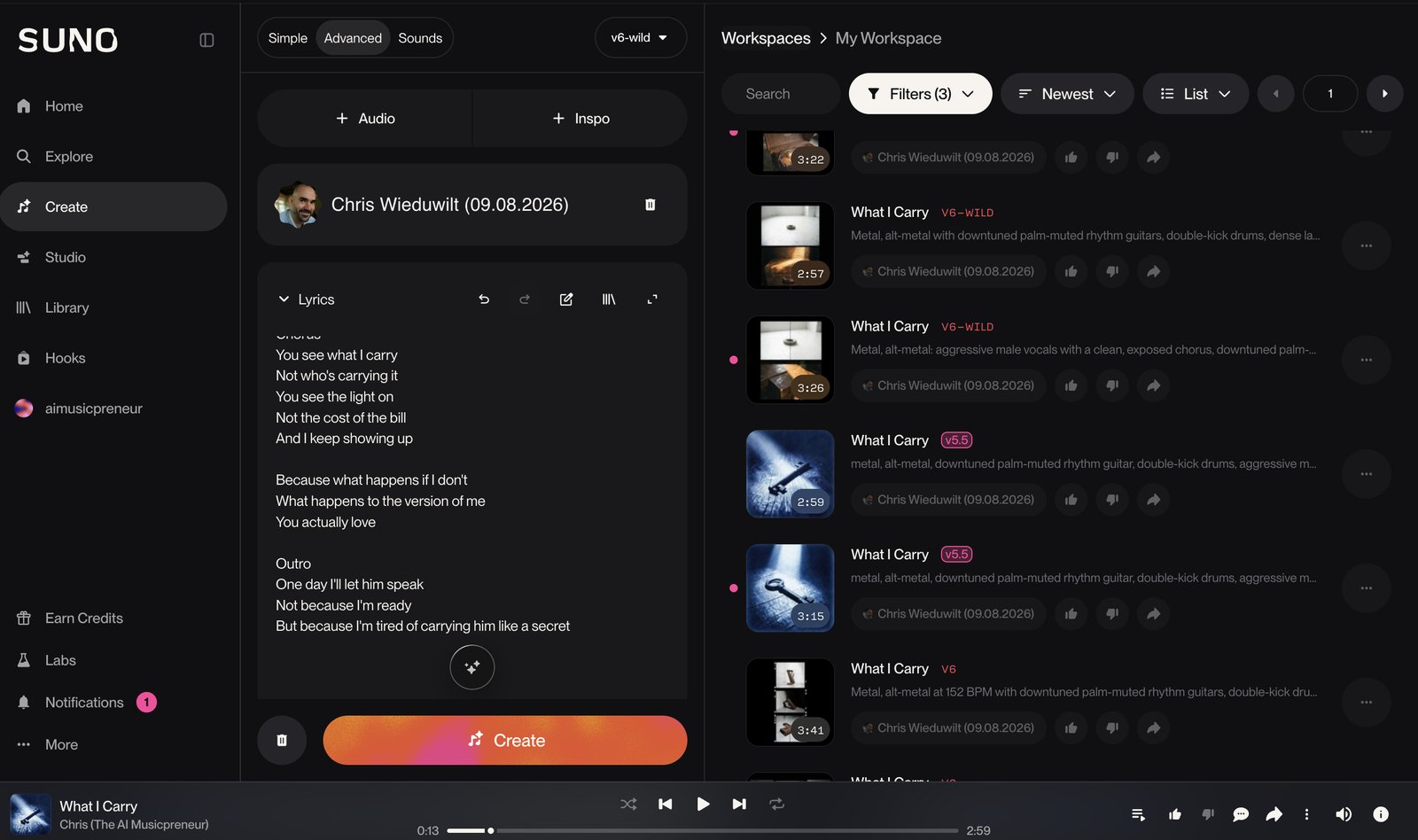
What changed in the sound: vocals with more control and less strain, more nuance in the writing, instrumental breaks that give a voice room, drums that sound close to real, and generation in seconds. What didn’t: the guitar and bass stems, which are as overproduced as ever.
Best for: anyone singing on their own songs, and anyone who prototypes fast. Voices, Custom Models and My Taste all carry over.
7 genres, one lyric, one voice: Suno v5.5 vs v6 audio pairs
Same passage within each pair, so you compare the models and nothing else. Each prompt was pasted byte for byte into every model.
I scored every genre on the same 3 questions, standard v6 against v5.5, and the scorecard under each pair carries the answers.
- Voice. Which vocal performs better: clear, controlled, sitting in the mix. Not which one sounds more like me, because neither model gets that right.
- Instrumentation. Which one sounds more real and more clear.
- Structure. Which one delivered the one arrangement instruction the prompt asked for.
Two of 3 decides the genre. v6-wild and v6-mini never get a mark, because the marks compare the outgoing model to its replacement. They get the second line on the card, which is the model I’d personally pick for that genre.
1. Indie rock and math rock
indie rock, math rock, post-rock, clean tapped electric guitar in odd time, interlocking bass line, tight dry drums with shifting accents, unaffected male vocal sitting forward, dynamic quiet-loud arrangement, 131 BPM, instrumental break before final chorus
The baseline. Voice recognisable but pushed, short breaks.
Better voice absorption, drums near real, break before the last chorus delivered.
Closer to v5.5 than to v6, and a shade ahead of v5.5 on the vocal.
Most experimental instrumentation of the 4. My voice sounded most like mine here.
- v6 winsVoice
Clearer and more controlled than v5.5. Better without being a lot better.
- v6 winsInstrumentation
The drums sound like a real kit.
- TieStructure
Both delivered the instrumental break before the final chorus.
Best instrumentation of the 4, and the take where my own voice came through most.
This is the genre I’d naturally sing, and it showed. On v6-wild my voice came through more clearly than on standard v6, most of all in the verse, and I think that’s range fit rather than the model. Hold that thought for the piano pair below, where wild did the opposite. Wild also pulled the instrumentation away from the usual shape, with different highlights across the track. Variety Normal gave 2 distinct clips instead of 2 near-copies.
2. Indie folk
indie folk, acoustic singer-songwriter, chamber folk, fingerpicked steel-string guitar, upright bass, brushed snare, close-mic intimate male vocal, room tone, sparse arrangement, 78 BPM, instrumental break before final chorus
- v6 winsVoice
v5.5 pushes my voice into a lower range and shifts in the chorus. On v6 it sits where it belongs.
- v6 winsInstrumentation
Drums crisper and clearer, and no longer buried.
- TieStructure
Both delivered the instrumental break before the final chorus.
Only v5.5 and v6 ran on this prompt, so there's no wild or mini take to compare.
Folk is a genre my song fits well, and it came out good on both models. The difference is what happens to the voice. On v5.5 it gets pushed into a lower range than mine and then shifts in the chorus, and that shift is the part that feels unnatural. On v6 the voice sits where it belongs for the whole track. The instrumentation moved with it: the drums are crisper and clearer, and no longer buried under the guitar.
The measurable difference on top: on Auto duration, v6 built a track almost a minute longer than v5.5 from the same prompt, 3:34 against 2:39. That’s the model choosing a longer arrangement, and it lines up with the extra breaks I heard elsewhere. v6 ran longer in 5 of the 7 genres.
3. Piano singer-songwriter
piano-led singer-songwriter, alt-pop ballad, felt piano, subtle string pad, restrained drums entering late, dry centered male vocal, dynamic build, quiet verses loud chorus, 72 BPM, no vocal layering in verses
The baseline verse.
My voice is much more recognisable in the quiet verse than on v5.5.
Clearest version of my own voice on this prompt.
A different singer on this prompt. No timbre or colour I would call mine.
- v6 winsVoice
Much more recognisable in the quiet verse, and this is where I hear that the v6 models carry fewer vocal artifacts.
- v6 winsInstrumentation
A touch clearer than v5.5.
- TieStructure
The drums come in late on both, the way the prompt asked.
No pick on this genre. v6-mini gave the clearest version of my voice here, and indie rock pointed the other way, so one prompt is not enough to call it.
In the quiet verse on v6, my voice was much more recognisable than on v5.5. On this prompt the four-way order ran v6-mini clearest, standard v6 next, v6-wild furthest away, where the singer was somebody else.
One prompt is not a rule, and I want to be straight about that. On indie rock, the opposite happened: v6-wild was the take where I heard myself most. So either the experimental model drifts from an uploaded voice, or a sparse ballad in a comfortable range holds a timbre better than a dense arrangement does, and my 2 results point in opposite directions. Indie rock also sits closer to my natural range than a piano ballad, so range fit is tangled up in it. I’d need the remaining prompts run on wild before calling it either way. What holds across every pair: sparse and quiet is where you hear the most of the real voice.
4. Alternative pop
alternative pop, synth-pop, warm analog synth bass, gated drum machine, layered vocal harmonies in chorus only, bright polished mix, wide stereo chorus, mid-tempo 104 BPM, pre-chorus lift into big hook
- v6 winsVoice
The vocal performs better here as it does on every other prompt in the test.
- v6 winsInstrumentation
Cleaner and more real than the v5.5 take.
- v6 winsStructure
v6 delivered the pre-chorus lift into the big hook. That lift is the thing to listen for in the pair above.
Only v5.5 and v6 ran on this prompt, so there's no wild or mini take to compare.
Pop is the only clean sweep in the test, the one genre where v6 took all 3 marks, and the pre-chorus lift is what earned the third one. It’s also the only genre where v6 came back shorter than v5.5, 2:30 against 2:35. Every other prompt ran longer on v6.
This is the pair I’d most like you to judge yourself. Play them back to back before you read my call, because pop is the genre where the polish gap is smallest and your ear may split it differently than mine did.
5. Contemporary R&B
contemporary rnb, neo-soul, laid-back swung drums, deep round bass, electric piano, muted guitar comping, breathy male lead vocal with stacked background vocals, spacious mix, 88 BPM, half-time bridge
The baseline.
Cleaner swing and stacked backgrounds than v5.5.
Holds the groove, less stylistic commitment than wild.
Drifts experimental again. Less formula, more style. My favourite of the 4.
- v6 winsVoice
The vocal sits better on top of the arrangement.
- v6 winsInstrumentation
v6 cleaned up the swing and the stacked background vocals.
- TieStructure
Both delivered the half-time bridge.
Less formula, more commitment to the style. My favourite of the 4 takes.
R&B was a deliberate stress test. Swung timing and stacked background vocals are where v5.5 tends to flatten. Wild drifted into a more experimental path here, less formulaic and more committed to the style, and I’ll admit the bias: I’m a sucker for ambient pop and anything that moves away from what the ear expects. American Football, Mogwai, Sigur Rós, Novo Amor. Wild is built for people like me.
The stems tell a different story. When I split the R&B track, the guitar and drum stems carried the same artifacts and baked-in effects I found on blues rock, so that’s a model trait, not a genre quirk. More on that below.
6. Blues rock
blues rock, alternative rock, gritty overdriven electric guitar, slide guitar fills, hammond organ pad, heavy backbeat drums, raw male vocal slightly distorted, live-room mix, 96 BPM, guitar solo after bridge
The baseline, and the longest track in the test.
More vocal artifacts than any other v6 genre.
The track I split into stems for the teardown below.
- v6 winsVoice
Both models carry vocal artifacts here, and v6 still carries fewer.
- v6 winsInstrumentation
The closest call in the whole test. The guitar has very similar problems on both, and the drums are much more natural on v6, which is what tips it.
- TieStructure
Both delivered the guitar solo after the bridge.
More unexpected turns than the other 3, like the riff at 1:37. The take I keep coming back to.
Blues rock produced more vocal artifacts than any other genre in the set, on v6 as well as v5.5. That continues a line I first wrote about in my v4.5 versus v4 comparison, where the rawer and harder genres were the weak spot. Four model generations later, the raw male vocal with distortion is still the request Suno struggles with most.
7. Metal
metal, alt-metal, downtuned palm-muted rhythm guitar, double-kick drums, aggressive male vocal with clean chorus, dense guitar layers, tight modern mix, 152 BPM, breakdown before the final chorus
The baseline.
Many guitar artifacts, overproduced.
Edgier, closer to what metal is supposed to feel like. The metal model.
- v6 winsVoice
Standard v6 still edges v5.5 on the vocal, artifacts and all.
- v6 winsInstrumentation
It edges it, and standard v6 is full of guitar artifacts and sounds overproduced. v6-wild is the edgier take.
- v6 winsStructure
The breakdown before the final chorus is where v6 beat v5.5, and it landed on the v6-wild take.
Closer to what metal is supposed to feel like, and the take that earned the structure mark.
Standard v6 gave me a metal track full of guitar artifacts that sounds overproduced. v6-wild gave me an edgier one. That makes 3 genres where wild won on character, and I’ll say more about metal specifically further down, because the problem with AI metal was never production.
Are Suno v6 stems usable? Guitar, drums and bass, one by one
I took the blues rock track from v6-wild into Suno Studio and split it, then did the same with the R&B track to check the pattern. Instrument by instrument, because they don’t behave the same.
Blues rock guitar stem. Compressed and drowned in effects, and removing FX in Studio did not change that.
R&B drum stem. Crisp, kick and snare good, artifacts on the cymbals.
R&B guitar stem. Same picture as blues rock: heavy processing baked in.
Guitar is not usable as delivered. It’s highly compressed and buried in effects. I removed the FX in Studio and, honestly, it was no better. The processing is in the generated audio, and Studio’s effect removal doesn’t reach it. Same result on R&B. I would not release the blues rock track with that guitar on it.
Drums were the surprise. Crisp, and compressed, but you can clearly hear cymbals, snare and kick apart from each other. Removing effects didn’t strip everything, which is a mixing job anyway. The cymbals carry audible artifacts. Kick and snare sound good. Not perfect, and I’d work with them.
Bass was the weakest stem in the set. Isolated, it doesn’t sound good, and there’s no qualifier to add.
If you play guitar and want Suno for inspiration rather than delivery: feed it your own audio clips to steer the track, take the generated stem as the sketch, then record the part yourself. A free amp sim like TONE3000 with its community tones gets you a better guitar sound than anything in these stems. Inside Studio you can also re-generate the guitar part or hum the melody in as a reference. What you shouldn’t do is expect the delivered guitar to survive into a release. My stem separation guide covers the 3 split modes.
Suno v6 bends your voice to fit the genre
Here is the fairest way I can put the vocal result. v6 handles an uploaded voice clearly better than v5.5. It also travels well beyond the sample you give it. Timbre and colour get transformed rather than reproduced. I recognised myself in individual passages, most of all in the piano verse, and less across a whole track.
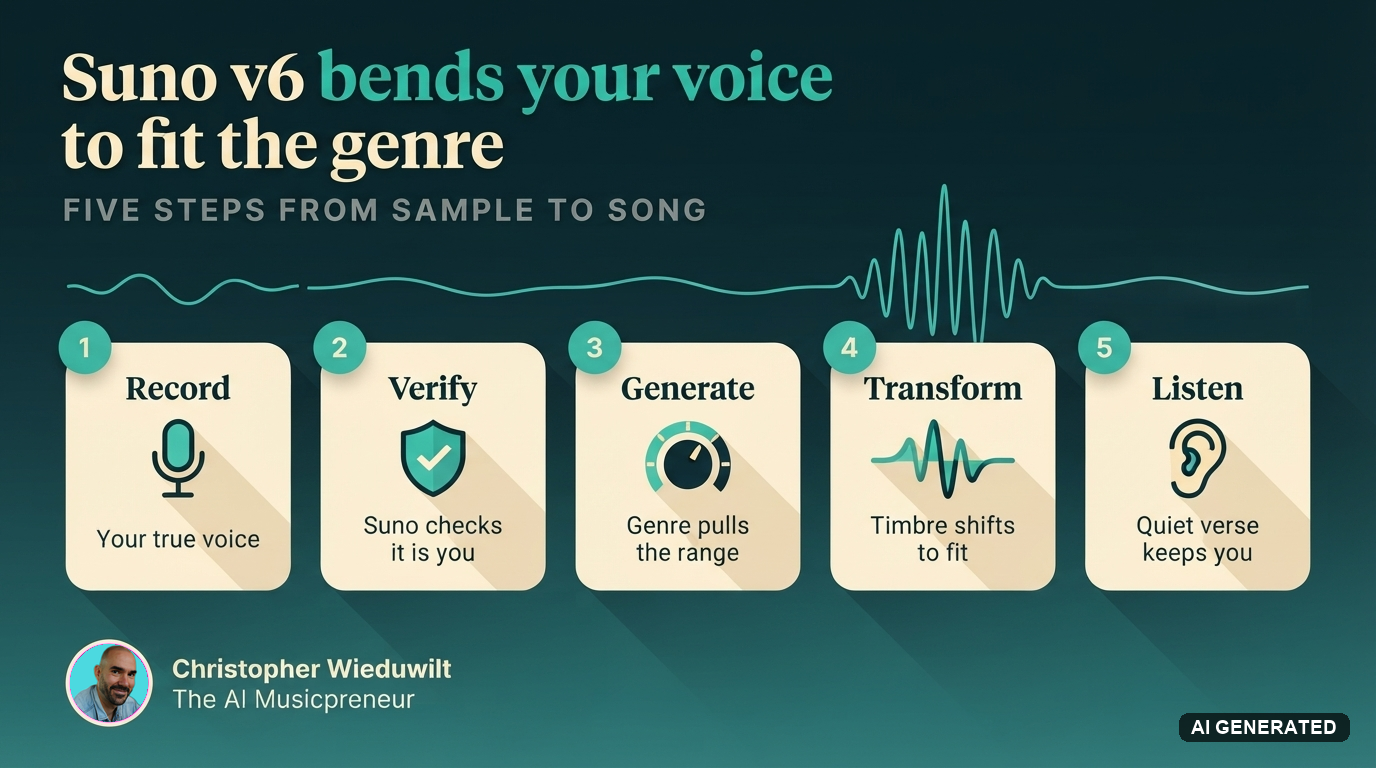
In Suno’s defence, that’s the design. The model bends your vocal to whatever the genre needs so the result sounds good regardless. Suno’s goal, as far as I can read it, is to make everyone a professional singer. Whatever you upload will probably sound good in v6. The question is whether it still sounds like you, and whether you’re fine with that.
My recommendation follows from that. Record a sample that’s true to your voice, then use your own experience to nail the genre and style your voice and range are built for, and stay there. Drift into genres that bend your range, and the identity shifts away from you. The uploaded sample also carries its delivery into every generation. A pop vocal sample won’t serve a metal track, so consider one clone per genre family rather than one clone for everything.
And the honest ceiling. A professional singer will rarely be satisfied with a Suno vocal. A hobbyist who can’t hold a note gets a lot out of it as-is. If you sit in the first group, generate the song, isolate the vocal stem, and swap in your own voice with a dedicated cloning tool like Controlla, trained on your own samples. Or take the stems and sing it yourself.
Why v6-wild is the metal model, and why metal stays the hardest test
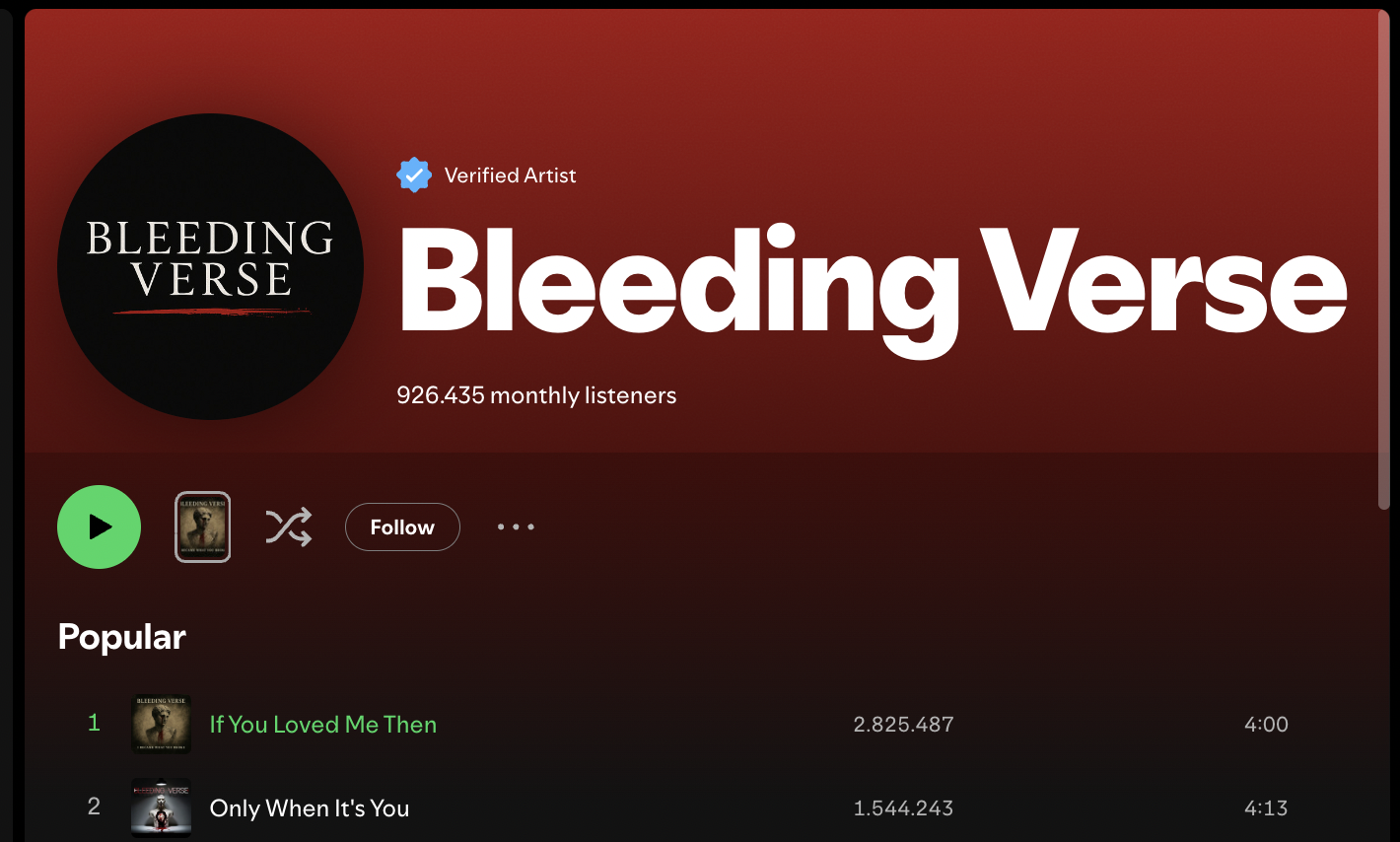
I’ve said a version of this across several Suno versions. Metal runs on identity and authenticity, and that’s a different axis from production quality. The clearest current example is Bleeding Verse, the AI band signed to Hallwood Media, and the backlash from Holding Absence, the UK band it cites as an influence. The music isn’t badly produced. Ownership is the contested part.
No working metal band is going to generate its record on Suno, and I don’t think Suno is trying to win them. The audience is the metal fan who can’t play an instrument and wants to feel what making a metal song is like. On that framing, a generator is a net gain, which is close to what Image-Line’s Robert Linke argued about FL Studio: people have their first music-making experience in a prompt tool, then move into a DAW. The same path could hold for someone who ends up learning guitar.
The limit sits right there. If I can’t play guitar, my control over the part is thin. A text prompt can’t carry the melody I hear in my head, and what I hear is usually more complicated than a prompt can hold. The audio-influence feature is the only real bridge, and it needs the exact skill the tool was meant to stand in for. v6-wild gets closer to the feel of the genre than standard v6, and the guitar still isn’t yours.
Suno v5.5 vs v6 head-to-head scores
Every genre first, on the 3 criteria. A check means v6 beat v5.5 on that row.
| Genre | Voice | Instrumentation | Structure | Verdict | My pick |
|---|---|---|---|---|---|
| Indie rock | v6 | v6 | Tie | v6 | v6-wild |
| Indie folk | v6 | v6 | Tie | v6 | v6 |
| Piano singer-songwriter | v6 | v6 | Tie | v6 | Not called |
| Alternative pop | v6 | v6 | v6 | v6 | v6 |
| Contemporary R&B | v6 | v6 | Tie | v6 | v6-wild |
| Blues rock | v6 | v6 | Tie | v6 | [CHRIS] |
| Metal | v6 | v6 | v6 | v6 | v6-wild |
v6 took all 7 genres. Across the 21 criteria, v6 won 16, 5 were ties, and v5.5 won none. Voice went to v6 in all 7. Instrumentation went to v6 in all 7 and was the closest column of the 3. Structure is where the ties sit, because both models mostly delivered the arrangement instruction I asked for, and pop and metal are the 2 where v6 pulled ahead.
Out of 10 per row, from my own listening across the 27 files.
| Criteria | Suno v5.5 | Suno v6 | Notes |
|---|---|---|---|
| Vocals and voice-clone fidelity | 6 | 8 | v6 sits better in every genre and strains less. It also drifts further from the sample, and how far varies by genre. |
| Songwriting and arrangement nuance | 6 | 8 | Instrumental breaks and dynamic changes that v5.5 mostly skipped. |
| Style-prompt adherence | 7 | 8 | Both follow the tags. v6 honoured the arrangement instruction more often. Gap is small. |
| Drum stem usability | 6 | 7 | v5.5 stems not split in this test, so the v5.5 score is from the mix. Gap is small. |
| Guitar stem usability | 4 | 4 | Overproduced on both. Effect removal in Studio does not fix it. |
| Bass stem usability | 4 | 4 | Weakest stem on both. |
| Generation speed | 5 | 9 | 10 to 20 seconds for a full song on v6. The widest gap in the table. |
| Total (out of 70) | 38 | 48 |
Suno v6 or Suno v5.5: which should you choose
There’s no choice to make for long. v5.5 leaves the picker for new generations at the v6 launch. So the question turns into which v6 model, and whether to bother.
Choose v6-mini if you’re on the free plan or working a credit budget, and to prototype. It landed close to v5.5, a shade ahead to my ear, which makes it a real sketchpad rather than a demo of an old model. Try 3 directions here before you spend anything.
Choose v6-wild for edgy genres and for experimenting. It won indie rock, R&B and metal on feel, and it’s the model I’d reach for when the genre lives on attitude instead of polish. Its vocal behaviour is the least predictable of the 3, so treat the voice as something you’ll fix downstream if it matters.
Choose v6 for the finished tune, once v6-mini has told you which direction is worth building. Same prompt, same clone, more control and a fuller arrangement, and your credits go to the takes that survive. Keep Audio Influence in mind: at 25% the model roams, and you can raise it to pull the clone closer to your sample.
What changed around Suno v6: rights, download caps and retirement
Three things moved around the model, and each has its own article, so a summary is enough here.
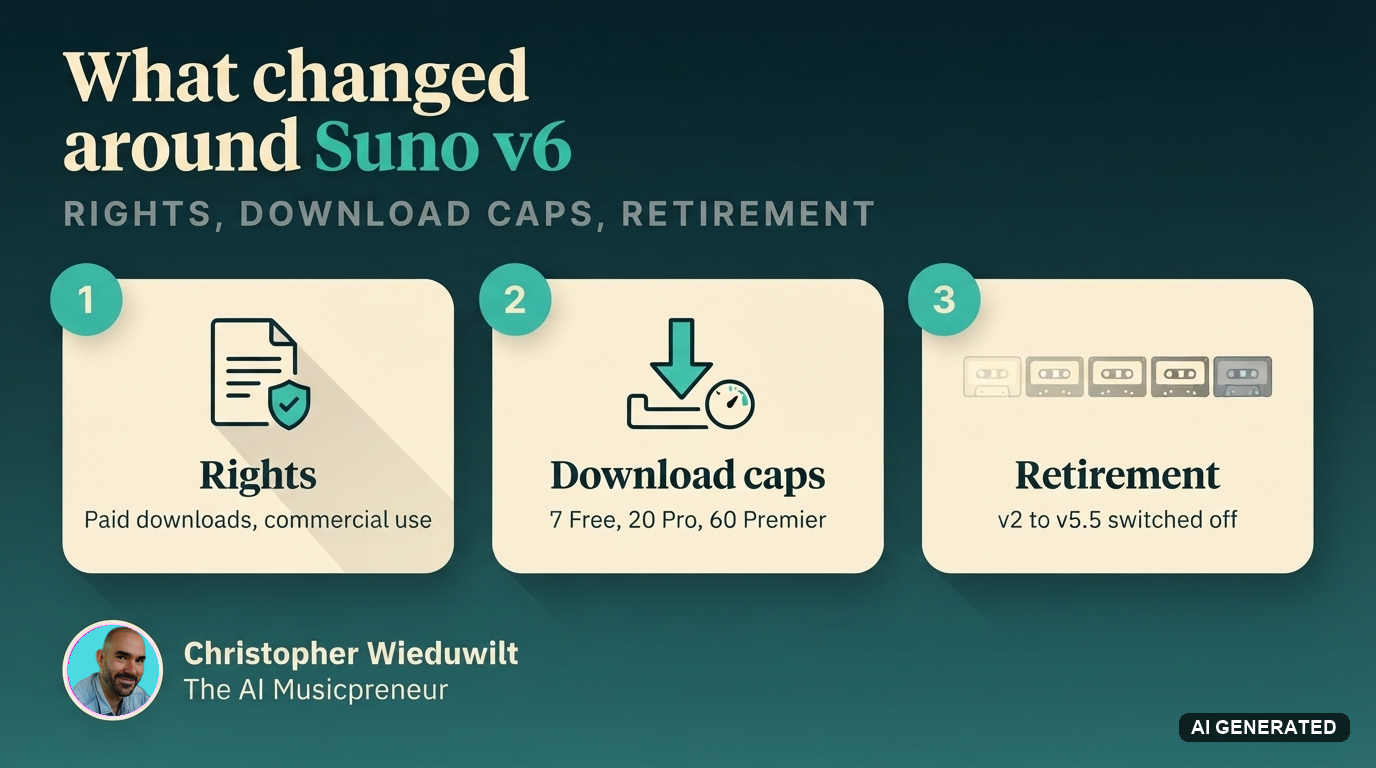
Since September 3, Free accounts get 7 lifetime downloads for personal use, Pro gets 20 a month and Premier 60, with unlimited exports inside Suno Studio on Premier. Every song in your library counts, including ones made before September 3. The download caps piece has the detail.
The Terms of Service that took effect the same day say you can commercially use Output you obtained through a permitted download within your tier, and that removing Suno’s watermark or fingerprint is prohibited. Commercial rights aren’t a copyright guarantee. The full terms are worth 10 minutes.
And the retirement: every prior model goes when v6 launches. Suno’s launch post puts it as moving Suno entirely onto the v6 generation, and the September 5 email to users said the same in plainer words. Your library stays playable and shareable. The chance to generate a fresh v5.5 take, or to reproduce the pairs on this page, doesn’t.
Where Suno v6 leaves you
You don’t get to run this test yourself, because half of it is about to disappear. That’s the reason it’s here, with the audio and the prompts, so you can hear the comparison instead of taking my word for it. Copy any prompt above, drop in your own lyric and your own clone, and the v6 side of the picture is yours in 20 seconds.
At scale, the 3 v6 models split cleanly by job. Sketch on v6-mini, chase attitude on v6-wild, finish on v6. The stems are sketches on all 3, with drums the exception.
Frequently asked questions
Is Suno v6 better than Suno v5.5 for vocals?
Yes, with a caveat. v6 handles an uploaded voice clone with more control and less strain than v5.5, and the vocal sits better in every genre I tested. It also transforms the voice further from the sample, so it sounds better and less like you at the same time.
Is Suno v6 faster than Suno v5.5 at generating a song?
Yes, by a wide margin. Across every generation in my test, v6, v6-wild and v6-mini returned a full song of 2:30 to 3:41 in 10 to 20 seconds. v5.5 took noticeably longer on identical prompts and settings.
Are Suno v6 drum stems good enough to use in a real mix?
Close to it. Isolated v6 drum stems are crisp, with kick, snare and cymbals clearly separable and the kick and snare sounding good on their own. Cymbals carry audible artifacts and the compression is baked in, which you'd address in mixing.
Which genres improved most from Suno v5.5 to Suno v6?
Vocal-led and structured genres gained the most. Indie rock, the piano singer-songwriter prompt and R&B showed clearer vocals, better instrumental breaks and more arrangement variety. Metal and blues rock still carry the most artifacts, a pattern that has held since v4.5.
Can you still compare Suno v6 and Suno v5.5 yourself after the retirement?
No. Suno retires v5.5 and every older model for new generations when v6 launches. Songs already in your library stay playable, but you can't generate a fresh v5.5 version of anything, which is why the audio pairs on this page were made before the switch.
Is Suno v6 any good for metal?
Standard v6 produces noticeable guitar artifacts on metal and sounds overproduced. v6-wild is the better metal model, with an edgier result that reads closer to the genre. Metal remains the hardest test for Suno, as it was on v4.5 and v5.
About the author

Covering AI music tools, industry shifts, and news for music creators and professionals. Twice-weekly newsletter at aimusicpreneur.com.