Suno v6 release date: v6, v6-wild and v6-mini go live on September 9, 2026, and every older model retires
My stack My fav 6 tools for AI music after testing 70+
-
 ElevenMusic · Music generation
 -
 Moises · Stem separation
 -
 Controlla · Voice swap & cloning
 -
 Cryo Mix · Mixing + mastering
 -
 Neural Frames · Music videos
 -
 ONCE · Distribution
Some links are affiliate links — I earn a commission at no cost to you. Every tool here is one I run myself and truly believe in. This stack is proven.
Suno v6 launches on September 9, 2026, and it isn’t one model. The picker now lists 3: v6 and v6-wild, both marked Pro, and v6-mini, which is free. Every model before it, from v4 to v5.5, gets retired. Suno published the announcement as Introducing v6, calling it “a new generation of music models developed with our industry partners, including Warner Music Group, BMG and Believe.”
The retirement is the part Suno announced first. On September 5 the company emailed people who had recently generated on older models. Subject line: “We’re retiring our older models when we launch v6.” Inside was a thank-you and 500 credits.
The suno v6 release date closes a promise that is 9 months old. When Warner Music settled its lawsuit in November 2025, Suno pledged licensed models in 2026 and said the current ones would be deprecated when they arrived. Here they are.
What Suno v6, v6-wild and v6-mini are, and which plan gets each
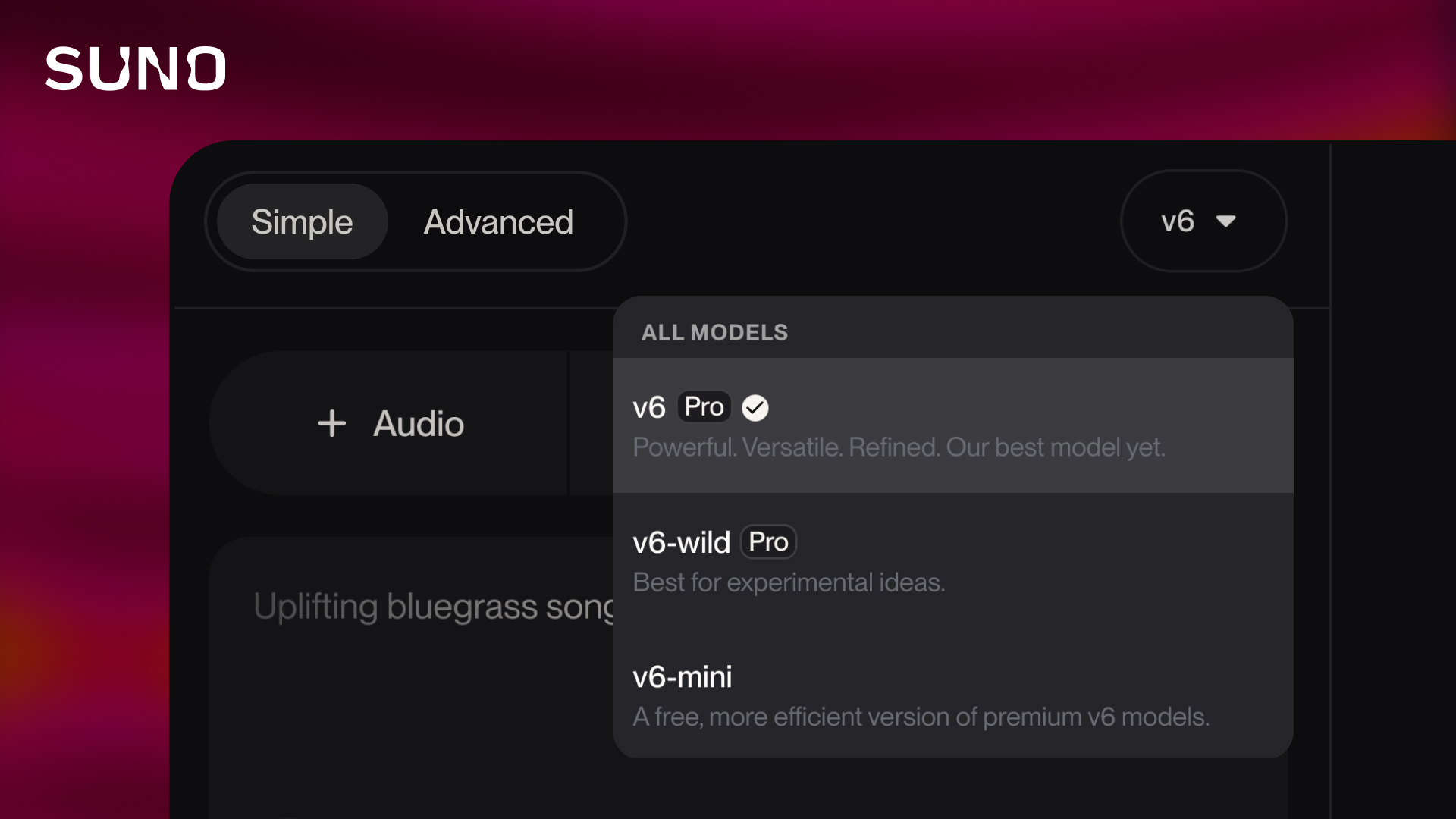
Suno has never shipped a family before. Every earlier version was a single model gated by plan. The v6 picker reads like a frontier AI lab’s lineup, a flagship, a variant, and a small free one.
Suno’s own descriptions, word for word from the picker:
| Model | Plan badge | Suno’s description |
|---|---|---|
| v6 | Pro | “Powerful. Versatile. Refined. Our best model yet.” |
| v6-wild | Pro | “Best for experimental ideas.” |
| v6-mini | none (free) | “A free, more efficient version of premium v6 models.” |
Two things matter for anyone with an existing account. First, free users move from v4.5-all, a model 2 generations behind, to a current-generation model. Suno’s claim for that free model is a big one: v6-mini “delivers better, faster results than any free model on any music creation platform.” No benchmark came with it, and I can’t verify a claim pitched against every competitor at once.
Second, Voices, Custom Models and My Taste all work on v6. The picker still lists v5.5 as the model that “powers” those features, but that copy is a leftover. Nothing you trained on v5.5 dies with it.
v6-wild is the one I did not expect. Suno already had a Weirdness slider and a Style Influence slider. Shipping a separate experimental model says those sliders hit a ceiling the base model imposed.
What Suno v6 can do that v5.5 could not
The model family got the headline. The editing tools are the bigger change to how you’d actually work. Suno says v6 reads more of the vocabulary musicians use, from instrumentation and structure to mood and references, and that this is what makes the new instructions land.
Six things Suno says you can now ask for, with Suno’s own example prompts:
| What you can ask for | Suno’s example prompt |
|---|---|
| Rewrite one section of a finished song, in plain language | “Change the chorus so it’s sung by a gospel choir” |
| Build a mashup from several of your own songs at once | “Take the vocals from x, drums from y, and add new lyrics about losing control, make it 80s synthwave” |
| Sample, isolate and build a beat in one workflow | “Sample the riff at 0:45, isolate the guitar, build a beat around it” |
| Start from a feeling or a reference rather than a genre tag | “Make a song that feels like midnight on a rooftop” |
| Prompt with text, audio, images and video together | “Make a song based on this image, this audio, and my journal entry” |
| Change a single lyric and leave the song alone | “Change the lyric from ‘love’ to ‘light.’” |
Every one of those is Suno’s claim from launch day, written against Suno’s own example prompts.
The single-lyric edit is the one I’d check first. Anyone who has written with Suno knows the loop: one word lands wrong, you regenerate, and the take you liked is gone. If v6 changes a word and leaves the performance intact, that’s a different tool for songwriters, not a faster one.
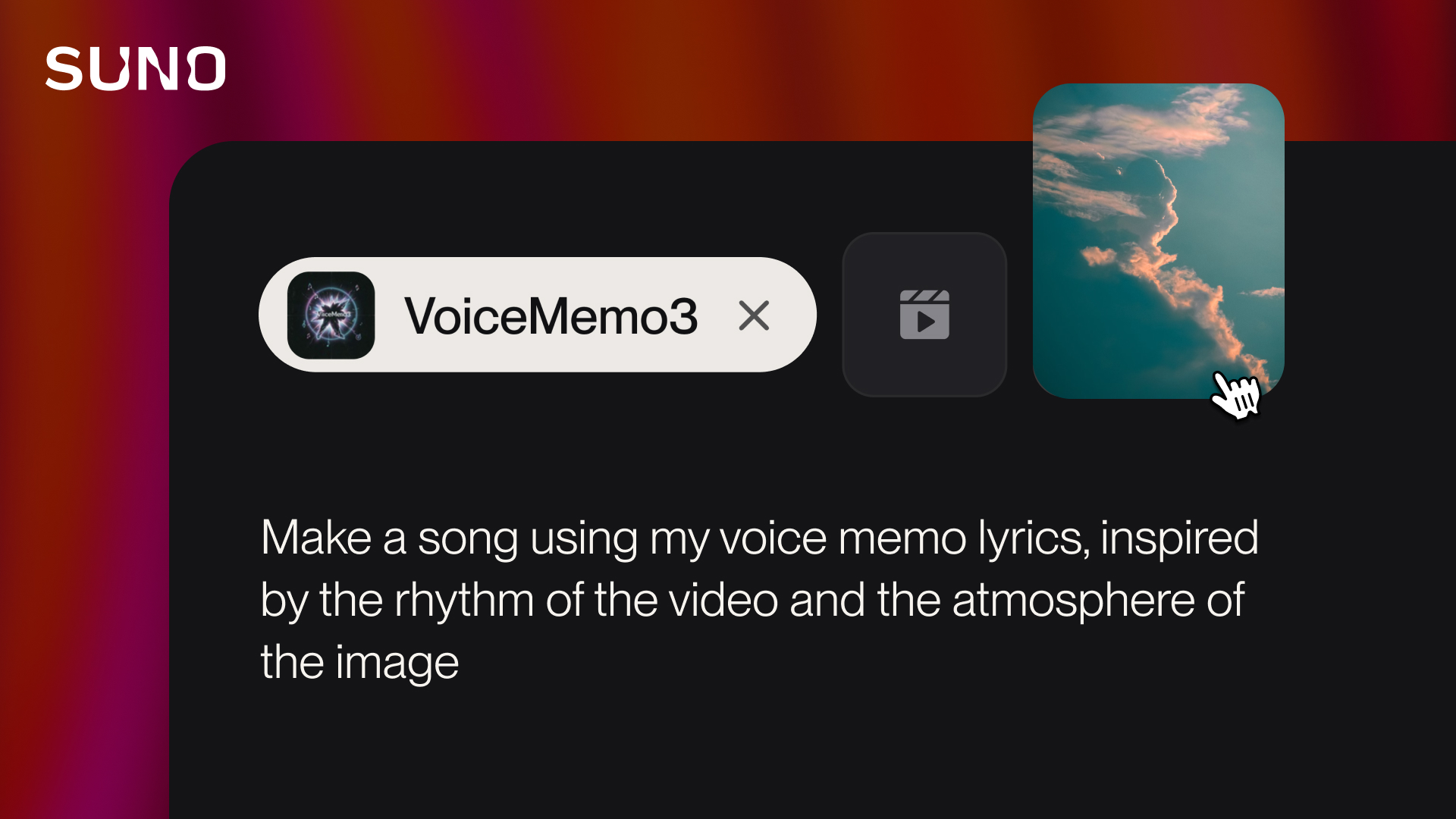
Video as prompt material is new. v5.5 took text and audio. v6 takes a phone video and an image alongside them, which puts Suno in the same input territory as the video-first tools rather than the text-to-song ones.
What happens to Suno v5.5 and older models
Suno stated the rule in the launch post: “As v6 rolls out, we will retire our previous models and move Suno entirely onto the v6 generation.” That matches the August 10 policy post, which said all prior models would be retired when the new ones launched. The September 5 email put it in plainer words.
You'll still have access to all of your music, and anything you've made on our older models will still be playable in your library. However, you won't be able to make new songs with older models.
So your library stays. Every song remains playable and shareable, and you can still use an old song as the base for a cover or remix. What ends is generating anything new on v5.5, v5, v4.5 or v4.
The retirement also changes what the September 3 download caps mean. Those caps apply to every song in your library, including ones made before September 3. A v5.5 track you never downloaded now sits behind a meter with no way to regenerate it.
Is Suno v6 trained on licensed music, and which labels signed
Suno calls v6 its first model developed with the music industry, and names 3 partners. Warner Music signed in November 2025 as part of settling its copyright case. BMG signed on August 12, 2026, with an opt-in for its artists and songwriters and a settlement covering Suno’s earlier use of BMG’s catalog. Believe and TuneCore signed on September 8, one day before launch, 4 months after Believe had blocked its tracks from Suno.
Universal Music and Sony Music have not signed, and both are still suing. SOCAN, the Canadian collecting society, filed its own suit on September 2. A Munich court ruled against Suno in the GEMA case in July. Suno is launching its licensed model into more litigation than it faced a year ago.
What “licensed” covers is the open question. Suno has not published what v6 was trained on, and nothing it has said confirms that Universal or Sony recordings were kept out. I can’t verify that either way. What Suno has said, through its product chief Jack Brody in June, is that it does not use artist names as training metadata. In practice, a prompt that names an artist gets re-routed rather than generated.
What safeguards ship with Suno v6
Suno put its compliance work in the launch post rather than a separate policy page. The sentence that matters: “We’ve also introduced safeguards to screen uploaded audio files and lyrics for unauthorized use, give people greater transparency into how AI is used in music and make it harder for bad actors to abuse these tools.”
Lyric screening is the piece with a name attached. Suno licensed Musixmatch’s Sentinel to screen prompts against a catalog of copyrighted lyrics. Audio-upload screening matters more for anyone using Voices or Audio Influence, because it sits between your upload and the model. Suno has not said what the audio screen checks against, how a false positive gets appealed, or what happens to an upload it rejects.
Suno also says its team runs “weekly writing camps with artists, producers, songwriters, and musicians” to see how they use Suno. That’s a process claim, not a product feature, and it reads as the answer to the accusation that Suno builds without asking musicians anything.
What Suno says comes next, and why it’s the real announcement
The last section of Suno’s post is the one the labels signed for. Suno describes what it’s building next as opt-in experiences “built around individual artists, where artists can choose to participate and get paid when they do, and fans get new ways to connect with the artists they love.”
Read that against the deals. BMG’s agreement carries an opt-in for its writers and artists. So does the Believe and TuneCore one. Suno’s own line is that v6 will “lay the foundation to launch new products that open up revenue opportunities” for the wider industry. The models are the infrastructure. The product being described is officially licensed artist likeness, sold to fans, with a payment rail attached.
No date, no pricing, no named artist. Suno has announced the shape and nothing else.
What Suno v6 costs
Pricing did not move with the launch. The free plan gives 50 credits a day and now generates on v6-mini. Pro is $8 a month on an annual plan or $10 monthly, with 2,500 credits and 20 downloads a month. Premier is $24 annual or $30 monthly, with 10,000 credits, 60 downloads a month, Suno Studio, and no download limit on Studio exports. Commercial rights still attach to songs you download on a paid plan, per the Terms of Service that took effect September 3.
The Suno tool page carries the plan detail, and the Voices tutorial covers the voice-clone feature that carries over to the v6 family.
Frequently asked questions
What is the difference between Suno v6, v6-wild and v6-mini?
v6 is the flagship, which Suno describes as its best model yet. v6-wild is a Pro model tuned for experimental ideas and pushes further from formula than the Weirdness slider can on v6. v6-mini is a free, smaller and more efficient version of the premium v6 models.
Which Suno plan do you need for v6, v6-wild and v6-mini?
v6 and v6-wild carry a Pro badge in the model picker, so they need the $8-a-month Pro plan or the $24-a-month Premier plan. v6-mini has no plan badge and is the free model, replacing v4.5-all as what a free account generates with.
Can Suno v6 edit part of a song without regenerating the whole thing?
Suno says yes. v6 accepts a plain-language instruction against an existing song, such as changing the chorus to a gospel choir or swapping a single lyric from love to light, and keeps the rest of the track intact. Suno announced this at launch.
Can Suno v6 make a song from an image or a video?
Suno says v6 takes text, audio, images and video as prompt material, so a voice memo, a photo and a video clip can feed one song request together. Earlier Suno models were text-and-audio only.
Do Voices, Custom Models and My Taste work with Suno v6?
Yes. All 3 personalization features carry over to the v6 family. A Voices clone or Custom Model you trained on v5.5 keeps working after v5.5 is retired.
Did Suno give users free credits before retiring v5.5 for v6?
Yes. On September 5, 2026 Suno emailed people who had recently generated on older models, thanked them as superusers, and added 500 credits to their accounts. Those credits don't expire.
Is Suno v6 trained on licensed music from Warner Music, BMG and Believe?
Suno names Warner Music Group, BMG and Believe as the industry partners it developed v6 with. Suno has not published a description of the training set, and Universal Music and Sony Music have not licensed anything and are still in court with Suno.
About the author

Covering AI music tools, industry shifts, and news for music creators and professionals. Twice-weekly newsletter at aimusicpreneur.com.