Lucian Grainge says streaming services should stop paying AI tracks the same as real artists
My stack My fav 6 tools for AI music after testing 70+
-
 ElevenMusic · Music generation
-
 Moises · Stem separation
-
 Controlla · Voice swap & cloning
-
 Cryo Mix · Mixing + mastering
-
 Neural Frames · Music videos
-
 ONCE · Distribution
Some links are affiliate links — I earn a commission at no cost to you. Every tool here is one I run myself and truly believe in. This stack is proven.
Universal Music Group CEO Sir Lucian Grainge used UMG’s Q3 2026 earnings call on Thursday, October 29, to go after how streaming services pay for AI music. “The uniform application of pro-rata payments makes the problem worse,” he said, because it treats “AI slop as the same as the greatest songs in the world,” according to Digital Music News.
His ask has 2 parts. AI tracks made unethically shouldn’t be paid like music people actually seek out. And UMG’s deals with streaming services have to change, so the pay “better reflects the value different content creates.”
Grainge also pointed to the volume. He cited Deezer’s figures on fully AI-generated uploads and told analysts that “the volume is growing faster than the safeguards,” Music Ally reported.
Why Lucian Grainge says pro-rata streaming pays AI slop like hit songs
Pro-rata is how most streaming services split subscription money today. All of it goes into one pot, and each track gets paid by its share of total streams. A stream of an AI track and a stream of an Olivia Rodrigo song draw from the same pot on the same terms.
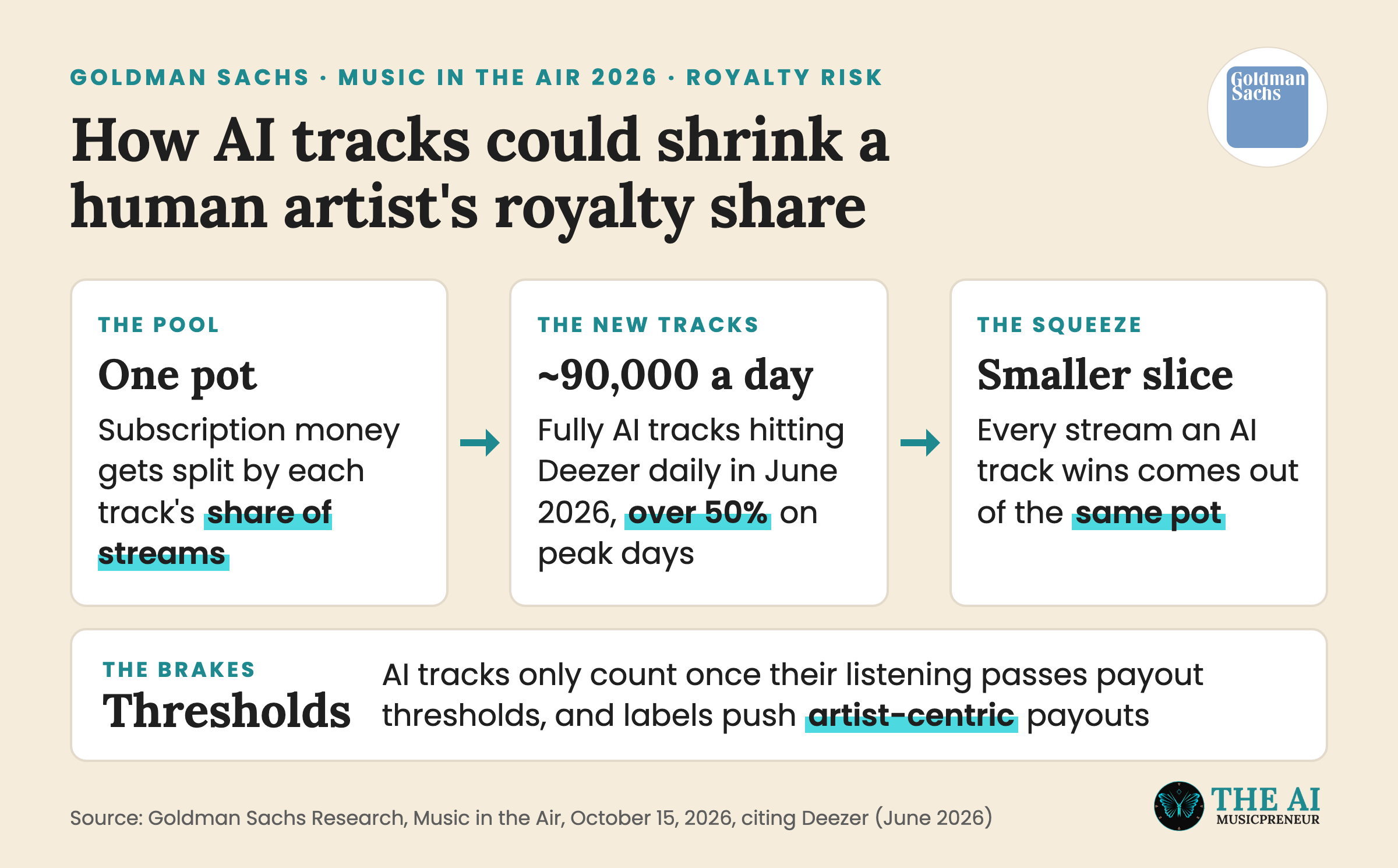
Grainge said that setup “incentivizes industrial-scale content production and dilutes the compensation earned by real talent.” Then he asked why the tracks are on the services at all:
Put plainly, unethically generated AI tracks should never be compensated on the same basis as music that creates real and lasting demand. And why would a music service even want to host them?
He gave one example. On blues charts at some big streaming services, “as many as five of the top 10 albums are attributed to AI-generated acts without clear labelling or disclosure,” he said, adding that “this is not harmless clutter.” He didn’t name the services or the acts. Blues is also where AI singer Eddie Dalton drew criticism from Joe Bonamassa earlier this month.
Grainge said many of UMG’s streaming partners are “taking meaningful steps,” and UMG welcomes the progress. In October alone, Spotify said it had hidden 50 million slop tracks from recommendations, and Deezer announced a toggle to hide fully AI-generated music. But Grainge said “the scale of the problem is still outpacing the guardrails.” That’s where the contracts come in.
What Lucian Grainge wants changed in UMG’s streaming deals by 2028
DSPs, short for digital service providers, are the streaming services: Spotify, Apple Music, Amazon Music, Deezer and the rest. Grainge’s argument for new terms rests on how much of the biggest music comes from UMG.
“UMG artists produced nearly half of the 900 music tracks streamed more than one hundred million times in the U.S. just last year,” he said. “That’s why the structure of our DSP agreements has to change, so the compensation better reflects the value different content creates.”
He said UMG has started “the next phase of our transformation,” which runs to the end of 2028. It covers “how we negotiate, price, and execute platform agreements,” and UMG will share the scope and financial targets with its full-year results. On AI specifically, Grainge said, “We will enforce our contractual protections and insist on clearer labelling across the ecosystem.”
Chief digital officer Michael Nash backed him up. He welcomed recent steps by Spotify, Deezer and Apple Music, then said: “But this is not sufficient.”
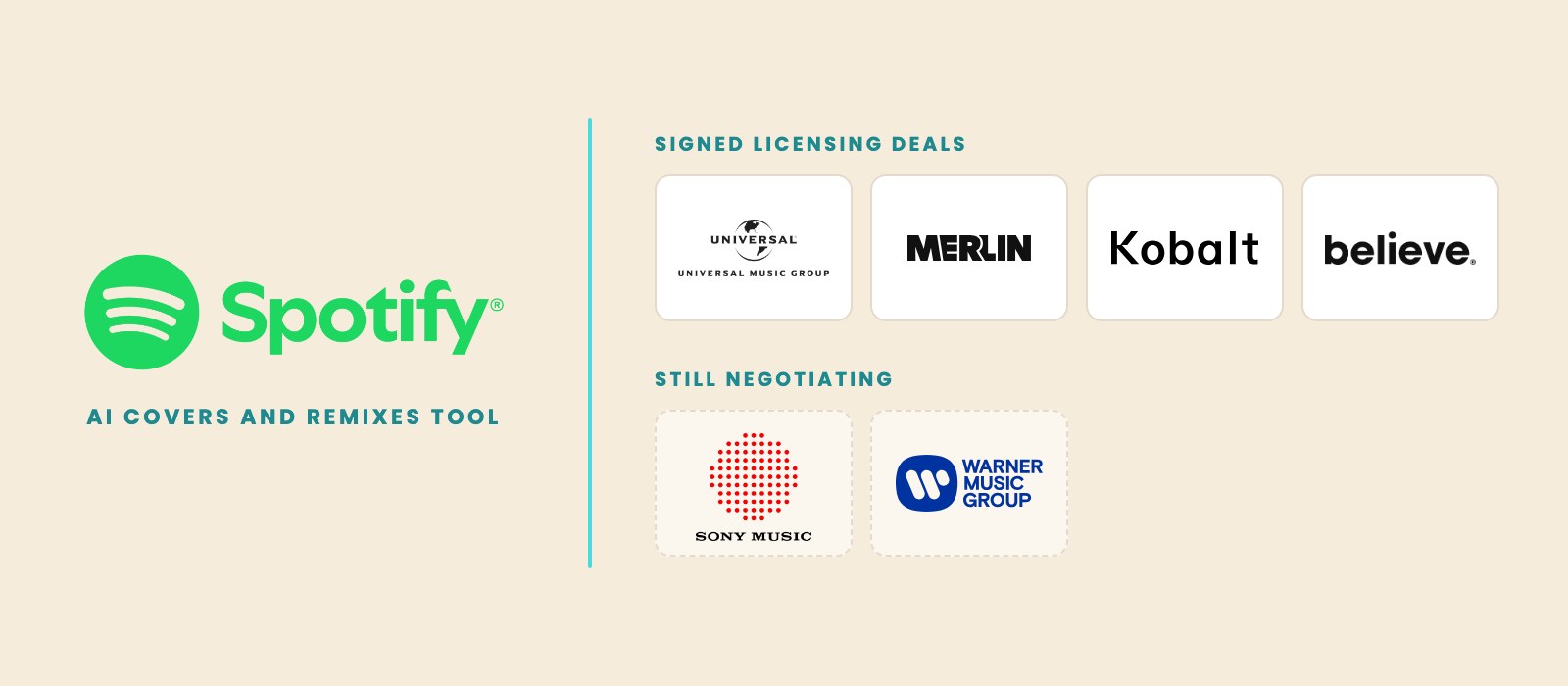
The other half of UMG’s AI plan is licensing. UMG has deals with Udio, ElevenLabs and KLAY. “We are moving from principles to products, and from products to revenue,” Grainge said. “We expect these partnerships to begin generating incremental revenue in fiscal ‘27.” Warner Music Group said in August that its own AI deals would start lifting revenue in its fiscal 2027.
Universal Music Group’s Q3 2026 revenue and subscription growth
UMG’s Q3 2026 results came out the same day. Revenue was €3,394 million, up 12.3% year over year and 11.7% in constant currency. Without Downtown, which UMG bought in February, growth was 5.3% in constant currency.
Recorded music subscription revenue grew 19.2% in constant currency, or 9.5% without Downtown, on “wholesale price increases and continued healthy subscriber growth.” Physical revenue rose 17.4%. Top sellers included Mrs. Green Apple, Olivia Rodrigo, Stray Kids, Ariana Grande and The Beatles.
The dollar figures you’ll see elsewhere range from $3.78 billion to $3.90 billion, because outlets converted at different exchange rates. The euro number is the one UMG reported.
If you release music, the next date to watch is UMG’s full-year results. That’s when UMG says it will lay out the scope of its next phase, including how it negotiates and prices its streaming deals.
Frequently asked questions
What did Lucian Grainge say about AI-generated albums on streaming blues charts?
On UMG's Q3 2026 earnings call, Grainge said that on blues charts at some big streaming services, as many as 5 of the top 10 albums are attributed to AI-generated acts without clear labelling or disclosure. He called it not harmless clutter. He did not name the services or the acts.
When does Universal Music Group expect its AI partnerships to make money?
Lucian Grainge said on the October 29, 2026 earnings call that UMG expects its AI partnerships to begin generating incremental revenue in fiscal 2027. He described the shift as moving from principles to products, and from products to revenue.
What did Universal Music Group's Michael Nash say about AI on the Q3 2026 earnings call?
Chief digital officer Michael Nash welcomed recent measures by Spotify, Deezer and Apple Music but said they are not sufficient. He described AI tracks as ecosystem pollution at a massive scale and said dilution and fraud threats are growing.
About the author

Covering AI music tools, industry shifts, and news for music creators and professionals. Twice-weekly newsletter at aimusicpreneur.com.