Copyright Alliance says Meta's November 20 terms let it scrape business accounts for AI, with no opt-out
My stack My fav 6 tools for AI music after testing 70+
-
 ElevenMusic · Music generation
-
 Moises · Stem separation
-
 Controlla · Voice swap & cloning
-
 Cryo Mix · Mixing + mastering
-
 Neural Frames · Music videos
-
 ONCE · Distribution
Some links are affiliate links — I earn a commission at no cost to you. Every tool here is one I run myself and truly believe in. This stack is proven.
On November 20, 2026, Meta’s new Commercial Terms take effect for every business on Facebook, Instagram, Messenger, Threads and WhatsApp. On October 28, the Copyright Alliance called them unconscionable, because it says they let Meta scrape business users’ websites, including to train its AI, and nobody can opt out.
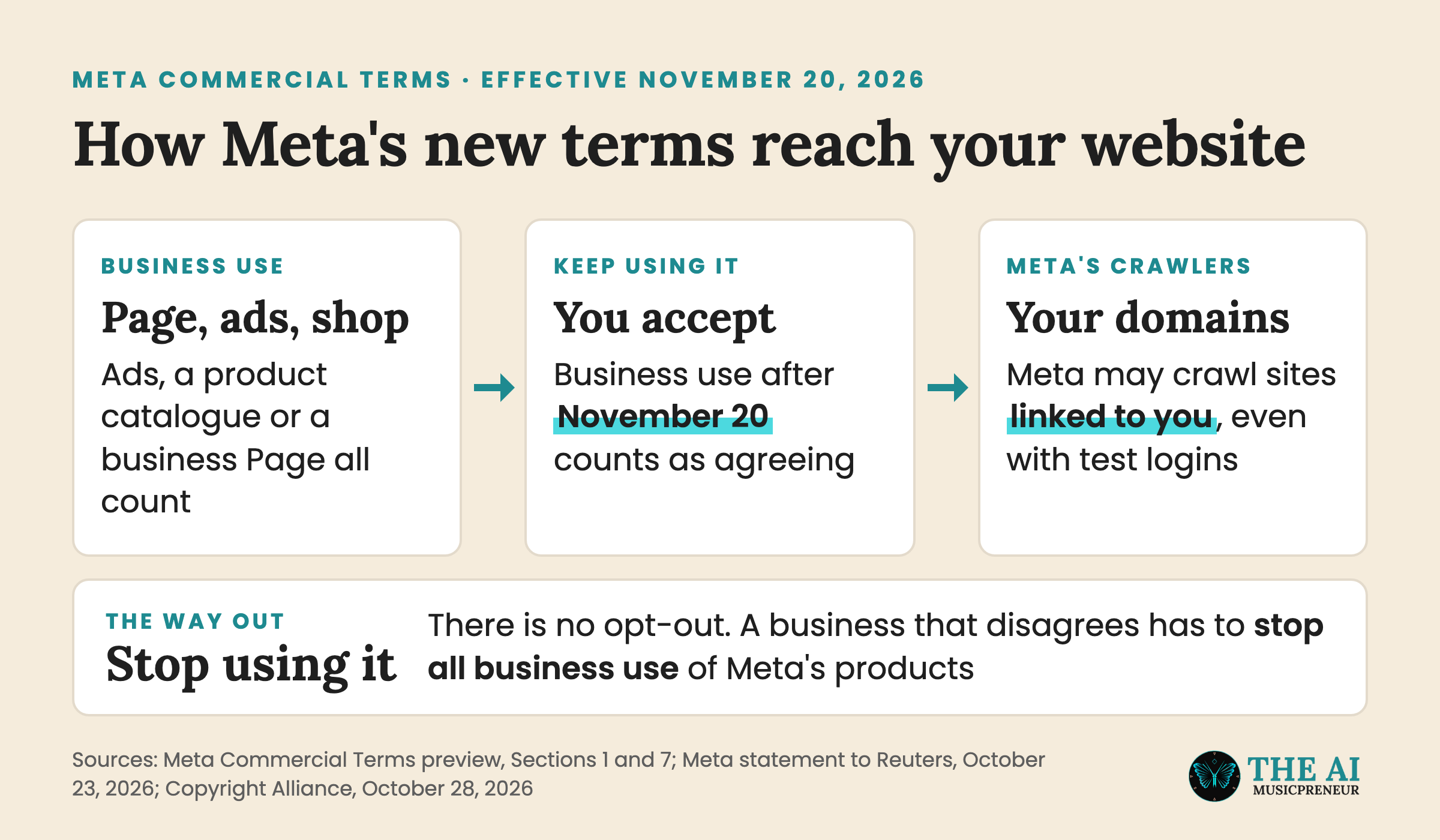
That includes you if you run ads for a release, sell merch through a shop or manage an artist Page for business on Meta. Keeping on using those tools after November 20 is how you accept.
The new terms of service that Meta intends to put into practice are unconscionable.
The Copyright Alliance says it speaks for more than 2 million creators and 15,000 organisations in the US. Its statement ran in full on Digital Music News.
What Meta’s new commercial terms say about crawling business websites
Section 1 of the Commercial Terms preview lets Meta “use automated software (such as web scrapers, bots, robots, spiders, crawlers, and user agents) and create test credentials” to crawl “the domains, web pages, or URLs (and any content available through them) that are associated with your products or services.”
That can include your own website, if it’s tied to the Page, shop or ads you run on Meta.
When Nieman Lab first reported the clause on October 15, it also said Meta could use that content to “train” its products. Snopes found the word was removed between October 15 and 20, and The Verge reported the edit on October 17. The right to crawl stayed in.
Meta spokesperson Daniel Roberts said the crawling terms only apply to Meta’s ads and business products:
“It does not change how Meta uses web crawlers. As always, content owners can use robots.txt to signal their preferences.”
The Copyright Alliance doesn’t buy it. Kupferschmid said Meta’s changes “do not ameliorate our concerns”, that the revised terms “continue to allow for broad scraping of websites and unjustified exploitation of content for generative AI purposes”, and that they let Meta “ignore or circumvent protocols like robots.txt.”
Why Meta moved its commercial terms from October 30 to November 20
The terms were first due on October 30. On October 16, Danielle Coffey, CEO of the News/Media Alliance, which represents more than 2,000 US publishers, called them “outrageous and probably illegal”, and the alliance demanded Meta withdraw them.
Meta didn’t. It told Reuters on October 23 that it was pushing the date to November 20 to explain to partners what’s changing and what’s not, and Nieman Lab reported that legal experts were still skeptical after the delay. No change to the crawling wording has been announced.
Can musicians opt out of Meta’s new commercial terms?
No. There’s no form to sign and no setting to switch off. Section 7 says that continuing to use Meta’s products for business after notice of an update means you agree to them, and that a business that doesn’t agree “may stop all access or use of our Products for business or commercial purposes.”
The one lever Meta points to is robots.txt, the file on your website that tells crawlers what they can visit. Meta’s AI crawler identifies itself as Meta-ExternalAgent, so you can disallow it there. But Meta’s promise to respect robots.txt is in a spokesperson’s statement. The contract text doesn’t include it.
A robots.txt rule only works when the crawler respects it. Patreon now blocks AI training crawlers at the network level with Cloudflare, after bots ignored its robots.txt. Opt-outs have come up elsewhere this year, too. Twitch’s product chief said an opt-in version of Amazon’s default AI training on streams would get no takers, and the UK government dropped its AI training opt-out in March.
The same business accounts carry Meta’s music features, from Instagram’s Create a Song in DMs to the Muse AI agent that took the @muse handle from the band Muse. If most of your fans only reach you through Instagram, here are 4 artists who moved 200,000+ fans onto lists they own.
The terms take effect on November 20, 3 weeks from today.
Frequently asked questions
What is Meta-ExternalAgent?
Meta-ExternalAgent is the user agent of the crawler Meta uses to collect web content for uses such as training its AI models. Website owners can disallow it in their robots.txt file. Meta says it respects robots.txt, but its new Commercial Terms do not write that promise into the contract.
Who is the Copyright Alliance?
The Copyright Alliance is a US non-profit that says it represents the copyright interests of more than 2 million individual creators and more than 15,000 organizations. Its CEO is Keith Kupferschmid, who issued the October 28, 2026 statement on Meta's commercial terms.
Why did Meta remove the word train from its commercial terms?
The first version of the crawling clause said Meta could use content from business users' websites to train its products. Snopes found the word was removed between October 15 and 20, 2026, and a Meta spokesperson said the change was made because of confusion.
Does Meta's crawling clause cover musicians with an artist Page?
Meta's updated terms apply to business or commercial use, which they define to include running ads, selling or listing products, using a product catalogue and managing a Page for business purposes. An artist who runs ads or sells merch through Meta falls inside that definition.
About the author

Covering AI music tools, industry shifts, and news for music creators and professionals. Twice-weekly newsletter at aimusicpreneur.com.