SAMRO now makes members disclose AI use when registering songs, but sets no minimum human input
My stack My fav 6 tools for AI music after testing 70+
-
 ElevenMusic · Music generation
-
 Moises · Stem separation
-
 Controlla · Voice swap & cloning
-
 Cryo Mix · Mixing + mastering
-
 Neural Frames · Music videos
-
 ONCE · Distribution
Some links are affiliate links — I earn a commission at no cost to you. Every tool here is one I run myself and truly believe in. This stack is proven.
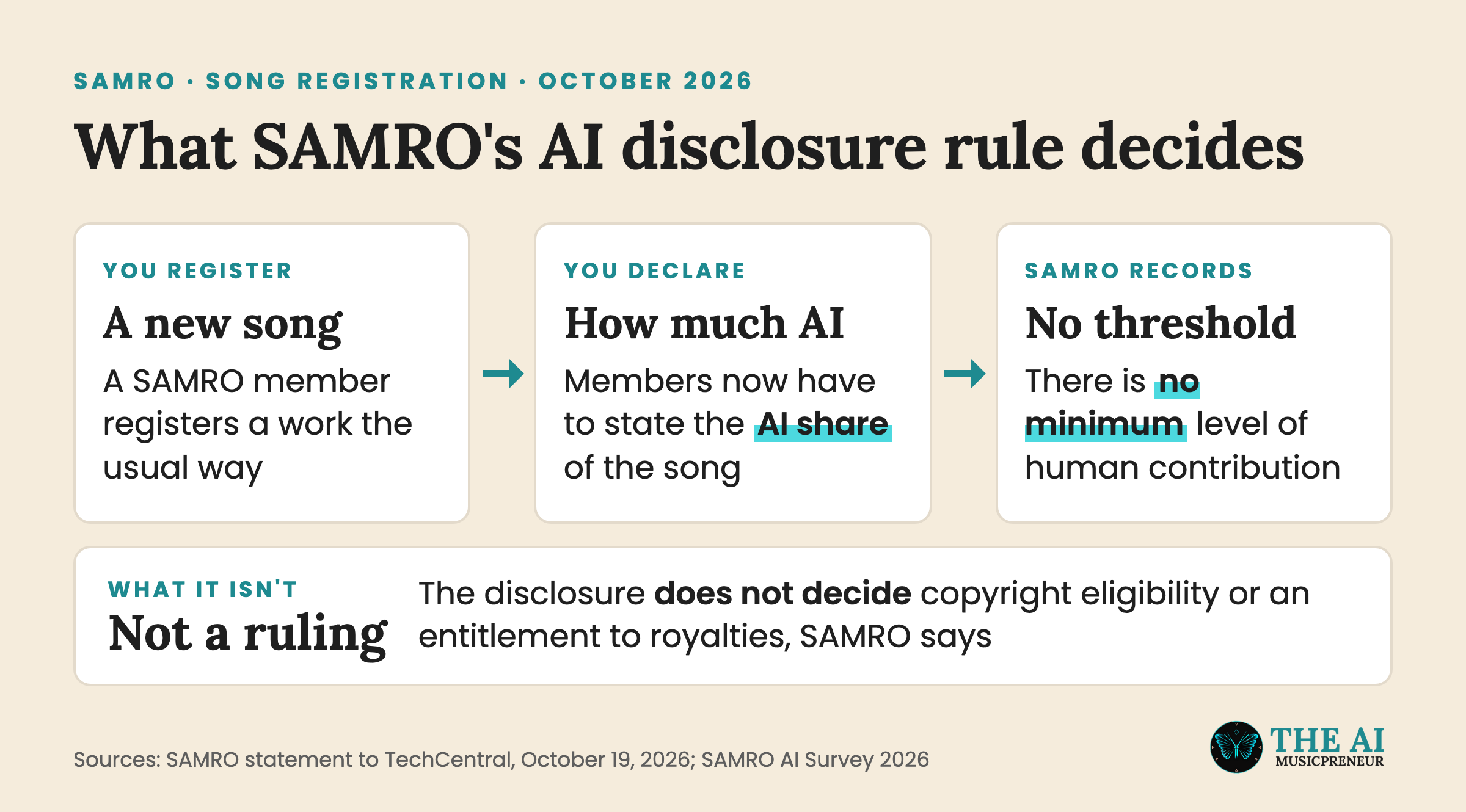
Register a song with SAMRO now, and you get one new question: how much of it did AI make? The Southern African Music Rights Organisation requires members to disclose the AI share of every work they register, but it sets no minimum level of human contribution.
And the answer doesn’t decide anything yet. SAMRO told TechCentral that disclosure “does not, in itself, constitute a determination of copyright eligibility or an entitlement to royalties.” News24 covered the rule on October 28 as SAMRO’s first step on AI.
How SAMRO’s AI disclosure rule works at song registration
You register a work the usual way, and you state how much AI went into it. SAMRO records that. It doesn’t set a threshold that the human part has to clear, and the disclosure isn’t a ruling on whether the song is protected or gets paid.
The rule is part of SAMRO’s response to its own AI Survey 2026, run with members in April. Some numbers from it:
- 34.3% of respondents had used Suno, and 45.1% had used ChatGPT.
- 10.8% said they had used AI in works without telling SAMRO.
- 35% said they hadn’t used any AI tools at all.
SAMRO says it is assessing a fuller AI policy, but “no definitive implementation timeline has been confirmed.”
Can you register AI-assisted music with SAMRO?
One producer already has. Justin Erasmus, who makes AI-assisted music in Alberton as Prismatic Wave and uses Suno at the centre of his workflow, told TechCentral he joined SAMRO and Sampra by presenting his production process and explaining “the substantial human intervention involved in my process.” He writes his own lyrics and builds a typical song from 8 to 15 instrumental versions.
He has registered 1 song so far, out of what he says is 11 albums, 5 EPs and 20 singles released in 13 months. SAMRO said it doesn’t comment on individual members, but that membership “does not, in itself, constitute confirmation of the copyright status of any particular work.”
The law behind it is older than Suno. Since 1992, South Africa’s Copyright Act has said the author of a computer-generated work is the person who made “the arrangements necessary for the creation of the work”, as The Open Letter points out. No court has applied that to a prompt yet.
Radio is just as unsettled. SABC head of communications Mmoni Ngubane said its stations “avoid airing fully AI-generated works until clear legal frameworks are established”, but that this is not a finalised policy and there are no firm rules for AI-assisted tracks.
How SAMRO’s AI rule compares with KOMCA in South Korea
South Korea’s KOMCA went further, then went back. It opened registration to AI-assisted music and asked for prompt logs as evidence, then pulled those rules 22 days after they took effect. SAMRO’s version, as reported so far, is a declaration. No evidence requirement has been reported, and there’s no threshold.
Both rules arrive while AI tracks are more than half of Deezer’s daily uploads, and Universal and Sony are suing Suno a second time. African creators have their own list of gaps, from voice cloning to copyright blind spots that western debates miss.
If you register in the US instead, here’s how ASCAP handles AI-assisted songs.
Frequently asked questions
What is SAMRO?
SAMRO is the Southern African Music Rights Organisation, the collecting society that licenses South African composers' and songwriters' works and pays out their performance royalties. In its 2026 AI survey, 97.2% of respondents were based in South Africa, with members in 8 countries.
What is the difference between SAMRO and Sampra?
SAMRO administers the rights of composers and songwriters in their musical works. Sampra, the South African Music Performance Rights Association, collects needletime royalties for recorded music on behalf of performers and record labels. Prismatic Wave producer Justin Erasmus joined both by explaining his AI-assisted process.
How many SAMRO members use Suno?
In SAMRO's AI Survey 2026, 34.3% of respondents said they had used Suno, and 45.1% had used ChatGPT. Another 35% said they had not used any AI tools.
Does the SABC play AI-generated music?
The SABC's stations avoid airing fully AI-generated works until clear legal frameworks exist, according to head of communications Mmoni Ngubane. She told TechCentral this is the broadcaster's current editorial approach, not a finalised policy, and that it has no firm rules on AI-assisted music.
About the author
Covering AI music tools, industry shifts, and news for music creators and professionals. Twice-weekly newsletter at aimusicpreneur.com.