Suno wants Apple to testify on whether Apple Music could survive without UMG and Sony
My stack My fav 6 tools for AI music after testing 70+
-
 ElevenMusic · Music generation
-
 Moises · Stem separation
-
 Controlla · Voice swap & cloning
-
 Cryo Mix · Mixing + mastering
-
 Neural Frames · Music videos
-
 ONCE · Distribution
Some links are affiliate links — I earn a commission at no cost to you. Every tool here is one I run myself and truly believe in. This stack is proven.
Suno wants an Apple witness to answer, under oath, whether Apple Music could run without Universal Music Group’s or Sony Music’s catalog. It made that case in a 24-page opposition filed on October 27, 2026, asking a federal court in San Jose to deny Apple’s motion to quash its deposition subpoena.
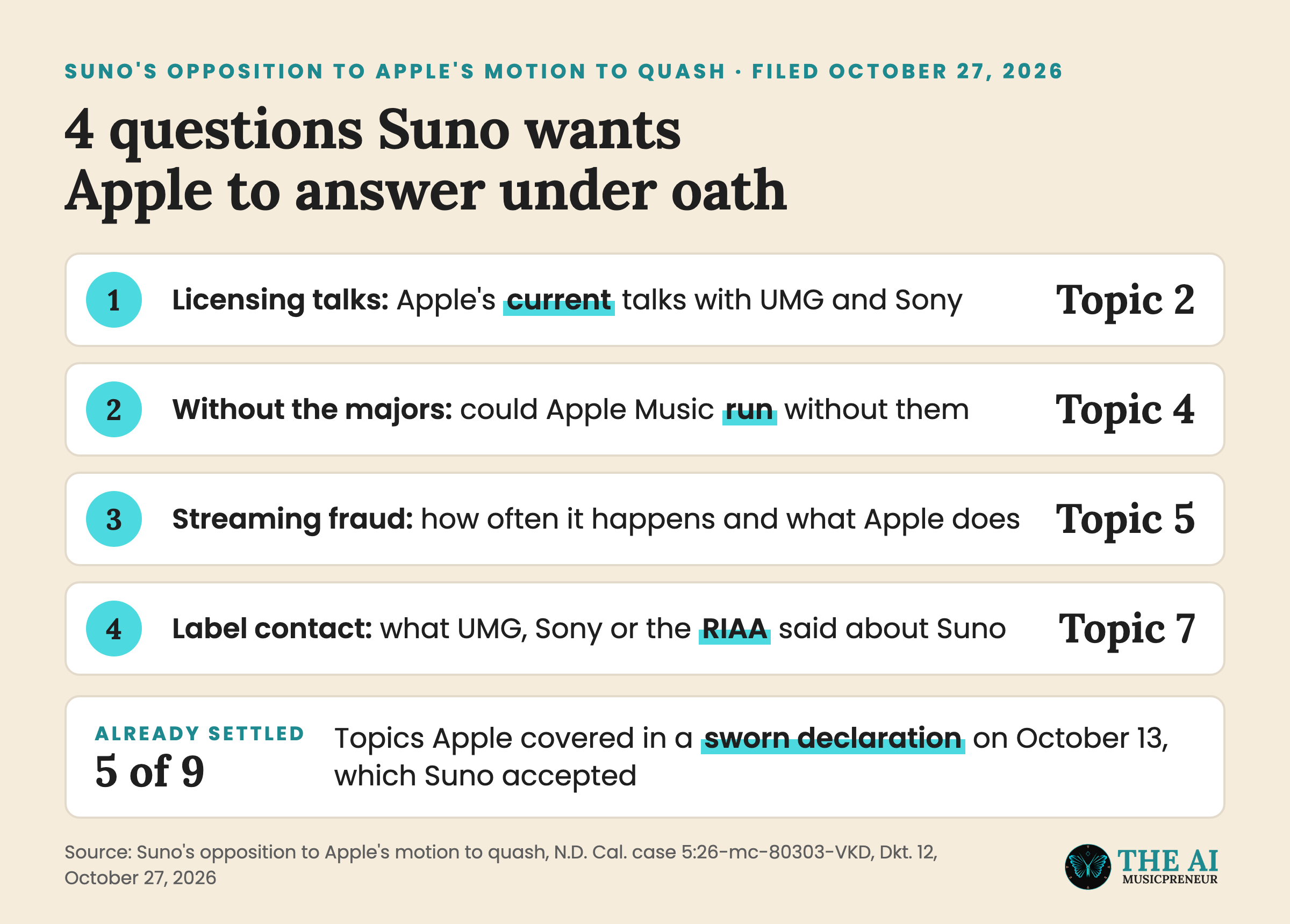
That question is 1 of 4 topics still in dispute. The other 3 are Apple’s current licensing talks with both labels, streaming fraud on Apple Music, and what the labels or the RIAA told Apple about Suno.
Magistrate Judge Virginia K. DeMarchi hears the motion on December 1. Apple’s side, which I covered on October 27, is that it already handed over data on Suno tracks and the rest is irrelevant.
So why does Suno think Apple’s deals with the labels belong in a lawsuit about AI training?
The 4 Apple Music topics Suno wants an Apple witness to answer
Suno served Apple a deposition subpoena with 9 topics. After months of talks, it accepted a sworn declaration Apple served on October 13 as the answer to 5 of them, Topics 1, 3, 6, 8 and 9.
Here is what’s left, from Suno’s filing:
- Topic 2: Apple’s current negotiations with UMG and Sony on licensing, royalties and “artificial intelligence initiatives”.
- Topic 4: whether Apple Music could operate without one or both of the labels’ catalogs.
- Topic 5: how often streaming fraud happens on Apple Music, how it gets found and what Apple does about it.
- Topic 7: what UMG, Sony or their agents, such as the RIAA, told Apple about Suno or the case.
Suno says it already narrowed them. Past and signed agreements are out of Topic 2, and the technical details of Apple’s fraud detection are out of Topic 5.
Suno says every one of these topics feeds its 2 main defenses. The first is fair use.
Why Suno says Apple Music is central to UMG and Sony’s case against Suno
The labels’ case is that Suno trained on their recordings, and that songs made by Suno users are “flooding streaming services like Apple Music, ‘eroding’ Plaintiffs’ market share and ‘diluting’ the royalty pools those services pay out,” as Suno’s filing sums up the complaint.
That matters for fair use, because 1 of the 4 things a US court weighs is whether the copying hurt the market for the original recordings. “Apple now asks the Court to prevent Suno from asking Apple a single question on these exact issues,” the filing says.
On royalties, Suno makes a specific point. It says label deals with streaming services can include “guaranteed minimum royalties” that get paid whether AI music is on the service or not, and terms that “specifically exclude AI-generated content from the royalty pool.” If those terms exist, Suno argues, AI songs can’t dilute the labels’ royalties at all.
Apple’s own motion says it “does not currently exclude AI-generated content from its royalty pool,” Music Business Worldwide reported. Suno says that’s exactly why it needs to know what UMG and Sony are asking Apple for now.
Suno also leans on UMG’s own investor calls. In March, UMG Chief Digital Officer Michael Nash cited “anti-AI dilution provisions in numerous UMG agreements,” and said UMG was seeing no sign that AI dilution was a material issue for its revenue.
That brings in Suno’s second defense.
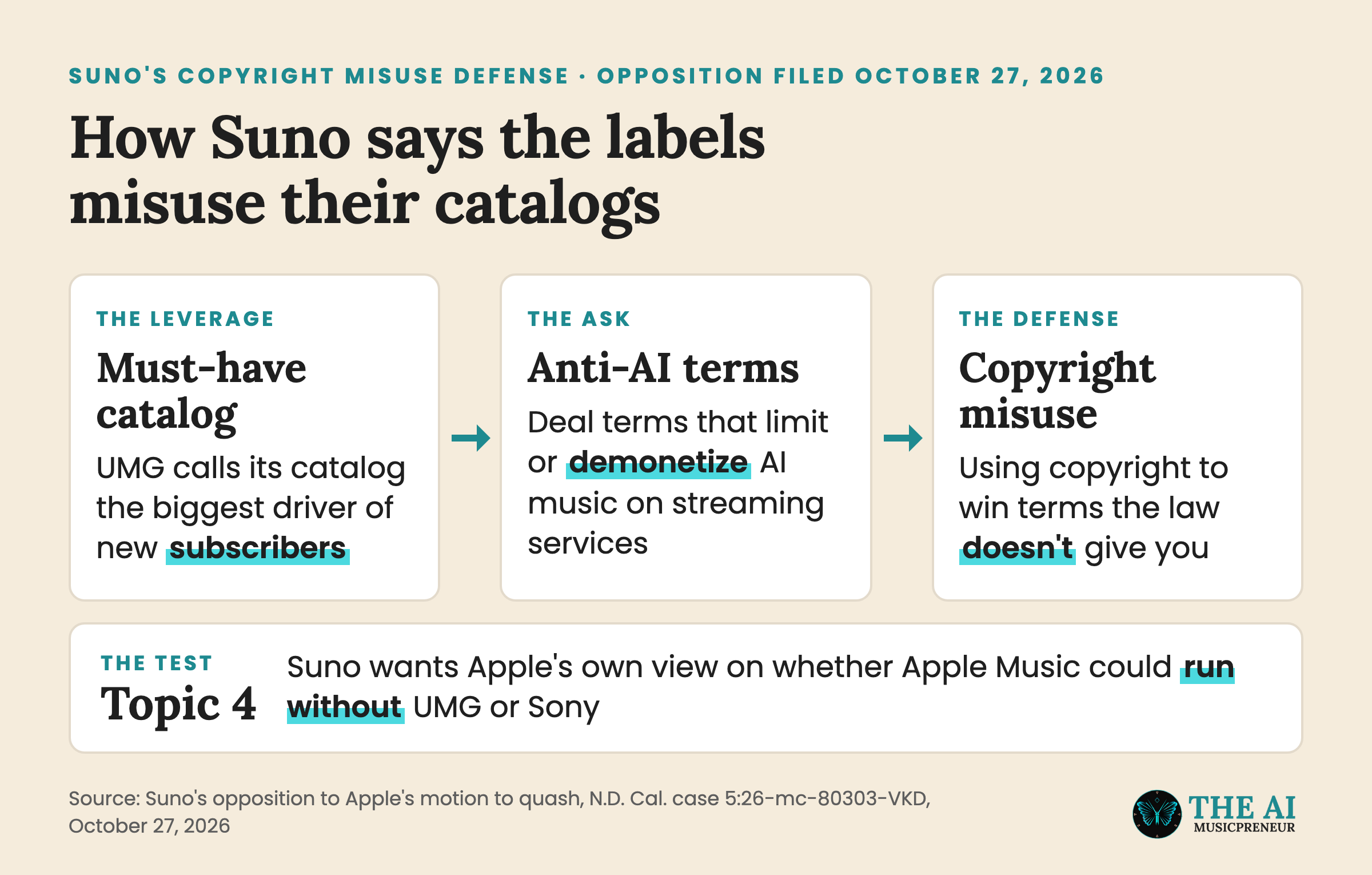
Suno’s copyright misuse defense: UMG and Sony’s catalogs as a “cudgel”
Copyright misuse is the argument that a rights holder used its copyrights to win concessions the law doesn’t give it. Suno pleaded it again in its September 1 answer to the labels’ amended complaint.
The core of Suno's copyright misuse defense is that Plaintiffs use their copyright monopoly and 'must have' catalog as a cudgel to extract broad, anti-AI concessions from DSPs.
Topic 4 is how Suno wants to test the “must have” part. “A copyright holder whose catalog is easily replaced has little ability to extract concessions beyond the scope of its copyright; one whose catalog is a ‘must have’ has a great deal,” the filing says.
Suno’s example is TikTok. In early 2024, UMG pulled its music from TikTok in part because TikTok “would not capitulate to UMG’s demands regarding AI content,” the filing says, pointing to UMG’s own open letter from January 30, 2024. The music came back after the two signed a new deal that May.
The labels say those anti-AI terms are about stopping streaming fraud. On the same March call, Nash said “Apple recently reported that its efforts to address the flood of AI uploads included exclusion of 2 billion fraudulent streams last year.”
Suno’s answer is that Apple, not the labels, is the one dealing with that fraud, so only Apple can say whether it actually involves AI music.
What Apple says about Suno’s deposition subpoena
I haven’t been able to read Apple’s motion itself, so these points come from Music Business Worldwide’s report on it:
- Apple calls the Topic 4 question “a fishing expedition by a new entrant to the music industry to gain insight into Apple’s business operations.”
- It says its licensing talks and AI strategy would be exposed in a case “populated by Apple’s licensing counterparties and competitors.”
- It says it has answered 6 subpoenas from the labels and Suno over more than a year, producing data on millions of Apple Music tracks.
- It says it deployed its own AI music detection tool in March 2026 and gave both sides a spreadsheet of tracks it identified as Suno-generated, with play counts.
Suno disputes the count. It says it served only 2 subpoenas, a document subpoena and a deposition subpoena, and that Apple counted the deposition subpoena twice after Suno had to re-serve it with a new date.
On secrecy, Suno says any testimony can be marked “Highly Confidential – Outside Counsel Only” under the protective order already in the case, “so that no one at Suno would ever see it.”
What happens at the December 1 hearing on Apple’s motion to quash
The case is now before Magistrate Judge Virginia K. DeMarchi, after Magistrate Judge Susan van Keulen recused herself on October 21. Suno asks DeMarchi to order Apple to put up a witness on the 4 topics within 14 days of a ruling.
Suno also wants the fight to stay in San Jose rather than move to Boston, which Rule 45(f) allows in some cases. Its reason is the schedule: fact discovery on the labels’ YouTube stream-ripping claim closes on November 20, expert disclosures are due on January 28, 2027, and dispositive motions come in June 2027.
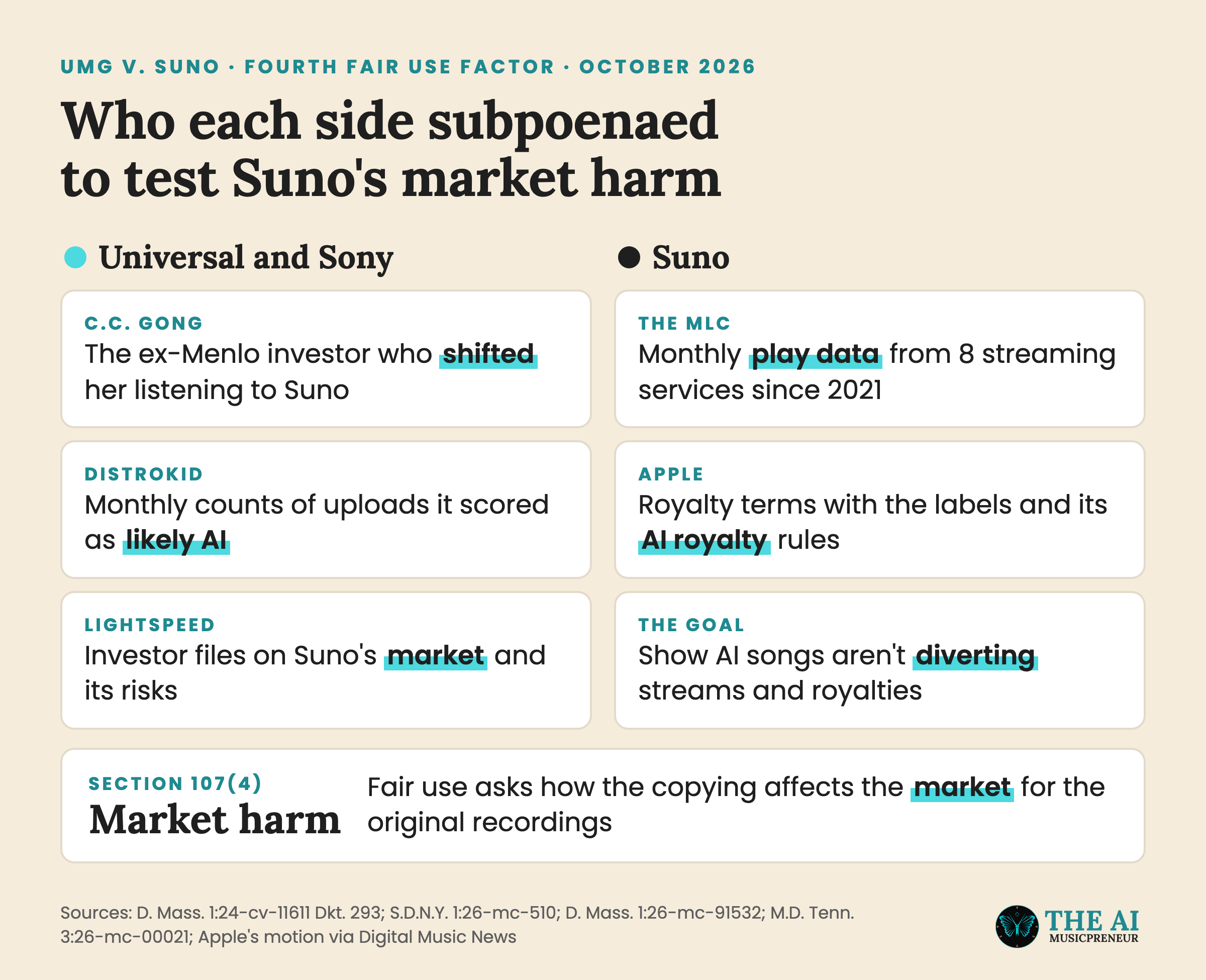
Apple is one of several outside companies in this fight. The labels are pushing DistroKid for its AI-detection counts, and Suno is pushing the MLC for streaming data.
Even if DeMarchi orders the deposition, the answers go to the lawyers first. They’d only become public if someone quotes them in an unsealed filing.
I log every step of the case on my Suno lawsuit tracker. If Apple has to testify, a streaming service would say under oath, in this case, how much Apple Music depends on the 2 labels suing Suno.
Frequently asked questions
How many subpoenas has Suno served on Apple in UMG Recordings v. Suno?
Suno says it served Apple 2 subpoenas, one for documents and one for a deposition, and that Apple counted the deposition subpoena twice after Suno re-served it with a new date. Apple's motion says it has answered 6 subpoenas from the labels and Suno combined over more than a year.
Does Apple Music exclude AI-generated songs from its royalty pool?
Not currently, according to Apple's own motion to quash Suno's subpoena, as quoted by Music Business Worldwide in October 2026. Suno argues that some label deals with streaming services contain terms that keep AI-generated content out of the royalty pool, which is one reason it wants Apple to testify about its current talks with Universal and Sony.
When are expert disclosures and dispositive motions due in UMG Recordings v. Suno?
Expert disclosures are due on January 28, 2027, and dispositive motions come in June 2027, according to Suno's October 27, 2026 opposition. Fact discovery on the labels' YouTube stream-ripping claim closes on November 20, 2026.
Would Suno see Apple's confidential licensing information if Apple testifies?
Suno says no. It told the court the testimony can be designated Highly Confidential, Outside Counsel Only under the protective order already in place in UMG Recordings v. Suno, so only outside lawyers would see it and no one at Suno would.
About the author

Covering AI music tools, industry shifts, and news for music creators and professionals. Twice-weekly newsletter at aimusicpreneur.com.