PLAI by GEMA explained: what the licensed AI music training dataset is, what it includes, and how creators get paid
My stack My fav 6 tools for AI music after testing 70+
-
 ElevenMusic · Music generation
 -
 Moises · Stem separation
 -
 Controlla · Voice swap & cloning
 -
 Cryo Mix · Mixing + mastering
 -
 Neural Frames · Music videos
 -
 ONCE · Distribution
Some links are affiliate links — I earn a commission at no cost to you. Every tool here is one I run myself and truly believe in. This stack is proven.
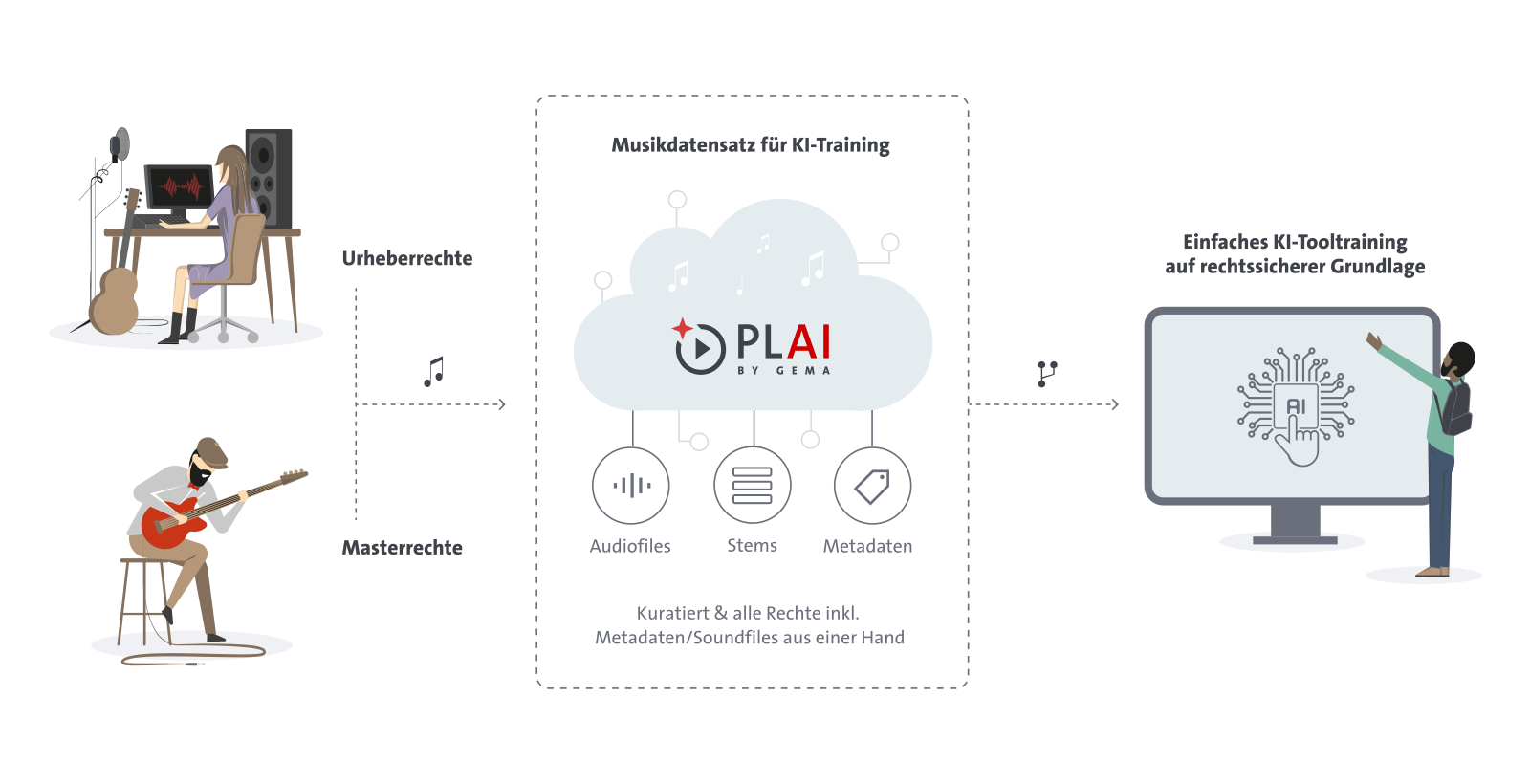
PLAI by GEMA is a licensed music dataset that GEMA sells to AI companies so they can train their music tools on cleared content. It bundles the rights, the recordings, and the metadata into one package, and it launched in July 2026 with the transcription firm Klangio as its first customer.
This page is the plain-English explainer: what PLAI by GEMA is, what is inside it, who supplies it, how creators get paid, and where the open questions are. For the dated launch coverage and the industry pushback, see the news piece on GEMA launching PLAI with Klangio as first customer.
One thing to clear up first. PLAI by GEMA is not the same as Plai Music, a separate AI music streaming platform. They share a name and nothing else.
What is PLAI by GEMA?
PLAI by GEMA is a training-data product from GEMA, the German collecting society that represents songwriters, composers, and music publishers. It sells a curated set of music to AI developers who need legally cleared audio to train their models.
The core pitch is one-stop rights. Training on music normally means clearing two separate layers: the authors’ rights to the underlying song, and the master rights to the specific recording. PLAI packages both, plus the sound files and the metadata, from a single source. For a developer, that is one license instead of a hunt across publishers and labels.
GEMA frames it as a fair, licensed alternative to the scraped datasets that AI music companies have leaned on. It also lets GEMA point to a working product while it fights the same fight in court.
What is inside the dataset?
The dataset holds about 178,000 audio files, drawn from roughly 57,000 musical works, across more than 60 genres. The music is production and library music, the kind used for sync in ads, film, and TV, supplied by GEMA’s publishing partners.
The metadata is the part developers will care about. Each track carries base data like genre, tempo, key, instruments, and chords. It also carries deeper data: segment start and end points, timestamps, repetitions, full track structure, ISWC and ISRC codes, and language and vocal-style tags. On top of that sit descriptive tags for mood and emotion, and contextual tags for target audience, cultural context, and sync use.
Training packages are not one-size-fits-all. GEMA says the data can be assembled to fit a specific model and use case, so a buyer picks what suits the tool they are building.
Who supplies PLAI by GEMA?
Five production-music partners contribute the catalogue and the metadata:
- Bailer Music Publishing
- Earmotion Audio Creation
- Intervox Production Music
- Music Sculptor
- Sonoton Music
GEMA says the offering can grow as more publishers, collecting societies, and individual rights holders join. That is how it plans to scale PLAI for different customers and use cases over time.

Who is the first customer?
Klangio, a transcription company from Karlsruhe, Germany, is the first named PLAI customer. Klangio builds tools that turn audio into sheet music, MIDI, and MusicXML.
That fit is worth understanding. Transcription is a narrow task: the model learns to read notes, chords, and structure from audio. Production music is fine training material for that. The customer and the dataset match.
How do creators get paid?
GEMA says every contributing rights holder is compensated proportionally when their content is licensed through PLAI. The idea is that the license money flows back to the publishers and authors whose works are in the set.
What GEMA has not published is the formula. How a license fee gets divided among the five publishers and their authors, or how the value of any single track to a trained model is measured, is not public. There is no disclosed standard for the split, which is the point critics have pressed on.
Is PLAI good for generative AI music?
For a generative model that writes full songs, the honest answer is: probably not on its own. Matthias Strobel Hohmann, president of MusicTech Germany, made that case directly after the launch.
An AI model trained solely on stock and library music does not learn songwriting, emotions, or the stylistic diversity of popular music. 178,000 audio files is a joke.
His point is about scale and fit. Generative models like the ones behind Suno or Udio are trained on millions of tracks with real vocals, real arrangements, and the messy diversity of popular music. A curated slice of 178,000 production-music files teaches a narrow tool well and a song generator poorly. PLAI is built for the first case, not the second.
Why the size critique misses most of music AI
Sebastian Murgul, co-founder and CEO of Klangio and GEMA’s first PLAI customer, agreed with the scale point, then turned it around. A song generator is not what PLAI is for.
There's a whole world of music AI beyond generation, transcription, analysis, education, MIR, where you simply don't need millions of tracks. Training on professional, fully licensed music is a real benefit for us.
MIR stands for music information retrieval, the field that builds tools to read, tag, and understand music instead of generating it. Transcription, chord detection, key and tempo analysis, and music-education tools all live here. These models learn from clean, well-labeled, licensed audio, and a few hundred thousand professionally produced tracks with deep metadata is strong training material for them. Murgul called PLAI a first step in the right direction.
How does PLAI relate to the GEMA v. Suno lawsuit?
The timing is not a coincidence. PLAI launched about one week before the Munich Regional Court was set to rule in GEMA’s copyright case against Suno on July 31, 2026.
That case is about this exact problem. GEMA argues Suno trained on protected songs, including works like “Forever Young” and “Mambo No. 5,” without a license. PLAI is the flip side of the same argument: here is a licensed way to get training data, so there is no excuse to scrape. You can follow the case in the GEMA v. Suno tracker, and read the background on the licensing model GEMA first proposed in 2024.
What PLAI by GEMA means for independent artists
For most independent artists, PLAI is not something you buy or opt into today. It is a wholesale product aimed at AI developers, sourced from production-music publishers, not from GEMA’s full membership.
The marker it sets still matters. It is the first time a major collecting society has put a cleared, paid dataset in front of AI companies. If the model works, it could expand to cover more of the catalogue and more creators. If it stays limited to library music and a handful of publishers, the songwriter middle class GEMA represents will keep asking when the licensed, paid future reaches them. Right now PLAI is a first step, not the finished system its name suggests.
Frequently asked questions
What is PLAI by GEMA?
PLAI by GEMA is a licensed music dataset that GEMA sells to AI companies for training their music tools. It bundles the authors' rights, the master rights, the sound files, and detailed metadata from a single source, so a developer can train on cleared content instead of scraped catalogues.
How many tracks are in the PLAI by GEMA dataset?
PLAI by GEMA holds about 178,000 audio files drawn from roughly 57,000 musical works across more than 60 genres. GEMA says training packages can be tailored to a customer's specific model and use case, so a buyer does not have to take the whole set.
Who is the first customer of PLAI by GEMA?
Klangio, a music transcription company based in Karlsruhe, Germany, is GEMA's first named PLAI customer. Klangio's tools turn audio into sheet music and MIDI, a transcription task rather than a generative one, which fits the dataset's production-music makeup.
Which publishers supply the PLAI by GEMA dataset?
Five production-music partners contribute the catalogue and metadata: Bailer Music Publishing, Earmotion Audio Creation, Intervox Production Music, Music Sculptor, and Sonoton Music. GEMA says the offering can expand to more publishers and collecting societies over time.
How does GEMA pay creators for PLAI licensing?
GEMA says every contributing rights holder is compensated proportionally when their content is licensed through PLAI. It has not published the actual formula, so how a license fee is split among publishers and authors, or how the value of any single track is measured, is not public.
Is PLAI by GEMA the same as Plai Music?
No. PLAI by GEMA is a licensed training-data product from GEMA, Germany's music collecting society. Plai Music is a separate, unrelated AI music streaming platform. They share a name but have no connection.
About the author

Covering AI music tools, industry shifts, and news for music creators and professionals. Twice-weekly newsletter at aimusicpreneur.com.